Author: Alex Xu
As the variety of stablecoin offerings increases, the bargaining power of channels (exchanges, merchant networks, wallets, card issuers, and even AI terminals...) relative to stablecoins will further rise, rather than decline as many previously said due to USDC's leading market share. Channels may further erode the profits of stablecoin projects.
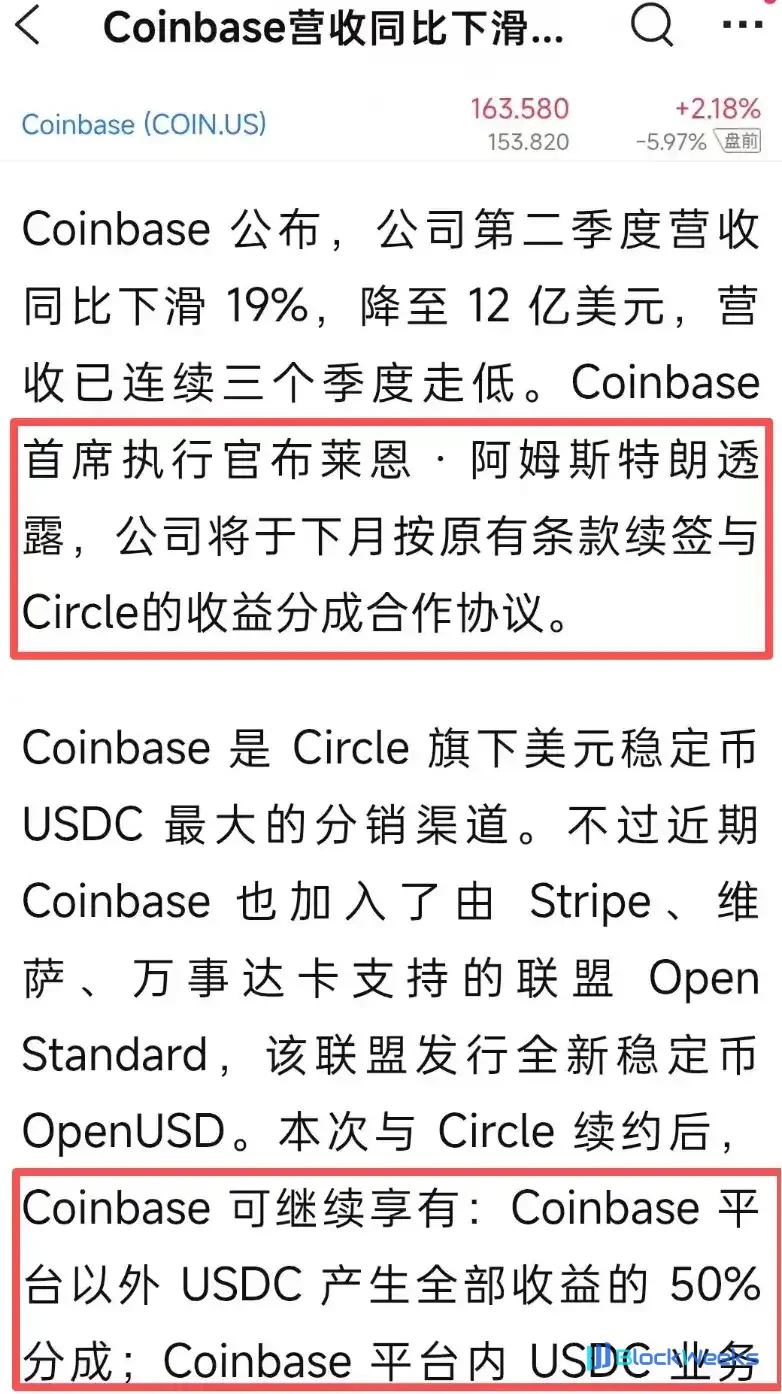
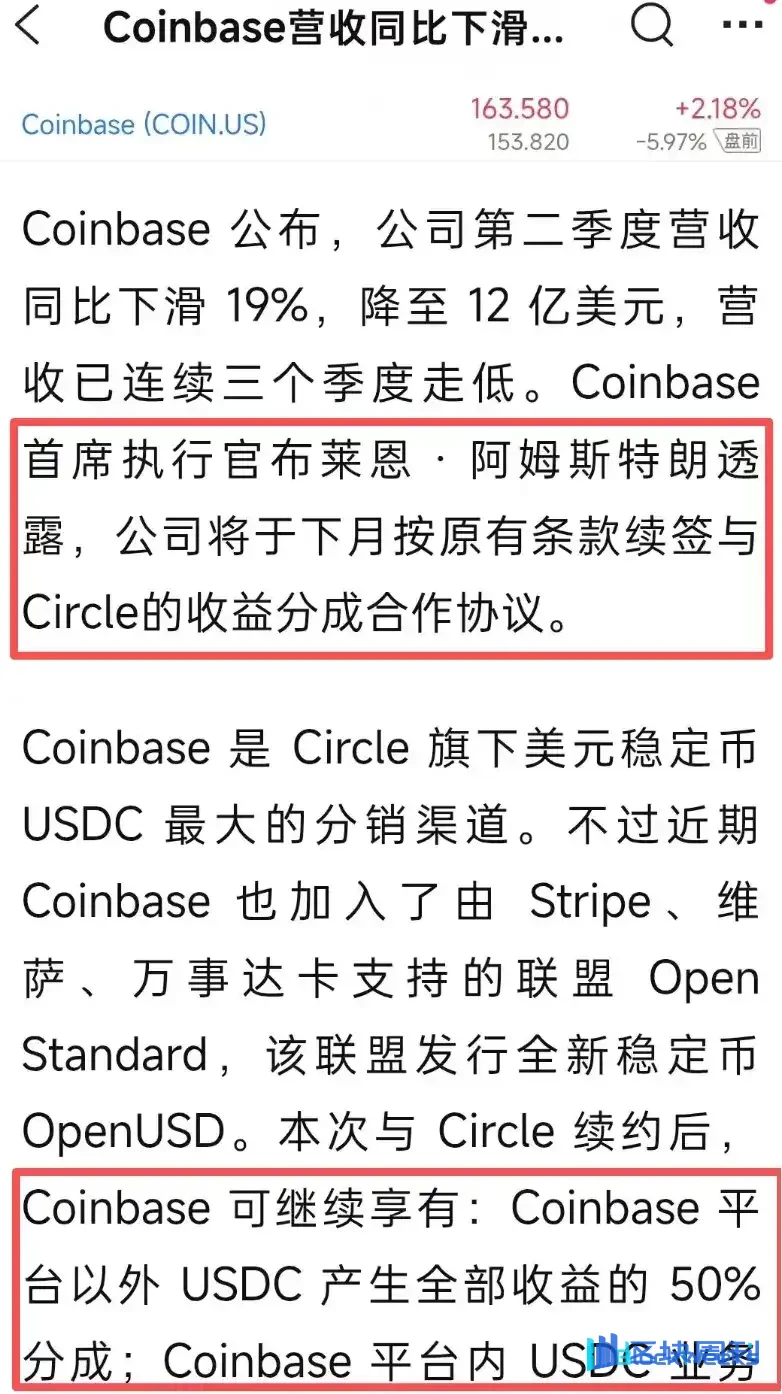
According to Coinbase CEO Brian Armstrong: the company will renew its revenue-sharing agreement with Circle next month under the original terms, meaning Circle will still need to share half of its profits (excluding the portion from Circle's own channels) with Coinbase, and profits generated by USDC held on Coinbase's platform will remain with Coinbase.
Prior to this, some optimists believed that due to USDC's dominant position in the compliant stablecoin market share, Circle had hope of negotiating a more favorable profit-sharing agreement with Coinbase, such as a lower sharing ratio.
In addition to the Coinbase agreement, several landmark events recently also confirm the trend of rising channel bargaining power:
1. According to the new agreement between Hypeliquid and Coinbase, Hypeliquid will take 90% of the reserve profits from existing USDC on its platform;
2. The recently emerging L2 Robinhood chain primarily promotes the stablecoin USDG (issued by Paxos) instead of USDC, yet this hardly affects user growth and activity at all (USDG must return 97% of channel revenue to Robinhood chain).
From the cases of Hypeliquid and Robinhood, as well as the emergence of more compliant stablecoins like OUSD (competing solutions), it is easy to foresee: the situation Circle will face in future negotiations with traditional crypto channels like Binance will likely be even more adverse, not more lenient.
"Hyperliquid has bargaining power when negotiating with you Coinbase/Circle, but doesn't Binance? Doesn't Kraken? You give Hyperliquid such favorable profit-sharing terms, but give me poor terms. Do you think Binance and Kraken are pushovers?"
Worse, this squeezing of bargaining power is happening in the crypto space, which is already Circle's traditional stronghold.
And in other potential incremental markets, such as traditional offline and online commercial payments, and future long-term options: Agent payments, Circle also faces channel squeezing and competition.
In the traditional payment field, Stripe, Visa, and Mastercard control merchant and bank networks (still channels) as well as familiar dispute resolution and compliance infrastructure. In this field, they are not even just squeezing USDC profits; they are directly entering the competition themselves: they created the OUSD stablecoin, and even Circle's main partner (vampire) Coinbase is one of the project's supporters.
In the Agent settlement field, it is currently uncertain whether stablecoins can even gain sufficient payment share. Traditional payment infrastructure and commercial contract-based point systems currently seem fully capable of handling Agent calls, while some edge scenarios (small-amount high-frequency payments) are too small in scale.
In traditional and agent payment fields, Circle also faces a problem: merchants, agents, and consumers almost don't care which stablecoin is used for settlement. After all, USDC, USD1, OUSD, OUSG—they are all compliant, aren't they?
In these scenarios, Circle's bargaining power vis-à-vis channels/consumers/merchants is likely even lower than in the crypto space.
If you are an investor in Circle or considering investing in Circle, these are all factors you should take into account.
These problems did not appear only after Circle's decline. I discussed Circle's issues on March 21 in "From Tencent and Circle: Simple and Difficult Questions in Investment," when optimistic investors were still cheering for Circle's return to 130.
The subsequent events (OUSD, hype securing 90% profit share, failed Coinbase agreement negotiations) merely confirmed my earlier deductions.
This is just one person's opinion, for reference only.