
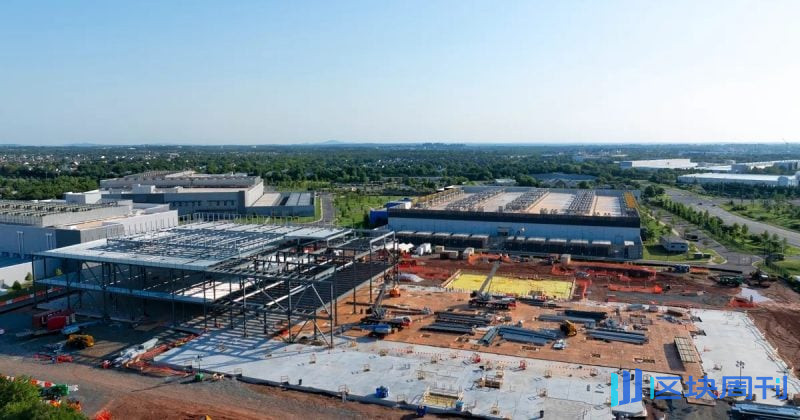
According to data from the U.S. Census Bureau, the annualized spending pace on data center construction has exceeded $68 billion, surging 46% year-over-year. The catalyst behind this is unsurprising: the robust demand for AI computing power has transformed once-empty land into the most valuable real estate in the tech sector.
This growth trend has persisted since early 2024 and further accelerated in 2025, with annualized spending reaching $45 billion to $50 billion or even higher in several months this year.
Bitcoin mining companies are undergoing their most significant strategic shift in recent years. Companies such as IREN, Cipher Mining, CleanSpark, Hut 8, and Core Scientific, which originally relied on cheap electricity to run ASIC miners, have now discovered that they possess assets more valuable than mining capacity: the power infrastructure that AI companies urgently need. As a result, a series of multi-billion-dollar lease agreements have been signed, with mining companies converting their facilities into high-performance computing and AI computing centers, shifting from SHA-256 hash operations to Transformer model training.
Microsoft and Meta have significantly increased their data center lease commitments to support AI expansion. Their ability to sign large-scale power agreements is precisely the bottleneck that hyperscale cloud providers face when rapidly deploying AI infrastructure. The broader non-residential construction sector shows mixed performance, highlighting the strength of the data center segment.
Currently, no specific cryptocurrency token is directly linked to this $68 billion in spending, but the impact on crypto-related companies is significant. First, publicly listed Bitcoin mining companies that have secured AI and high-performance computing lease contracts have effectively diversified their revenue, reducing their dependence on Bitcoin prices. For example, Core Scientific, after emerging from bankruptcy, has become a major player in AI infrastructure, and its valuation logic now differs from that of pure mining companies. Second, if mining companies find it more profitable to lease their facilities to AI applications than to mine, computing power may migrate away from the Bitcoin network. Third, as facilities shift to AI use, mining hardware being replaced may flood the second-hand market, lowering costs for miners still in operation.
The 46% year-over-year growth is not a single-quarter anomaly. The sustained acceleration since January 2024 indicates that this is a multi-year construction cycle.