Author: Payment201
Over the past decade, the global payments industry has undergone tremendous changes. Payment methods are increasing, APIs are becoming more open, cross-border transfers are getting faster, and Stripe, Adyen, Wise, PayPal, and Stablecoin are constantly changing the payment experience. More and more practitioners believe that in the future, global payments will become more open, more decentralized, and more like the internet.
But if we observe from the bottom layer where funds actually flow, we will find a completely different trend: Payment entry points are opening up, but the underlying funds are being re-centralized.
In 2025, the global foreign exchange market trades approximately $9.6 trillion per day. The US dollar participates in about 89% of all foreign exchange transactions. CHIPS processes over $2 trillion in dollar payments daily.
But what truly supports these fund flows is not thousands of companies. It is a small group of:
Global Transaction Banks;
Core clearing systems;
Liquidity Providers.
The true power center of global payments is not on the checkout page.
It lies in:
Who can connect to another Balance Sheet.
This is Correspondent Banking.
It has no consumer brand, no beautiful app, and even many payment practitioners do not directly interact with it.
But it determines:
Whether a bank can enter the dollar system;
Whether an African bank can connect to global trade;
Whether a cross-border enterprise's money can ultimately return to the headquarters' Treasury.
This is also why: Stripe is increasingly like a bank, and Stablecoin is getting closer to financial infrastructure. And institutions like JPM and Citi still stand at the core of the global fund network.
Because the real competition in global payments has never been just the payment entry point.
It is:Who has the ability to connect to the global financial system.
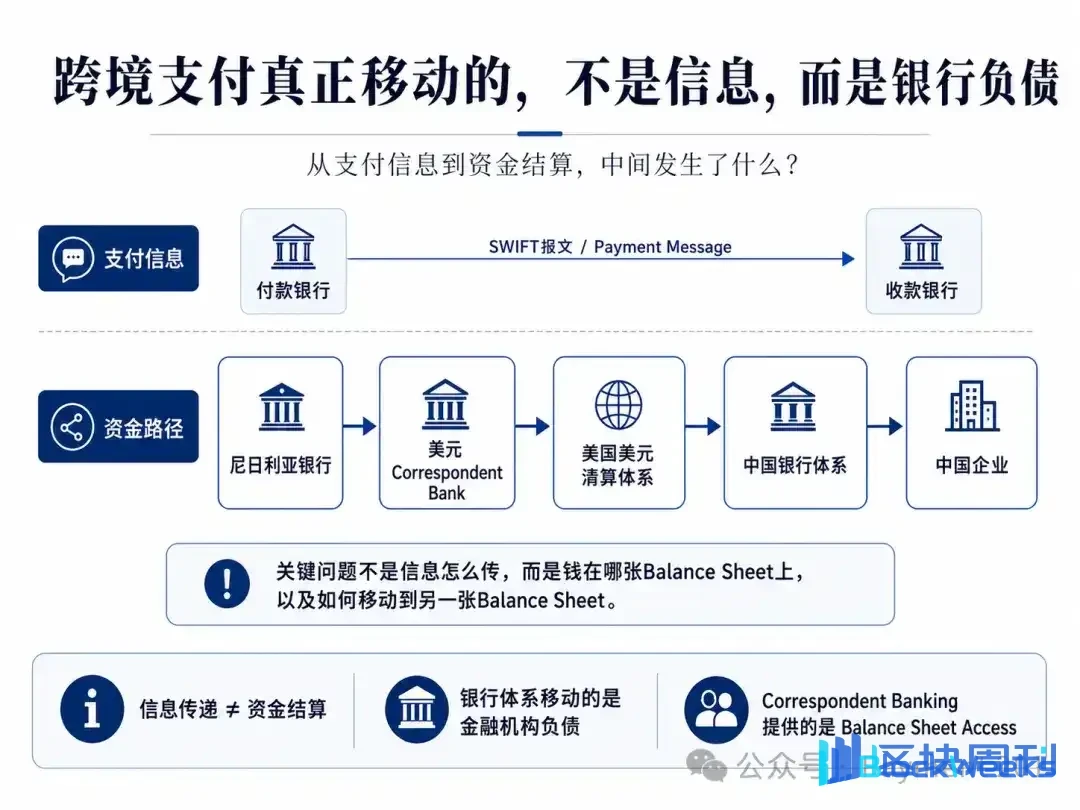
1. What truly moves in global payments is not information, but bank liabilities
When many people think of global payments, the first things that come to mind are: SWIFT, Visa, Mastercard, Payment Gateway. But these mostly solve: how payment information is transmitted.
The truly difficult question is:Where is the money?
This is one of the biggest differences between the internet and the financial system.The internet transmits information; the banking system moves: liabilities of financial institutions.
If you have $1 million in your JPMorgan account, essentially: JPMorgan owes you $1 million. If a Nigerian bank's customer account shows $1 million, that bank must also hold corresponding dollar assets or dollar positions on its asset side.
So the real problem in cross-border payments is never:
"How does Bank A tell Bank B that I want to pay $1 million?"
But rather:
Where is this $1 million currently on the balance sheet? How does it move to another balance sheet?
Suppose a Nigerian bank needs to pay a Chinese supplier in dollars. It can send a SWIFT message.
But: if it has no U.S. branch; is not a direct participant in the core dollar clearing system; cannot directly obtain dollar liquidity; it still needs a large bank to connect to the global dollar system.
So the fund chain might become:
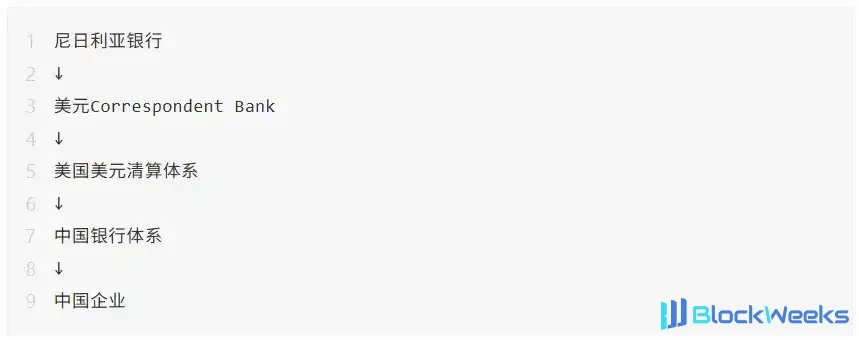
This is Correspondent Banking.
Many people understand it as: "Banks helping each other transfer money." But this understanding is too shallow.
What Correspondent Banking truly provides is:
Balance Sheet Access.
A Global Transaction Bank provides more than just an account.
It provides a complete set of financial capabilities:
Clearing Access;
Liquidity;
FX;
Payment Routing;
Intraday Credit;
AML;
Sanctions Screening;
Regulatory Infrastructure.
More importantly:
Institutional Trust.
APIs can be bought, and systems can be developed. But whether a global bank is willing to let your funds enter its Balance Sheet; whether it is willing to let your customers go through its financial network; whether it is willing to bear your transaction risks; these are completely different questions.
So what is truly scarce in global payments is never: "whether there is a payment interface."
It is:whether there is a financial institution willing to connect you.
2. What truly determines the value of a payment network is not how many countries it covers, but which nodes it connects to
This is also the core behind the previous Payment201 article on the value of JPM accounts.
Many companies understand bank accounts: I want an account, I want to receive and pay, I want online banking. But large enterprises see it completely differently. The true value of an account is not the Account Number.
It is: what networks it connects to. Including:
Which currency system;
Which clearing systems;
Which banks;
Which liquidity providers;
Which countries and regions.
Therefore:
An ordinary bank account is an account. A top-tier transaction bank account is the gateway to the global financial network.
J.P. Morgan discloses that its global clearing network connects more than 4,000 correspondent banking partners, covering over 160 countries.
The truly valuable part of this number is not: "JPM has many partner banks."
Rather:
Network effect.
Suppose: Bank A needs to pay Bank B.
Ordinary path:
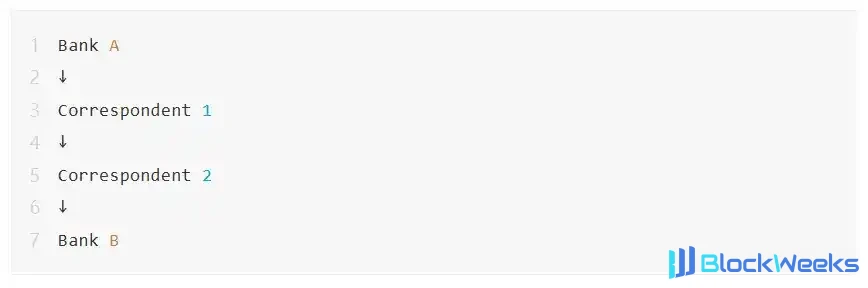
If both parties are connected to JPM:
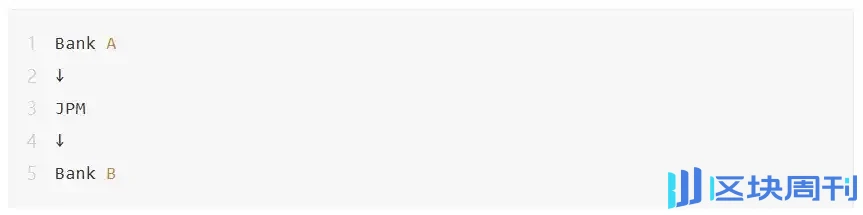
If both parties' accounts are even within JPM:
It may be completed directly:Book transfer.
The funds do not actually need to pass through multiple banks; it is just an internal rebalancing of the balance sheet at JPM.
Why does this matter?
Because each additional intermediary node may increase:
Fees;
Compliance checks;
Data conversion;
Repair;
Settlement time;
Liquidity occupation.
So one of the truly important metrics for global payments is not: Coverage. It is:Path Length.
3. How Global Payment Networks Are Built: Why Do Remittance Companies Look for Local Direct Partners?
There is another often misunderstood issue in the global payment industry: how does a payment company actually enter a new market? Many companies advertise: "We cover over 200 countries."
But for payment infrastructure:
Coverage and Connectivity are not the same thing.
Adding a country to the map does not mean truly having payment capability in that market. Because the truly important question for a market is not: "Can we receive a payment?"
It is:Can this money stably enter the local financial system and ultimately complete Settlement?
To enter a new market, payment companies typically have several paths.
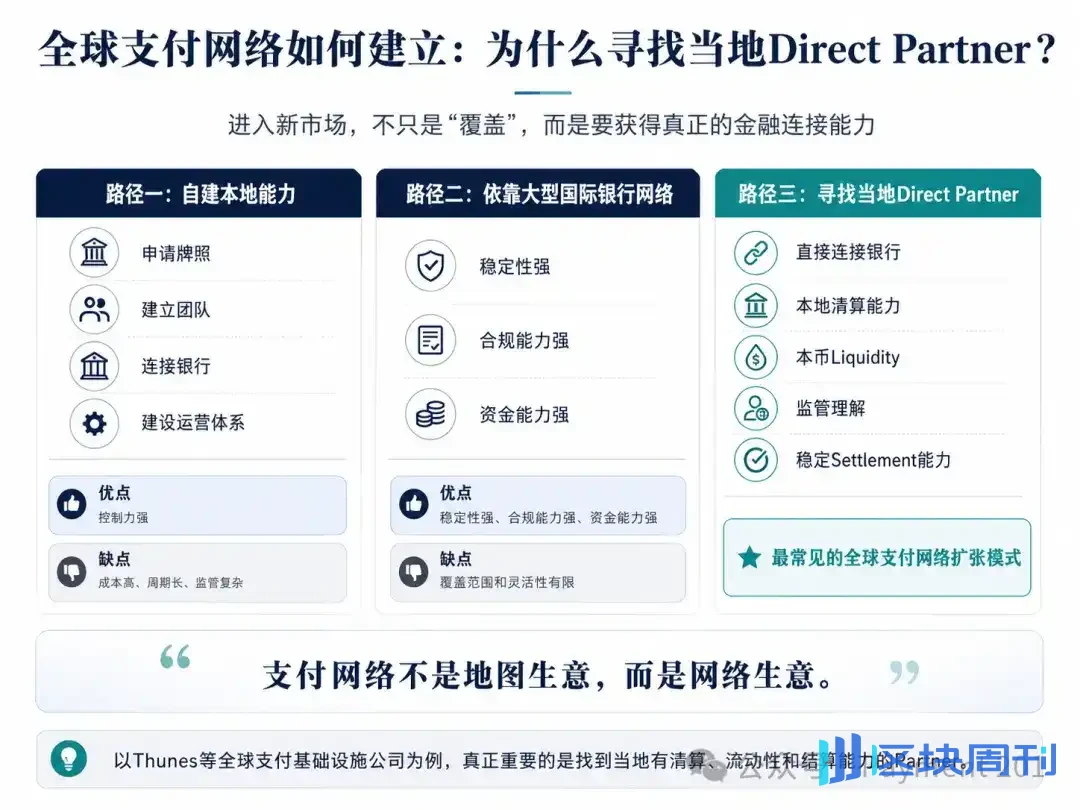
The first: build local capabilities yourself.
Including:
Apply for a license;
Build a team;
Connect to banks;
Build local operations.
Advantages: strong control.
Disadvantages: high cost, long cycle, complex regulation.
The second: rely on large international banking networks.
For example: enter local markets through Global Transaction Bank.
Advantages: strong stability, strong compliance, strong capital. But: limited coverage and flexibility.
The third: find local partners who truly have financial connectivity capabilities.
This is also the main model for many global payment network companies. For example, global payment infrastructure companies like Thunes and Nium, when expanding into different markets, do not simply pursue: "adding a country to the map."
What really matters is finding:
Local direct bank connections;
Local clearing capabilities;
Local currency liquidity;
Regulatory understanding;
Stable settlement capabilities.
Because: whether a market is truly covered does not depend on whether it lights up on the map. It depends on: whether funds can truly come in, whether they can truly go out, and whether settlement can be completed stably.
Therefore: the value of a global payment network does not come from how many countries it covers, but from what financial infrastructure is connected behind each country.
For example: a payment network can advertise coverage of a certain country.
But if: receiving payments requires multiple intermediaries; funds need complex routing; settlement depends on multiple third parties; then the commercial value of such coverage is actually limited.
What is truly valuable is: Direct Connectivity.
This is also an important change taking place in the global payment industry: in the past, the competition was about who covers more countries; in the future, the competition will be about who connects more deeply. Because payment is ultimately not a map business, but a network business.
4. Another change behind the global financial network: China's banking industry is accelerating its globalization
While researching Correspondent Banking, I also thought of a relatively deep observation I made recently. In July this year, I had a dinner with a deputy president of a domestic bank's head office. During the conversation, he mentioned something that left a deep impression on me: the layout of Chinese banks in overseas markets is far more in-depth than many people imagine.
In the past, many people understood banks going overseas as: opening an overseas branch, serving local customers, and helping Chinese enterprises go global. But in reality, in the global financial network, banks have another very important role:correspondent Bank.
This bank executive mentioned that they are promoting correspondent banking business in Afghanistan, Iraq, and some African markets. These markets may not be as mature as financial centers in Europe and the United States. But for global trade and capital flows, they still need to connect to the international financial system.
And the role banks play in this is not necessarily the same.
Sometimes: it requires landing through a local branch.
For example:
Establishing local institutions;
Obtaining regulatory licenses;
Serving local customers.
Sometimes: physical presence is not necessarily required.
Instead, acting as:Liquidity Provider or: Correspondent Partner.
Providing:
Clearing capabilities;
Liquidity in currencies such as RMB;
Cross-border settlement capabilities;
Risk management capabilities.
This actually reflects the different layers and positions in banking business.
The global financial network is not: whoever opens the most branches is the strongest.
What really matters is: a bank's position in the global capital network.
Some institutions are responsible for: connecting local markets.
Some institutions are responsible for: providing clearing capabilities.
Some institutions are responsible for: providing liquidity.
Some institutions are responsible for: undertaking global fund transfers.
Different roles together form the infrastructure for today's global fund flows.
At the same time, we also see more and more overseas banks joining the RMB cross-border clearing system. For example, regional large banks such as Standard Bank are strengthening their connectivity capabilities related to RMB internationalization. The logic behind this is not simply adding a payment currency. Rather, it is: more financial nodes are beginning to connect to new fund networks.
Future global payment competition is not just about connections within the dollar system. Rather, it is: among different currency systems, who can establish a more efficient and stable settlement network.
This also validates a viewpoint again:
Correspondent banking has not disappeared.
It is changing.
From traditional correspondent banking relationships, it is gradually evolving into:the connection layer between global currency systems.
Five, the most counterintuitive change in global payments: transactions are increasing, but core nodes are decreasing
If correspondent banking is so important, why don't large banks continue to expand their correspondent networks?
The reality is just the opposite.
Over the past decade or so, an important trend is called:de-risking.
Many large banks are proactively reducing:
high-risk markets;
small financial institutions;
correspondent relationships with lower commercial value.
Why? Because maintaining a correspondent banking relationship is very costly.
Including:
KYC;
AML;
Sanctions;
Transaction Monitoring;
Audit;
Data Governance;
Regulatory Review;
Operational investment.
A large portion of these are fixed costs.
But a small market with a population of a few hundred thousand may only contribute limited revenue in a year. So the bank will calculate: what is the income from this relationship? What is the potential regulatory risk? Is the Risk-adjusted Return reasonable?
If: the revenue is limited and the risk is huge, the most rational choice may not be to increase fees.Instead: exit.
This is what De-risking really changes. It does not change how much a payment costs, but rather:the structure of the global financial network.
In the past: many banks directly connected to many global banks.
Now it is increasingly becoming:
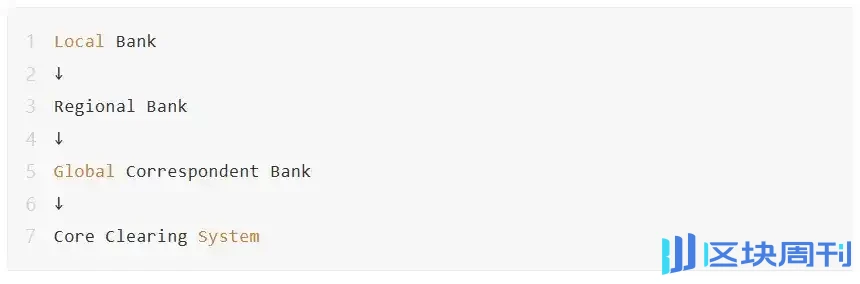
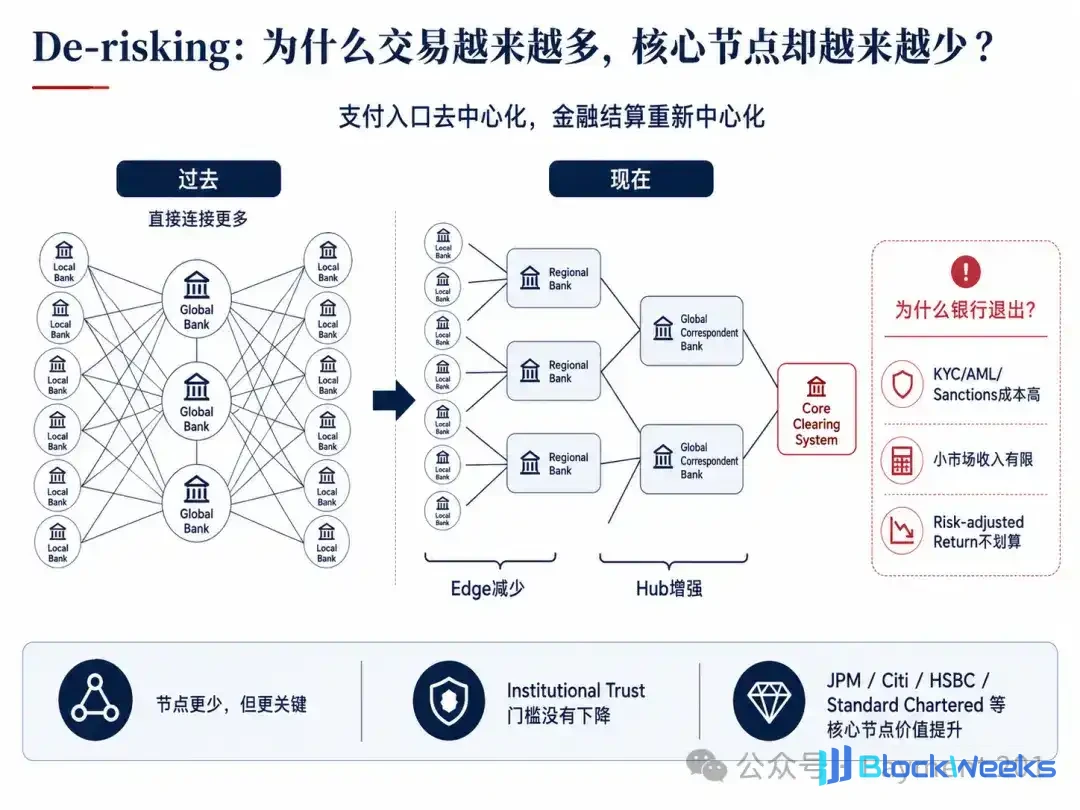
Result: Edges decrease, Hubs strengthen.
Thus, institutions like JPM, Citi, HSBC, and Standard Chartered further increase in value. Because they possess:
Global clearing capabilities;
Multi-currency liquidity;
Rich correspondent network;
Long-term financial trust.
This forms one of the biggest contradictions in global payments today:
Payment entry points are decentralizing, but financial settlement is re-centralizing.
There are more and more Stripe-like services, more PSPs, and more payment methods.
But those who truly possess:
USD liquidity;
Core clearing capabilities;
Global balance sheet;
Financial trust;
have not increased correspondingly.
The technical barrier has lowered, but the institutional trust barrier has not.
So the core of future global payment competition is not just: who has more users, who supports more payment methods.
It is:who has the ability to connect to the global financial system (partners).
Six, Payments Earn Fees on the Surface, but the Real Battle Underneath is the Balance Sheet
If you are a bank that needs to process $10 billion in payments every day, what do you care about more? Saving $1 per wire? Or locking up $2 billion less in cash?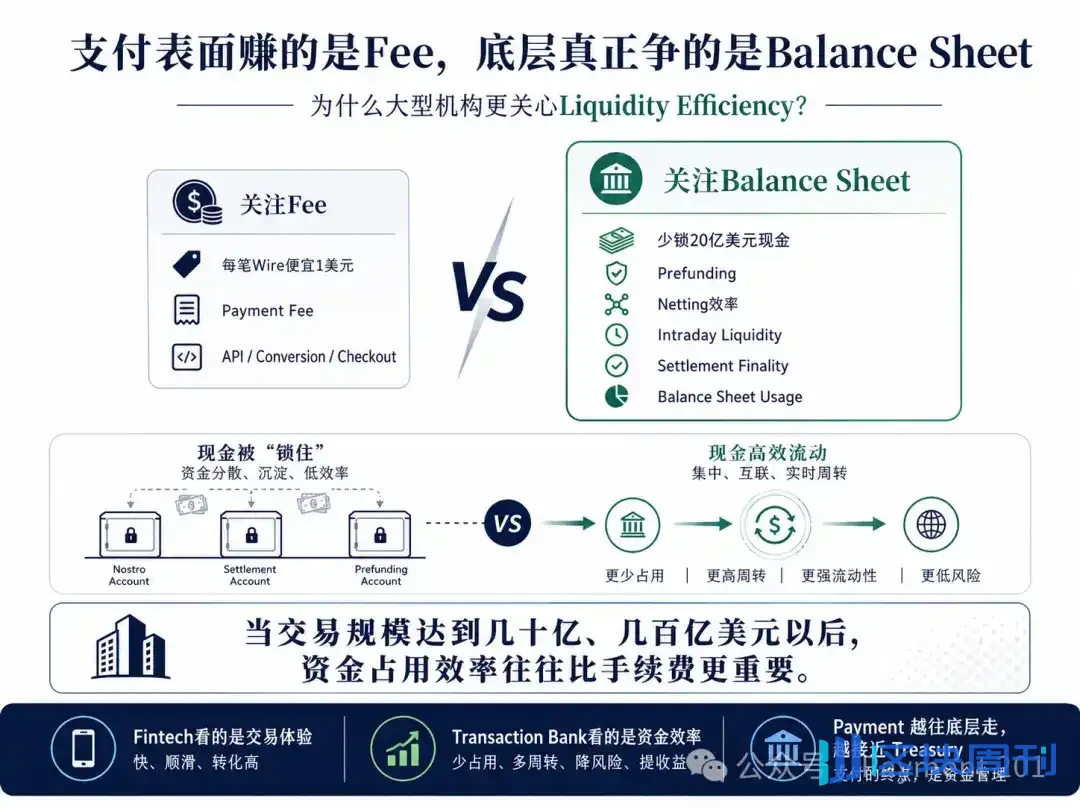
For large financial institutions, the answer is usually the latter, because capital itself has a cost.
Many people, when understanding payment infrastructure, focus on:
Transaction fees;
Speed of settlement;
API stability.
But at the global Transaction Bank level, the real competition is:
Liquidity Efficiency.
In 2025, the U.S. CHIPS system processes on average over $2 trillion in dollar payments daily. But what truly matters about CHIPS is not just the processing scale. More critically, it is how it utilizes limited liquidity to complete settlements far exceeding the actual amount of funds.
Because if a bank needs to process $10 billion in payments daily, it does not mean it is willing to lock up $10 billion in cash in advance.
These funds could otherwise be:
Lent out;