Original author: Bu Shuqing
Original source: Wall Street CN
Michael Hartnett, Chief Investment Strategist at BofA Securities, put forward a seemingly contradictory yet logically self-consistent market judgment in his latest Flow Show report: Stay cautious in the short term and recommend withdrawing from risk assets; but from a long-term strategic perspective, he maintains a "long stocks, short bonds" allocation, with the core logic being that U.S. policymakers have come to view the stock market as a "too big to fail" systemic asset.
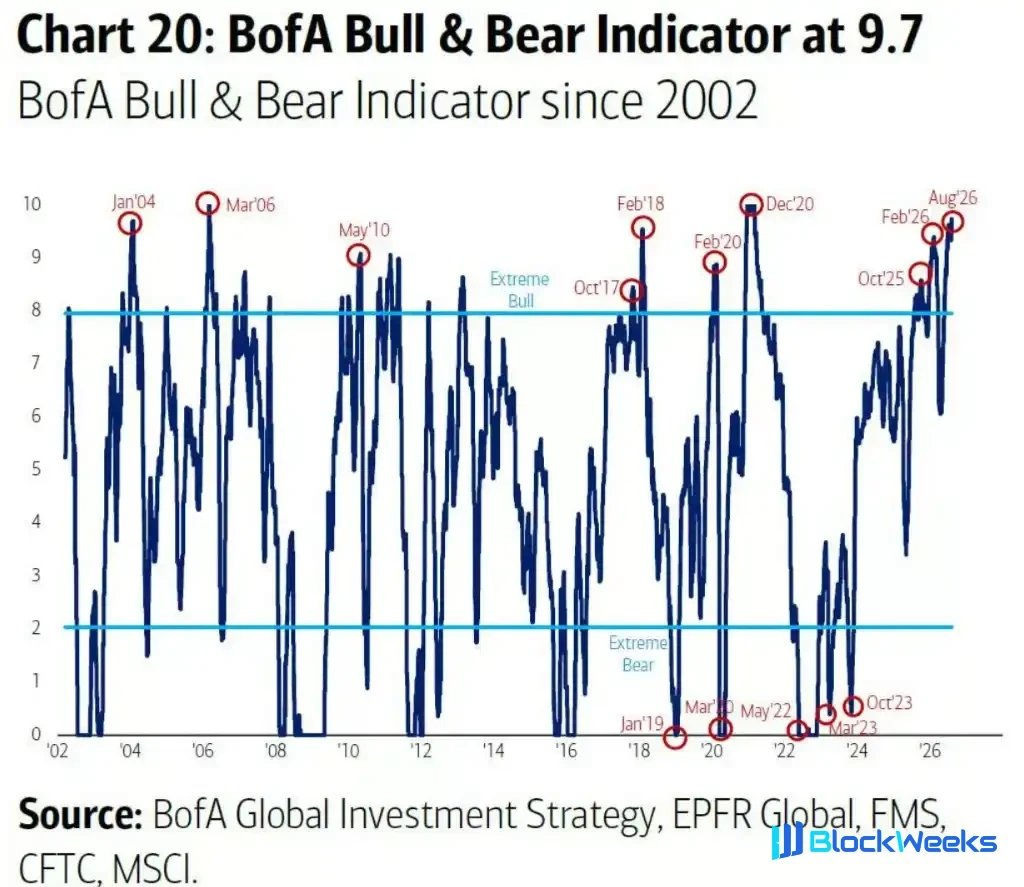
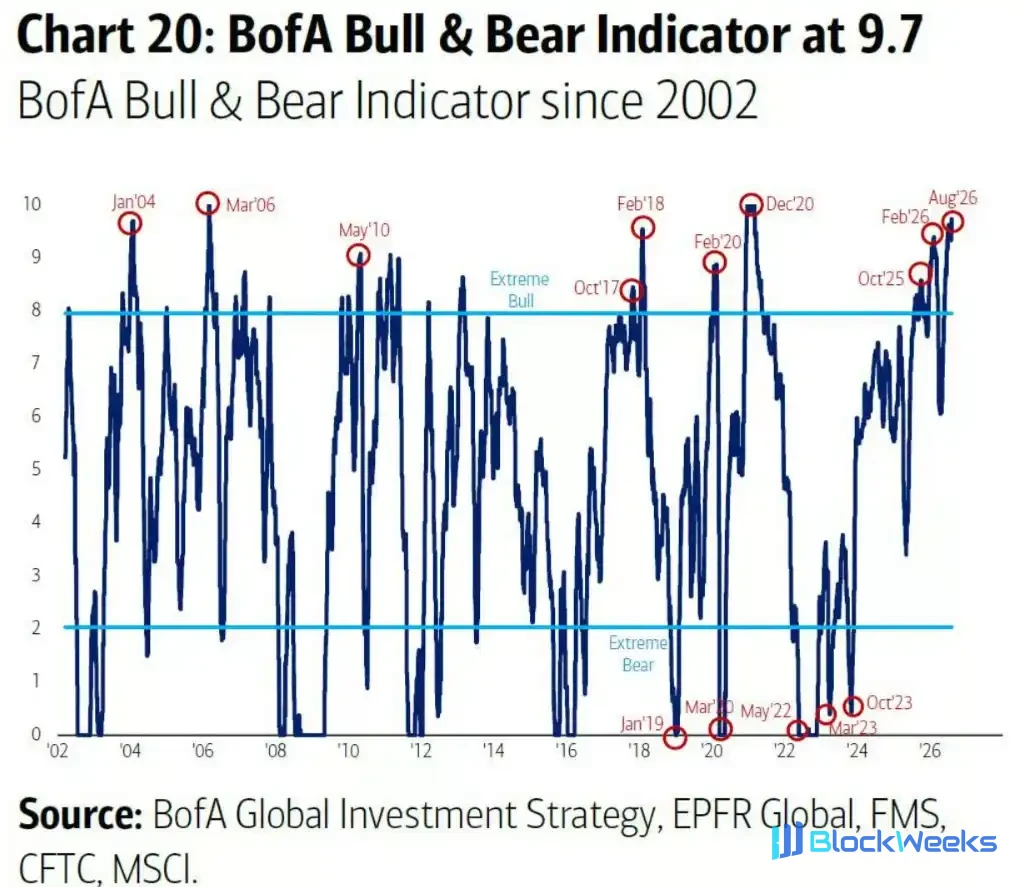
On the latest developments, the BofA Bull & Bear Indicator has risen from 9.4 to 9.7, the highest level since the meme stock bubble in early 2021, reflecting extremely optimistic market sentiment.
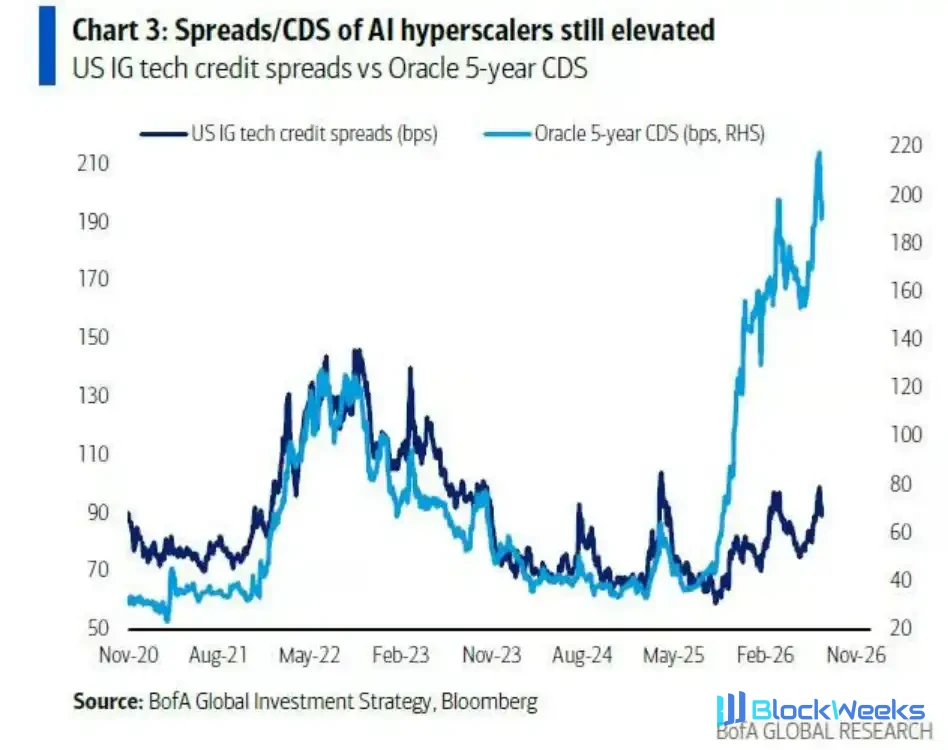
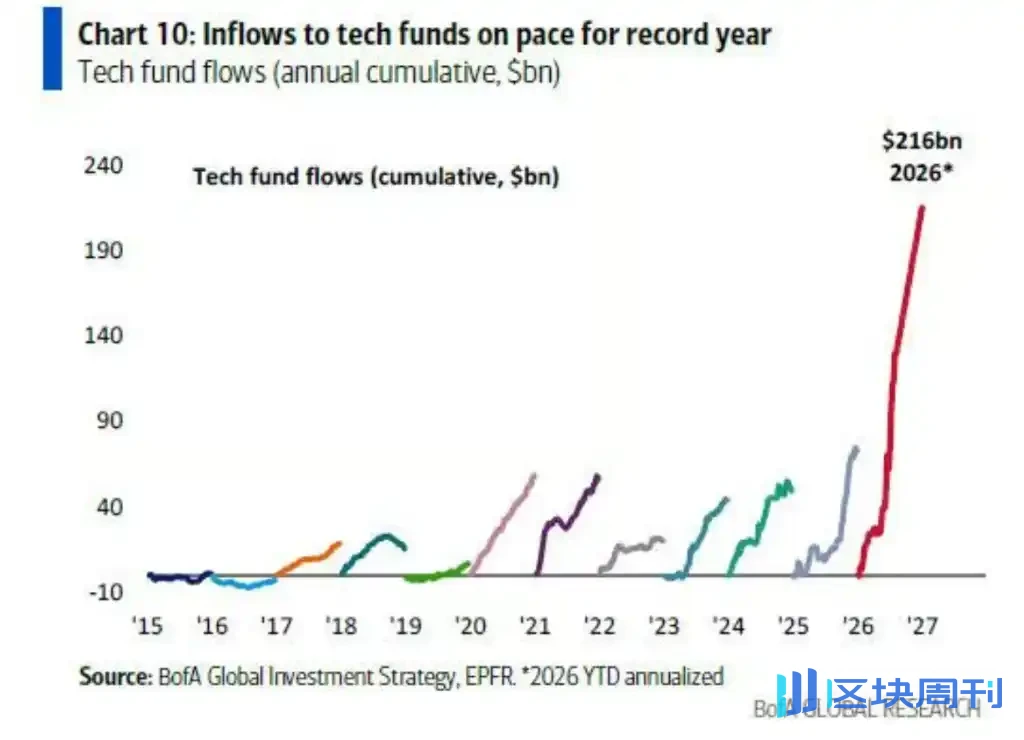
Meanwhile, Hartnett warned that the credit market is sending increasingly bearish signals, with credit spreads and CDS of AI hyperscale data center operators continuing to widen, and tech stock fund flows turning net negative for the first time in six weeks.
For investors, this dual-track judgment of "tactically bearish, strategically bullish" means: in the short term, one should rotate into defensive and duration assets, but there is no need to be overly pessimistic about the long-term market outlook—unless a key reversal signal of "rising yields and falling bank stocks" appears.
Bull & Bear Indicator Hits Five-Year High, Risk of Overheated Sentiment Rises
The BofA Bull & Bear Indicator rose to 9.7, the highest reading in nearly five years, driven mainly by large inflows into high-yield bonds, narrowing spreads on global high-yield and AT1 risk bonds, and improved breadth in global equity indices.
Hartnett noted that historically, whenever the indicator hit similar extremes—whether in 2018, 2020, or 2021—market sentiment often reversed rapidly from extreme optimism to extreme pessimism within the following year. He did not assert that history would necessarily repeat, but clearly cautioned that this pattern warrants vigilance.
Looking at this week's fund flows, almost all asset classes saw net inflows: cash inflows of $53.7 billion, equity inflows of $32.9 billion, bond inflows of $23.1 billion, gold inflows of $0.9 billion, and cryptocurrency inflows of $0.6 billion.
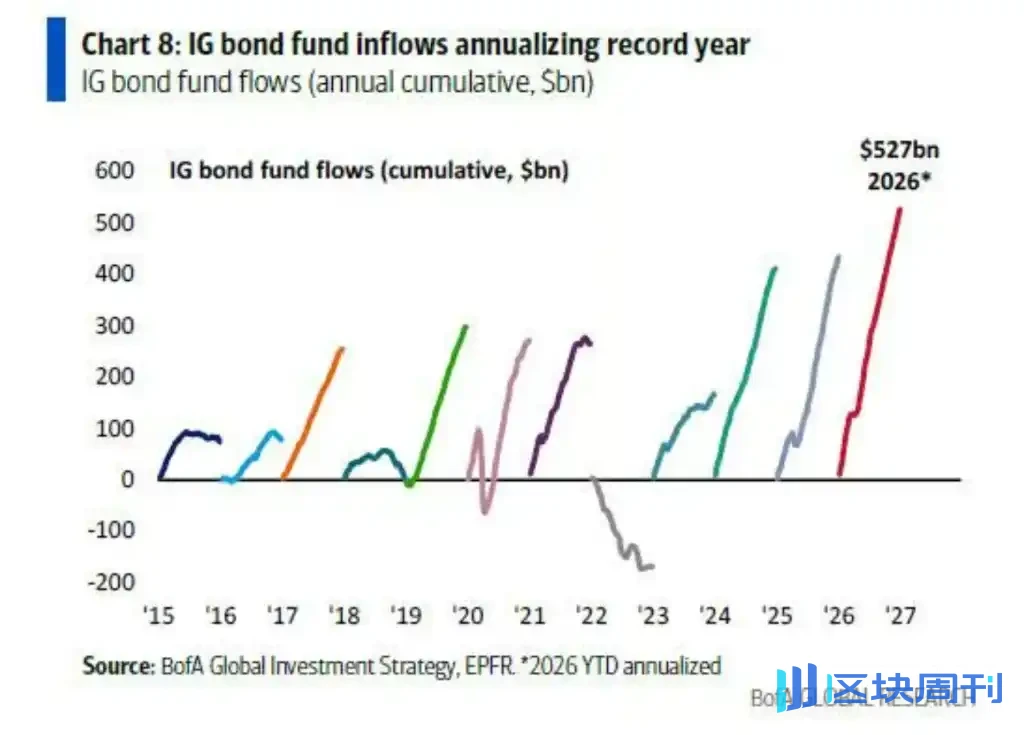
Among them, U.S. equities saw annualized inflows of $652 billion, a record high; investment-grade bonds saw annualized inflows of $527 billion, also a record high.
Short-Term Tactics: Retreat and Rotate, Not Add Positions
On the short-term operational level, Hartnett explicitly stated that he remains in the "summer retreat/rotation rather than adding positions" camp, advising investors to withdraw from risk assets and rotate into defensive assets (such as consumer staples), duration assets (such as REITs, small caps, biotech), and the U.S. dollar.
His logic is that these assets have stronger resilience to continued tightening of financial conditions and, compared to cyclical sectors such as banks, industrials, and semiconductors, are less impacted by the disappointment of the market's mainstream consensus of "no macro hard landing, no Fed rate hikes, no AI capex cuts, no Democratic midterm sweep."
On the macro data front, Hartnett had previously predicted that if July nonfarm payrolls exceeded 125,000 and the unemployment rate was below 4.1%, Fed chair candidate Kevin Warsh might return to a hawkish stance at the Jackson Hole meeting on August 28; if nonfarm data fell below 50,000 and the unemployment rate exceeded 4.3%, it would favor duration assets and defensive allocations.
The final data released showed mixed signals—nonfarm payrolls significantly missed expectations, but the unemployment rate fell to 4.1%, partially offsetting the negative impact, although the labor force shrank by 264,000 during the same period.
Long-Term Strategy: Policy Support Makes Stocks "Too Big to Fail"
From a strategic perspective, Hartnett maintains a core allocation of "long stocks, short bonds," reasoning that policymakers have clearly indicated they will not allow a significant stock market decline. He pointed out that the current U.S. economy is highly dependent on the wealth effect—U.S. household stock holdings have increased by $7 trillion so far this year, following increases of $9 trillion in 2024 and 2025—and the AI data center capital expenditure boom.
Last week's coordinated intervention in the foreign exchange market—aimed at ending what Hartnett called the "poor man's LTCM" deleveraging event—further confirmed this judgment: the U.S. government will always step in to prevent tightening financial conditions from ending the boom and the bubble. He added that the Trump administration and Treasury Secretary Scott Bessent still hold the yield curve control card.
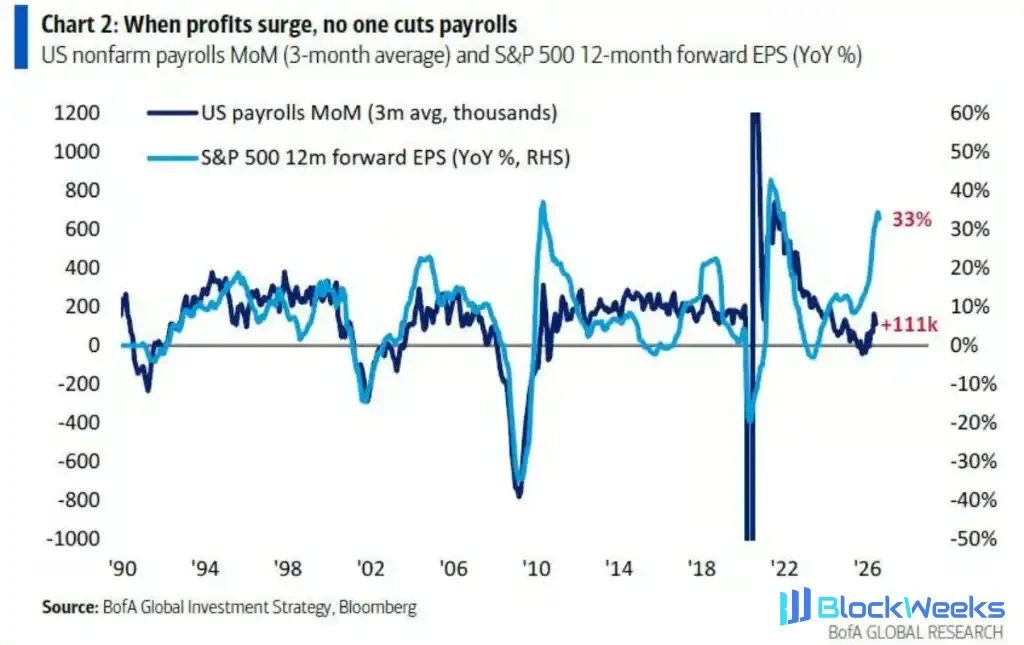
On the earnings front, Hartnett acknowledged that EPS is the core engine of the current bull market, with 12-month forward EPS expectations revised up by 33%, partly thanks to about $35 billion in tariff refunds over the past three months, partially offsetting the roughly $75 billion tariff shock between May and July 2025.
Termination Signals and Tail Risks
Despite a long-term bullish outlook, Hartnett clearly identified the conditions for the end of the current bull market: Once a bond market self-defense sell-off event of "rising yields, falling dollar" occurs, forcing a sharp pivot in fiscal policy and driving asset allocation to shift from stocks to bonds, this boom will come to an end.
For the "canary in the coal mine" reversal signal that investors care most about, Hartnett gave a clear answer: "Rising yields, falling bank stocks."
In the credit market, he noted that credit spreads and CDS for AI hyperscale data center operators are still widening, due to massive share buybacks and fading cash flows. He believes that if MAGS (tech giants) quarterly earnings per share exceed $70, the threat of "cheap Chinese computing power ending the AI capital expenditure boom" can be eliminated.
Gold as a Hedge for Political Cycles and Midterm Elections
At the end of the report, Hartnett broadened the perspective to a more macro political-economic framework.
He pointed out that political populism in the 2020s has driven fiscal expansion, boosting U.S. nominal GDP from $20 trillion to $32 trillion over the past six years, an increase of 63%, while U.S. national debt is about to exceed $40 trillion.
In terms of the political landscape, he characterized the upcoming midterm elections as a contest between "populist capitalism" (reducing deficits through growth) and another political path (reducing deficits through wealth taxes).
In terms of market implications, Republicans retaining a Senate majority would be positive; going long consumer stocks is the best strategy to bet on Trump shifting focus to affordability for the people; and going long gold is an effective tool to hedge against the tail risk of a simultaneous sharp decline in yields, the dollar, and stocks triggered by the "K-shaped" voter structure before year-end.