On August 10, 2026, after nearly a week of trading suspension, the market-anticipated change of control of Baolai Te (300246.SZ) was announced to be terminated. This negative news directly triggered a massive sell-off in the secondary market, and Baolai Te's stock price was firmly pinned at the 20CM limit-down board by huge sell orders. As of the close, the stock price was fixed at 15.41 yuan per share.
But for Baolai Te, the stock price decline caused by the collapse of the "change of control" expectation is by no means a simple emotional vent. At the business level, the company's core hemodialysis business is deeply mired in the price war of centralized procurement, the monitor track has reached its growth ceiling, and with three consecutive years of huge losses, there is no visible point in time to break even so far.
In January this year, the entry of Zhejiang Quwei Zhihie Holding Partnership (hereinafter referred to as "Quwei Zhihie") gave the outside world a glimpse of another possibility for the company. The announcement of the transfer of control rights more than a week ago further led outsiders to speculate whether Weigu Information Technology (Quzhou) Co., Ltd. (hereinafter referred to as "Weigu Information"), which is behind Quwei Zhihie and specializes in solid-state storage and computing fusion solutions (storage chips), would take a backdoor listing. But for now, this illusion has been shattered.
Lightning Termination of Change of Control
Rewind to the evening of July 31, 2026, when Baolai Te suddenly announced that controlling shareholder Yan Jinyuan and his concerted action partner Wang Shi were planning a major matter that could lead to a change in the company's control. This news was like a deep-water bomb, instantly igniting market speculation.
In fact, the signs of a change of control began to sprout as early as early January this year. On January 12, 2026, against the backdrop of the company's obvious performance decline, controlling shareholder Yan Jinyuan and his concerted action partner Wang Shi signed a "Share Transfer Agreement" with Quwei Zhihie, transferring 7% of the company's shares at a price of 9.45 yuan per share, cashing out approximately 175 million yuan. On May 28, the share transfer was completed, and Quwei Zhihie officially became a major shareholder holding more than 5%.
Quwei Zhihie, established in September 2025, does not have any related entity business. Rather, it is the national-level specialized and innovative "little giant" enterprise Weigu Information behind it that deserves more attention.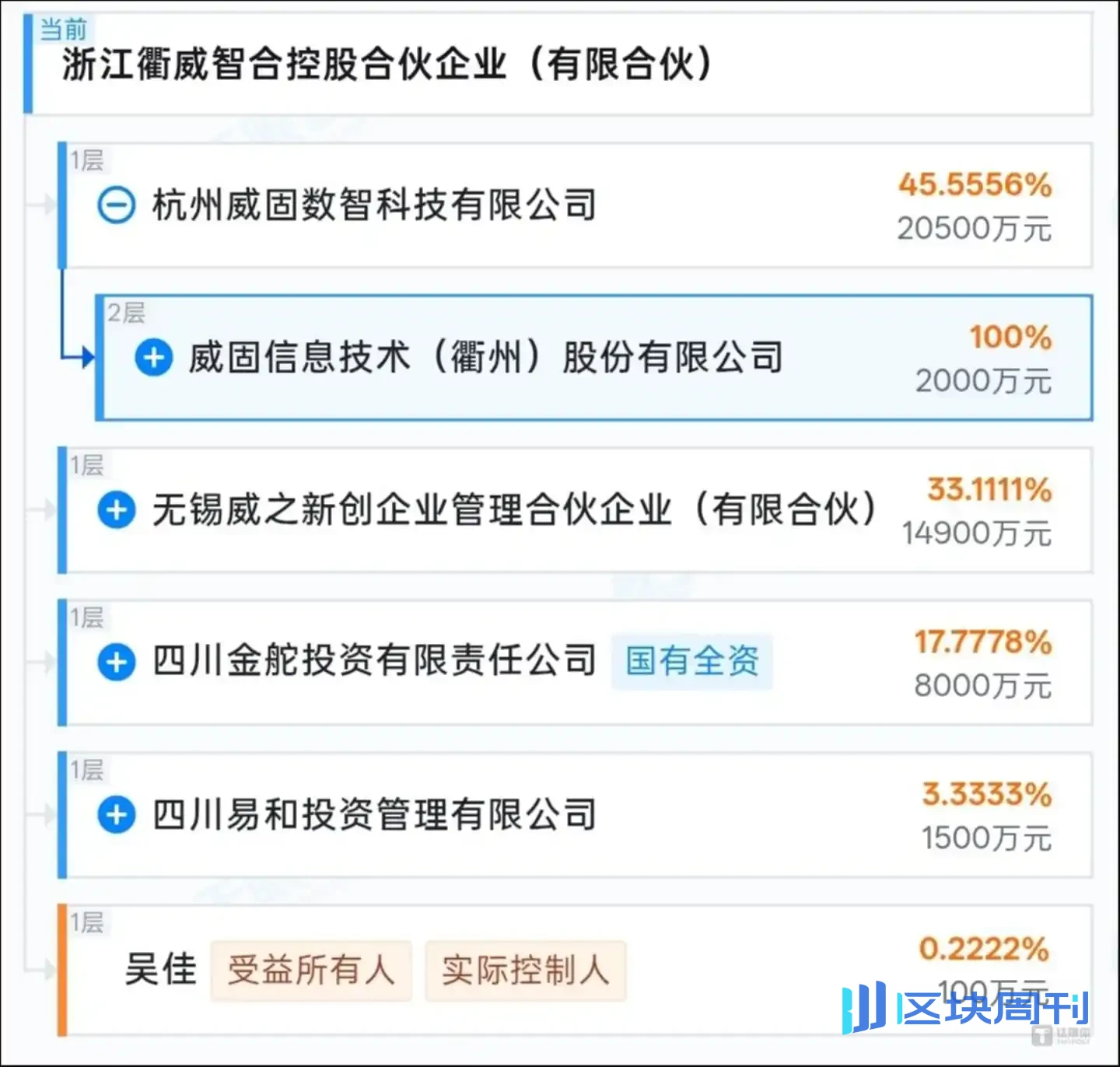
Source: Tianyancha APP
From public information, the author learned that the company focuses on high-reliability special solid-state storage business, with self-developed flash controllers and firmware algorithms. Its products cover chip-level, embedded, and ruggedized storage solutions, mainly targeting high-reliability scenarios such as aerospace, military equipment, rail transit, and automotive-grade applications. It also lays out in the domestic substitution and industrial storage tracks. The core team has a technical background in supercomputing projects and holds a full set of military qualifications.
Because of its development in the storage business, it has also attracted investors with industrial and state-owned backgrounds. In December 2020, the company completed a 200 million yuan Series C financing round, with participation from the aerospace science and industry investment platform, Chinalco Capital, Shandong High-speed, and other central and local state-owned enterprises, as well as several listed companies' industrial capital. In September 2021, the company received another several hundred million yuan in Series C+ financing, with leading institutions such as Shenzhen Capital Group, Qianhai Mother Fund, and Beyond Moore Fund entering one after another. In August 2024, it completed a Series D+ financing round.
Obviously, Weigu Information and Baolai Te have vastly different main businesses, which also made the market and investors speculate. Based on this strong expectation of "cross-border restructuring," Baolai Te's stock price once doubled within 2026. The stock price continued to rise from the closing price of 8.61 yuan on January 5, and hit 21.67 yuan intraday on May 20, with a maximum increase of 151.68% during the period. As of the suspension on July 31, the stock price had risen 137.78% within the year, and on the trading day before the suspension, it surged 10.37%.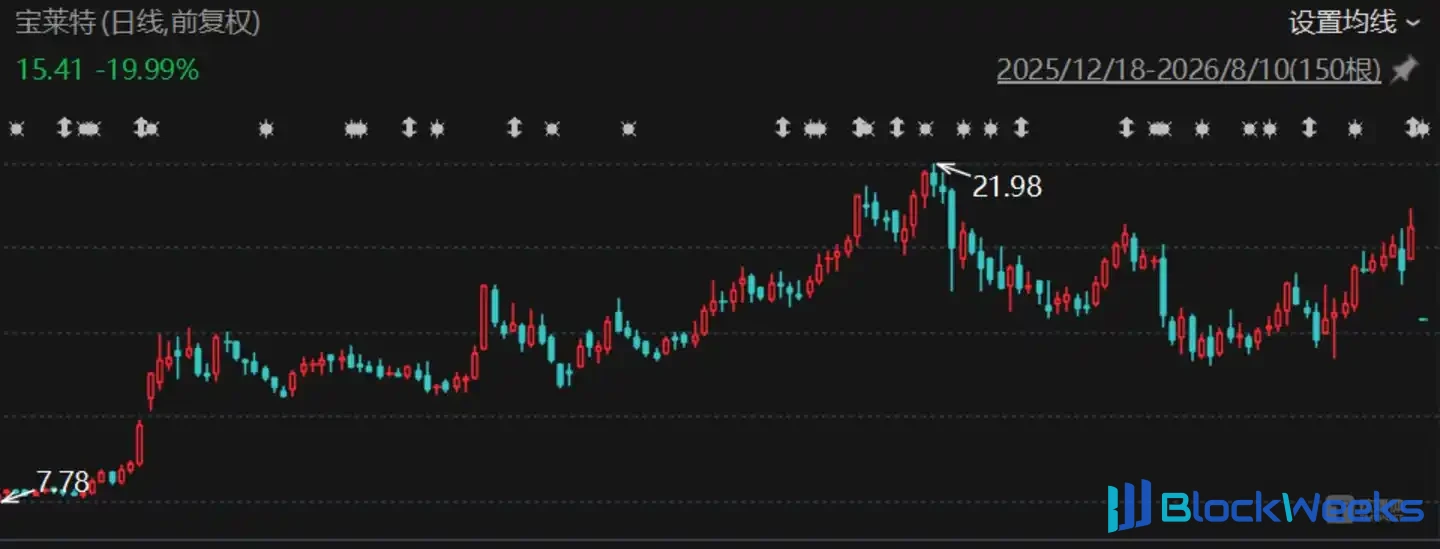
Source: Choice
But all this was shattered by the announcement on the evening of August 7 that the planning of the change of control had been terminated. Baolai Te stated that during the suspension period, the controlling shareholder and the counterparty conducted full discussions on the major matters. "Due to the many matters involved, the relevant trading parties, after careful consideration and listening to opinions from all sides, decided to terminate the planning of this change of control."
Deep in the Quagmire of Losses
If the termination of the change of control is the direct trigger for the stock price collapse, then Baolai Te's loss-making fundamentals are the fundamental reason for its 20CM limit-down.
As a veteran medical device company listed on the ChiNext in 2011, Baolai Te initially established its market position relying on the monitor business. As time has passed, the hemodialysis business has grown into the company's largest revenue pillar, and the company's focus has shifted to nephrology medical care. However, the monitor business has not exited and still serves as an important high-margin business segment, running in parallel with the hemodialysis business.
Since 2023, Baolai Te has been mired in continuous losses. Financial data shows that from 2023 to 2025, the company's net profits were -65.1851 million yuan, -71.4413 million yuan, and -69.4278 million yuan, respectively, with a cumulative loss of over 200 million yuan over three years. Entering 2026, the loss situation has not been curbed. The first-quarter financial report shows that the company's revenue declined 1.91% year-on-year to 243 million yuan, with a net loss of 7.3189 million yuan, and the non-GAAP net loss expanded to 14.6275 million yuan.
Source: Choice
The primary reason is the centralized volume-based procurement (VBP) of medical consumables led by the National Healthcare Security Administration. With the full implementation of VBP for domestic hemodialysis consumables, prices of dialyzers, dialysate, and other products have plummeted, severely squeezing Baolai Te's gross margin.
More urgent is the huge short-term debt repayment pressure. As of the end of the first quarter of 2026, the company's current liabilities reached 830 million yuan, while book monetary funds were only 457 million yuan. Relying solely on existing monetary funds cannot cover all short-term liabilities. Coupled with the upcoming maturity of Baolai Convertible Bonds, the short-term capital turnover pressure is prominent. More critically, the company's convertible corporate bonds "Baolai Convertible Bonds" will mature on September 3, 2026, with a remaining total face value of approximately 218 million yuan. Given the current stock price (15.41 yuan) is far below the conversion price (18.30 yuan), it is almost impossible for convertible bond holders to choose conversion, meaning Baolai Te faces considerable short-term cash payment pressure.
Source: Choice
Therefore, the company had to close out previously raised projects and permanently supplement working capital with the remaining 60.6631 million yuan of raised funds.
For Baolai Te, the termination of the change of control may just be the delayed bad news, but how to fill the hole in main business profitability and how to resolve the imminent debt crisis are the urgent problems facing management. (Text | Company Observer, Author | Cao Shengyuan, Editor | Deng Haotian)