Author: Foresight Ventures
The growth of Perp DEX has largely benefited from token incentives.
Cold start requires incentives; traders, liquidity providers, and order flow channels create value for the market and deserve to be rewarded. What is truly worth discussing is not "whether to incentivize," but in what form incentives occur, and whether the rewards truly correspond to contributions.
Before TGE, platforms typically use points, airdrops, and trading mining to attract current trading volume and liquidity with the expectation of future tokens. Such mechanisms can quickly acquire users, but the fees users pay are real, while the rewards they receive still depend on future token distribution and market pricing. After TGE, fees begin to be used for buybacks, burns, and staking rewards, with value gradually returning to the ecosystem, but mainly still through the platform token for absorption and distribution.
The problem therefore lies not in incentives themselves, but in whether incentives rely excessively on future expectations. Traders create trading demand and fee income; liquidity providers offer depth and execution; wallets, trading terminals, and communities bring continuous order flow. But existing mechanisms reward point-earning ability and token holdings more than who truly makes the market function.
This is also a key issue Foresight Ventures has focused on in investing in and incubating PopDEX: Can the platform establish a more direct and sustainable value return path, making rewards closer to real market contributions?
I. Early Growth and Demand Validation under Token Incentives
1. Why Tokens Became the Default Tool
The cold start of Perp DEX requires simultaneously acquiring traders, liquidity, and distribution channels, while early platforms typically lack stable income and find it difficult to sustain high cash subsidies over the long term.
Tokens provide a more efficient coordination method: platforms can convert the contributions of traders, market makers, and early participants into future claims, using future value to exchange for current trading volume, liquidity, and market attention.
dYdX represents an earlier complete token incentive model. In its initial token supply, 25% was allocated to trading rewards, 7.5% to historical users, and 7.5% to liquidity rewards. Trading rewards are calculated based on fee contribution and open interest, while liquidity rewards consider quote uptime, two-sided depth, bid-ask spread, and number of markets covered. Customer acquisition, market-making subsidies, and early ownership distribution are thus incorporated into the same token system.
Subsequent platforms made different adjustments within this framework:
- Hyperliquid combines points, Referral, and HLP to attract traders, expand order flow, and build protocol liquidity;
- Aster: adopts multi-season trading mining, using consecutive points cycles and phased token distribution to sustain trading participation and user activity.
- Lighter lowers the trading barrier through zero fees and sets separate retail points and market-making points to distinguish trading activity from liquidity quality;
These platforms do not rely solely on tokens, but tokens remain the core coordination tool in the cold start system. Its advantage is not just "issuing rewards," but being able to uniformly convert the contributions of different participants into future claims and defer most customer acquisition and liquidity costs until TGE. The specific mechanisms vary, but the exchange relationship is basically the same: platforms first use future claims and upfront subsidies to exchange for current trading volume, liquidity, and market attention.
2. What Points Attract May Not Be Long-Term Traders
Points airdrops not only change whether users enter the platform, but also change why users trade.
Under normal circumstances, traders choose a platform focusing on liquidity, execution stability, fees, asset coverage, and risk management. After points airdrops are added, these criteria do not disappear, but users' decision weights change: in addition to the trading experience itself, users also calculate how many points can be obtained per unit of trading cost, whether potential airdrops can cover fees and capital occupation, and when rewards will be realized.
This does not mean that users participating in points are not professional traders. On the contrary, many professional traders also rationally evaluate points returns. The problem is that when points become an important variable in trading decisions, the trading volume the platform obtains no longer only reflects product competitiveness, but also includes users' pricing of future rewards.
Both types of trading behavior contribute to trading volume, but the retention logic differs.
One type of trading behavior comes from sustained product demand: users stay because the platform's liquidity, execution, cost, and asset coverage can meet trading needs. Another type of trading behavior comes more from reward expectations: whether users continue trading depends on whether points still have value, whether airdrops still have imagination, and whether the input-output ratio still holds.
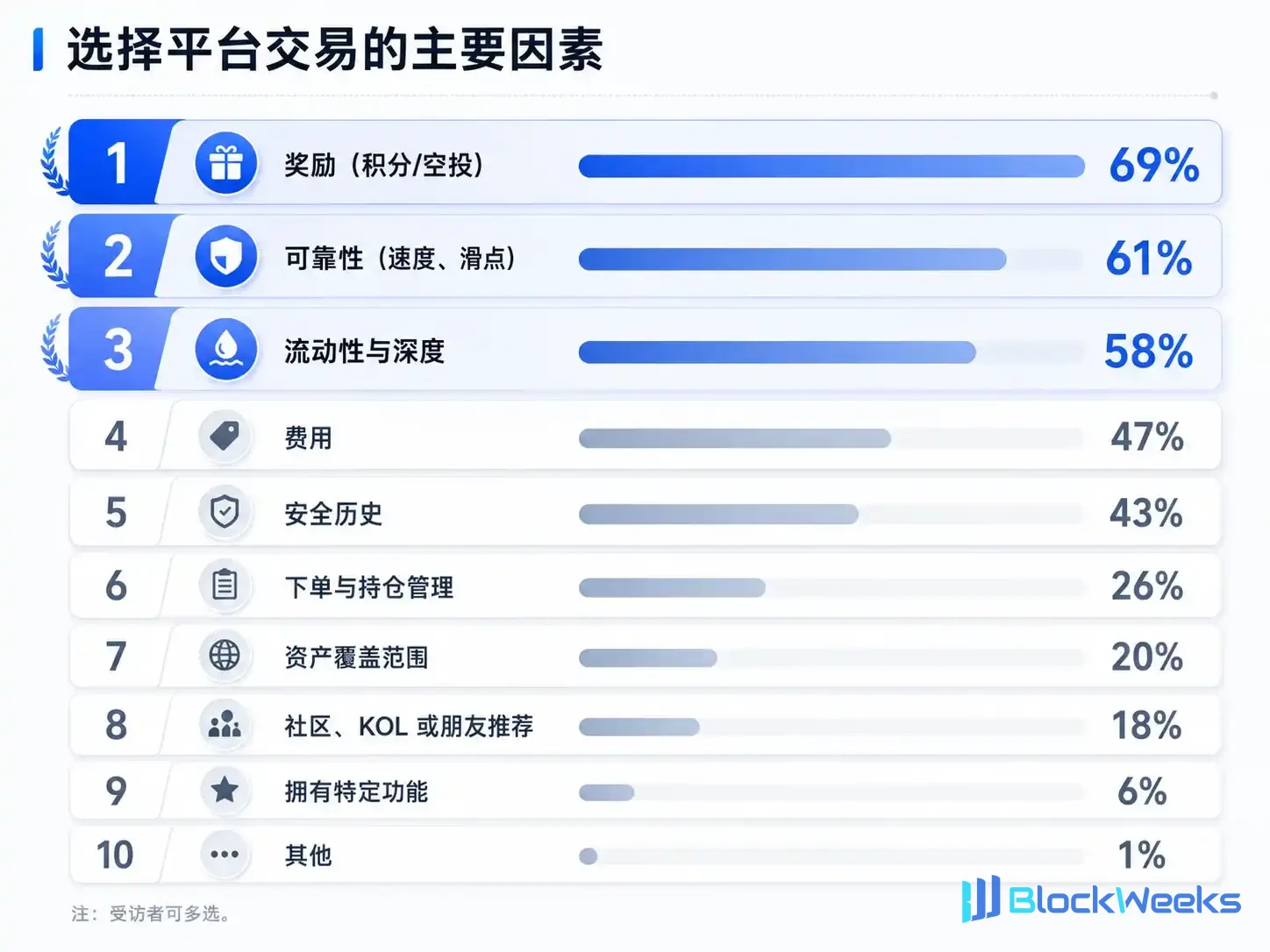
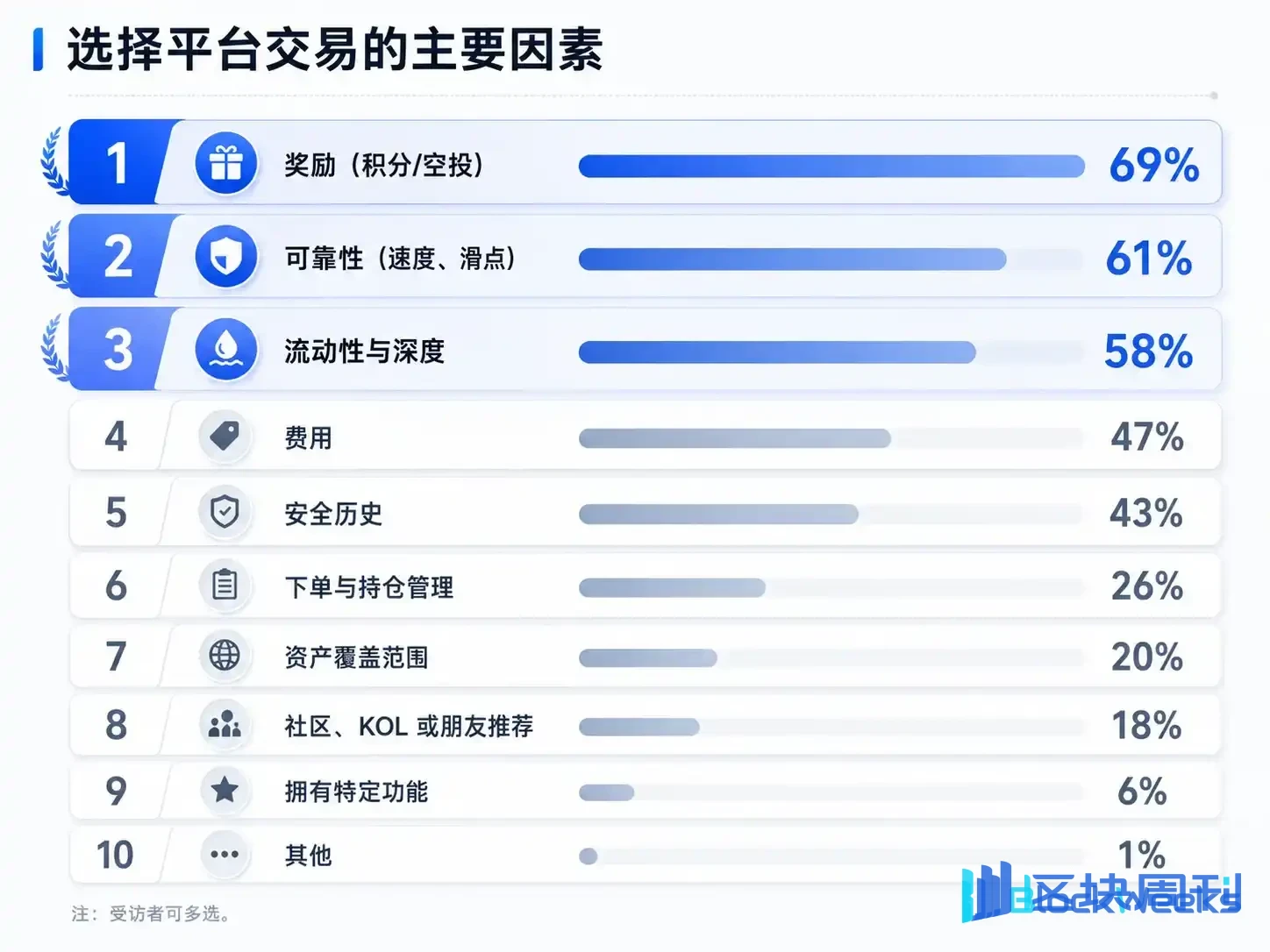
In a previous Perp DEX retail survey conducted by Foresight Ventures, 69% of respondents listed points or airdrops as an important factor in choosing a trading platform, higher than reliability (61%), liquidity and depth (58%), and fees (47%). Points and airdrops are no longer just additional rewards outside the product, but are directly competing with reliability, liquidity, and fees, becoming core variables in users' platform selection.
This changes the nature of the order flow the platform obtains. When users enter primarily based on reward expectations, the platform builds not a high switching cost based on product habits, but a trading relationship that requires continuous subsidies. Rewards can lower the barrier for users to enter the platform, but they also lower the barrier for users to leave.
3. TGE is the First Stress Test of Trading Demand
During the points cycle, the platform buys not only trading volume, but also users' waiting for future claims. As long as airdrops still have imagination, users are willing to trade, pay fees, occupy capital, and accept a product experience that is not yet fully mature.
But data from the points period is not pure. A trade may come from real market demand or from expectations of airdrops; a new user may form long-term order flow or may stop trading after completing tasks.
On the surface, they all count as growth.
When these different motivations are placed into the same token and points system, it is difficult for the platform to determine what it ultimately obtains. Therefore, after TGE, data should not be viewed only in terms of rises and falls; more importantly, three things matter:
- Whether trading volume remains after rewards exit, or is sustained by a new round of incentives;
- Whether market share has increased, rather than merely following the overall Perp DEX market fluctuations;
- Whether the platform has entered a natural retention phase, or is still in a new incentive cycle.
| Platform | TGE Date | Average Daily Trading Volume 30 Days Before TGE | Average Daily Trading Volume 30 Days After TGE | Market Share Change |
| Hyperliquid | November 29, 2024 | Approximately $2.41 billion | Approximately $5.08 billion | +18.6% |
| Lighter | December 30, 2025 | Approximately $6.64 billion | Approximately $3.72 billion | −7.5% |
| edgeX | March 31, 2026 | Approximately $2.55 billion | Approximately $1.70 billion | −2.9% |
Note: The table only includes platforms for which unified trading volume and market share data for the 30 days before and after TGE are available. Aster is not included in this comparison due to incomplete current public data.
What this data really shows is not which platform had higher trading volume after TGE, but which one converted the attention brought by the airdrop into sustained trading relationships.
If there is still a new round of points, mining, or subsidies after TGE, the trading volume still contains incentive components and cannot simply be equated with demand retention. The real watershed is whether users are still willing to continue trading based on the platform itself after the marginal appeal of reward expectations declines.
In other words, pre-TGE tests whether the platform can attract users to enter; post-TGE tests whether the platform can make users stay. The former can be accomplished by incentives, while the latter ultimately depends on product capability and value distribution mechanisms.
II. Value Begins to Flow Back, but Still Centered Around the Platform Token
1. From Distributing Tokens to Supporting Tokens
After TGE, incentive mechanisms typically shift from "distributing tokens" to "supporting tokens." Platforms usually use fee income for buybacks, burns, staking rewards, and holding discounts. Value begins to flow back, but the basis for distribution also shifts from trading contribution to token holdings.
This means that traders first generate revenue through trading, and then qualify to share in that revenue by purchasing or staking the platform token. The platform thus needs to maintain two markets simultaneously: the trading market and the platform token market.
The two can reinforce each other, but they are not always aligned. Professional traders may contribute fees over the long term but are unwilling to take on additional platform token risk. As a result, platform rewards gradually include not just trading itself, but also users' capital investment in the platform token.
This shift is implemented differently across platforms. What is truly worth comparing is not just whether there is a buyback, but how much revenue enters the token system, how the repurchased tokens are handled, and who ultimately absorbs this value.
| Platform | Handling of Fee Income | Buyback Ratio | Use After Buyback | Main Value Recipients |
| Hyperliquid | Fees go into the Assistance Fund and are used to buy HYPE | Approximately 99% | Burned after purchase | HYPE holders benefit indirectly through supply contraction |
| Aster | Most platform fees are used to buy back ASTER | 99% | Handled according to token economic mechanism | ASTER holders and ecosystem incentive participants |
| Lighter | Platform trading fee income is used for programmatic buyback of LIT | Approximately 97% | Permanently burned after buyback | LIT holders benefit indirectly through supply contraction |
2. Platform tokens expand participation, but do not equal trading demand
Platform tokens can expand ecosystem participation, but the address growth they bring may not necessarily translate into perpetual contract trading demand. To observe this difference, we conducted a cross-analysis of Hyperliquid's HYPE holding addresses, yield farming user addresses, and perpetual contract trading user addresses.
The results show that among the intersection of the three user groups, HYPE holding addresses account for 89%, yield farming users account for 27%, and perpetual contract users only account for 20%; users who simultaneously participate in holding, yield farming, and perpetual contract trading account for only 5% of the total.
Further breakdown reveals:
- Among perpetual contract users, 62% hold HYPE, but over 70% do not participate in yield farming;
- Among HYPE holders, 86% have never engaged in perpetual contract trading;
- Among yield farming users, 85% hold HYPE, but only 19% participate in perpetual contract trading.
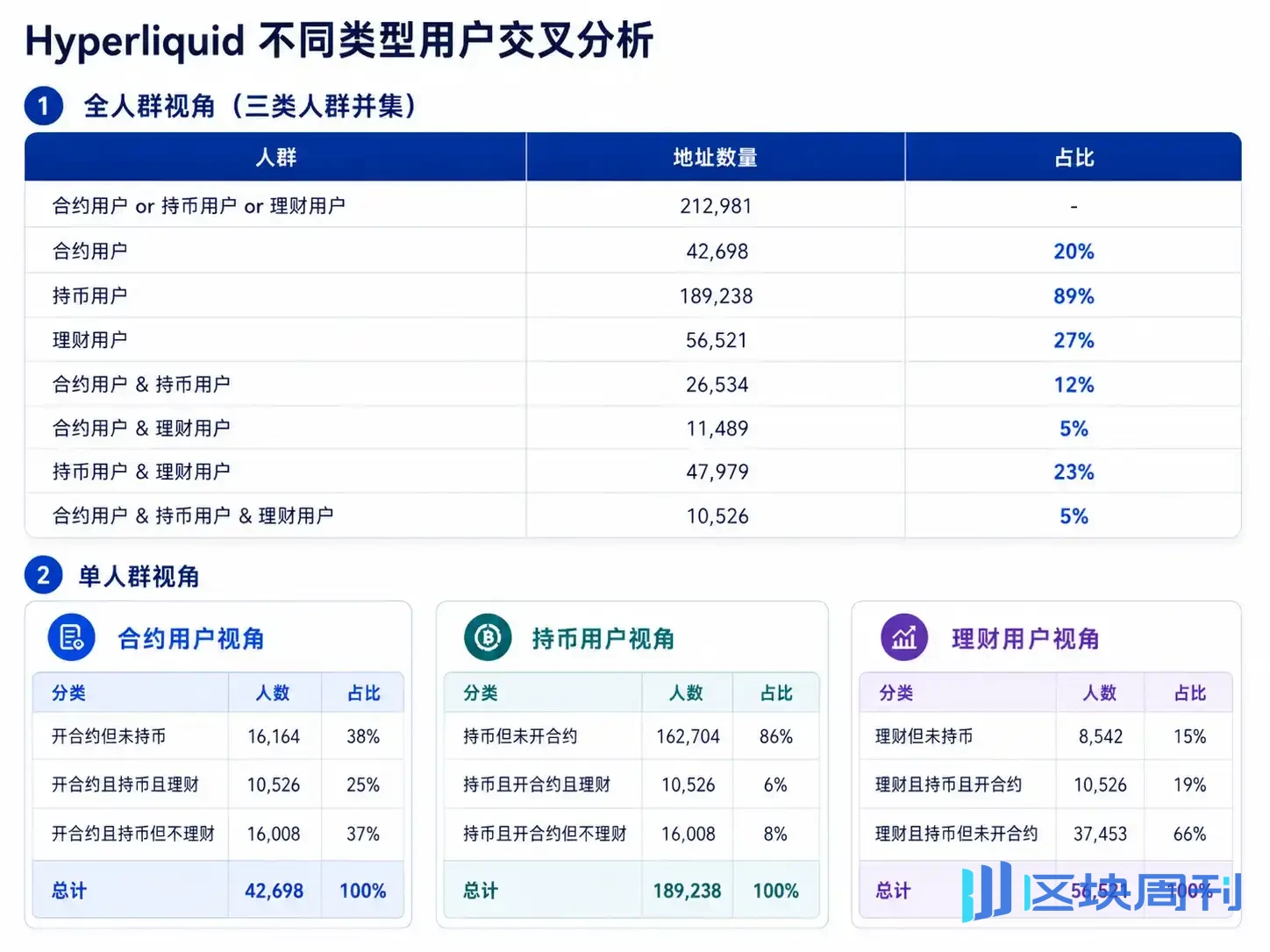
This set of data shows that platform tokens can bring broader asset holding and ecosystem participation, but holding, yield farming, and trading do not correspond to the same demand. Holding may stem from asset allocation and price expectations, yield farming corresponds more to yield strategies, and perpetual contract trading directly reflects trading demand and order flow.
When holding addresses, asset scale, and yield farming users are uniformly counted as ecosystem growth, capital participation can easily be misread as trading market growth. But for Perp DEX, what truly determines market quality remains sustained trading, effective liquidity, and real fee income.
Platform tokens can expand ecosystem participation, but they cannot replace trading demand itself.
3. One platform, two sets of growth goals
When income distribution, fee discounts, and product permissions are all tied to the platform token, Perp DEX actually needs to operate two markets simultaneously: the trading market and the token market. This creates a fundamental tension: what the platform prioritizes serving is whether it is the trading product itself or the value cycle built around the platform token.
These two sets of goals are not always in sync. The trading market focuses on execution quality, liquidity, and cost, relying on long-term product capabilities; the token market focuses on demand, scarcity, and price expectations, relying on continuously creating reasons to hold the token.
The resulting risk is not just that resources are dispersed, but that evaluation criteria shift. Trading volume, fees, and user growth are no longer only used to measure whether the trading product is healthy, but also begin to support the token narrative. What the platform pursues may no longer be just more real trading, but more data that can strengthen token demand.
III. PopDEX: Another Answer to Incentive Mechanisms
From Foresight Ventures' investment perspective, what is worth noting about PopDEX is not simply whether a platform token exists, but that the team did not use token expectations as the starting point for growth, nor did they set token holding as a prerequisite for trading rights. Compared to first aggregating platform value into the platform token and then redistributing it through the token, PopDEX more directly starts from real market contributions: whoever creates value, value should return to them.
Based on this idea, PopDEX has established a 100% value return system.
The 100% here refers to the distributable value formed by trading fees, not returning each fee directly to traders. Its core is that the distributable value formed by trading fees is no longer prioritized to support the platform token, but enters a return framework designed around real contributions.
Under this framework, PopDEX's value return will cover two types of participants: ecosystem contributors and real trading users. The former includes ecosystem roles such as Referral, Affiliate, trading activities, joint Campaigns, etc., that continuously bring in users, order flow, and market attention; the latter, based on real trading contributions, explores more direct, periodic, transparent, and verifiable ways of value return.
As for the final form in which this value will be distributed, PopDEX will gradually disclose it in subsequent product phases.
For PopDEX, this is not a denial of the existing model, but an attempt at a different incentive mechanism: incentives are not only used to drive growth, but can also become a way for the platform to continuously give back to the ecosystem.
There is no standard answer to how incentive mechanisms should evolve, and the market will ultimately make its own judgment. However, we believe that as the Perp DEX industry continues to mature, its incentive mechanisms should not have only a single path, and more answers are worth exploring.