

Author: Arthur Hayes, former co-founder of BitMEX
Compiled by: Saoirse, Foresight News
Take a look at the world and see the various marks humans have left on the Earth's natural environment. Some transformations are pleasing to the eye, some are shocking, but all changes originally originated only in the minds of higher primates. Our brains have to process a huge amount of messy external information, so they weave an internal narrative to sort out chaos and establish logic. In short, the narrative itself gives rise to the corresponding reality.
To predict the future ups and downs of asset prices, understanding the collective illusion formed by market participants becomes of utmost importance. For the same nominal future cash flow, the market will give vastly different valuation multiples due to different narratives. For an unremarkable company with sluggish growth, the simplest way to achieve a valuation re-rating is to reshape the narrative to fit the trend that current investors are desperately chasing at any cost.
The internal logic of the narrative framework is the core variable in judging whether there is a bubble in the AI industry. But before dissecting the AI bubble, we should first clarify a fundamental issue: what exactly are we investing in at present? Borrowing the concept of emotional relationships, what kind of "relationship" do we have with the AI industry? From the perspective of a techno-skeptic like me, there are two completely divergent perceptions of AI capital expenditure in the market: do people regard AI infrastructure as cutting-edge technology or as real estate development? The current mainstream opinion believes that this multi-trillion-dollar expansion of computing infrastructure belongs to the "tech track" and should enjoy extremely high growth valuations. But I believe that AI capital expenditure is essentially just another ordinary real estate cycle; the only special thing is that the computing power contained within data centers is nurturing silicon-based intelligent life, whose impact on human civilization is unparalleled since the railway era.
Distinguishing between "real estate" and "computing power" is crucial. Nowadays, young hedge fund practitioners, commercial banks, private credit funds, and even governments mistakenly believe that lending to build data centers and supporting power plants is equivalent to investing in high-quality tech companies like Apple, rather than the Lehman Brothers of yesteryear. The AI bubble will eventually burst because, under the implicit endorsement of the Chinese and American governments, various financial intermediaries will unrestrainedly expand data centers and all supporting chips and computing infrastructure. Therefore, the AI bubble is essentially a credit crisis, comparable to the 2008 subprime crash, rather than the 2000 internet bubble - the latter being a story of collapsing earnings.
In the 2000 internet bubble, the vast majority of listed companies had almost no revenue, let alone profits, with Pets.com being a typical example; this was a bubble of missing earnings. The 2008 subprime crisis was completely different: the slowdown in US housing price growth directly triggered a debt crisis for banks and financial institutions holding mortgage assets, making it a credit collapse bubble. The trigger point for the AI bubble will appear when the growth rate of data center construction slows down and cloud vendors lower their guidance for computing expansion plans. Leading AI companies will still earn huge profits, but market valuation multiples will shrink significantly, and the weakest AI credit targets will face debt repayment risks, thereby dragging down the balance sheets of many highly leveraged financial institutions heavily invested in AI debt. Ultimately, the government will step in to bail out highly indebted AI companies and their funders in the name of "national security." And this massive misallocated capital will eventually flood into the crypto market, boosting Bitcoin's surge.
Whenever someone proposes that "there is a bubble in AI," the most common rebuttal from bulls is the Jevons paradox, to rationalize massive capital expenditure. This theory points out that when commodity prices fall, demand expands significantly, and industry total revenue actually grows exponentially. If investors internally assume that "capital expenditure = computing demand," they will feel that the Jevons paradox can dispel all concerns: as computing costs continue to decline, the demand for AI applications and intelligent agents that consume computing tokens will explode exponentially, and credit invested in AI infrastructure will always be safe. But this logic completely fails when applied to the current AI investment environment.
By deconstructing the logic of cloud vendors building data centers, we can see the fallacy of the Jevons paradox: cloud vendors are essentially doing real estate development, building factories and then purchasing the latest chips for model training and inference. The semiconductor industry has clear industrial laws: the floating-point operations that can be produced per unit of electricity consumption will increase exponentially with technological iteration. Within just a few years, manufacturers such as Nvidia, AMD, Intel, Huawei, and SMIC will produce chips with thousands of times higher computing efficiency, and the physical carriers of existing server rooms will be able to carry a thousand times more computing power in the future with even lower electricity consumption. This means two things can be true simultaneously: first, the physical construction of AI data centers will quickly saturate; second, the market's consumption of AI computing tokens will grow exponentially. The question arises: do you really want to do the real estate business of being a "computing landlord" like cloud vendors, or hold assets in the upper-layer AI application segment?
The second layer of defense for AI bulls: cloud vendors are both factory landlords and computing users. They rely on the huge free cash flow generated by Web2 traffic monetization businesses to borrow and build data centers, and then sell various AI services to the public through their self-developed intelligent models. If you firmly believe in this logic, never touch related debt. The ceiling for fixed-income assets is principal plus a small amount of interest. Even if Google's market value soars thanks to top-notch AI products and stock holders make a fortune, creditors can only get back fixed principal and interest; but once Google becomes an owner of old server rooms full of obsolete chips and unable to repay principal and interest, debt holders will suffer deep losses, and the residual value of data centers full of outdated silicon chips is not guaranteed at all. The financial executives of cloud vendors and financial practitioners know very well: they are doing real estate business and must find a group of buyers who mistakenly believe they are investing in cutting-edge technology rather than real estate. This group of buyers includes insurance asset management under Apollo, and ultimately the ordinary people of China and the US who implicitly back AI credit. As long as you dig into the obscure financial reports of cloud vendors, you will find that all debt used for AI infrastructure is placed off-balance-sheet, completely separated from the core profitable business that supports the stock price.
How we define the narrative of AI capital expenditure directly determines the scale of capital misallocation - a misallocation that may even surpass the railway infrastructure wave of yesteryear. And because the AI bubble is credit-driven rather than earnings-driven, the government will inevitably rescue those investors who mistakenly treat real estate debt as technology equity assets.
The recent pullback in the AI sector (with particularly sharp declines in highly leveraged markets like South Korea) is nothing to panic about; the AI bull market is far from over and will soon enter its final blow-off phase. Last week, the Federal Reserve had the opportunity to suppress persistently high inflation indicators by raising interest rates but chose to keep rates unchanged, with even former Chairman Powell voting in favor. For crypto traders stuck in a sideways bear market and forgotten by the market, why is the deterioration path of AI credit so relevant to us? Because it directly determines how and to what extent the central banks of China and the US will print money to rescue the market when the credit misallocation in AI infrastructure triggers a financial crisis.
The rest of this article will fully explain this logic and why the government is bound to activate the money-printing tool. When AI capital expenditure growth slows down and credit expansion continues to increase, Bitcoin will find its bottom and start a long-term upward trend. When authorities realize that GDP growth driven by AI is nothing more than a new real estate bubble, the scale of money printing will far exceed that of the 2008 global financial crisis, ultimately pushing Bitcoin's price past the million-dollar mark.
The Second Derivative Is the Core of the Market
I often remind myself: investing is essentially trading the second derivative, that is, the acceleration or deceleration of growth. The logic is intuitive: when industry growth continues to rise, the market weaves a narrative of infinite growth, giving rise to statements like "Even if this cloud vendor goes bankrupt, I don't want to miss the opportunity to position for general artificial intelligence."
But growth will eventually slow down. For investors, asset prices often peak during the acceleration phase of growth, remain range-bound during the slowdown phase, and only truly crash when the growth rate (the first derivative) turns from positive to negative. We can never precisely predict how long it takes from slowing growth to industry contraction; most investors, including myself, will have the illusion that even if growth has slowed, assets can still continue to rise.
If the AI bubble is credit-dominated, the significance of the second derivative will be infinitely amplified: the premise for the whole society to lend and build computing factories is the default assumption that capital expenditure growth will continue to accelerate. Once growth slows down, the risk of new credit will skyrocket. But it is human nature not to stop voluntarily until a financial crisis is imminent; only when the market bottom appears and funds bottom-fish will people suddenly wake up. Therefore, during the slowdown phase, credit expansion will still continue; only when AI capital expenditure plans truly contract will the market experience a "cliff-falling moment," exposing one by one the highly leveraged institutions heavily loaded with inferior AI debt.
Let's review this pattern using the 2008 US subprime crisis. During my college years, I took a course on US housing policy taught by the Deputy Secretary of Housing under the Clinton administration, which happened to start in the spring of 2008 when Bear Stearns collapsed, making the course content highly relevant to reality. The core conclusion of the course: in those years, the government encouraged everyone to buy homes in the name of social equity, and mortgage lending expanded wildly; by 2006, the adjustable-rate monthly payments of a large number of first-time homebuyers had risen sharply, and only if housing prices continued to accelerate could they cover the repayments.
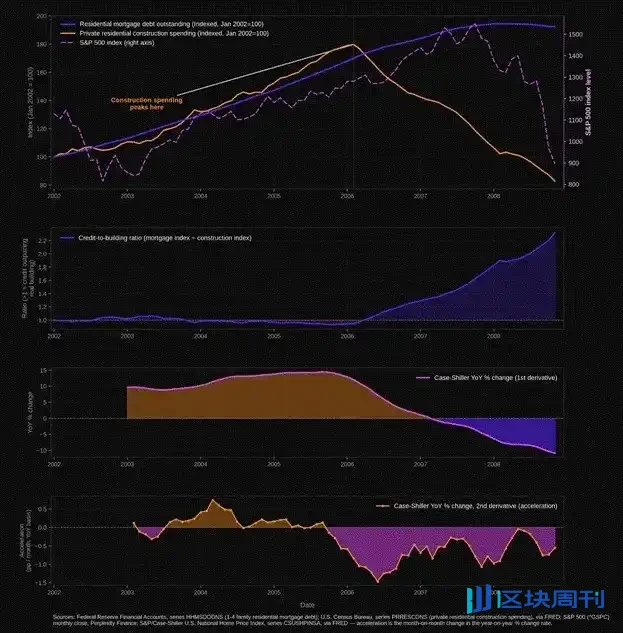
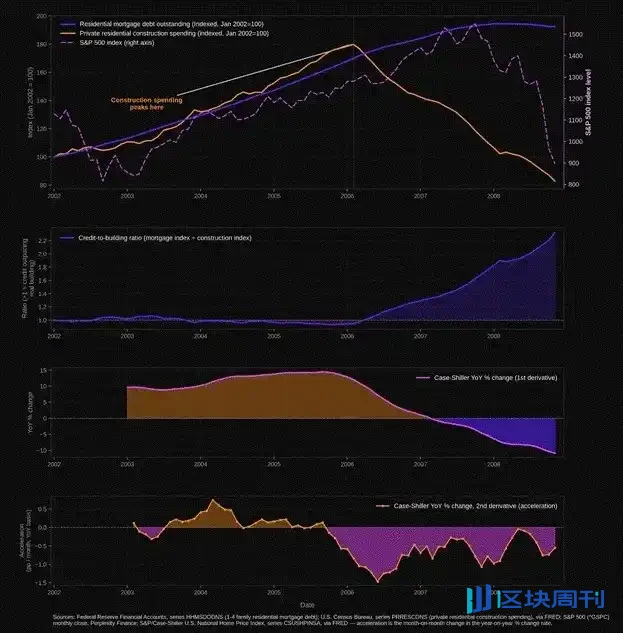
A set of four-panel charts covering the S&P 500 index, construction loan issuance, and the Case-Shiller national home price index: In late 2005, housing price growth slowed, corresponding to a peak in physical construction spending; but real estate credit issuance continued to rise until the US stock market peaked and pulled back slightly. The period from 2006 to 2007 was the "no man's land" of slowing growth, with US stocks reaching a high in mid-2007; in August 2007, three credit hedge funds of BNP Paribas collapsed, officially kicking off the crisis, followed by the successive failures of Bear Stearns and Lehman Brothers, and in September 2008, the S&P 500 halved from its high. The market completely crashed because investors saw the holders of a massive amount of toxic financial derivatives. Ultimately, the government prevented a repeat of the Great Depression by acquiring the debt and equity of financial institutions; this bailout logic will be fully replicated in the subsequent AI industry crisis.
The second column of the chart clearly reveals: the starting point of capital misallocation exactly corresponds to the slowdown in housing price growth. If all new credit were used to build new homes, the risk would be manageable; but when the system needs to borrow new debt to repay old debt (with the ratio of construction loans to construction spending continuously rising), the seeds of a credit collapse are already sown.
Applying this analysis to the AI track, the core observation indicator is the capital expenditure plans announced by cloud vendors. The current market consensus is: computing infrastructure = cutting-edge technology, and cloud vendors that continue to increase capital expenditure will see their stock prices keep rising.
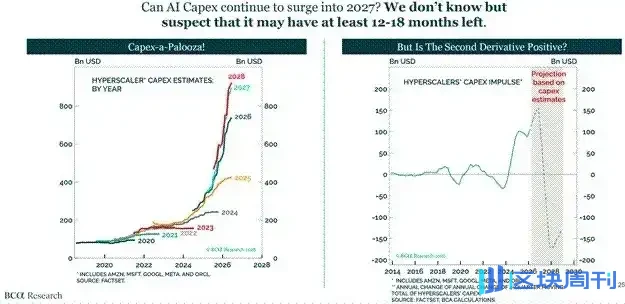
The market expects that from mid-2027 to the end of the year, the growth rate of computing power expansion plans across the industry will begin to slow down; by 2028, the trend of slowing growth will become completely clear.
Even if capital expenditure growth weakens, the scale of credit issuance will continue to expand. First, financial institutions believe they are lending to the tech sector rather than real estate; second, both the Chinese and American governments have declared that they must seize global dominance in AI, and funds will continue to tilt toward AI infrastructure. In 2027, the market will enter a "slowdown no-man's land" similar to the property market in 2006-2007. The current decline in the AI sector is just a correction within a bull market. Next year, the AI bubble will reach its ultimate peak, after which the market will reward cloud providers that proactively reduce capital expenditure.
Unlike the early bubble period from 2022 to mid-2026, cloud providers now find it difficult to cover computing power expansion with operating cash flow alone, and can only raise funds through debt issuance and equity offerings. As balance sheets continue to come under pressure, management will rethink whether the economic logic of borrowing to build factories to store continuously depreciating chips holds. For American cloud providers, Chinese frontier AI models with comparable cost-effectiveness and lower prices will completely shatter their illusion of technological monopoly. As long as the performance gap is not significant, the market will always choose the lower-priced solution. This logic has already been validated in the electric vehicle, photovoltaic, and power battery sectors, and the AI industry will be no exception. As the computing power output per unit of chip energy increases exponentially and Chinese manufacturers lower token costs, rational CFOs will no longer frantically borrow to expand factories. Even if the Jevons paradox brings a surge in demand for computing power tokens, the growth rate cannot offset the negative returns from debt issued years ago. The worst credit targets will be sold off by the market, and the massive capital misallocation problem will be fully exposed.
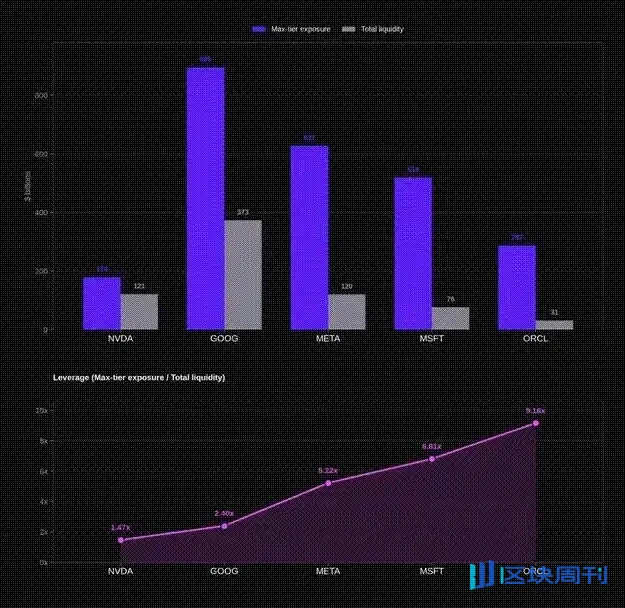
I cannot predict which cloud provider will be the first to default and trigger panic in the credit market. But before analyzing why banks continue to lend despite known risks, let's look at a set of comparative charts: a comparison of cloud providers' public capital expenditure commitments and their book cash reserves. With trillions of dollars in leverage supporting the AI bull market narrative, a major player is bound to completely default; at that point, Warsh and Buffalo Bill Bessent will activate the money-printing tools to backstop, rather than Wall Street hedge funds buying at low prices.
The Credit Officer's Dilemma
Many believe that a slowdown in AI capital expenditure growth signals the imminent end of the bubble, but there is a core question: why do banks continue to lend despite known risks? Three core drivers: lending is highly profitable, policy requires support, and the government will inevitably bail out after a crisis.
Louis-Vincent Gave of Gavekal Research recently published an article interpreting Warsh's current interest rate policy logic: deliberately creating a steep yield curve to amplify bank lending profits while diluting the massive U.S. national debt. Ultimately, banks will continue to create credit to support U.S. industrial reshoring and AI research. This policy perfectly aligns with the Hamiltonian economics approach mentioned in Buffalo Bill Bessent's recent speech.
Judging by all objective inflation indicators, the Fed should have raised interest rates at its last meeting, but chose to hold steady, directly triggering sharp volatility in long-term U.S. Treasury yields.
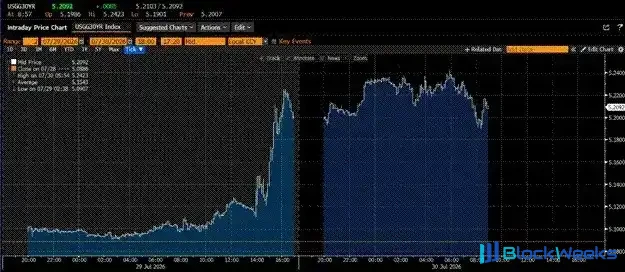
After the Fed held rates steady rather than raising them, the 30-year U.S. Treasury yield surged
The Fed keeping short-term rates below nominal economic growth, resulting in negative real interest rates, is a huge boon for banks: banks borrow at very low federal funds rates and lend long-term to sectors such as data center developers, rare earth miners, and defense companies. The steeper the yield curve, the higher the bank's net interest margin, and commercial and industrial loan volumes expand in tandem.
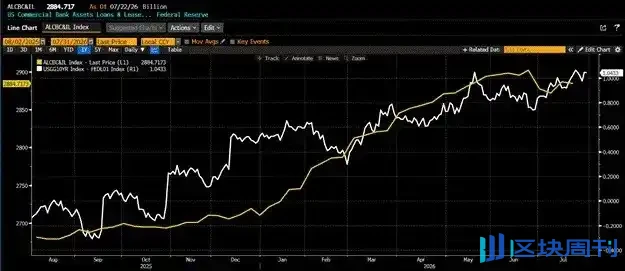
The 10-year yield minus the effective federal funds rate (white) shows the steepening of the yield curve relative to U.S. commercial banks' total commercial and industrial loans (yellow)
From a political standpoint, this monetary policy is highly sustainable: even Cook and Powell, who were once investigated by the Trump Justice Department, voted to maintain negative real interest rates. Warsh has rallied a group of Fed governors who support Trump and oppose the anti-Trump camp. On the monetary front, the Fed's current policy facilitates Bessent's issuance of short-term Treasury bills with yields below nominal growth; if the market cannot absorb the massive weekly Treasury auctions, the RMP tool will directly print money to fill the gap. To suppress the rising long-end Treasury yields, Bessent can initiate Treasury buybacks: issuing short-term bills that are monetized by the Fed while buying 10-year and 30-year Treasuries to push yields down. Warsh, who claims to be a hawk on balance sheet reduction, has not tightened the RMP tool or shrunk the Fed's balance sheet at all; all operations are superficial moves in the White House political game.
For credit officers at "too big to fail" banks, career advancement requires approving loans to policy-supported industries like AI and defense: this boosts bank profitability and aligns with Fed and Treasury policy direction. Even if bad debts erupt in the future, the government will launch massive rescue programs, so practitioners face almost no downside risk—this is window guidance with American characteristics.
In 2026, the U.S. Treasury and the Fed reached an implicit policy agreement, not publicly announced, but the facts are clear: the Fed maintains negative real interest rates and prints money to absorb Treasury short-term bills; the Treasury encourages banks to lend to strategic industries through implicit guarantees, and after a crisis, the ruling party initiates bailouts. This is also the core reason I am extremely bullish on subsequent asset markets, and the scale of future money printing will only be larger.
The U.S. Sovereign Wealth Fund Concept
To see the long-term bullish case for the crypto market, we can hypothesize a more aggressive intervention plan by the U.S. government that goes beyond bank bailouts. This is purely theoretical and for thought expansion only.
The rescue plan for the AI industry has already been initiated during the Trump administration. Under the guise of national security and the U.S.-China AI race, the U.S. government has borrowed to take equity stakes in "strategic core industries" such as rare earths and semiconductors. This is equivalent to equity quantitative easing: idle dollars from government accounts flow into financial markets, directly increasing dollar liquidity. Leveraging the CARES Act, the CHIPS Act, and the Department of Defense budget, the government has already completed multiple industrial equity investments:
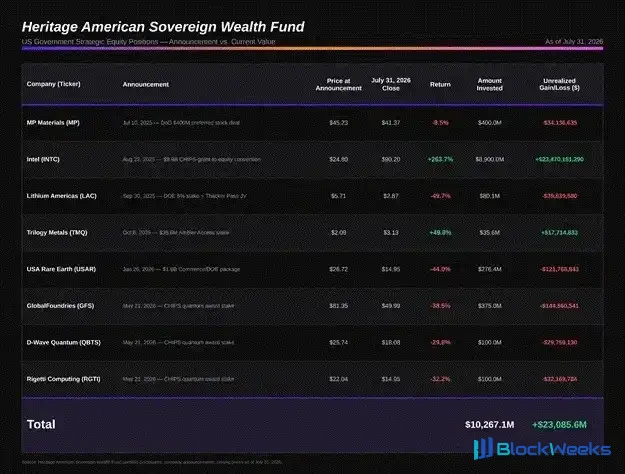
However, under the current legal framework, the space for the government to continue large-scale equity investment in tech companies is extremely limited. Nevertheless, the Trump administration and Treasury Secretary Buffalo Bill Bessent have shown a strong willingness: once AI company stock prices plummet, they will not hesitate to borrow money to buy the dip. In their logic, if the United States cannot dominate the AI industry, the global order will be dominated by China, pure free-market capitalism will cease to exist, and it will be replaced by corporate socialism. 90% of Americans do not hold stocks and are unlikely to share in the policy dividends; the 2028 election might shift toward supporting left-wing politicians like AOC.
Core question: Can the government directly print money to buy AI stocks before a crisis erupts, without congressional approval? The answer is yes. Under the Federal Reserve Act, in extreme emergencies, the Federal Reserve can lend unlimited amounts to special purpose vehicles (SPVs) established by the Treasury. During the 2008 financial crisis and the 2020 pandemic, the Treasury used the Exchange Stabilization Fund (ESF) to provide subordinated equity buffers for SPVs, with the Fed providing leveraged loans to buy financial assets and support the market.
Currently, the Exchange Stabilization Fund has $28 billion on its books. Bessent can allocate all of it to a new SPV to specifically support AI companies. Historically, the Fed has provided 10x leverage, meaning it could potentially mobilize up to $280 billion to support loss-making AI companies. But compared to the trillions of dollars in market capitalization of leading AI companies, this amount is far from sufficient. Theoretically, the Treasury could establish an SPV without a subordinated buffer, but the Fed would face public pressure over "unlimited backdoor equity QE."
Does the Fed care about public pressure? It's a double-edged sword. New Chairman Warsh claims to reshape the Fed system, publicly advocating that AI can significantly boost U.S. productivity, and internally agrees with the full narrative of AI bulls. As long as Trump orders intervention to rescue loss-making AI companies like OpenAI, even if Anthropic is profitable and has better model performance, Warsh will fully cooperate. To lend through the SPV, three Fed governors must jointly agree. Previously, Cook and Powell, who opposed Trump's policies, both voted to maintain low interest rates, so this intervention plan will face almost no internal resistance. Compared to the paper gains on personal holdings from money printing, the so-called policy bottom line is not worth mentioning.
The Treasury, by printing money to underwrite new stock issuances of AI companies, can realize the paper gains of early investors and employees. This is the purest form of liquidity creation—this money did not exist before the government entered, providing buyer support out of thin air for inflated primary market valuations. This operation can bring two layers of paper benefits to the government:
- Funds will flood into government-backed AI companies, creating huge paper gains for the SPV. The Trump administration can claim these profits offset the federal deficit. If the AI industry meets expectations, the paper gains could even wipe out the entire U.S. national debt on paper.
- Newly wealthy founders and employees, after selling stocks, must pay federal and state capital gains taxes, further reducing the fiscal deficit. The government can claim that the debt-to-GDP ratio is continuously declining. In the short term, the bond market will rally, yields will fall, and the market will allow the U.S. government to issue debt at lower costs.
But this plan merely postpones the crisis, leaving it for the next Republican administration, not a fundamental solution. A simple example: you spend a few thousand dollars to register a company, issue 1 billion and 1 shares, sell 1 share to your mother for $1, and your paper net worth immediately becomes $1 billion. Using this paper valuation to apply for a $100 million loan from a bank to buy a mansion and luxury cars, the bank will directly refuse, because the stock lacks liquidity; if you default, the bank cannot liquidate the asset to recover the debt.
Mapping to AI SPV equity investment: once the SPV becomes a major shareholder, other institutions enter only because of government backing. In the future, when the government reduces its holdings, there will be no buyers. Once political elites collectively sell, all funds will flee simultaneously; the paper gains that were offsetting the deficit instantly turn into real losses, and combined with the Treasury needing to repay Fed loans, the federal debt expands further. The SPV can only buy one-way and cannot sell; the Fed must roll over loans indefinitely to avoid margin calls, permanently expanding its balance sheet. But all short-term political benefits are enjoyed by the current administration: loss-making AI companies can compete with Chinese technology; industrial wealth creation brings tax revenue and stimulates the real economy; paper data creates the illusion of declining debt, and the market accepts lower borrowing rates. All hidden dangers are postponed.
The government has two operational paths: one is to intervene early to delay the AI industry's liquidation; the other is to wait until capital expenditure growth turns negative and the AI sector crashes before rescuing the market. The U.S. government is already implementing industrial equity investment, and will only increase it. Combined with bank window guidance on credit allocation and government equity support, the credit crisis will at least be delayed until after the 2028 presidential election.
Many will question: from 2022 to now, with continuous money printing, Bitcoin hasn't broken through $126,000. How does this logic benefit crypto assets? Please continue reading below.
Bitcoin's Bottom Range
Bitcoin's last cycle bottom was born when the FTX scandal of misappropriating customer funds was exposed; Binance founder CZ indirectly fueled market risk. Coinciding with the commercial launch of ChatGPT, the AI bull market officially began.
Starting in October 2023, the U.S. dollar liquidity environment shifted, with funds continuously flowing out of the overnight reverse repurchase facility, increasing the total dollar supply in the market; bank credit and government bond issuance expanded simultaneously, and Bitcoin began to rise, reaching its cycle high in October 2025. But Bitcoin's gain was only twice the previous all-time high, and it couldn't continue higher. The core reason is that the AI sector absorbed all incremental fiat liquidity in the market. As AI capital expenditure accelerated, all incremental funds flowed into the computing power sector, and Bitcoin subsequently retraced 50%.
In mid-2026, the liquidity logic completely reversed: over the next 18 months, cloud providers' planned expansion of computing power will slow, but bank and government targeted AI credit is just beginning. If bank lending falls short of policy expectations, the government will strongly guide through window guidance; in extreme cases, it will directly provide equity support and long-term purchase agreements (similar to Intel, IBM) for leading AI companies, reducing banks' lending concerns.
Bitcoin will find its bottom in the early stages of this credit misallocation. A large amount of dollars and yuan chasing limited high-quality AI projects will inevitably lead to large-scale capital misallocation, replicating the logic of China's property bubble from the 1990s to 2019.
Back then, China planned an unprecedented urbanization wave, investing trillions of dollars in residential, airport, highway, and railway infrastructure. For decades, infrastructure projects funded by state-owned banks had real returns; by the end of 2000, high-quality profitable real estate projects became saturated, and a period of massive capital waste began. In 2019, top leaders explicitly stated that "houses are for living, not for speculation," actively pricking the property bubble and guiding credit toward high-end manufacturing such as electric vehicles. But from 2000 to 2019, a large amount of credit that should have been used for housing flowed into financial speculation, with real estate companies effectively becoming hedge funds.
The same story will unfold in the United States: companies with political and financial resources can obtain low-cost credit and even government equity injections, nominally for AI, but actually their businesses are tied to commodity and computing power asset prices, becoming de facto AI hedge funds. Bitcoin is a warning signal for market liquidity; under massive capital misallocation, Bitcoin and AI stocks will rise together.
When I wrote this article in late July 2026, I couldn't precisely predict Bitcoin's bottom price, and the bottom may have already appeared. The market needs to digest the pessimistic sentiment from MicroStrategy and other digital asset treasuries selling Bitcoin, while waiting for new narratives to support price increases: once MicroStrategy can no longer issue stock or preferred shares to raise funds for buying coins, the market needs new logic to support the rally. Bitcoin will likely oscillate in the $60,000 to $70,000 range for a long time, with extreme downside to $50,000. During this period, capital waste in the AI sector will continue to intensify, laying the foundation for Bitcoin to bottom out and slowly rise.
Bitcoin's Inflationary Boom
If my core thesis holds—that the size of high-quality, implementable AI projects is far smaller than the total credit flowing into the AI sector—excess liquidity will eventually be reflected in Bitcoin's price. Even if digital asset treasuries like MicroStrategy can no longer raise funds through equity or corporate bonds to buy Bitcoin, Bitcoin can still complete its bottoming process. I will continue to track two key indicators: the slowdown in AI capital expenditure growth and the simultaneous expansion of AI credit, or the continuous increase in off-balance-sheet computing power commitments by cloud providers.
Once we enter the capital waste phase of the AI credit bubble, the core question is how regulatory authorities in various countries will respond: will they print money to support the market in advance, or wait until the crisis erupts to introduce rescue plans? For investors holding Bitcoin without leverage, when the rescue comes doesn't matter; the institutional incentives of governments will inevitably lead to continuous money printing to maintain stability.
The current expansion of AI infrastructure credit as a share of GDP has already matched the U.S. railroad construction wave of the past, and the scale of capital misallocation far exceeds the 2008 subprime crisis. The total amount of money printing for future rescues will exceed the combined global central bank easing from 2009 to 2013. Bitcoin was born to counter the currency devaluation caused by banks' indiscriminate bailouts after the subprime crisis. Before this crisis arrives, Bitcoin has already matured and is expected to challenge a million-dollar price.
The current crypto market is persistently depressed, making it hard to imagine this super cycle, but there is a huge asymmetric opportunity. Maelstrom fund has already heavily invested in Bitcoin. So what will be the next narrative to drive the major crypto currencies in the next six months? Ethereum is the most forgotten top-tier coin in the market, having failed to break its 2021 all-time high of $5,000, while other top ten cryptocurrencies have already set new highs.
I predict the new main narrative: traditional financial institutions like Robinhood will issue real-world asset (RWA) tokenization chains, built on customizable Ethereum Layer 2 networks like Arbitrum; Ethereum becomes the underlying settlement layer for all on-chain securities. Even if the gas fees attributable to the Ethereum mainnet are extremely low, Ethereum remains the underlying carrier for the tokenization of everything.
I myself am not bullish on the RWA tokenization track; Maelstrom receives numerous homogeneous RWA financing proposals daily. But traditional financial institutions are fervently advocating for the tokenization of all assets on-chain. If this narrative materializes, the tokenization business of traditional financial institutions will inevitably be built on public chains. Robinhood launching a chain on Arbitrum dispels the career risk for traditional finance practitioners in adopting the Ethereum ecosystem, giving this narrative strong speculative potential. Ethereum is the second-largest cryptocurrency by market cap, born in 2015, with vitality second only to Bitcoin. Combined with Bitmine's Tom Lee providing narrative endorsement for institutional capital entry, institutional investors will allocate to Ethereum in batches, betting on the wave of capital market tokenization.
My target price for Ethereum at the end of 2026 is $5,000, approximately 2.6 times the current price. The core advantages of this trade:
- Configurable large notional positions, with extremely low risk of a 75% crash due to technical vulnerabilities;
- Sufficient liquidity, even if it accounts for a high weight in the Maelstrom portfolio, can be fully liquidated within minutes;
- Selling out-of-the-money put options to earn additional income, and if the coin price falls below the strike price, can also accumulate Ethereum spot at low prices.
The AI bubble once drained all incremental liquidity from the crypto market, but the inflection point has arrived. The market narrative will gradually shift from "all in AI at any cost" to "return on investment," and eventually to "when to recover principal." The Chinese and American authorities, whose core economic policies are based on AI, will fear the bubble bursting. To cover up policy mistakes and delay the crisis, they will inject massive misallocated liquidity, giving rise to the strongest crypto bull market since 2021.