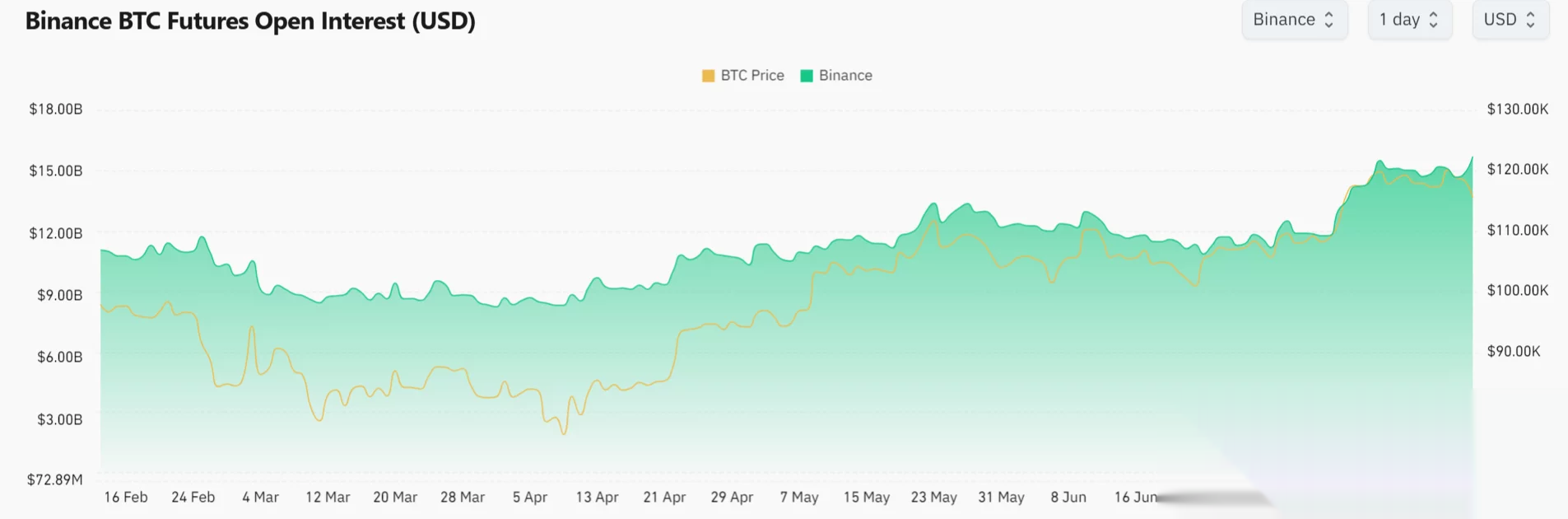
Binance has overtaken CME Group in Bitcoin futures open interest for the first time since late 2023, holding roughly 148,500 BTC against CME’s 102,840. The reversal unwinds two years of institutional dominance narrative and raises questions about whether traditional finance is retreating from crypto derivatives or simply relocating.
Summary
- Binance has surpassed CME Group in Bitcoin futures open interest for the first time since late 2023, holding roughly 148,500 BTC ($9.6 billion) compared with CME’s 102,840 BTC ($6.7 billion).
- CME open interest has fallen to its lowest level since February 2024 after five consecutive months of decline, driven largely by the unwinding of the cash and carry basis trade.
- The annualized Bitcoin futures basis has compressed to roughly 3%, falling below the 3.8% yield on two year U.S. Treasuries, eliminating the arbitrage incentive that fueled institutional CME positioning.
- Market makers and hedge funds are migrating toward offshore perpetual contracts on Binance, Bybit, and OKX, while a parallel regulatory shift is bringing perpetual futures onshore through CFTC approved venues like Kalshi.
- The reversal raises fundamental questions about whether the “institutional adoption” narrative built on CME dominance was always more fragile than it appeared, and whether traditional finance is retreating or simply relocating.
For two years, a single chart told the story of Bitcoin’s institutional coming of age. CME Group, the Chicago exchange where pension funds, sovereign wealth managers, and hedge funds trade everything from corn to crude oil, held more Bitcoin futures open interest than any venue on Earth. That lead over Binance, the offshore exchange synonymous with retail speculation, became the most cited proof point for the “institutions are here” thesis.
That chart has now flipped. Binance holds roughly 148,500 BTC in open interest, worth approximately $9.6 billion. CME has dropped to around 102,840 BTC, or $6.7 billion, its lowest reading since February 2024. The gap is not narrow. It is roughly 45,000 BTC wide and growing.
The shift did not arrive overnight. CME open interest has fallen for five consecutive months, accelerating through the second quarter of 2026 as the profitability of the basis trade collapsed and institutional appetites shifted. What looked like a permanent structural change in Bitcoin market microstructure may have been, at least in part, an arbitrage play dressed in institutional clothing.
Understanding what happened, why it matters, and where it leads requires following the money through a maze of basis spreads, regulatory upheaval, and the evolving definition of what “institutional” even means in crypto.
The basis trade machine and how it broke
The centerpiece of CME’s rise to the top of the Bitcoin futures leaderboard was not directional conviction. It was the cash and carry basis trade, a delta neutral strategy older than most of the people trading it.
The mechanics are straightforward. Buy spot Bitcoin, or more commonly after January 2024, buy shares of a spot Bitcoin ETF like BlackRock’s IBIT. Simultaneously sell Bitcoin futures on CME at a premium to the spot price. The difference between the futures price and the spot price, the basis, represents annualized yield. When Bitcoin was rallying through 2024 and the first half of 2025, that basis regularly exceeded 15% to 20%, dwarfing anything available in traditional fixed income.
Hedge funds, proprietary trading desks, and institutional players rotated capital into this trade at scale. According to CFTC Commitments of Traders data, leveraged funds held persistent net short positions on CME Bitcoin futures throughout most of 2024 and 2025, the signature footprint of the basis trade. They were not bearish on Bitcoin. They were harvesting yield from the contango.
The problem is that the basis trade is self limiting. As more capital enters, competition compresses the spread. As Bitcoin’s price declined from its highs above $120,000 to the $60,000 to $80,000 range through the first half of 2026, futures premiums collapsed alongside it. By mid 2026, the annualized three month basis on CME had fallen to roughly 3%, below the 3.8% yield on two year U.S. Treasuries.
At that point, the math stopped working. Why lock up capital in a trade that earns less than risk free government debt, while carrying counterparty risk, margin requirements, and the operational complexity of rolling quarterly futures contracts? The answer, for most institutional desks, was to unwind.
The unwinding was not panic. It was arithmetic. The Block reported that CME Bitcoin futures activity slumped to a 14 month low in April 2026, with average daily open interest falling below $8 billion and daily trading volume dropping under $3 billion. Each month since has continued the decline.
The scale of the exodus is visible in the raw numbers. CME began 2026 with approximately 175,000 BTC in open interest. By April, that figure had dropped to roughly 120,000 BTC. By August, it sat near 103,000 BTC, a decline of more than 40% in eight months. For context, the open interest that CME lost over this period, roughly 72,000 BTC, represents more than $4.5 billion in notional value at current prices. That is not a rounding error. It is a structural repricing of where institutional derivatives capital lives.
Where the money went
The capital that exited CME did not vanish from the Bitcoin derivatives market. Some returned to direct spot holdings, simplifying portfolios and removing the futures leg entirely. But a meaningful share migrated to offshore perpetual contracts, the instrument that dominates crypto derivatives trading and has for years.
Perpetual futures, which have no expiration date and use a funding rate mechanism to stay tethered to spot prices, account for roughly 90% of all crypto derivatives volume globally. Binance alone controls approximately 33% of the centralized perpetual futures market, followed by OKX and Bybit. In the first quarter of 2026, Binance tightened its grip even as overall crypto trading volume declined, capturing a 40% share of perpetual futures activity.
The appeal for institutional market makers is not mysterious. Perpetuals offer continuous liquidity without the friction of quarterly roll dates. Margin requirements on offshore exchanges are more flexible. And for desks that are genuinely market neutral, providing liquidity on both sides, the funding rate on perpetuals can generate yield similar to the old basis trade, often with better capital efficiency.
What has changed is not the existence of these benefits, which offshore venues have offered for years, but the willingness of institutional participants to act on them. As the basis trade on CME became unprofitable and the regulatory climate around perpetuals began to shift, the stigma of trading on offshore venues appears to have softened for a segment of the institutional market.
This does not mean Goldman Sachs is opening a Binance account. The migration is concentrated among crypto native market makers, quantitative trading firms, and smaller hedge funds that operate across jurisdictions. Many of these firms are registered in Singapore, Dubai, or the British Virgin Islands and face no regulatory barrier to trading on Binance or similar platforms. For them, the question was never whether they could trade offshore but whether the economics justified staying on CME. Once the basis spread vanished, the answer changed.
These participants were a significant share of CME’s open interest, and their departure has been measurable. CoinGecko data from the first quarter of 2026 shows that Binance and OKX together dominate the perpetual futures landscape, with decentralized perpetual exchanges also nearly quadrupling their share of open interest year over year, adding another layer of competition that CME cannot match.
CME’s countermove and why 24/7 was not enough
CME did not sit idle while its Bitcoin futures franchise eroded. On May 29, 2026, the exchange launched 24/7 trading for cryptocurrency futures and options, eliminating the weekend gap that had been a persistent structural disadvantage against crypto native venues.
The inaugural weekend saw more than 7,200 contracts traded, roughly $50 million in notional value. Average daily volume across CME’s crypto complex reached 407,200 contracts, up 46% year over year. The exchange also introduced Bitcoin volatility futures on June 1, expanding the toolkit available to institutional traders.
These moves addressed genuine pain points. Corporate treasury desks, asset managers, and hedge funds running Bitcoin positions had long struggled with the inability to adjust hedges during weekends when spot markets kept moving. The CME gap, a visible discontinuity in Monday’s opening price relative to Friday’s close, was a real source of basis risk.
But 24/7 trading arrived too late to reverse the basis trade exodus. The open interest decline continued through June, July, and August, suggesting that the forces driving capital away from CME were more fundamental than trading hours. The basis trade collapse was a yield problem, not an access problem, and extending trading hours does not restore the contango.
The perpetual futures revolution comes onshore
While CME was losing open interest to offshore venues, a parallel regulatory development was reshaping the competitive landscape from the other direction. On May 29, 2026, the same day CME went 24/7, the CFTC approved Kalshi’s BTCPERP contract, the first Bitcoin perpetual futures product listed on a regulated U.S. exchange.
The approval represented a watershed moment for American crypto derivatives trading. Perpetual futures had existed exclusively offshore for nearly a decade, generating trillions of dollars in annual volume on exchanges beyond the reach of U.S. regulators. The CFTC’s decision to allow them onshore, initially through Kalshi and with additional applications from Coinbase and others in the pipeline, opened a new front in the competition for institutional flow.
CME’s response was to sue. The exchange filed a federal lawsuit against the CFTC and its chairman, arguing that the agency had overstepped its authority and that perpetual futures should be classified as swaps, not futures, which would subject them to different regulatory treatment and potentially restrict their availability. The legal argument centers on whether a contract that never expires and settles through continuous funding rate payments meets the statutory definition of a futures contract or whether it more closely resembles a swap, which carries heavier compliance obligations including mandatory clearing and reporting. The case remains pending, and its outcome could reshape the regulatory framework for crypto derivatives in the United States for years to come.
Kalshi’s early traction has been notable. Within weeks of launch, the platform generated more than $5.5 billion in cumulative perpetual futures volume. It subsequently added Ethereum, Solana, and XRP perpetuals, broadening its product lineup beyond Bitcoin.
The implications for CME are significant. If regulated perpetual futures gain a foothold in the United States, they could siphon volume not only from offshore venues but from CME’s own quarterly futures contracts. The instrument that CME is fighting in court may ultimately become the instrument that defines the next phase of institutional crypto derivatives trading.
Was institutional adoption ever what it seemed?
The Binance CME flip forces a reexamination of the “institutional adoption” narrative that has underpinned much of the bullish thesis for Bitcoin since 2024. That narrative rested on several pillars: the approval of spot Bitcoin ETFs, the growth of CME open interest, the expansion of custody solutions from banks like Citi, and the entry of traditional brokerages like Charles Schwab into crypto trading.
Each of those pillars remains standing. Spot Bitcoin ETFs control more than $100 billion in assets, even as the institutional rotation into other products accelerates. Schwab launched Bitcoin and Ethereum trading on its $13 trillion platform in May 2026. Citi is building $30 trillion custody rails scheduled for deployment later this year.
But the CME open interest decline reveals that a meaningful portion of what was counted as “institutional demand” was actually basis arbitrage, mechanically long spot and short futures, with no directional view on Bitcoin’s price. When the basis compressed, the demand disappeared.
This distinction matters for how markets interpret institutional flow. A pension fund buying IBIT because its investment committee believes in Bitcoin as a long term asset is fundamentally different from a prop trading desk buying IBIT and shorting CME futures to harvest a 15% annualized spread. Both show up as ETF inflows. Both contribute to CME open interest. But only one represents genuine conviction in Bitcoin’s value proposition.
The first half of 2026 exposed this ambiguity. U.S. spot Bitcoin ETFs recorded $5.4 billion in net outflows, the first negative half year since the products launched in January 2024. A significant portion of those outflows traced directly to basis trade unwinding, as desks closed the spot leg alongside the futures leg. The headline, that institutions were dumping Bitcoin, obscured the more nuanced reality that arbitrageurs were simply closing a trade that no longer paid.
The opposing case: why this reversal may be temporary
Not everyone reads the Binance CME flip as a structural shift. Several factors could reverse the trend and restore CME to the top of the open interest rankings within months.
First, the basis trade is cyclical. When Bitcoin enters its next sustained rally and futures premiums expand back into double digit contango, the cash and carry trade will become profitable again. Institutional capital will return to CME for the same reason it arrived: risk adjusted yield. A move above $100,000 in spot Bitcoin, combined with renewed ETF inflows, could compress the timeline for this reversal to weeks rather than months.
Second, CME’s 24/7 trading is still new. The exchange needs time to build liquidity around the clock, particularly on weekends when crypto markets are often most volatile. As that liquidity deepens, the structural advantages of trading on a CFTC regulated exchange, counterparty clearing through CME Clearing, standardized margin, and regulatory certainty, may draw institutional flow back.
Third, the regulatory crackdown on offshore exchanges could intensify. Binance has operated under scrutiny from U.S., European, and Asian regulators for years. Any enforcement action, licensing restriction, or counterparty event affecting Binance could rapidly shift open interest back toward regulated venues.
The invalidation criteria for the structural shift thesis are clear: if Bitcoin’s three month annualized basis on CME returns above 8% for a sustained period, if CME regains the open interest lead from Binance, or if U.S. spot ETF flows turn decisively positive again, the reversal narrative loses its foundation.
What the hedge fund positioning data reveals
One of the most telling signals in the CME data is not the decline in overall open interest but the shift in how hedge funds are positioned. For most of 2024 and 2025, leveraged funds on CME held persistent net short positions, the signature of the basis trade. In recent weeks, CFTC Commitments of Traders data shows that hedge funds have flipped to a net long position, a rare and significant shift.
This flip suggests that the remaining institutional participants on CME are no longer running delta neutral arbitrage. They are taking directional bets on Bitcoin’s price. The nature of institutional demand on CME is changing from yield extraction to conviction, which is arguably a healthier and more durable form of institutional participation.
The flip also means that the next phase of CME open interest growth, when it comes, may be driven by genuine directional flow rather than arbitrage. This could produce a CME open interest profile that is smaller in absolute terms but more meaningful as a signal of institutional sentiment.
Whether this transition is complete or merely in its early stages remains unclear. The net long positioning could reverse if Bitcoin’s price declines further, triggering stop losses and margin calls among the remaining directional traders. But for now, the data suggests a qualitative change in the type of institution that trades Bitcoin futures on CME.
There is a parallel signal worth noting. JPMorgan analysts have observed that institutional participation in perpetual futures skews heavily toward speculative trading instead of hedging, a dynamic that differs from traditional commodity futures markets where commercial hedgers anchor open interest. If CME’s remaining participants are increasingly directional while perpetual venues remain speculative, the two markets may be evolving toward different functions entirely: CME as a venue for macro conviction bets, and perpetuals as the infrastructure for short term trading and market making.
What to watch
The Binance CME flip is not the end of institutional Bitcoin adoption. It is, however, the end of a specific chapter in which CME open interest served as the primary scoreboard for measuring it.
Several developments will determine whether this shift is temporary or permanent. The Bitcoin futures basis is the single most important variable: if annualized yields return above 8% to 10%, expect the basis trade and the CME open interest it generates to come back quickly. The trajectory of U.S. spot ETF flows will signal whether institutional appetite for Bitcoin exposure, independent of arbitrage, is growing or contracting.
The onshore perpetual futures market deserves close attention. Kalshi’s volume trajectory, CME’s lawsuit against the CFTC, and whether additional regulated venues launch competing perpetual products will shape the competitive landscape. If perpetuals win regulatory acceptance in the United States, the quarterly futures contract that made CME the center of institutional crypto trading may become an increasingly niche product.
Binance’s regulatory status is equally critical. The exchange is operating under a monitored compliance agreement with U.S. authorities and faces ongoing scrutiny in multiple jurisdictions. Any deterioration in Binance’s regulatory position could rapidly redistribute open interest toward CME and other regulated venues.
Finally, watch the CFTC Commitments of Traders data for shifts in hedge fund positioning. The recent flip from net short to net long is a meaningful signal, but it needs confirmation over multiple reporting periods to constitute a trend.
The market structure that emerges from this transition will look different from what came before. A world in which CME, Kalshi, Binance, and decentralized perpetual protocols each serve distinct segments of the institutional and retail spectrum is more fragmented but potentially more resilient than one in which a single venue dominates. The risk is that fragmentation reduces transparency, making it harder for regulators and market participants alike to gauge total leverage in the system.
The story of Bitcoin’s institutional market is not the story of one exchange winning and another losing. It is the story of capital finding the most efficient venue for each strategy at each moment. Right now, that search is pulling capital away from CME and toward offshore perpetuals, onshore innovations, and direct spot holdings. Where it goes next depends on basis spreads, regulation, and whether the next Bitcoin rally reignites the machine that made CME dominant in the first place.