







Bitcoin traded near $77,900 on Aug. 31 despite renewed fighting between the United States and Iran that pushed oil prices higher and pressured global equity markets.
Summary
- Bitcoin held near $77,900 after U.S. strikes on Iranian launchers lifted oil and pressured equities.
- BTC gained roughly 23% during August, outperforming reported monthly gains for gold and Nasdaq equities.
- Brent crude climbed above $90 as renewed Strait of Hormuz fighting revived supply disruption concerns.
- September rate-hike probabilities rose after Federal Reserve Chair Kevin Warsh maintained a hawkish inflation stance.
- August employment data arrives September 4, providing Bitcoin’s next major test across macroeconomic markets globally.
BTC was down approximately 0.4% over 24 hours, after moving between $77,162 and $79,343. The limited change contrasted with a sharper reaction across energy, bond and equity markets following U.S. strikes on Iran’s Larak Island.
An unnamed U.S. official confirmed that American forces targeted two Iranian rocket launchers. The official claimed Iran’s Islamic Revolutionary Guard Corps was preparing rockets carrying sea mines for deployment in the Strait of Hormuz, according to Reuters.
Iran said the attack killed and wounded soldiers and civilians. The Revolutionary Guards promised a “response and punishment,” but did not immediately provide casualty figures or details of further action.
Bitcoin price holds as oil crosses $90
Brent crude climbed approximately 2.7% to $90.51 per barrel during Monday’s Asian session. West Texas Intermediate traded near $85.23 after gaining more than 2%.
The increases reflected renewed concern about shipping through the Strait of Hormuz. The route handles a large share of global oil and liquefied natural gas movements, making military activity near the waterway relevant to energy prices and inflation expectations.
Asian equities declined, while Nasdaq 100 futures fell between 0.5% and 0.7% across early market readings. Gold also failed to receive a sustained safe-haven bid, falling approximately 0.8% to around $4,418 per ounce in the cited market snapshot.
Bitcoin remained close to $78,000. Its stability does not establish that BTC has permanently become a geopolitical hedge. However, it shows that the latest escalation did not trigger the immediate cryptocurrency sell-off seen during some earlier risk events.
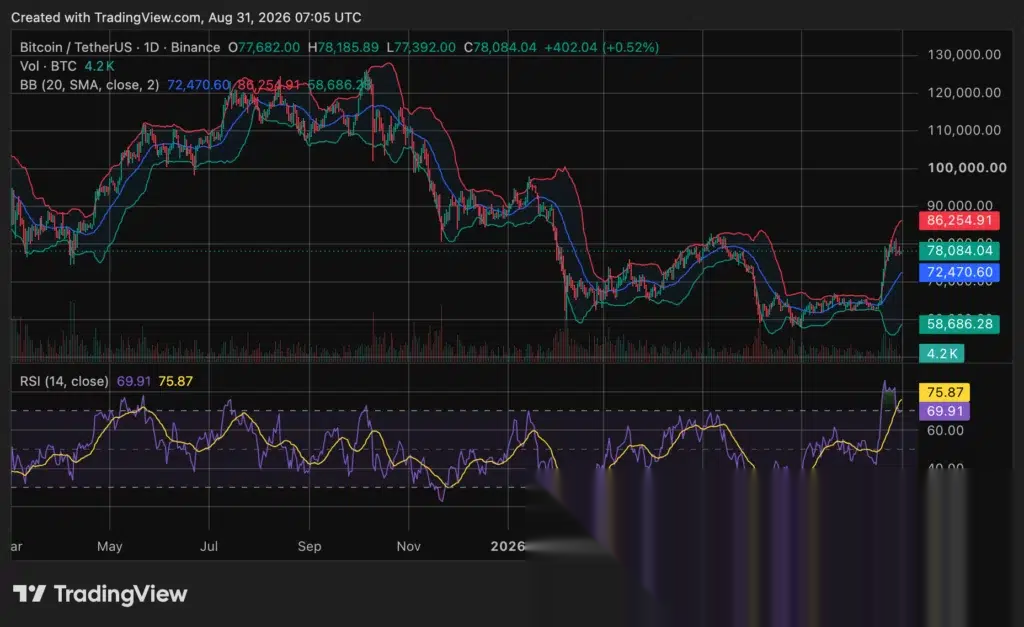
Meanwhile, the daily chart also supports Bitcoin’s short-term strength. BTC traded near $78,084, comfortably above the Bollinger Bands’ $72,471 midpoint but below the $86,255 upper band. The bands widened after the latest rally, pointing to higher volatility.
RSI stood at 69.91, just below overbought territory, after recently crossing 70. This shows strong momentum, although the elevated reading leaves Bitcoin vulnerable to consolidation. Daily volume of about 4,200 BTC remained below the initial breakout spike, suggesting buyers may need stronger participation to challenge $80,000.
Bitcoin also held above $62,000 during July’s U.S.–Iran strikes, even as oil, bonds and Asian stocks experienced larger moves.
August performance separates BTC from other assets
Bitcoin gained approximately 23% during August, compared with reported advances of 9% for gold and 4% for the Nasdaq. The cryptocurrency therefore remained the strongest performer among the three assets over the month.
The broader crypto market showed less resilience on Monday. XRP declined approximately 0.8%, while Solana lost around 0.6%. Ether traded near $1,625 as traders reduced exposure to several major altcoins.
Part of Bitcoin’s monthly performance followed renewed institutional demand through U.S. spot exchange-traded funds. The products accumulated approximately $2.8 billion across eight consecutive inflow sessions during the recovery from Bitcoin’s August lows.
The streak did not continue through Friday. U.S. spot Bitcoin ETFs recorded an estimated $201.9 million in net outflows on Aug. 28, according to Farside. The reversal suggests ETF demand should not be described as uninterrupted.
Bitcoin’s rally from approximately $63,500 was previously supported by eight consecutive ETF inflow sessions, although declining futures exposure indicated that leverage was not the only source of demand.
Federal Reserve policy complicates Bitcoin’s outlook
The geopolitical escalation arrived after Federal Reserve Chair Kevin Warsh delivered a restrictive policy message at the Jackson Hole symposium on Aug. 28.
Warsh said inflation remained too high, while labor markets were stable and economic output was solid. He said most Federal Open Market Committee members preferred to await more information before deciding whether another policy change was appropriate, according to his published remarks.
Markets interpreted the speech as increasing the possibility of another interest-rate rise. Fed funds futures placed the probability of a September increase near 57% to 60%, up from approximately 35% before the address. The estimate remains market pricing rather than a Federal Reserve commitment.
Higher oil prices could further complicate the outlook. Sustained energy increases can raise transportation and production costs, making it harder for inflation to return toward the Fed’s 2% objective.
September 4 jobs report becomes the next test
The next major U.S. catalyst is the August employment report, scheduled for Sept. 4 at 8:30 a.m. ET, according to the Bureau of Labor Statistics calendar.
Strong employment data could reinforce expectations for tighter monetary policy. A weaker report could reduce rate-hike forecasts, although the market reaction would also depend on wage growth and unemployment.
Bitcoin’s immediate technical range remains between support around $77,000 and resistance extending from approximately $79,400 to $80,800. These levels are market observations rather than guaranteed reversal points.
The durability of Bitcoin’s relative strength will depend on whether it remains stable if oil continues rising, equity losses deepen or rate expectations move higher. ETF flows and the Sept. 4 labor report will provide the next evidence.