





Mantle has accumulated about $880 million in stablecoins and tokenized assets as its onchain product range has expanded across equities, Treasuries, funds and yield-bearing assets.
Summary
- Mantle holds about $550 million in stablecoins and $330 million in tokenized assets.
- USDT0 accounts for approximately $440 million, or nearly 80% of the network’s stablecoin supply.
- The network supports 985 distinct tokenized assets across six product categories.
- Mantle increased its tokenized equity selection from 10 products in April to 155 by late June.
Mantle’s asset base approaches $880 million
Blockworks Research data shows that Mantle’s stablecoin circulating supply has reached approximately $550 million, while tokenized assets on the network account for another $330 million. The two categories place the combined value at about $880 million.
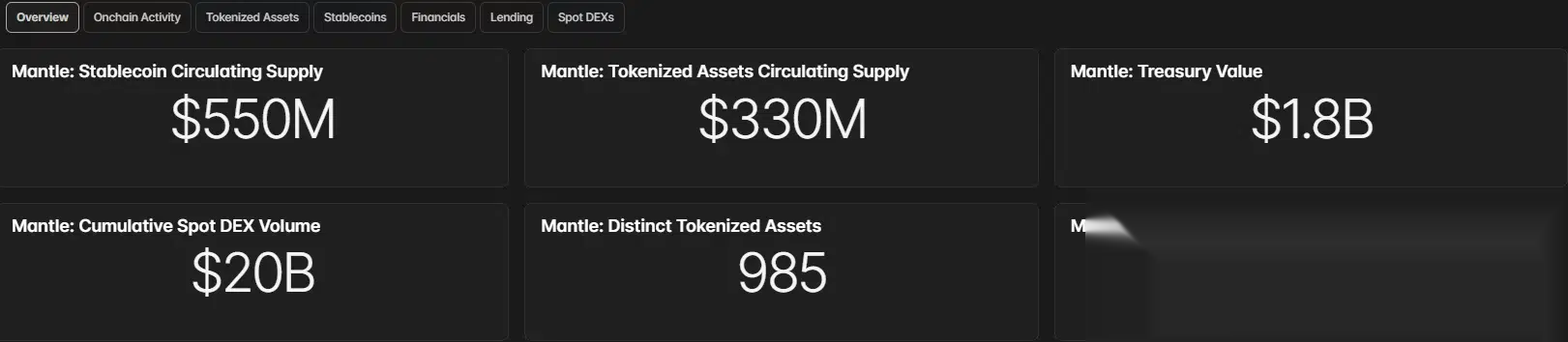
Unlike networks built mainly around one class of real-world assets, Mantle’s tokenized supply covers commodities, stocks, U.S. Treasuries, yield-bearing stablecoins, a pre-IPO vault and the MI4 tokenized fund. Blockworks counts 985 distinct tokenized assets across the network.
Stablecoins provide most of the liquid capital available within the two categories. Based on the dashboard’s latest asset-level readings, their combined circulating supply stands at approximately $553.7 million, with USDT0 accounting for $440.03 million.
USDe ranks second with $57.93 million, followed by USDC at $34.15 million and conventional USDT at $12.96 million. AUSD contributes $5.15 million, while World Liberty Financial’s USD1 and Aave’s GHO account for $2.29 million and $1.23 million, respectively.
Calculated from the displayed figures, USDT0 represents close to 80% of Mantle’s stablecoin supply. The concentration means that most of the network’s dollar-linked liquidity comes from one asset, even though Mantle supports seven stablecoins.
Recent flows have added to the two largest positive movers. The dashboard recorded a daily USDT0 net inflow of $18.42 million and a USDC inflow of $9.94 million when the data was checked. Over 30 days, USDC supply increased 33.93%, while USDT0 rose 9.51%.
Smaller tokens posted faster percentage growth from lower starting levels. GHO supply climbed 203.5% during the same period, while USD1 rose 190.89%. In contrast, USDe fell 9.09%, standard USDT declined 2.28%, and AUSD slipped 0.09%, according to Blockworks.
Tokenized equities have expanded to 155 products
Equities have become a larger part of Mantle’s tokenized-asset catalog. Nansen counted 155 tokenized equities on the network at the end of June, up from only 10 in April, according to an Aug. 25 report.
The selection includes instruments tied to public companies, private businesses, and exchange-traded funds. Nansen identified products linked to SpaceX and Franklin Templeton’s U.S. Equity Index ETF among the available assets.
In November 2025, Mantle integrated Backed’s xStocks through an arrangement involving Bybit. The rollout brought tokens linked to Apple, Nvidia and Strategy shares onto Mantle, while Bybit supported direct deposits and withdrawals between its centralized exchange and the network.
Backed said at the time that its xStocks platform had processed more than $1.6 billion in tokenized equity volume. According to the company, each token was backed one-to-one by an underlying security held through licensed custodians in Switzerland.
Product structures remain important for investors because tokenized equities do not always provide the same legal rights. As crypto.news reported in August, some products deliver only synthetic price exposure and do not give holders ownership, voting rights, or other shareholder protections. Access can also depend on the issuer, distributor, and user’s jurisdiction.
Mantle’s products, therefore, need to be assessed according to their individual terms rather than grouped under a single ownership model. Backed’s one-to-one structure, for example, differs from tokenized derivatives that track a share price without transferring a claim on the underlying stock.
Mantle has added RWA yield through DeFi
Stablecoin liquidity on Mantle is also being used in yield products. On Aug. 25, the network opened its RWA vault to DeFi users after an earlier version distributed through Bybit passed $200 million in assets under management.
The DeFi vault accepts USDC and USDT0 through Fluxion, according to Mantle’s announcement. CIAN designed the non-leveraged strategy, Grove connects deposits to yield from the Sky ecosystem, and Fluxion provides the user interface.
Deposited assets gain exposure to returns from sUSDS, the savings version of Sky’s USDS stablecoin. Sky governance sets the applicable savings rate, so the return can change rather than remaining fixed throughout a deposit.
Mantle’s launch materials listed a target annual percentage yield of up to 6.5%, including campaign incentives. The offer also included Fluxion Points and an allocation of 5.14 million GROVE tokens, although the value received by each depositor depends on participation rules and token prices.
Without leverage, the vault removes one source of liquidation risk, according to Mantle’s product description. Users still face smart-contract failures, stablecoin price changes, liquidity conditions, and adjustments to Sky’s governance-set savings rate.
The self-custodial version also changes who controls the deposited assets. Bybit users previously entered the strategy through an exchange account, while Fluxion users approve transactions from their own wallets and remain responsible for managing their private keys.
Other network figures provide additional scale. Blockworks places Mantle’s treasury value at about $1.8 billion, cumulative spot decentralized exchange volume at $20 billion, and deployed decentralized applications above 150.
U.S. investors face access and ownership limits
For U.S. users, the presence of tokenized American equities on a public blockchain does not establish that the products are legally available in every state or to every investor. Eligibility depends on the issuer’s terms, distribution controls and applicable federal and state securities rules.
Stablecoin yield carries a separate regulatory question. The GENIUS Act prevents payment stablecoin issuers from paying interest or yield directly to holders, while rewards generated through exchanges, brokers, and DeFi protocols have remained part of congressional discussions.
Mantle and its partners describe the DeFi vault’s return as strategy-generated yield from sUSDS rather than a direct payment from a stablecoin issuer. Fluxion Points and GROVE incentives are provided separately from the underlying Sky savings return.
Tokenized-stock models also differ in how they treat U.S. securities. In August, Crypto.com introduced tokenized derivatives tied to 1,500 U.S. equities and ETFs for eligible users in the European Economic Area and other approved markets. Crypto.com said buyers receive price exposure but do not gain legal ownership or shareholder rights.
Regulated U.S. market operators are developing another model. The Depository Trust Company received a Securities and Exchange Commission no-action letter in December 2025 allowing a defined tokenization service for three years, covering eligible assets held in DTC custody.
Under DTC’s stated plan, potential assets include Russell 1000 stocks, major index ETFs, U.S. Treasuries and certain corporate bonds. The company selected Stellar for part of its multi-chain strategy and targeted the first half of 2027 for deployment.