










Oxialink launches a crypto payment gateway with fresh deposit addresses, blockchain monitoring, and signed payment webhooks.
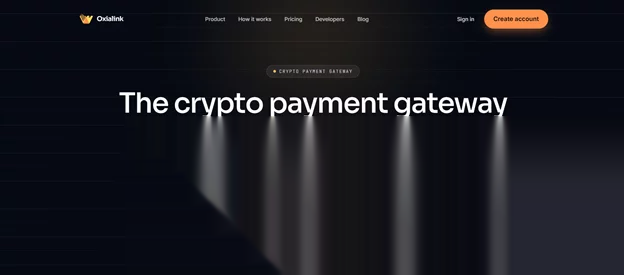
Singapore, August 26th, 2026, Oxialink has launched a cryptocurrency payment gateway that appears as a real payment method at checkout on the major storefronts, backed by a documented REST API and a sandbox running the same build as production. The platform issues a fresh deposit address for every order, watches the blockchain for the payment, and notifies the store with a signed webhook once it confirms.
Live on a storefront in an afternoon
Plugins for WooCommerce, Magento 2, OpenCart, PrestaShop and WHMCS install as ordinary payment methods, so the customer never leaves the checkout they know. The Shopify integration is built on the manual payment method and order webhooks, the pattern Shopify permits for gateways outside its approved partner list.
Developers working without a plugin get SDKs for PHP, Laravel and Node.js, and a REST API documented with webhook signature verification examples in three languages. Merchants with no storefront at all can generate a payment button, a pricing table or a presale widget from the dashboard and paste it into any page.
Hosted checkout carries a QR code and a live confirmation count, and runs inside Telegram as a Mini App. Recurring billing raises and chases subscription invoices on schedule.
Tested against the production build
A free sandbox runs the same code against public test networks, so an integration can be exercised end to end before real money moves. Five assets are available there, chosen because their faucets hand out test coins in under two minutes. A webhook signature that verifies in the sandbox verifies in production, because it is the same verifier.
Fourteen assets, ten pricing currencies
Bitcoin, Litecoin, Dogecoin, Dash, Ether, BNB, TRON and Toncoin settle natively, with Tether on TRON, Ethereum, BNB Smart Chain, Solana and TON, and USD Coin on Solana. Stablecoins on the cheaper chains are the practical default, because the balance stays dollar denominated and the network cost is measured in cents.
Invoices are priced in the merchant’s own currency, in ten of them, and locked to the rate quoted at checkout, so a market move while the customer opens a wallet does not change what is owed.
Fees that are published rather than negotiated
Processing costs 0.5 percent per payment on the free plan, which carries no monthly fee, and 0.2 percent on Premium at $24.99 dollars a month. Alongside it sits a fixed network fee per coin, charged at what the chain actually costs rather than as a percentage of the order.
Two levers cut it further. Batching withdrawals pays that fee once instead of per order. And a funded Gas Station, a small balance of a chain’s native coin held for gas, cuts the network fee on token payouts by roughly 60 percent: USDT on TRON falls from 4 to 2.8, and on Ethereum from 8 to 5. Every figure is published on the fee schedule and readable from an unauthenticated API endpoint.
No underwriting, because there is nothing to underwrite
Card acceptance needs an acquiring bank carrying chargeback liability, which is why the card networks insist on an underwritten merchant and a rolling reserve. A confirmed blockchain payment cannot be reversed by the sender, so there is no liability to carry and no reserve to hold back against future disputes. Signing up takes an email address and there is no approval queue.
That matters most to the categories card processors handle badly: digital goods, gaming, hosting, subscriptions, consulting, and companies registered outside a processor’s supported country list.
Where the money sits
Payments settle on-chain and credit a balance the merchant withdraws to an address they nominate. Auto-withdraw can forward funds as they arrive or batch them to save on network fees. Balances earn no interest and are not lent out.
Every order receives its own never reused address, so a payment is attributable with certainty rather than matched by amount. Webhooks are signed with HMAC-SHA256, carry a replay window and a unique delivery id, and retry with a backoff. Behind them an hourly status poll and a six hourly reconciliation catch what a callback missed, so a failed notification cannot strand an order.
Private keys live in an encrypted keystore that never enters the database, so a copy of the database is not a copy of the money. API secrets are stored hashed, two-factor authentication is available on every account, and balance changes run inside a locked database transaction so two requests cannot spend the same funds twice. Backups run nightly with thirty days retained, and the restore has been rehearsed. Servers and merchant data are located in the European Union.
What it does not do
Oxialink does not convert cryptocurrency into national currency, and refunds are issued by the merchant from their own balance.
Availability
Oxialink is available now and accounts are free to open.
About Oxialink
Oxialink is a cryptocurrency payment gateway for merchants who want to accept digital assets with the same effort as adding any other payment method. It provides deposit addresses, on-chain payment detection, hosted checkout, embeddable widgets, recurring billing, signed webhooks and withdrawals across 14 assets and nine networks, with plugins for the major e-commerce platforms and a documented REST API.
For more information, visit the official website.