

Overview
The RLUSD market cap has surpassed $2 billion, marking another major milestone for Ripple’s dollar-backed stablecoin less than two years after its December 2024 launch. The growth is notable because RLUSD is not positioned primarily as a retail trading stablecoin. Ripple is increasingly building it into a broader institutional infrastructure stack spanning payments, tokenization, collateral management, custody and cross-border liquidity.
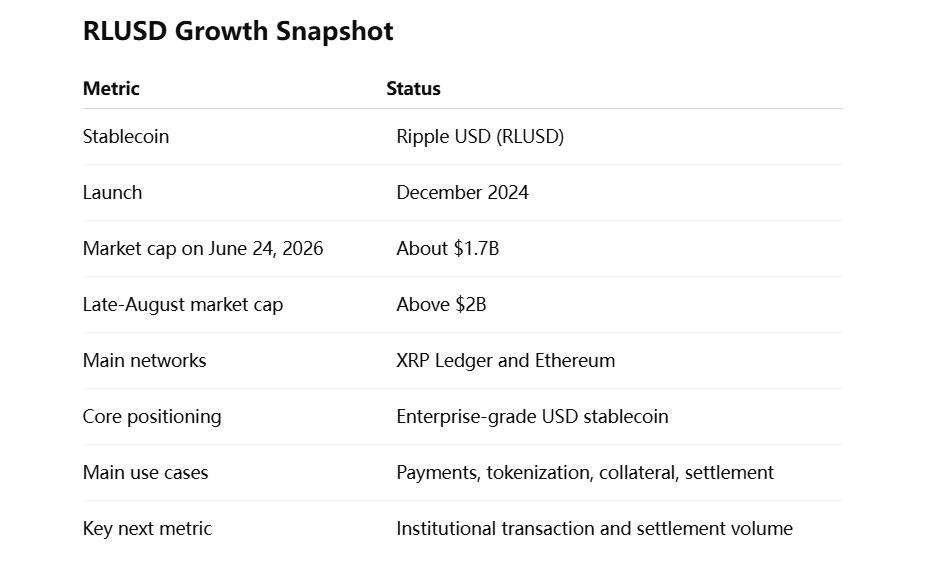
The pace of expansion has accelerated. Ripple disclosed that RLUSD had reached approximately $1.7 billion in market capitalization by June 24, 2026. By late August, circulating supply had moved above the $2 billion threshold, adding more than $300 million in roughly two months.
That growth does not mean Ripple generated $2 billion in revenue. Stablecoin market capitalization primarily reflects the dollar value of tokens in circulation. The more important question is whether those tokens are increasingly being used for real settlement, payments and financial-market activity.
RLUSD operates across the XRP Ledger and Ethereum, giving Ripple access to both its own payments-oriented blockchain ecosystem and the broader Ethereum liquidity environment. As the RLUSD market cap grows, the next phase will depend on whether Ripple can turn stablecoin supply into sustained institutional transaction volume.
Key Takeaways
- RLUSD market cap has surpassed $2 billion.
- Ripple reported approximately $1.7 billion in RLUSD market cap on June 24, 2026.
- RLUSD is positioned around payments, tokenization, collateral and institutional liquidity.
- The stablecoin operates on XRP Ledger and Ethereum.
- Market cap growth is not the same as revenue or transaction volume.
- Ripple’s next challenge is turning circulating supply into recurring financial activity.
Why Did the RLUSD Market Cap Surpass $2 Billion?
How Fast Has RLUSD Grown?
RLUSD launched in December 2024 and has expanded rapidly in less than two years.
By June 24, 2026, Ripple said the stablecoin had reached approximately $1.7 billion in market capitalization. The move above $2 billion by late August represents another important step in its growth curve.
That increase matters because stablecoin markets often become more useful as liquidity improves.
A larger circulating supply can make it easier for exchanges, market makers, payments providers and financial institutions to transact without creating large price deviations.
Stablecoins also benefit from network effects.
Users prefer dollar tokens that counterparties already accept, while institutions prefer assets that have sufficient liquidity and predictable redemption infrastructure.
The RLUSD market cap milestone therefore gives Ripple a stronger position when approaching institutional users.
Does a $2B Market Cap Mean Ripple Raised $2B?
No.
This is one of the most important distinctions for understanding stablecoins.
Stablecoin market capitalization is generally calculated by multiplying circulating token supply by the asset’s market price, which is designed to remain close to $1.
If 2 billion dollar-pegged tokens are circulating near $1 each, the stablecoin has a market capitalization of roughly $2 billion.
That does not mean the issuer earned $2 billion in revenue.
Issuers hold reserve assets supporting the stablecoins and may earn income from the assets in those reserves, depending on the product structure and applicable rules.
The RLUSD market cap therefore measures the scale of circulating dollar liquidity rather than Ripple’s corporate earnings.
RLUSD Growth Snapshot
Where Is RLUSD Liquidity Growing?
Why Is XRP Ledger Important for RLUSD?
The XRP Ledger gives Ripple a native blockchain environment optimized around asset transfer and settlement.
That makes it strategically important for RLUSD.
Ripple has spent years building payment infrastructure around XRP Ledger, financial institutions and cross-border settlement. Adding a regulated dollar-denominated asset creates another settlement option within the same ecosystem.
For users who do not want exposure to XRP price volatility, RLUSD can provide a stable unit of account while still using XRP Ledger infrastructure.
This creates a potentially complementary relationship.
XRP can continue serving its network and liquidity roles, while RLUSD provides dollar-denominated settlement.
The long-term significance will depend on how much real payment and tokenization activity occurs on XRP Ledger using the stablecoin.
Why Is RLUSD Also Available on Ethereum?
Ethereum provides access to a much larger smart-contract and DeFi ecosystem.
Stablecoins on Ethereum can interact with exchanges, lending markets, custody platforms and other financial applications.
For Ripple, this broadens RLUSD distribution beyond the XRP Ledger ecosystem.
It also reduces the risk of relying on one network for all liquidity.
Multichain distribution can make a stablecoin more useful to institutions that already operate across different blockchain environments.
The challenge is maintaining consistent liquidity and operational standards between networks.
Fragmented supply can reduce efficiency if users cannot move capital easily between ecosystems.
Why Is Ripple Targeting Institutional Stablecoin Demand?
How Can RLUSD Support Payments?
Cross-border payments remain one of Ripple’s oldest strategic markets.
Traditional international transfers can involve multiple correspondent banks, time-zone limitations and delayed settlement.
A dollar stablecoin can potentially move continuously across blockchain networks.
That does not eliminate regulation or banking relationships, but it can reduce some settlement friction.
RLUSD gives Ripple a dollar-denominated asset that can be incorporated directly into payment workflows.
This is particularly relevant for businesses that need predictable dollar value rather than exposure to a volatile cryptocurrency.
The larger the RLUSD market cap becomes, the more liquidity Ripple can potentially connect to those payment systems.
How Can RLUSD Support Tokenized Assets?
Tokenized financial markets need more than tokenized securities.
They also need digital cash.
If a tokenized Treasury, fund share or receivable moves onchain but payment still occurs through a separate banking system, part of the settlement process remains fragmented.
A stablecoin can provide the cash leg.
RLUSD can potentially settle tokenized assets directly, making delivery-versus-payment workflows more efficient.
That use case becomes increasingly important as banks and asset managers experiment with tokenized securities.
Ripple’s broader institutional infrastructure creates a natural distribution channel for RLUSD in these markets.
Why Does Collateral Management Matter?
Collateral is another large institutional opportunity.
Financial institutions constantly move cash and securities to support loans, derivatives and other positions.
Traditional collateral movements can be constrained by banking hours and operational processes.
A stablecoin that can move 24/7 could improve flexibility.
RLUSD could theoretically be used as digital cash collateral where counterparties are comfortable with its reserve, legal and compliance structure.
This would create demand that is less dependent on retail crypto trading.
For Ripple, that distinction is strategically important.
Institutional collateral usage can produce recurring transaction volume even during periods when speculative crypto activity slows.
Can RLUSD Compete With USDT and USDC?
Does RLUSD Need to Become the Largest Stablecoin?
No.
Stablecoins can succeed in different market segments.
USDT has built enormous global distribution and is especially strong in crypto trading and emerging-market dollar access.
USDC has established deep links with regulated exchanges, DeFi and institutional infrastructure.
RLUSD can differentiate around Ripple’s payments, custody and enterprise relationships.
The relevant competitive question is therefore not whether RLUSD immediately surpasses larger stablecoins in market capitalization.
It is whether Ripple can establish areas where RLUSD becomes a preferred settlement asset.
Institutional payments, tokenization and collateral could provide those niches.
What Advantages Does Ripple Have?
Ripple already operates across several institutional crypto businesses.
Its infrastructure spans cross-border payments, custody, liquidity and other financial services.
That creates potential distribution channels that a standalone stablecoin startup may not have.
Ripple can theoretically integrate RLUSD directly into services that institutions already use.
The benefit is vertical integration.
Instead of asking users to adopt a stablecoin first and then search for applications, Ripple can potentially embed RLUSD into existing financial workflows.
The challenge is execution.
Institutions will still compare RLUSD with competing digital dollars on reserve quality, liquidity, regulation, redemption and cost.
What Could Slow RLUSD Growth?
Is Stablecoin Competition Increasing?
Yes.
The stablecoin market is becoming more competitive as banks, fintech companies and crypto firms launch or plan their own dollar-backed assets.
Regulatory clarity may increase that competition further.
A market that once concentrated around a few dominant stablecoins could become more segmented by geography and use case.
RLUSD therefore needs more than supply growth.
It needs network effects.
Merchants, exchanges, institutions and payment providers must have reasons to continue using RLUSD instead of switching to another dollar token.
Does Supply Growth Guarantee Usage?
No.
A stablecoin can increase in circulating supply without generating proportional growth in real economic activity.
Some tokens may sit in wallets or remain concentrated among a limited number of holders.
This is why the next phase of RLUSD analysis should focus on velocity and transaction use.
Relevant metrics include payment volume, exchange liquidity, number of holders, settlement value and use as collateral.
If those figures grow alongside the RLUSD market cap, the expansion becomes much more meaningful.
What Should Investors Watch Next?
How Important Is Institutional Adoption?
Institutional adoption is likely the most important long-term indicator.
Ripple has explicitly positioned RLUSD for enterprise and financial-market applications.
Named integrations with banks, asset managers, payment providers and tokenization platforms would therefore provide stronger evidence of product-market fit.
Investors should also monitor whether institutions use RLUSD repeatedly rather than testing it in isolated pilots.
Recurring settlement is the real benchmark.
Could New Markets Accelerate Growth?
Yes.
Ripple has been expanding RLUSD geographically, including through its partnership with SBI Group for Japan.
Additional regulatory approvals and distribution partnerships could expand access.
Stablecoins are highly dependent on distribution.
A technically strong product cannot grow rapidly if users cannot acquire, redeem or deploy it easily.
Ripple’s global financial relationships may therefore become one of RLUSD’s most important competitive advantages.
RLUSD's $2B Milestone Is Really About Institutional Utility
The RLUSD market cap surpassing $2 billion confirms that Ripple’s stablecoin has moved beyond an experimental scale.
Growth from roughly $1.7 billion in late June to more than $2 billion by late August shows that circulating supply continues to expand rapidly.
But market capitalization is only the first layer of the story.
The more important question is what that liquidity does.
Ripple is positioning RLUSD as infrastructure for payments, tokenization, collateral management and institutional settlement rather than simply another trading pair.
That strategy gives the stablecoin a different path from products built primarily around retail exchange activity.
The XRP Ledger provides a native settlement environment tied to Ripple’s broader payment ecosystem, while Ethereum gives RLUSD access to deeper smart-contract and DeFi liquidity.
Together, those networks provide distribution.
The next challenge is usage.
If transaction volume, institutional integrations, tokenized-asset settlement and collateral activity grow alongside the RLUSD market cap, the $2 billion milestone may represent the beginning of a much larger financial network.
If supply grows without corresponding economic activity, the headline number will become less meaningful.
RLUSD’s next phase should therefore be judged not by how quickly it reaches another market-cap milestone, but by whether it becomes an increasingly important dollar settlement layer across Ripple’s institutional infrastructure.
Sources
https://ripple.com/solutions/stablecoin/
https://ripple.com/ripple-press/ripple-and-sbi-group-partner-to-launch-ripple-usd-in-japan/
https://ripple.com/insights/ripple-usd-rlusd/
Risk Disclaimer: This article is for reference only and does not constitute investment advice. The cryptocurrency market is highly volatile. Please make decisions cautiously based on your individual circumstances.