






With one of its biggest comebacks of 2026, Solana has a significant advantage over Hyperliquid thanks to its most recent technical structure: SOL has already overcome the long-term resistance that typically divides a brief rally from a more significant reversal.
Solana is back at growth
After surging from roughly $75 in the second half of August, SOL is currently trading at about $104.65. The cryptocurrency gained about 45% from the consolidation range at its most recent peak, momentarily rising above $110. What matters is where that move took place. Before attacking the much more important cluster near $90, SOL broke through the 50-day and 100-day moving averages around $80.78 and $82.46.
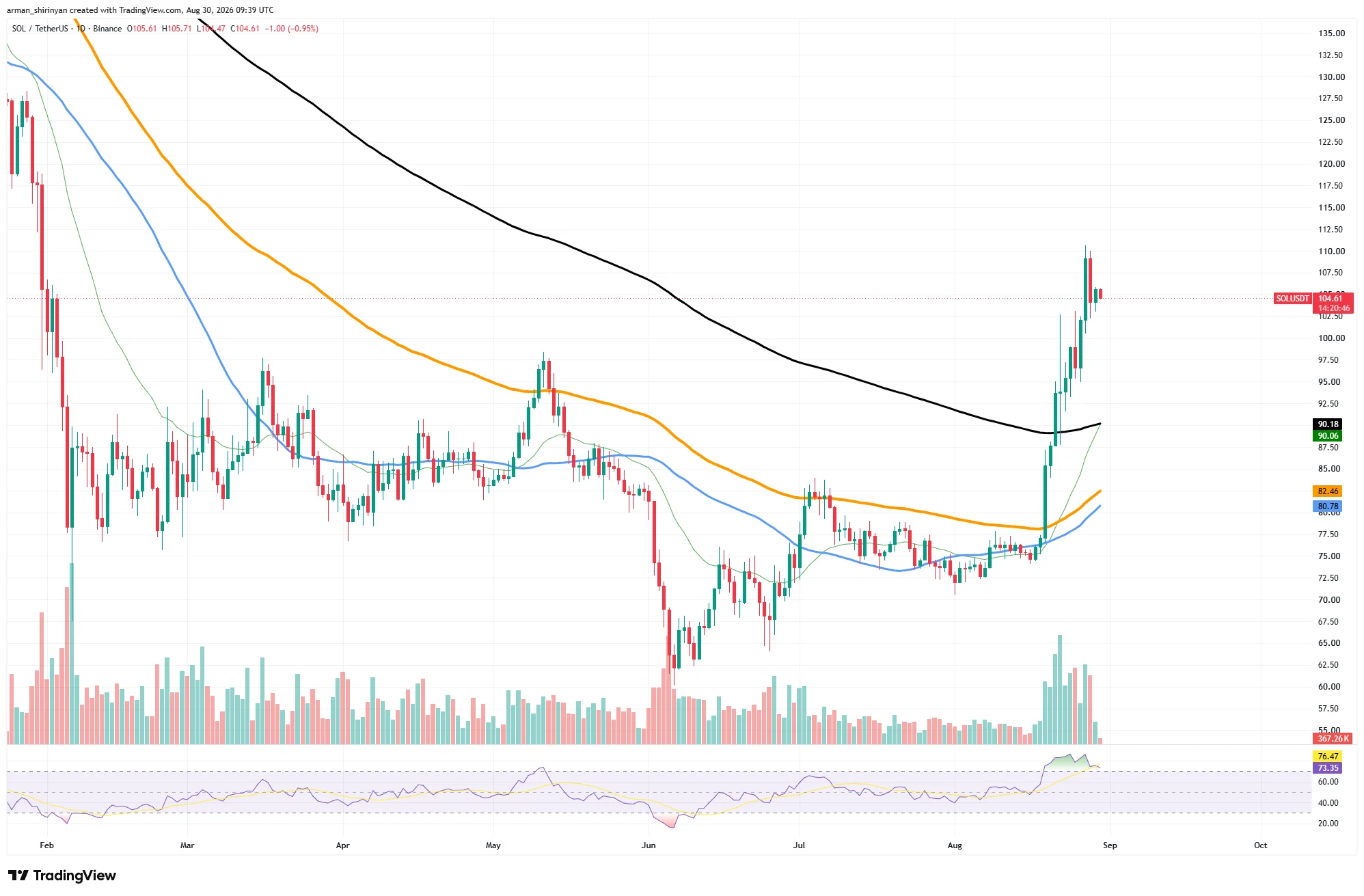
Currently, the 20-day EMA and 200-day moving average are at roughly $90.06 and $90.18, respectively. Solana punched straight through the 200-day average on increasing volume rather than being rejected right away. The current price is over 15% higher than that indicator.
When evaluated from a relative technical perspective, this gives SOL a stronger technical foundation than assets that stay stuck below their long-term trend resistance, such as Hyperliquid. Instead of breaking its 200-day average, Solana must now defend it. However, there is a clear immediate issue.
Solana being pushed
During the breakout, SOL experienced severe overbought conditions. The daily RSI rose above 80 before falling to about 73.4. Although momentum is still very strong, chasing the asset between $105 and $110 is much riskier than it was between $80 and $90. Following the breakout burst, volume is also starting to return to normal. Because of this, consolidation is more likely.
The recent peak between $110 and $111 continues to be the first immediate obstacle. Breaking it would allow SOL to compete in the $115–$120 range. A retracement toward $100 and then the critical $90 area could occur if the price does not keep rising. The current technical line in the sand is that $90 area.
A successful retest would bolster the claim that Solana has entered a true trend reversal and verify that previous long-term resistance has turned into support. Thus, SOL's current advantage is structural: the challenging breakout has already taken place. The next question is whether buyers will be able to hold it.