





TL;DR
- Blockstream CEO Adam Back said Bitcoin creator Satoshi Nakamoto was often wrong in early technical calls, rejecting theories that Nakamoto planned unlimited block-size growth.
- The White House holds a closed-door crypto meeting on Aug. 19 with SEC Chair Paul Atkins, CFTC Chair Mike Selig, and executives from Ripple, Coinbase, Gemini, Polymarket, Nasdaq, NYSE, CME and DTCC, bypassing the stalled CLARITY Act.
- Coinbase CEO Brian Armstrong predicted AI agents will outnumber human wallet holders, pointing to the x402 payment protocol and USDC on Base, which have already processed over $100 million.
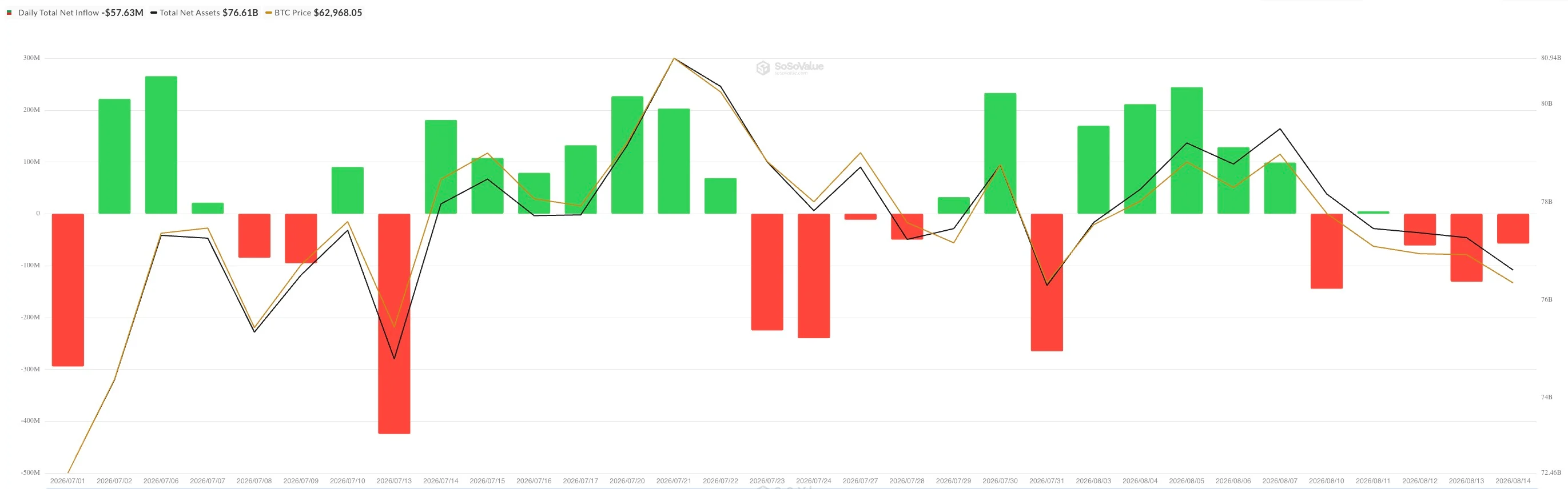
- Bitcoin fell below its 200-week moving average, trading between $62,000 and $65,000, as U.S. spot ETFs saw $389.7 million in net outflows during Aug. 10–14 — the largest weekly withdrawal since early July.
- Strategy raised $334 million via an MSTR stock sale to defend its 840,447 BTC holdings, while BitMine extended its ETH accumulation streak to 59 consecutive weeks.
Adam Back reminds crypto community of Satoshi's mistakes
Blockstream CEO Adam Back delivered a harsh reality check to supporters of the theory about Satoshi Nakamoto's "true plan."
Commenting on a new podcast by Robin Linus — which claimed that Satoshi intended to increase block sizes indefinitely in accordance with Moore's Law to push BTC to $1 million — Back reminded them that Bitcoin's creator was not a prophet and often contradicted himself.
On the very first day of the network's launch, Satoshi defended Bitcoin rather uncertainly against criticism from James A. Donald, who predicted a scaling collapse because of the overwhelming bandwidth demands and resource requirements imposed on full nodes.
Nakamoto later acknowledged these limitations himself and shifted to discussing higher-layer systems: Layer 2 solutions and even the concept of "Bitcoin banks."
Back stated directly that BTC's creator was plainly wrong in several of his early technical forecasts, meaning that his archives should not be treated as scripture.
With this context in mind, the Blockstream CEO is urging the industry to stop performing textual analysis of posts written 15 years ago. Bitcoin should be developed using reason and the fundamental principles of mathematics and security as they apply today, not through blind faith in authority.
White House gathers crypto market leaders without waiting for Congress
The U.S. administration does not intend to wait for Congress and is taking crypto market regulation into its own hands. According to ETF Store President Nate Geraci, the decision to move forward has already been made: the executive branch is launching a proactive policy on its own without waiting for approval of the stalled CLARITY Act.
The clearest confirmation will be a closed-door meeting at the White House scheduled for Aug. 19. Geraci expects the event to send an unequivocal signal to the market: the rules will be established here and now, regardless of the legislative deadlock in Congress.
At the Eisenhower Executive Office Building, senior administration officials, new SEC Chair Paul Atkins and CFTC Chair Mike Selig will bring together industry heavyweights. The list of participants includes Ripple, Coinbase, Gemini and Polymarket, as well as Wall Street giants Nasdaq, NYSE, CME and DTCC.
The meeting will serve as an official preview of the first session of the CFTC Innovation Committee, which begins the following day.
The real intrigue, in Geraci's view, lies in the tectonic shift for players such as Ripple. Instead of spending years waiting for legislation or fighting regulators in court, the company now has a seat at the negotiating table inside the White House.
Support for the CLARITY Act on Capitol Hill would be an ideal scenario, but Geraci stresses that the executive branch is signaling that it is ready to maintain the market's momentum on its own by implementing rules through agency directives on an accelerated timetable.
AI agents will outnumber humans in wallet count, Brian Armstrong says
Coinbase CEO Brian Armstrong has made the bold prediction that AI agents will inevitably outnumber humans and that cryptocurrencies will become their new financial foundation.
According to Armstrong, traditional banks simply cannot open accounts for software code without a passport, which is why the robot economy will be powered by the concept of AiFi (Agentic Finance).
To support this forecast, Coinbase is already rolling out ready-made infrastructure in which the stablecoin USDC serves as the base currency on the fast Base network. Armstrong identifies the open x402 protocol as the foundation of this new ecosystem — a machine-to-machine payment standard based on the classic HTTP status code 402 Payment Required.
The system allows bots to pay one another for APIs, computing power or databases without any human involvement. This is not some distant future: the technology has already been validated by the market, with more than $100 million processed through x402 and support from giants such as Google, Visa and Stripe.
Armstrong's prediction overturns the conventional understanding of mass crypto adoption. AI agents do not care about polished applications or marketing — they need low-cost transactions around the clock.
If the Coinbase CEO's prediction comes true, blockchain will complete its transformation from a speculative instrument into the only viable circulatory system for the global robot economy.
Crypto market outlook: Time to buy? Bitcoin falls below 200-week MA and tests summer 2022 levels
Institutional capital is flowing out of funds as investors reassess risk amid the asset's prolonged consolidation. At the same time, long-term corporate holders are using the lull to aggressively defend their treasury positions and hedge their balance sheets.
Key checkpoints:
- ETF momentum reverses: After a temporary stabilization, U.S. spot Bitcoin ETFs recorded net outflows of $389.7 million during the week of Aug. 10–14, marking the largest weekly withdrawal since early July. Fidelity's FBTC led the redemptions with $153 million.
- Bitcoin tests a technical reversal: The leading cryptocurrency is trapped in a narrowing trading range between $62,000 and $65,000 because of historically low spot demand, while its price has fallen below the critical 200-week moving average.
- A historical cycle bottom approaches: Technical analysts note that Bitcoin is on day 1,363 of its current cycle and is rapidly approaching the 1,432–1,436-day range in which macroeconomic lows have typically formed, drawing strong historical parallels to the market bottom of summer 2022.
- Corporate treasury protection intensifies: To protect its substantial holdings of 840,447 BTC, acquired at an average price of $75,385, Strategy raised $334 million through the sale of Class A common stock (MSTR). This increased its dollar reserve to $4.8 billion, providing 2.8 years of operational autonomy without being forced to sell its coins.
- Ethereum accumulation continues: High-conviction corporate buying remains active, with BitMine Immersion Technologies (BMNR) extending its ETH purchasing streak to 59 consecutive weeks and locking 87% of its position in staking to generate an estimated $250 million in annual yield.