










TL;DR:
- Bitcoin, Ethereum and XRP whale short positions reach $1.38 billion as Abraxas Capital, Wintermute and Fasanara Capital hedge gains on Hyperliquid rather than bet on a downturn.
- Gold hit a fresh August high of $4,659.85, driven by Treasury Secretary Scott Bessent's plan to move $950 billion from the TGA into long-term bonds.
- Ray Dalio urges investors to cut Treasury exposure for gold and Bitcoin, citing a looming US debt crisis.
On Monday morning, Aug. 24, the cryptocurrency market is holding onto the momentum of its best weekly rally in three years, showing stable consolidation at elevated levels. Following the historic $4 billion short squeeze at the end of last week, trading platforms have entered a localized battle for liquidity.
According to CoinGlass, positions held by 78,395 futures traders worth $339.53 million were forcibly closed over the past 24 hours, with sellers accounting for a slight majority at $181.36 million. Against this backdrop, institutional capital continues its aggressive accumulation: weekly inflows into U.S. spot Bitcoin ETFs reached a 10-month high of $1.5 billion, according to SoSoValue estimates.
At the same time, major issuers are making large balance-sheet moves. While Strategy has accumulated $1.59 billion in USD cash for future BTC purchases, BitMine has increased its stake to 4.8% of Ethereum's market supply, indefinitely removing liquidity from circulation by staking 87% of its ETH.
While retail optimism pushes spot prices higher, the market's underlying microstructure points to a significant divide between individual speculation and institutional strategies.
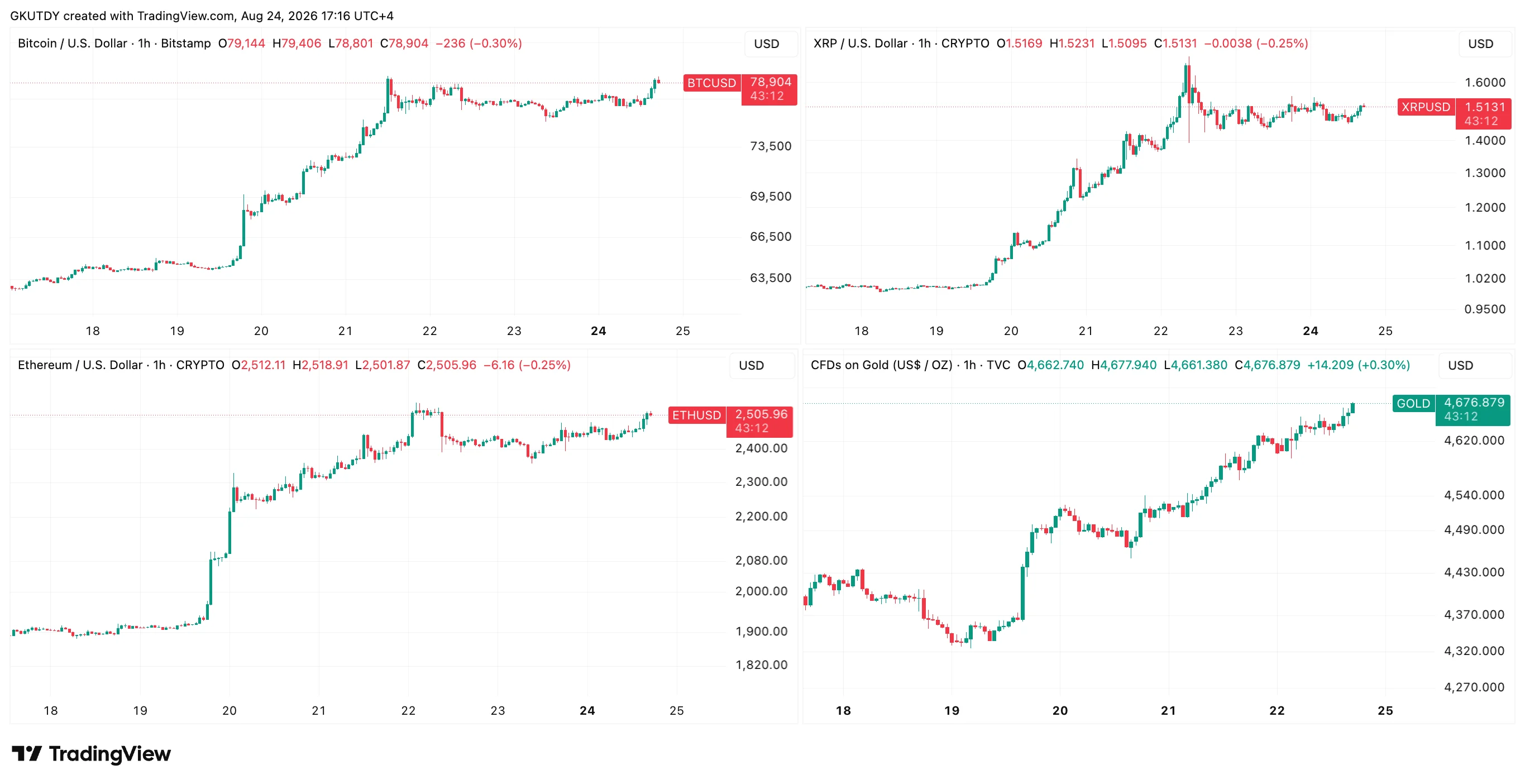
The largest market makers are calmly maintaining short positions worth more than $1.3 billion across key digital assets, including Bitcoin, Ethereum and XRP. This aggressive short exposure is not a bet on a crash but part of a sophisticated multibillion-dollar risk-hedging strategy unfolding alongside a global flight of capital into hard assets.
Gold is posting a powerful V-shaped daily recovery of 1.24%, moving toward $4,660. The current morning calm merely conceals a fierce battle for liquidity, fueled by U.S. Treasury interventions and regulatory uncertainty in Washington.
Crypto market news: Behind the $1.38 billion BTC, ETH and XRP shorts
The explosive rise in prices has triggered a surge in institutional hedging, with the largest liquidity providers building heavy short positions on decentralized derivatives platform Hyperliquid. The current balance of power in the institutional sector looks as follows:
- Abraxas Capital Management: Maintains the lead with a massive $783 million short portfolio across BTC, ETH and other assets, while simultaneously withdrawing 73,000 ETH, worth approximately $173 million, from Binance to build a spot-long cushion.
- Wintermute: Controls a $190.8 million short position, including $53 million in ETH, $30.7 million in BTC and $22.6 million in SOL. Despite a local unrealized loss of $5.85 million caused by the current rally, the firm's historical net PnL exceeds $203.6 million.
- Fasanara Capital: Together with Wintermute, forms an additional pool of short positions, bringing the total institutional short block to $1.38 billion.
Wintermute founder and CEO Evgeny Gaevoy has sharply criticized superficial media interpretations of these metrics, emphasizing that large market-maker shorts represent neutral inventory management and premium collection rather than bearish sentiment.
As retail euphoria sends funding rates through the roof, funds execute a classic cash-and-carry basis trade: they short perpetual futures while simultaneously buying the underlying asset on the spot market to earn a risk-free, double-digit annualized return.
Institutional discipline stands in stark contrast to the behavior of retail futures traders. The latest CoinGlass heatmap shows that Ethereum took the biggest hit over the past 24 hours, with $117.09 million in liquidations, including a $6.86 million ETH/USDT order on Binance. Bitcoin followed with $72.59 million.
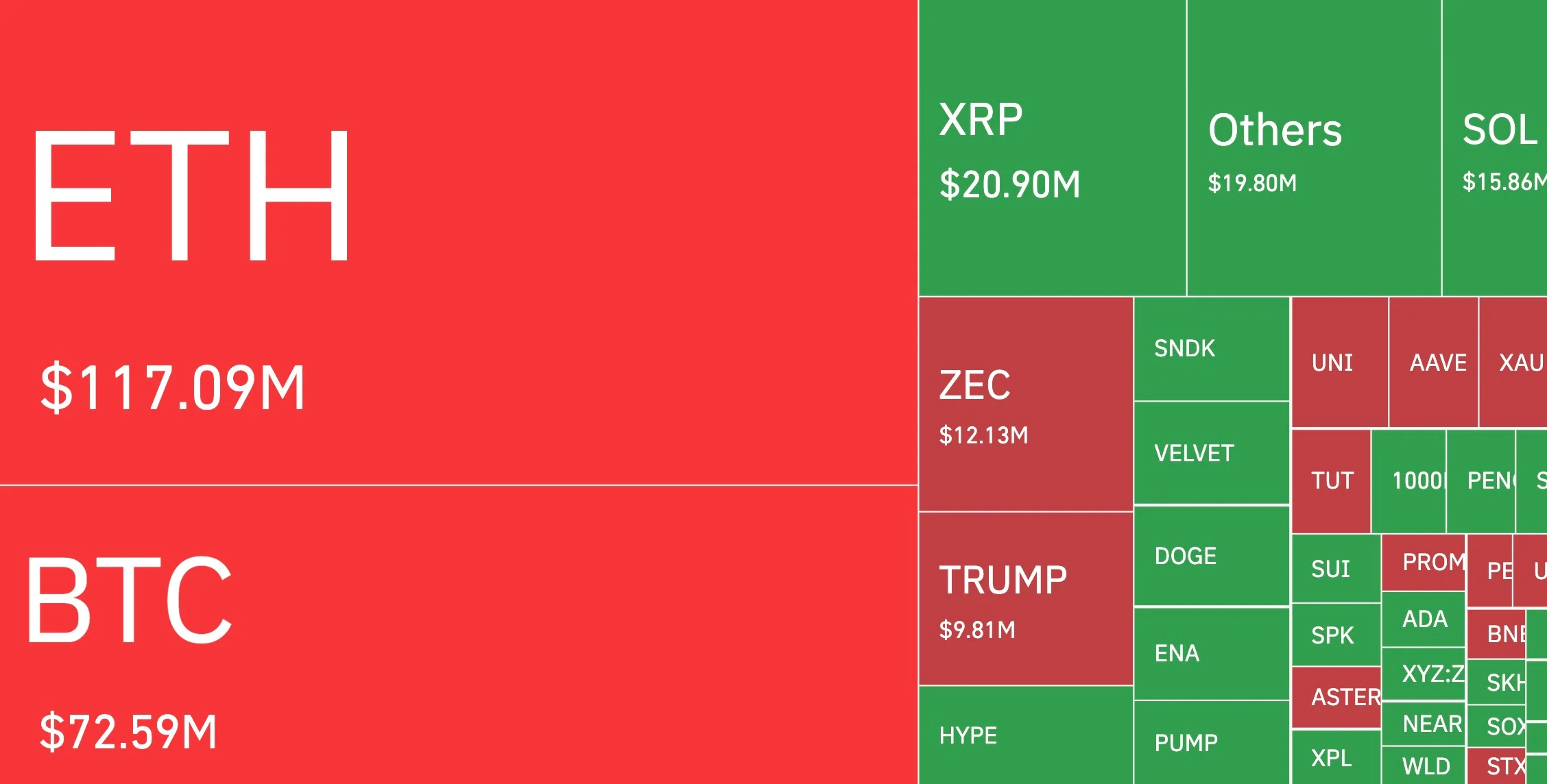
Traders continue aggressively attempting to catch local price movements, as reflected in retail activity around XRP, with $20.90 million in liquidations, Zcash with $12.13 million and other altcoins.
While individual retail traders make repeated mistakes by attempting to short this powerful trend with extremely high leverage, such as 40x, major players are pricing in the risks of systemic fiat debasement and seeking a fundamental hedge in global markets, where gold traditionally serves as the main ally of digital assets.
Ray Dalio chooses gold and Bitcoin as protection against a U.S. debt crisis
The rapid rise of gold and silver reflects the same processes now unfolding in the cryptocurrency market: investors are fleeing the traditional U.S. financial system amid concerns about its hidden vulnerabilities. Gold has gained approximately 15% over the past month, while silver has posted an even more aggressive 19% increase.
This synchronized advance is being driven by a massive maneuver from Treasury Secretary Scott Bessent, who plans to deploy nearly $950 billion from the Treasury General Account, or TGA, to purchase long-term government bonds from the market. This liquidity injection has already pushed gold to a new August high of $4,659.85, breaking through key technical resistance at $4,400 on TradingView's daily chart.
Weakening demand for U.S. government bonds and aggressive financial engineering by the Treasury have prompted Wall Street heavyweights to speak out. At the end of last week, legendary investor and Bridgewater founder Ray Dalio directly urged investors to reduce their Treasury positions and shift capital into gold, predicting a full-scale U.S. debt crisis within the next three years — "plus or minus two years if the current policy direction does not change."
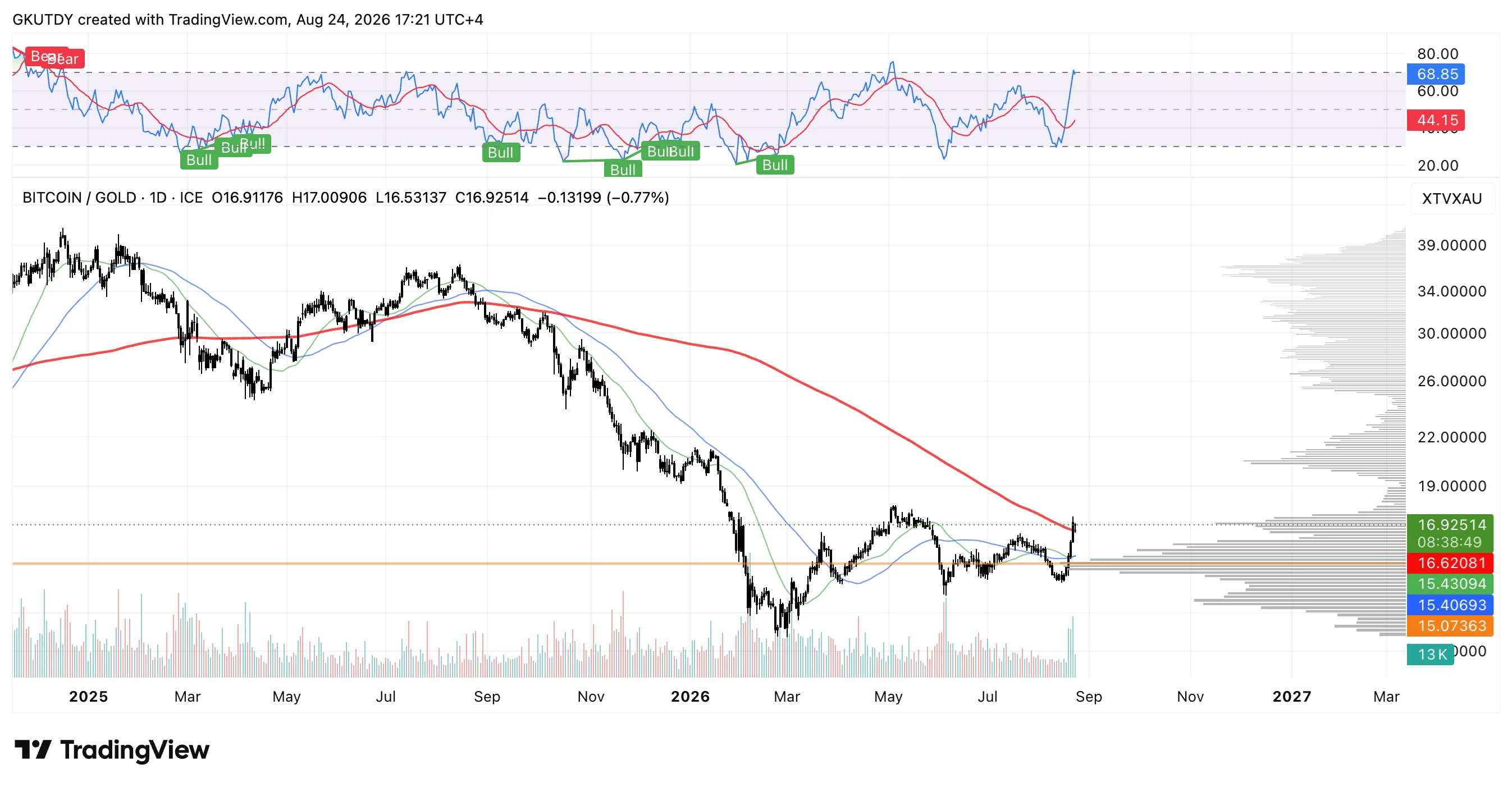
Dalio emphasized that if demand for government bonds declines, authorities will resort to uncontrolled dollar issuance, triggering another wave of severe inflation. Notably, alongside gold, Dalio separately identified Bitcoin as one of the most effective alternative instruments for protection against these sovereign risks.
Major institutional funds are already acting within this paradigm. Fidelity International has doubled its gold longs over the past three weeks, hedging against the regulatory uncertainty left in the wake of new Federal Reserve Chair Kevin Warsh.
Nevertheless, macro analysts note that as the V-shaped recovery in precious metals approaches a local ceiling near the spring highs of $5,400, excess capital is beginning to seek higher beta in digital infrastructure, which is posting record figures:
- Solana ecosystem: Set an unprecedented record by processing 1.318 billion transactions in a single week.
- Stablecoin market: Daily usage in the real economy reached $1 billion via debit cards.
- Zcash (ZEC): Surged 22% toward its 2018 price highs at $855 following Grayscale's updated application to launch the first U.S. spot ETF for a privacy-focused cryptocurrency.
Bitcoin is directly absorbing this overflow from fiat, holding firmly at $78,143 and easily digesting local selling by whales. As Dalio predicted, capital is flowing into hard digital alternatives amid the deterioration of the debt market.
This is laying the foundation for Bitcoin to challenge the $100,000 level by the end of 2026. According to Standard Chartered analysts, even that target may prove overly conservative as daily ETF inflows return to levels above $1 billion.