TL;DR
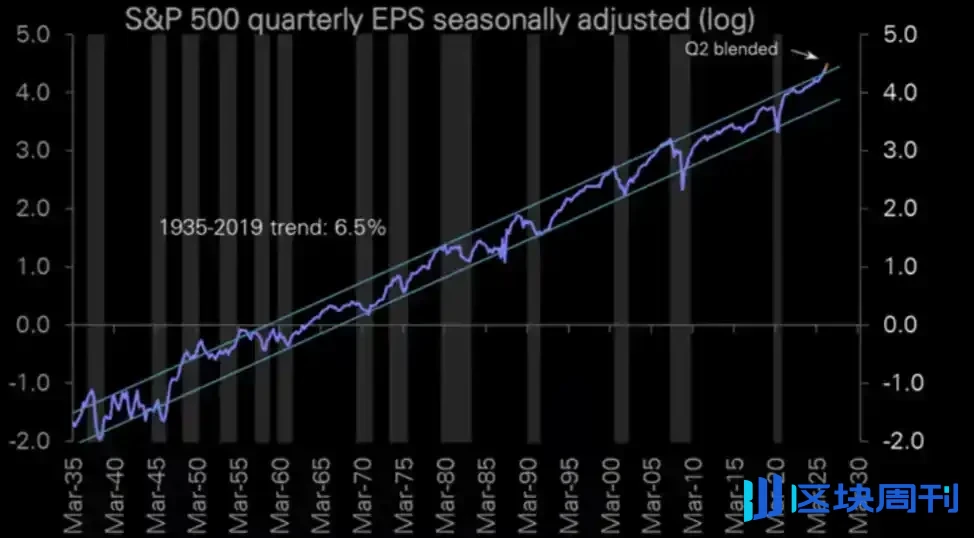
· A US stock earnings revision report says S&P 500 EPS is 14% above a trend channel spanning over 90 years, the first time since 1955.
· Public FactSet data shows S&P 500 Q2 earnings growth is roughly in the 23% to 25% range.
· Earnings growth is broadening from large tech stocks to more companies, but there is still divergence among sectors, and high profit benchmarks also raise the difficulty of meeting expectations in subsequent reports.
The high valuation of US stocks is gaining stronger fundamental support: corporate earnings are not only maintaining growth, but analysts are also continuously raising future expectations.
A US stock earnings revision report aggregating data from multiple institutions shows that S&P 500 earnings per share are already about 14% above the trend channel formed by over 90 years of historical data, the first time since 1955 that such a high deviation has been reached. The report also points out that the proportion of companies beating earnings expectations, the magnitude of sales beats, and analyst earnings upgrades are all at historically strong levels.
This data explains why US stocks can still be supported despite high valuations. Over the past year, AI investment, interest rate expectations, and liquidity have jointly driven risk assets higher; as the index climbs further, relying solely on narrative is no longer enough, and corporate profits must continue to grow to digest higher valuations.
But strong earnings also have another side: when profit levels are already significantly above long-term trends, market expectations rise in tandem. Companies merely meeting forecasts may no longer be sufficient to push stock prices up; once revenue, profit margins, or future guidance fall short of expectations, high valuations will face greater pressure.
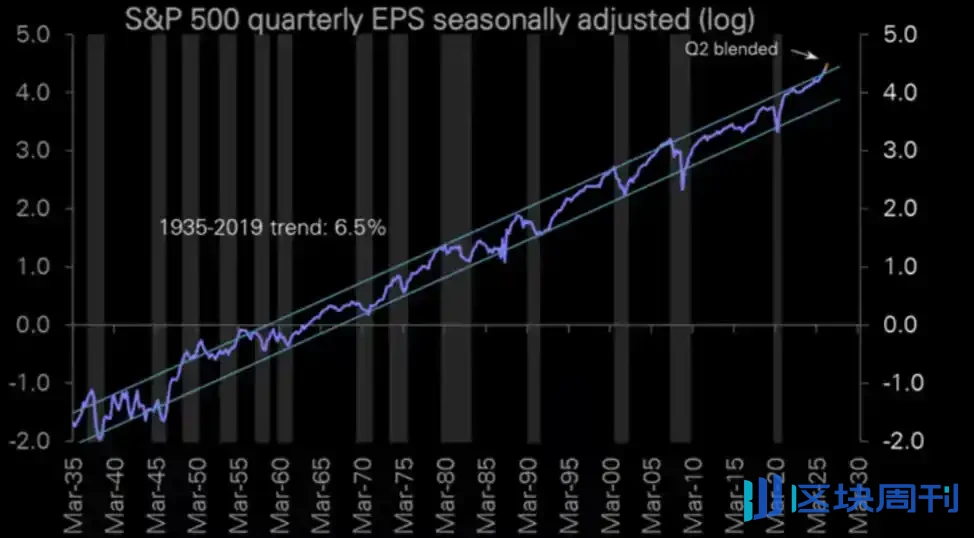
S&P 500 quarterly EPS rises above the long-term trend channel. The report says it is 14% above the trend channel spanning over 90 years, the first time since 1955.
How strong are earnings: S&P 500 EPS reaches a rare level in 70 years
The report's assessment of current earnings strength mainly comes from three aspects.
First, the absolute level of S&P 500 EPS continues to rise and has clearly broken above the long-term trend range. According to Deutsche Bank's calculations cited in the report, several consecutive quarters of strong earnings growth have pushed S&P 500 EPS 14% above the long-term trend channel.
Second, actual corporate performance is generally better than analyst forecasts. The report says the coverage of S&P 500 companies beating earnings expectations is near historical highs, and the overall magnitude of sales beats has also risen to a five-year high.
Third, earnings expectations have not been lowered as usual after the start of earnings season, but have continued to rise. The report shows that in July, analysts raised the bottom-up EPS expectations for the S&P 500 quarter by 0.3%. Historically, analysts typically lower forecasts in the first month of the quarter to reflect more cautious management guidance and macroeconomic assumptions.
These signals together indicate that the current US stock market is not simply driven by valuation expansion. Corporate profits themselves are providing support, and actual performance continues to exceed previous expectations.
However, "strong earnings" does not mean all data can be directly mixed.
A striking figure in the report is that S&P 500 second-quarter earnings growth reached 33.2%, a rare high in over 30 years, second only to the special recovery phases after the financial crisis and the pandemic.
It is worth noting that in the public data cited in this article, FactSet on July 2 expected S&P 500 second-quarter earnings to grow 23.3% year-over-year; Axios cited FactSet's figure as 22.5%, and Bloomberg's figure was about 25%. Therefore, a more accurate statement is: under public data, S&P 500 second-quarter earnings growth is roughly in the 23% to 25% range; the 33.2% in the report may use different statistical timing, sample scope, or adjustment methods.
However, even under the 23% to 25% figure, S&P 500 second-quarter earnings growth remains at a relatively high level, and the profit side is still providing fundamental support for the index.
Where is the strength: earnings beat expectations, and earnings forecasts are also being revised up
The value of this round of earnings improvement lies not only in the high second-quarter numbers, but also in the simultaneous rise of actual performance and future expectations.
Typically, once companies enter earnings season, analysts gradually lower forecasts based on company guidance, cost changes, and macroeconomic risks. But this earnings season has seen the opposite: actual earnings continue to beat expectations, and analysts subsequently continue to raise future EPS.
The report cites Carson's data, saying that at the beginning of the year, the market expected S&P 500 earnings growth of about 13% in 2026, and this expectation has now risen to nearly 28%. This figure should be clearly labeled as the institutional figure cited in the report, not a unified consensus in the public market.
More importantly, US stock bulls are now not only relying on rate cut expectations, liquidity, or AI narratives, but also gaining support from earnings upgrades.
As long as corporate profits continue to beat forecasts and analysts continue to raise future earnings expectations, high valuations may be gradually digested through profit growth. Conversely, once earnings revisions stop rising, the market will lose an important support, and valuation issues will become prominent again.

The proportion of S&P 500 companies beating earnings expectations rises to near historical highs, and the overall magnitude of sales beats also rises to a five-year high
Has it broadened: tech stocks remain the main driver, more companies are starting to take over
Whether strong earnings can be sustained also depends on whether growth spreads from a few large tech companies to the broader market.
FactSet's breakdown data on July 20 shows that the overall S&P 500 second-quarter blended earnings growth was 24.7%, and the earnings growth for the 493 companies excluding the "Magnificent Seven" was 22.8%. This means that index earnings growth is not entirely driven by a few mega-cap tech companies.
But the pull of heavyweight stocks cannot be ignored. If Micron and Nvidia are further excluded, S&P 500 second-quarter earnings growth would drop to 16.8%. The report also points out that after excluding star companies and their one-time gains, the median company's earnings growth in the S&P 500 is about 13.8%.
These numbers point to a more balanced judgment: earnings growth has broadened, but large tech and semiconductor companies remain important engines.
Sector-level data also needs to be taken with caution.
According to Deutsche Bank's figures, all S&P 500 sectors are expected to achieve positive growth for the second consecutive quarter, with 8 of the 11 sectors potentially achieving double-digit growth. FactSet's public data on July 2, however, says that 10 of the 11 sectors are expected to see year-over-year earnings growth, with healthcare being the only sector expected to see a decline; on the revenue side, all 11 sectors are expected to see year-over-year growth.
From this, it can be seen that earnings improvement has covered most sectors, but there is still divergence among sectors.
It is worth noting that revenue growth indicates that overall corporate sales are still expanding, but final profits are also affected by factors such as wages, raw materials, depreciation, product mix, pricing power, and one-time gains or losses. The same revenue growth rate may translate into very different profit capabilities across different industries.
The real value of earnings broadening lies in the fact that the profit base of the S&P 500 is widening, and the index no longer relies entirely on a few tech giants. But this is not yet enough to prove that all companies and sectors have entered a synchronized growth cycle.

Under the report's metrics, earnings growth accelerated across most S&P 500 sectors, and the contribution of companies outside technology and large-cap growth stocks to index earnings growth also expanded.
Why Stronger Earnings Raise the Bar for Earnings Reports
Strong earnings can support valuations, but they also create a higher comparison baseline.
According to the report's estimates, S&P 500 EPS is already 14% above the trend channel of over 90 years. This does not mean corporate earnings are about to peak, nor does it directly imply an imminent market pullback; it indicates that current profit levels are significantly above the long-term trend, and future year-over-year growth will face stronger high-base pressure.
When earnings expectations were revised up from about 13% at the start of the year to nearly 28%, the market had already priced in fairly optimistic growth assumptions. From then on, the test for companies is no longer just "whether there is growth," but whether the growth rate can continue to exceed the ever-rising forecasts.

The report shows that the full-year earnings growth expectation for the S&P 500 has risen from about 13% at the start of the year to nearly 28%.
This also means that the earnings season may present a seemingly contradictory situation: overall earnings remain strong, but individual stocks may not rise on the back of earnings growth.
The reason is that stock prices reflect the gap between actual results and market expectations. If the market already expects a company's revenue to grow 20%, an actual 20% growth only meets expectations; if profit margins, orders, or future guidance fall slightly short of what the market had previously envisioned, the stock price may still decline.
High earnings also increase the sensitivity of valuations to bad news. Slowing sales growth, margin pressure from costs, AI capital expenditure returns below expectations, or management providing more conservative guidance for the next quarter could all trigger more pronounced valuation adjustments.
Therefore, stronger earnings do not mean lower market risk. It means a firmer fundamental support, but at the same time, it also means higher demands from investors.

In July, analysts raised their quarterly EPS expectations for the S&P 500 by 0.3%; historically, analysts typically lower earnings expectations in the first month of a quarter.
What to Watch Next: Revenue, Margins, and Whether Earnings Revisions Can Persist
Going forward, determining whether U.S. stock earnings can continue to support the index requires attention to four more specific variables.
First is revenue growth. Profits can be improved in the short term through cost control, buybacks, or one-time gains, but revenue better reflects whether demand is genuinely expanding. If sales growth begins to slow noticeably, the sustainability of earnings expansion will also be questioned.
Second is profit margins. Current earnings growth partly comes from the high margins and scale effects of large technology companies. If wages, energy, depreciation, or financing costs rise, revenue growth may not translate proportionally into profits.
Third is the return on AI-related capital expenditures. Large technology companies are still investing huge sums in building data centers, purchasing chips, and expanding cloud infrastructure. Investors need to see these expenditures gradually translate into cloud revenue, software subscriptions, advertising efficiency, or enterprise AI service revenue.
Fourth is the direction of earnings revisions. Whether analysts continue to raise EPS forecasts for 2026 and 2027 may be more important than the earnings growth rate of a single quarter. As long as expectations continue to be revised upward, high valuations can still be supported; if earnings revisions peak or even turn downward, the market's tolerance for valuations will also decline rapidly.
In summary, the most positive signal for U.S. stock earnings in this cycle is the simultaneous improvement in short-term performance, growth breadth, and future expectations. The index's rise is not solely dependent on liquidity and the AI theme; corporate profits themselves are also providing support.
But this support is already built on exceptionally high profit levels and market expectations.
The stronger the earnings, the more reason valuations have to hold; the higher the expectations, the greater the cost of earnings misses. What will ultimately determine whether U.S. stocks can continue to rise is no longer whether companies can deliver a "decent" earnings report, but whether revenue, profit margins, and future guidance can consistently exceed the increasingly high market bar.