The story of the rise of Chinese manufacturing has been told so many times that it's become a cliché: electric vehicles rank first in global production, photovoltaic modules are deployed across half the globe, high-speed rail has been built in Indonesia, and the whole world uses Chinese home appliances and plays with Chinese toys.
But if you ask what China is still catching up on in manufacturing,
many people will probably think of these names: lithography machines, chips, and machine tools.
Machine tools might be the least noticed among them. Lithography machines frequently trend on social media, chips constantly affect international politics, but machine tools?
Most of the time they sit quietly in factories, not even worthy of a trending topic.
But they are the most fundamental equipment in modern manufacturing. The precision of parts a country can produce is largely limited by its machine tool level.
In most people's impression, Chinese machine tools are those expensive devices bought from Germany or Japan, and they come with a lot of annoying rules.
The international machine tool giant DMG MORI installs GPS displacement detection devices on all equipment exported globally. The machine's installation location is registered at the factory, and if it is moved without authorization, the equipment will lock itself and stop working.
Although this is a global export compliance mechanism (to prevent resale for weapons manufacturing), when you spend tens of millions to buy a machine and place it in your own factory, you still have to report to them if you want to move it. You don't need me to explain how frustrating that is.
Expensive, dependent on imports, few choices, and many restrictions—that's the Chinese machine tool industry in many people's memory.
But in 2025, a shocking number appeared:
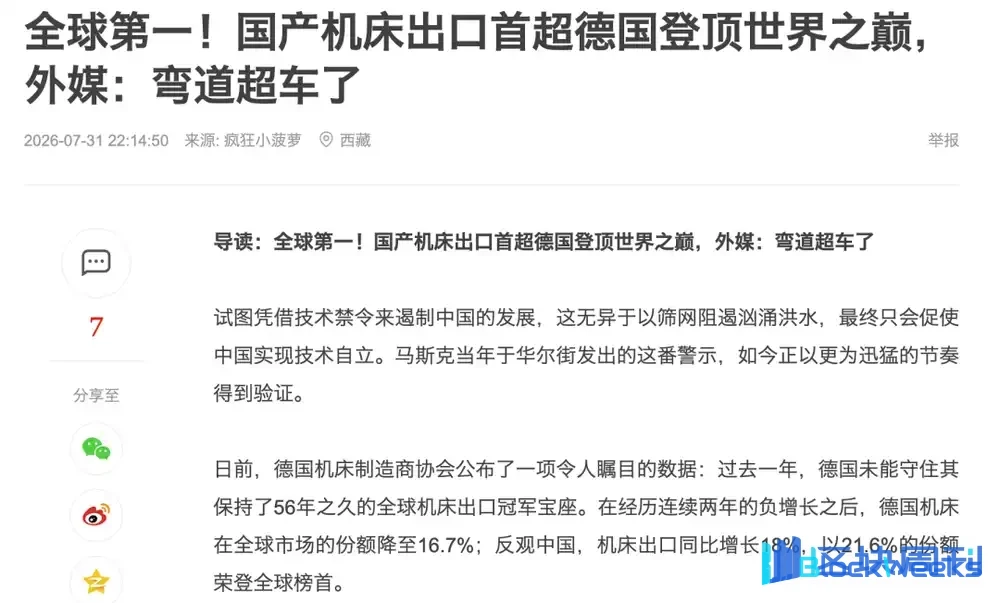
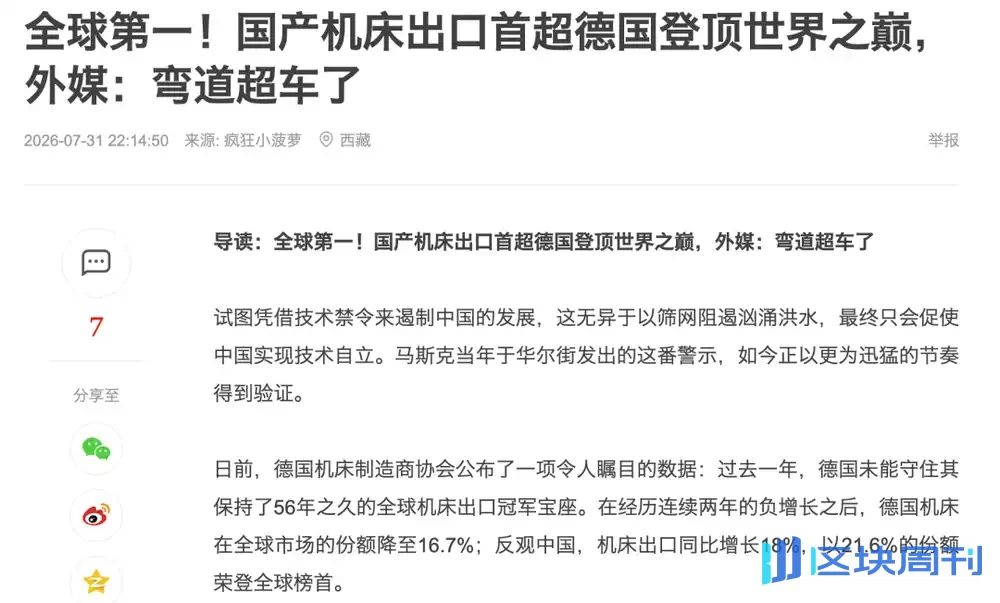
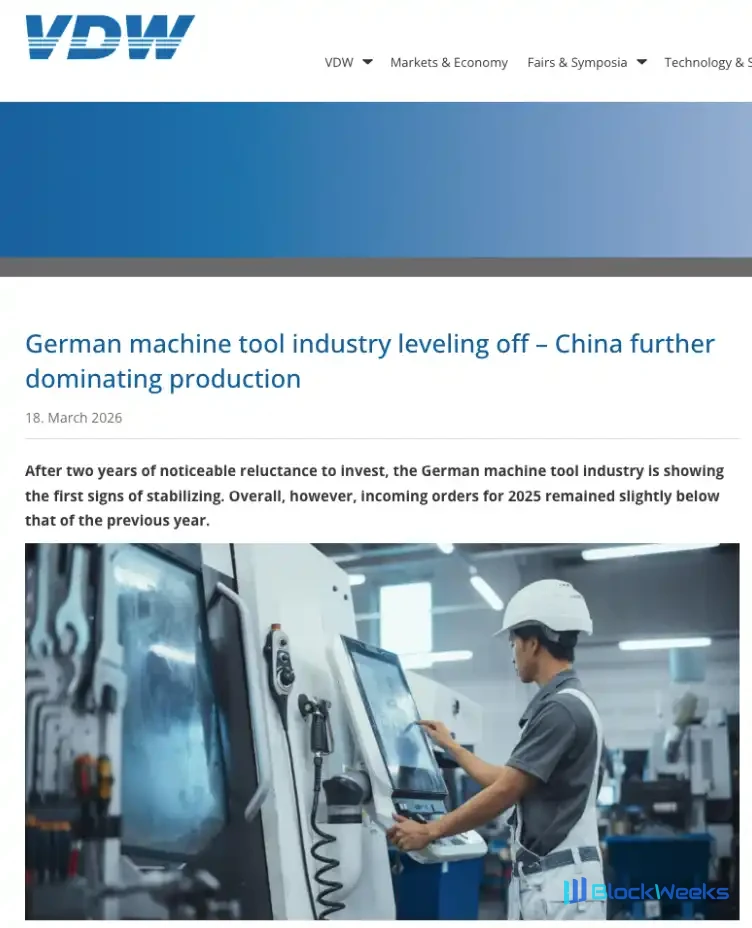
According to the German Machine Tool Builders' Association (VDW), China's machine tool exports reached 8.6 billion euros, accounting for about 21% of the global share, surpassing Germany's 7.1 billion euros for the first time. Germany had held the top spot for decades.
This is the first time China has topped the list, and it makes one wonder:
From spending tens of millions to buy a machine from others, to exporting 8.6 billion euros a year and becoming the world's number one, what exactly happened in between?
01: Making a good machine tool is much harder than you think
The job of a machine tool is simple to describe: use processing equipment (like a cutting tool) to cut, grind, or press metal into the shape we want.
For a high-end machine tool, the precision you need to achieve is at the micron level. One micron is one-sixtieth of the diameter of a human hair.
It might seem that as long as you have hard enough materials for the cutting tool, combined with advanced sensors and control algorithms, it shouldn't be difficult to achieve.
But in fact, making a usable machine tool and making a good machine tool are two completely different levels of difficulty.
The problem mainly lies in sustainability:
You need to cut metal to that precision under enormous cutting forces, high-speed rotation, and impacts, and you have to do it for tens of thousands of hours without losing precision.
There are three physical challenges.
The first is heat: when a machine tool is working, the motor, bearings, and cutting area all generate heat. Metal expands with heat and contracts with cold. Even a few degrees of temperature difference can cause parts to expand by several microns, ruining your machining precision. Uneven heating in different parts can also cause originally aligned axes to slowly shift.
High-end machine tools require a complex thermal compensation system to correct this in real time. This is not something a simple sensor can solve; it involves systematic optimization of the entire machine structure, material selection, and control algorithms. Imagine running a marathon while performing surgery—your body is heating up and shaking, but the scalpel still has to cut along a micron-level line.
The second is vibration: during high-speed cutting, the tool impacts the metal, creating large reaction forces. Self-excited vibration can occur between the tool and the workpiece, known in engineering as "chatter." Once chatter occurs, the machined surface is full of ripples and burrs, and in severe cases, the part is scrapped. Suppressing vibration involves structural rigidity, damping design to absorb vibration energy, cutting parameters, and dynamic compensation in the CNC system. If any link is weak, problems arise.
The third is wear: after the spindle rotates hundreds of millions of times at high speed, bearings, guideways, and ball screws will wear out. The precision is good when it leaves the factory, but whether it can maintain that precision after one or two years of use is the real test.
Domestic machine tools often have good precision at the factory, but after a period of use, they start to drift. The industry calls this "precision retention."
In simple terms, a new car feels great when you first drive it, but the real test is whether it still performs well after three years. That's where skill comes in.
And these three enemies don't come alone; they happen simultaneously and compound each other.
These physical problems ultimately come down to a few core components: the spindle is the heart of the machine tool, determining cutting power and rotational precision; the ball screws and guideways are the bones and tendons, determining the accuracy and smoothness of movement; the CNC system is the brain, responsible for coordinating multiple motion axes and performing compensation and calculations.
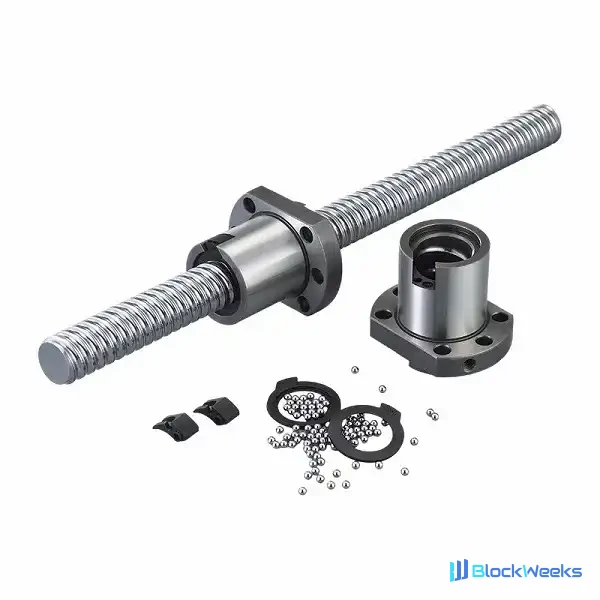
Every component must be top-notch for the whole machine to be top-notch. What's more, to make precision ball screws and spindles, you first need a precision grinder to machine them. This is the classic chicken-and-egg problem in the machine tool industry: you need a good machine tool to make a good machine tool.
Where does China's machine tool industry get stuck? It's stuck on these core components. As of the 2020 assessment, about 90% of high-end CNC systems and servo systems responsible for precisely executing motion commands were imported, and more than 90% of high-end functional components such as spindles, ball screws, and guideways were also bought from others. The heart, brain, and bones—nine out of ten are not our own.
Another professional review from 2025 shows that the mean time between failures (MTBF) of foreign high-end CNC systems exceeds 50,000 hours, while domestic ones are about 30,000 hours. This metric measures how long a system can run on average between two failures, and there is still room for improvement.
02: From Nobody Dared to Use, to Export No.1
So how was this situation gradually turned around?
First, let's look at how low our starting point was:
The Chinese government's largest concentrated effort in the machine tool field was a major national project called "High-end CNC Machine Tools and Basic Manufacturing Equipment," known in the industry as the 04 Special Project.
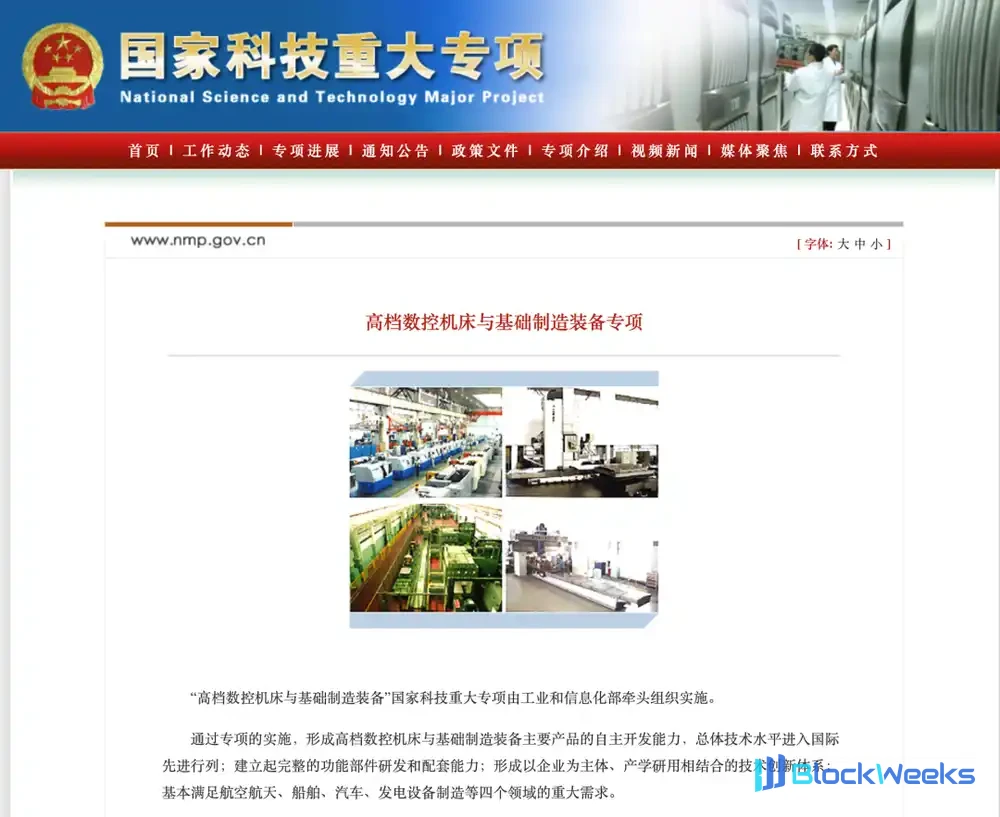
Before this project started, the market share of domestic high-end CNC systems in domestic machine tools was less than 1%, and the MTBF of high-end CNC machine tools as a whole was only about 600 hours. Does 600 hours sound okay? Calculated based on an automotive production line running 20 hours a day, the average time between failures is about one month.
Who would dare to use that?
The 04 Special Project started in 2009 and ran until 2020. Over eleven years, it accomplished several concrete things:
The localization rate of high-end CNC systems increased from less than 1% to 31.9%;
The MTBF of high-end CNC machine tools as a whole increased from 600 hours to over 2,000 hours.
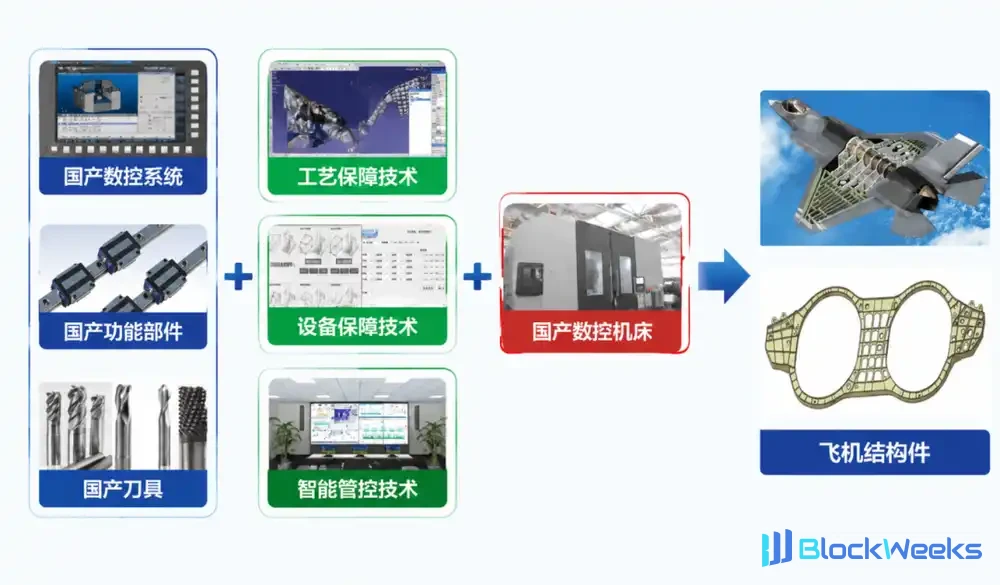
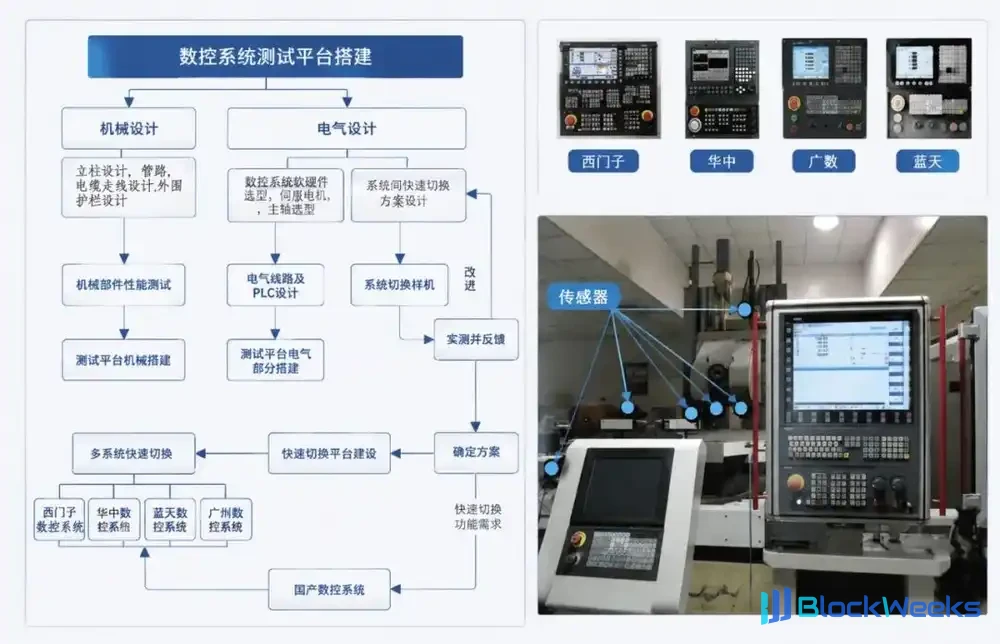
From 1% to 31.9%, from 600 hours to 2,000 hours—not impressive, but enough to sit at the table.
But getting on the step doesn't mean it's done.
The MTBF of the whole machine increased from 600 hours to over 2,000 hours, catching up a lot, but there is still a gap from the world's top tier. The localization rate of core components such as precision grinders and high-end ball screws remains very low.
The 04 Special Project solved the problem of "having or not having," but as for "being good or not," it still needs the next force to push it.
That force is the market, and it is the world's largest and fastest-iterating market. The industrial Cthulhu has arrived.
Let's take new energy vehicles as an example. The explosion of this industry has an impact on the machine tool industry that is not just "more orders." It changes what needs to be processed: traditional fuel vehicles require machining of engine blocks and multi-speed transmission housings, which are no longer needed in pure electric vehicles. Instead, they are replaced by integrated die-cast bodies that cast multiple parts into one, as well as battery housings and electric drive system housings. The work has completely changed, and the old methods no longer work.
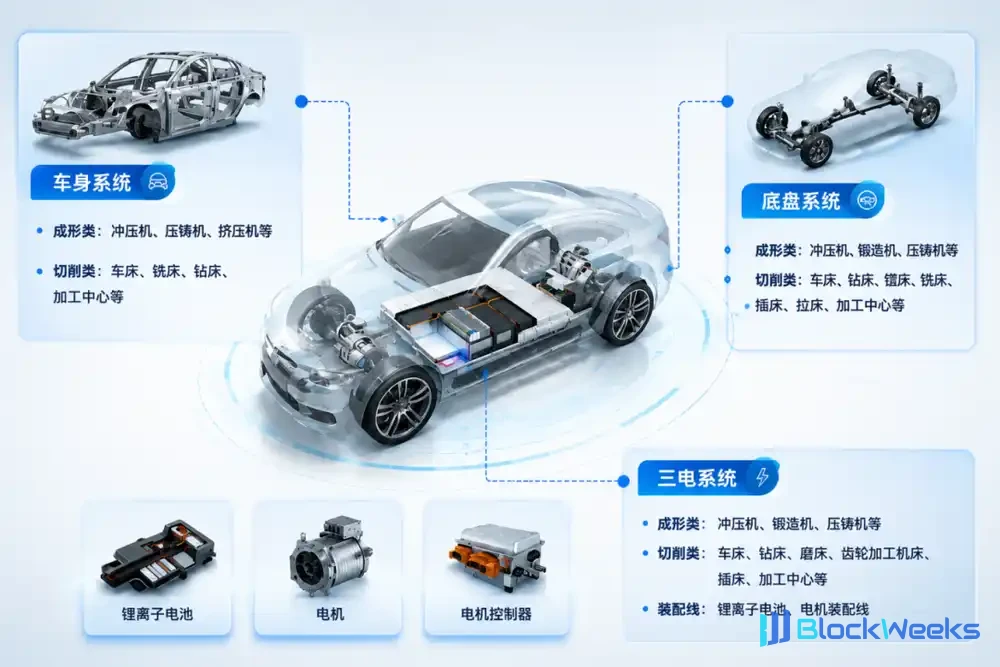
Figure | The body, chassis, and three-electric system of new energy vehicles correspond to the needs for large-scale forming, cutting, die-casting, and assembly equipment.
These new demands have given rise to a batch of domestic equipment and complete line solutions specifically for new energy vehicles. Integrated die-cast parts are much larger than traditional components, requiring gantry machining centers with extra-large travel. Battery housings have thin walls, are prone to vibration, and have extremely high sealing requirements, so general solutions are hard to apply directly; targeted fixtures and machining solutions must be developed.
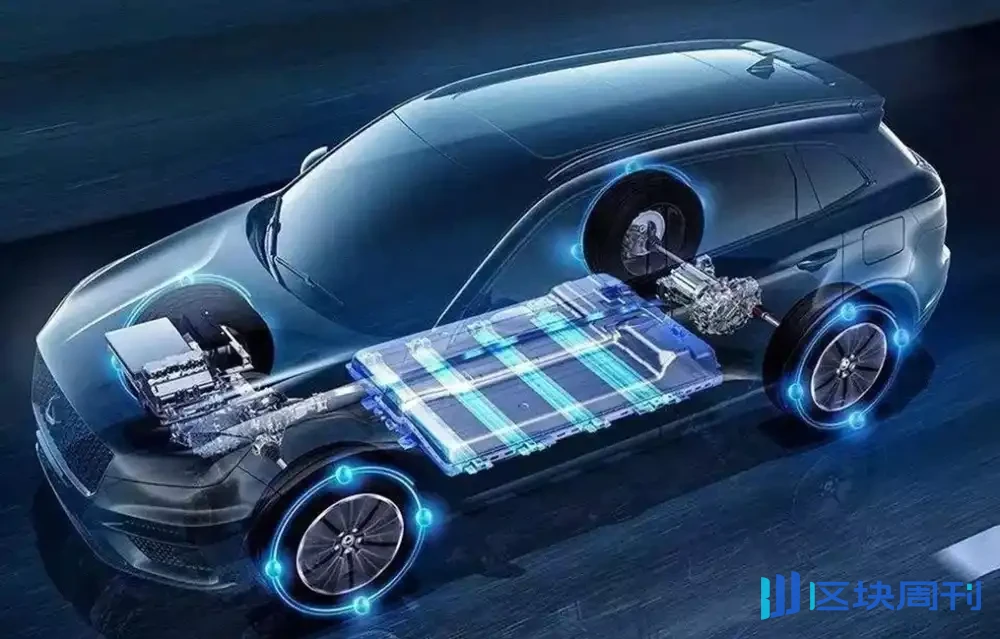
Figure | The battery, electric drive, and chassis systems of new energy vehicles have changed the combination of parts and processes that machine tool manufacturers need to cover.
The story of integrated die casting itself is the most illustrative.
To turn the rear body of the Model Y from more than 70 stamped and welded parts into a single cast piece, Tesla needed a 6,000-ton-class ultra-large die casting machine, and only a handful of manufacturers worldwide could produce such equipment.
What does 16,000 tons of clamping force—the force that holds the two mold halves tightly together during die casting—mean? It is equivalent to stacking more than 10,000 cars and pressing down, just to form an entire body piece in seconds. Integrated die casting started with Tesla and quickly spread to NIO, XPeng, and more Chinese automakers. A brand-new manufacturing process, from definition to mass production and then diffusion, has its main stage in China.
This is not an isolated case. In the new processing fields of integrated die casting, battery housings, and electric drive housings, Chinese companies are closer to the starting line with German and Japanese companies, because these are new topics for everyone.
And local Chinese manufacturers have a natural positional advantage: the world's largest new energy vehicle market is right at their doorstep, customers are next door, and local manufacturers are better positioned in terms of customer distance, response speed, and supply chain coordination to quickly turn feedback into product iterations.
But even with such a large market pushing, the domestic localization rate of high-end machine tools in the automotive field is still less than 10%, and the localization rate of high-precision internal and external cylindrical grinders and precision high-speed gear grinders used for shaft gear precision components is less than 5%. The large market has accelerated the catch-up, but it has not eliminated the gap.
Both technology and the market are moving forward, but manufacturing equipment has an iron rule: selection is slow, and switching is even slower. Once an automotive production line is put into operation, it runs for ten years or even longer. The cost of changing equipment suppliers in the middle is extremely high, not just the cost of the equipment itself, but also redoing process validation, re-validating product qualification rates, and retraining workers.
Therefore, the logic for automakers choosing equipment suppliers is completely different from consumers buying things: it is normal to spend several years evaluating, but once selected and validated, they do not easily change.
No matter how good your spec sheet looks, ultimately you need customers willing to bet their real production lines on you.
Here is a story that spans from 2004 to 2016, lasting twelve years.
It can be said that China's machine tool catch-up is not a single point flip, but a process of climbing step by step with technology, market, and user validation twisted together.
03: Export value surpasses Germany, but this is just the beginning
China's machine tool export value surpassing Germany did not happen overnight: the industry achieved its first trade surplus in 2019, a surplus across all categories in 2023, and officially overtook in export value in 2025, step by step to where it is today.
Overseas markets have transformed from a supplementary channel to a major growth driver, with exports contributing 63.6% to the industry's overall revenue growth in 2025.
But this number one is won on scale and coverage, not yet on all-around technological leadership.
The largest export category is special processing machine tools, which are equipment that mainly uses methods such as electrical discharge machining or laser, rather than direct cutting with traditional tools.
The top five export destinations are Vietnam, Russia, India, Thailand, and the United States, indicating that the current export focus of China's machine tools is clearly tilted towards Asian manufacturing markets.
VDW also specifically noted: this total also includes exports from factories in China operated by international companies such as Germany, Japan, and Switzerland, but the specific proportion was not disclosed. In other words, part of the "Chinese exports" are actually made in your place by others.
However, the identity of China's machine tools has indeed changed: previously, they were the ones being controlled in purchases, with others' export control lists determining what precision equipment they could use; now it is the opposite.
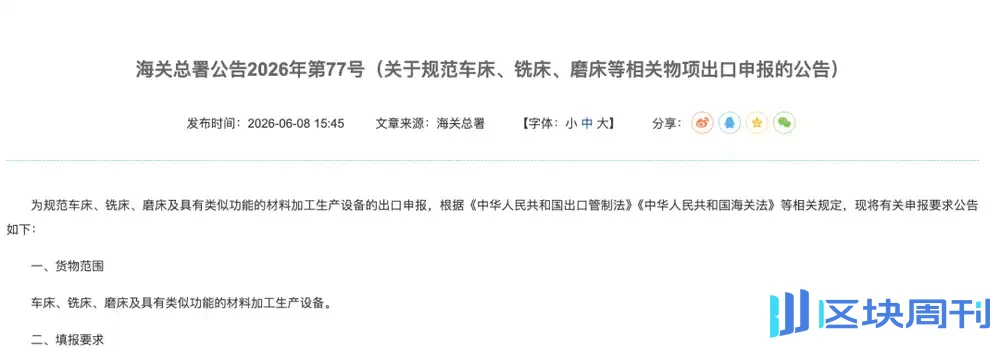
On June 30, 2026, customs further required that when exporting related equipment, technical parameters must be declared and whether they are controlled items must be indicated.
From being controlled in buying to starting to control selling more finely, the export value ranking is just a number; the more important change is that China's machine tool industry has entered a new stage where it must identify and manage the export of sensitive equipment.
And to be calm, becoming the world's number one does not mean firmly holding the world's number one position.
For equipment like machine tools, selling is just the beginning; what follows is ten to twenty years of installation and commissioning, fault response, spare parts supply, and precision assurance. Export value can be reversed within a year or two, but overseas service networks cannot turn around that fast.
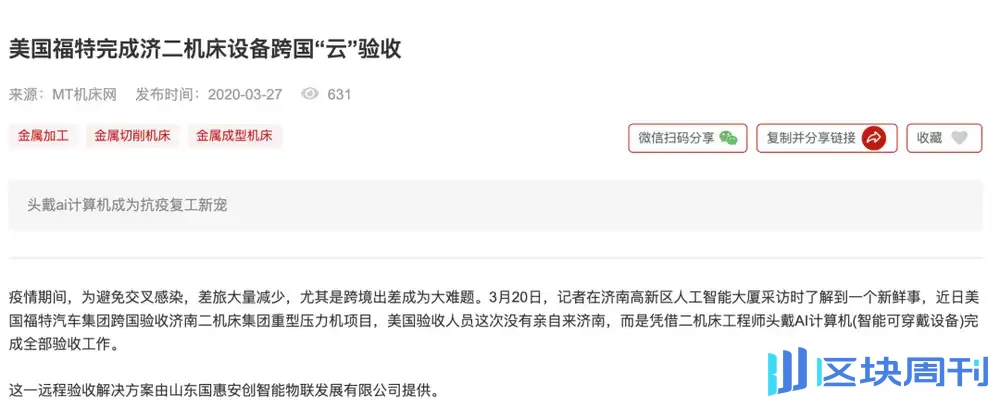
At the 2026 China CNC Machine Tool Fair, there was such a scene: a Turkish buyer flew nearly 9,000 kilometers specifically to find Chinese equipment, repeatedly asking only one thing: after purchase, is there someone locally to repair it? How soon can you arrive if a malfunction occurs?
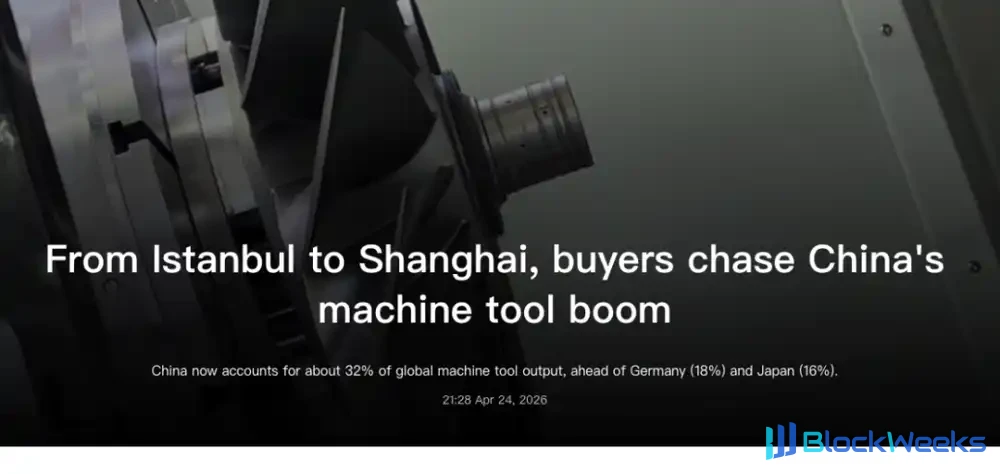
More than a decade ago, when Chinese companies bought German machine tools, they worried about whether the equipment could run stably for a long time and the usage restrictions brought by GPS displacement detection;
Today, overseas buyers care more about after-sales response. The specific issues may differ, but they still point to the same thing: after buying such high-value equipment, can they use it with confidence for a long time?
Selling equipment abroad is only passing the first hurdle. Only when it is installed well overseas, adjusted accurately, repairable in case of failure, and maintains precision for ten years can it truly be said to have firmly held the global number one position.
Whether this comeback can go the full distance is not determined by the ranking table, but by whether factory owners around the world, when they walk into a workshop and stand in front of a new machine, are willing to stake their future ten years of livelihood on a single piece of equipment.
The kind that says "Made in China."
Cool Lab compiled and edited
First published on WeChat public account: Cool Lab (ID: coollabs)
This article is from WeChat public account: Cool Lab , author: Cool Lab