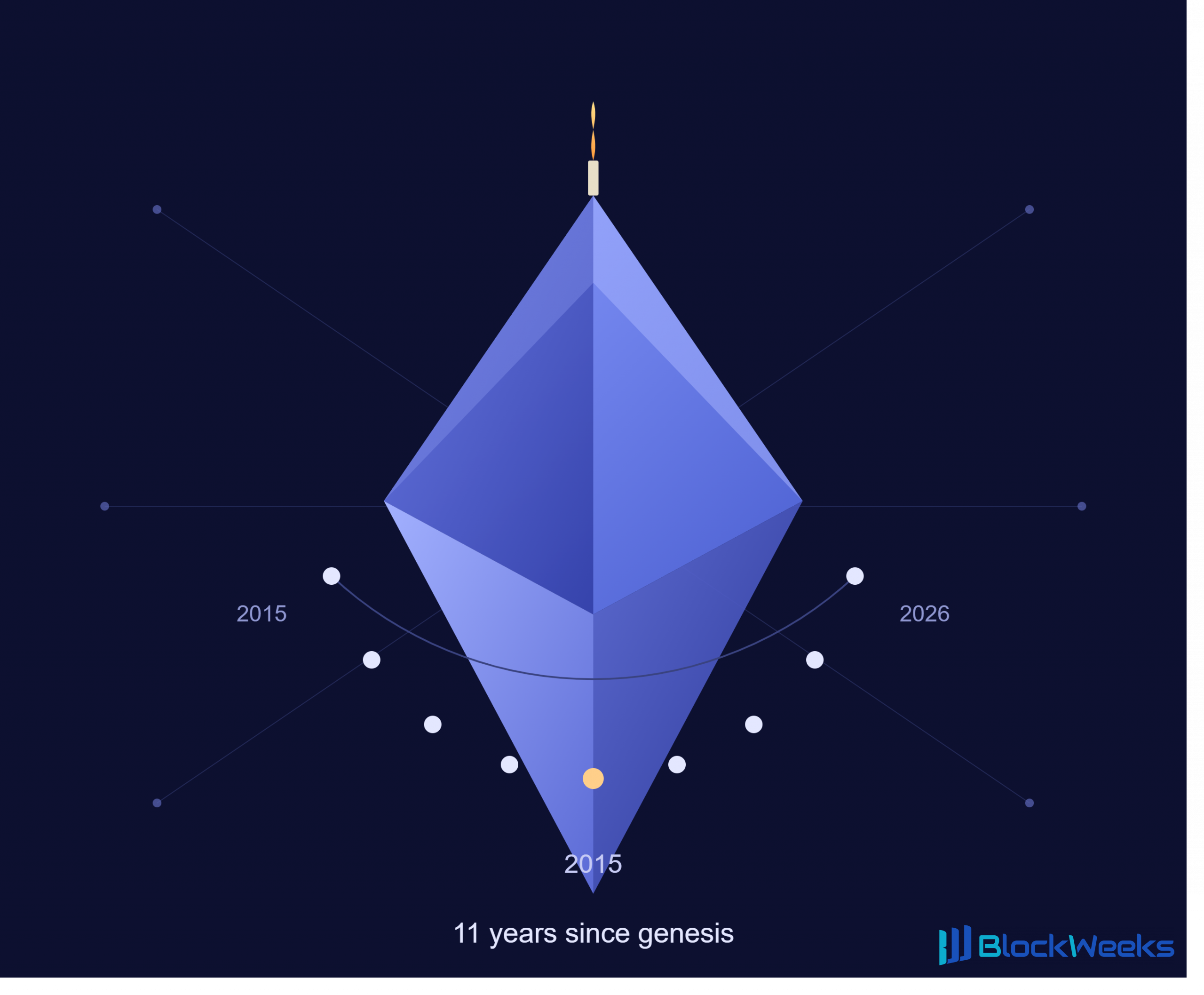
On July 30, 2026, Ethereum celebrated its 11th birthday. From the genesis block that went almost unnoticed in 2015 to the infrastructure that now supports DeFi, stablecoins, RWA, and Layer2 networks, Ethereum has completely transformed the landscape of the crypto world. Currently, about 95% of Ethereum's daily transaction volume occurs on Layer2 networks.
Back in 2011, 17-year-old Vitalik Buterin learned about Bitcoin from his father and became fascinated by it. After contributing to Bitcoin Magazine and briefly attending the University of Waterloo, he wrote the Ethereum whitepaper in November 2013, proposing the idea that "blockchain can run any program." In early 2014, he publicly introduced this concept in Miami and formed the founding team with Gavin Wood, Joseph Lubin, and others. That year, through a crowdfunding campaign, they raised approximately $18 million in BTC and distributed over 60 million ETH to early supporters.
On July 30, 2015, the Ethereum mainnet launched with the Frontier version. But the real test came quickly: in June 2016, an attacker exploited a vulnerability in The DAO smart contract and stole about 3.6 million ETH (worth approximately $50 million at the time). Thanks to the built-in 28-day lockup period, the community was able to negotiate urgently and eventually reversed the theft through a hard fork. The minority who insisted on "code is law" remained on the original chain, which later became Ethereum Classic. This incident became a classic lesson in decentralized governance for the crypto community.
On September 15, 2022, Ethereum completed its boldest upgrade yet — "The Merge" — transitioning from proof-of-work to proof-of-stake with zero downtime. Energy consumption dropped by approximately 99.9%. Combined with the EIP-1559 burn mechanism, ETH's net issuance decreased significantly, even entering a net deflationary state during periods of high usage.
Subsequent upgrades gradually addressed withdrawal and fee issues. Shapella (April 2023) enabled withdrawals of staked ETH; Dencun (March 2024) introduced Layer2-specific data "blobs" via EIP-4844, reducing average gas fees from about 98 Gwei to below 10 Gwei, and cutting fees for Rollups like Arbitrum and Optimism by over 90%.
In May 2025, Pectra raised the maximum validator balance from 32 ETH to 2048 ETH and shortened activation wait time from 12 hours to about 13 minutes; in December 2025, Fusaka further expanded blob capacity through PeerDAS. Together, they doubled the gas limit to 60 million, bringing Layer2 transaction fees below 2 cents.
As of February 2026, over 50% of issued ETH has passed through the staking deposit contract, with approximately 37 million ETH securing the network. Institutional interest is also heating up, with several large asset managers launching regulated Ethereum ETPs with staking features. However, ETH's price remains below its all-time high set in August 2025. The Ethereum Foundation has lost two co-executive directors and several senior researchers over the past few months, primarily due to internal strategic disagreements rather than a decline in confidence in the network.
The next major upgrade, Glamsterdam, is planned for the second half of 2026 and will introduce native proposer-builder separation (ePBS) and block-level access lists to achieve fairer block construction and parallel transaction execution, as well as prepare for higher gas limits in the future. The longer-term roadmap also includes post-quantum cryptography, stateless clients, and zero-knowledge verification of the Ethereum execution layer.
Eleven years ago, a few developers mined a genesis block that no one paid attention to; today, Ethereum settles billions of dollars in stablecoin transactions daily and supports a Layer2 ecosystem that often exceeds the main chain's transaction volume. This is not the result of a sudden flash of inspiration, but the product of a community continuously building through crises and internal friction.