
Every Monday to Friday morning, focusing on macro, US stocks, AI, precious metals, and crude oil, using data to review the market and trends to seize opportunities, produced by PANews.
Dow closes at record high for third consecutive day, gold breaks above $4,300, two Fed officials discuss rate hikes
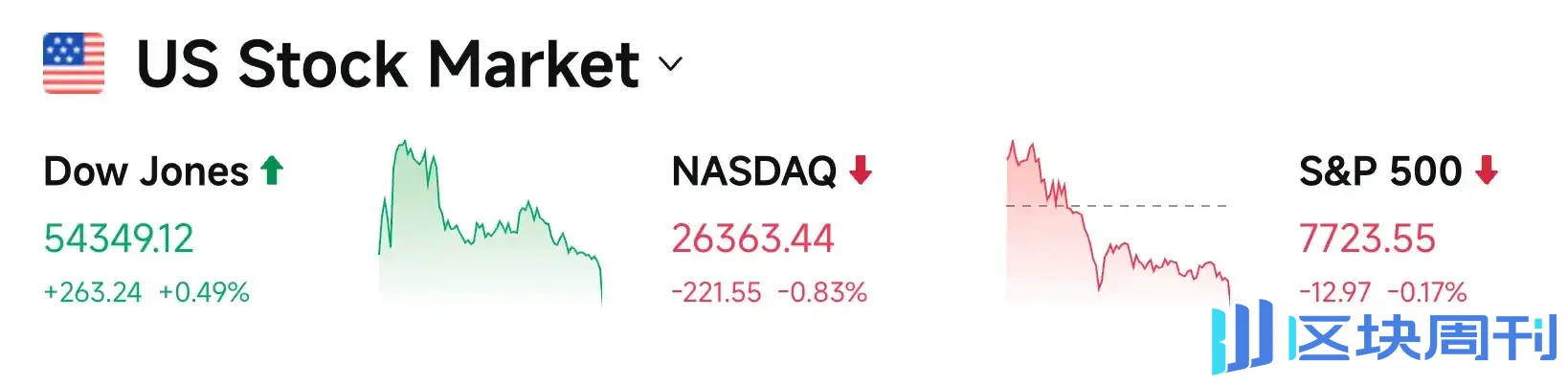
Overnight and this morning, the Dow Jones Industrial Average rose 0.49% against the trend, marking a third consecutive day of record closing highs, and the 24th time this year it has rewritten the record; meanwhile, the Nasdaq and S&P 500 fell 0.83% and 0.17% respectively, with weakness in tech stocks dragging down the broader market.
Gold was the biggest winner of the day, with spot gold surging more than 4.2% in a single day, recording its largest daily gain in five months and breaking above the 50-day moving average, and breaking through the $4,300 per ounce level this morning, the first time since June 18. Bloomberg analyst Cameron Crise pointed out that according to traditional driving models, gold prices "should" have fallen slightly, but this time there was the largest excess performance outside the model in the past decade, with the core driver being CTA trend funds facing concentrated short covering at the key level of $4,200, coupled with management funds having previously reduced long positions, leading to a vacuum in the market's buying structure and causing violent fluctuations.
Data from the World Gold Council shows that central banks globally made record net gold purchases in the second quarter, with Poland buying 51 tons, the People's Bank of China increasing holdings by 33 tons, and South Korea returning to the market after 13 years. These central bank purchases have provided solid bottom support for gold prices. Silver also surged, with gold/silver sector stocks generally rising around 7%.
Geopolitical tensions showed signs of easing, and the crude oil market fluctuated slightly. On the news front, Iran and Oman are in final consultations on a new shipping arrangement for the Strait of Hormuz. Iran's Deputy Foreign Minister stated that the new plan will redesign shipping routes, with most segments passing through Iranian territorial waters, and Iran rejects any intervention by external forces. Currently, there are significant differences on fee standards, with Iran proposing a fee of 5% to 7% of cargo value, while the US opposes any fees. Iran emphasized that the reopening of the strait is conditional on the US ceasing sanctions and military pressure, and subsequent progress of the agreement still depends on US-Iran relations.
Meanwhile, Trump expressed strong dissatisfaction with Defense Secretary Hegseth because the US military's inventory of long-range guided missiles and air defense interceptors (such as ATACMS) is nearly depleted, and this shortage directly limits US military options in dealing with Iran.
On the macro and monetary policy front, affected by relevant data and geopolitical situations, the interest rate market's probability expectation for a Fed rate hike in September plummeted from nearly 70% to around 54.9%. Despite cooling rate hike expectations, Fed officials maintained a hawkish stance: Fed Governor Cook and Minneapolis Fed President Kashkari both issued warnings, emphasizing that they are prepared to raise rates further if inflation does not slow down.
Nvidia hits two-month high with five consecutive gains, SpaceX and AMD "beat expectations but dumped" dragging down the Nasdaq
The AI mainline that previously drove the Nasdaq to continuous record highs has cooled down. On Wednesday, the tech seven giants index fell slightly. Nvidia rose 3.43% against the trend, leading gains, rising for five consecutive trading days and hitting a near two-month high, with market value approaching $5.8 trillion; Micron rose slightly, returning to the trillion-dollar market cap club. AMD fell more than 7%, SpaceX plunged nearly 14%, and Google fell over 4%, dragging down the Nasdaq and the Philadelphia Semiconductor Index (down 1.4%).
The major leadership reshuffle in Google's AI department was a big blow to US stocks last night. DeepMind CEO Demis Hassabis transitioned to Chairman and became Alphabet's Chief Scientist, with CTO Koray Kavukcuoglu taking over daily operations; Jeff Dean, Chief Scientist for 27 years, left with three top scientists to start a venture focused on automated scientific research. The delayed release of the flagship Gemini version has raised investor concerns that Google is lagging behind OpenAI and Anthropic.
Storage, optical communications, and photovoltaic sectors generally came under pressure, while gold mining and pharmaceuticals were the winners.
Photovoltaic company SolarEdge beat market expectations in both revenue and adjusted EPS, and achieved positive free cash flow, but still recorded a GAAP net loss, and its Q3 guidance was low, with the stock plunging over 30%. In contrast, Eli Lilly raised its full-year guidance and saw strong demand for GLP-1 weight-loss drugs, rising nearly 5%, leading the healthcare sector; e-commerce Shopify saw Q2 revenue up 34% and Q3 guidance exceeding expectations, with the stock surging nearly 17%.
SanDisk and Western Digital reported strong earnings data, but their next fiscal quarter guidance failed to meet the market's high expectations for the AI storage cycle, leading to sharp declines in after-hours trading. SanDisk's Q4 revenue grew significantly but Q1 guidance missed expectations, and Western Digital was similar, with after-hours losses widening.
Specific project actions and stock price fluctuations:

SpaceX fell about 13.6%: In its first quarterly report after listing, revenue nearly doubled, losses narrowed, and Starlink and AI performed strongly, but capital expenditures surged sixfold to $18.4 billion (mainly invested in AI), raising concerns about sustainability. Goldman Sachs noted that despite short-term volatility, its differentiated advantages in space and AI remain solid. Deutsche Bank lowered its target price to $235, while JPMorgan raised it to $240 and maintained an overweight rating. The space communications and tower sectors collectively came under pressure, with AMT, CCI, and SBAC falling 5% to 7%, and telecom giants AT&T and Verizon also dragged down about 2%.
AMD fell more than 7%: Quarterly revenue guidance beat expectations and data center revenue doubled, but it still failed to meet the elevated expectations for AI accelerator cards and server CPU market share. Musk's confirmation that he only uses Nvidia chips further dampened sentiment.
Nvidia surged 3.43%: Five consecutive gains, with the stock hitting a nearly two-month high, boosted by Musk's endorsement and strengthened expectations for cloud capital expenditures.
Google fell more than 4%: AI department restructuring and the departure of veterans like Jeff Dean raised concerns about strategic coherence and Gemini progress. Related tech stocks: Apple rose 0.52% against the trend due to strong new iPhone stocking, Meta edged up 0.14%, while Microsoft and Amazon fell 1.09% and 1.72% respectively.
Eli Lilly rose nearly 5%: Raised 2026 sales guidance to $85-87 billion, with Mounjaro and Zepbound sales far exceeding expectations, alleviating concerns about a cooling weight-loss drug craze. The healthcare sector rose about 1%, leading the eleven major sectors.
Shopify surged nearly 17%: Q2 revenue grew 34% beating expectations, Q3 guidance of "low 30% range" was higher than the market's 27% expectation, marking the sixth consecutive quarter of over 30% growth. Analysts noted that AI code generation now accounts for more than half, and cost concerns are being digested by growth.
- Circle edged up 0.05%: Q2 revenue of $701 million missed the expected $717 million, but net profit of $48 million beat expectations by 8%. Despite growth in average USDC circulation, quarter-end circulation shrank 4.8% quarter-over-quarter.
Gold and silver mining stocks collectively surged: Eagle Mining rose 9.89%, Kinross Gold rose 8.89%, AngloGold rose 8.72%, Barrick Gold rose 7.46%, Pan American Silver rose 7.41%, Newmont Mining rose 6.69%, and Royal Gold rose 4.40%.
SanDisk fell 5.40%, and fell more than 8% in after-hours trading: Q4 revenue was $8.97 billion, up 372% year-over-year, adjusted EPS was $39.25, and full-year revenue reached $20.25 billion, up 175% year-over-year. Additionally, it announced a new $14 billion share repurchase plan. However, the market was dissatisfied with the outlook: fiscal 2027 Q1 revenue guidance of $10.3-10.8 billion was below the analyst expectation of $11.16 billion.
Western Digital fell 5.36%, and plunged about 12% after hours: Q4 revenue was $3.75 billion, up 44% year-over-year, with non-GAAP EPS of $3.56. The company expects next quarter's revenue midpoint of about $4.1 billion and non-GAAP EPS of about $4.00. Despite solid results, the market was disappointed with the guidance elasticity due to previously overheated expectations in the AI storage sector, putting pressure on the stock.
AppLovin plunged over 25% after hours: Q2 revenue of $1.92 billion slightly missed expectations, and management admitted that the pace of AI model upgrades had stalled, with market tolerance for AI monetization having dropped to freezing point.
What to watch next:
August 6 (Thursday)
SpaceX's approximately $116 billion insider shares officially enter circulation: The largest lock-up expiry in history may intensify short-term selling pressure and test the market's capacity to absorb AI capital expenditures; also watch for potential catalysts from Musk's Grok-related developments (timing TBD) on AI sentiment.
20:30 US initial jobless claims for the week of August 1: The market is watching whether the data will be higher than the expected 205,000, with the prior reading at 197,000. If initial claims rise, it will further confirm labor market cooling, pushing down Treasury yields and the dollar, which is positive for gold and growth stock valuations; if the data is strong, it may weaken the sustainability of the gold squeeze.
August 7 major earnings: crypto miners CleanSpark, MARA, Datadog, D-Wave Quantum, ConocoPhillips, Unity, AAOI, MP Materials, Atlassian, Rigetti, MGM China, Zai Lab, etc.