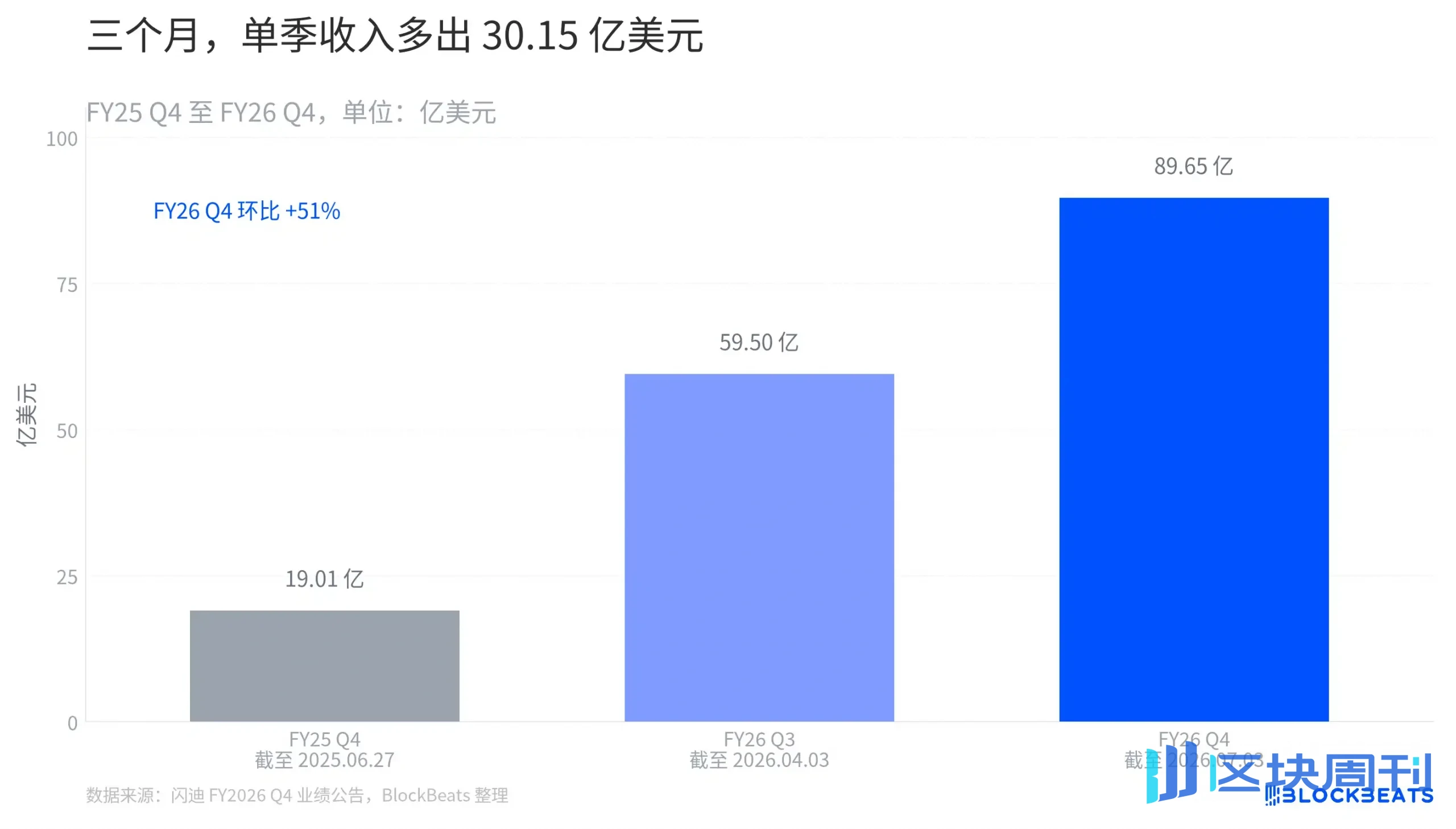
SanDisk's latest quarterly report card, at the top is quarterly revenue of $8.965 billion. According to the company's announcement, this is 51% higher than the previous quarter.
This is not the "second quarter" of the company's fiscal year. On SanDisk's books, it is called FY2026 Q4, with the reporting period ending July 3, covering most of the natural year's second quarter, and it is also the latest second-quarter operating snapshot. The fiscal year name takes a detour, and what is easier to overlook when reading the financial report is where the growth actually comes from.
In the 8-K attachment submitted to the U.S. Securities and Exchange Commission, the company noted that the results are still before the fiscal year closing and audit process, and the final 10-K may be adjusted. This article is based on this earnings announcement and does not treat management's next-quarter guidance as already realized revenue.
How exactly did this quarter's revenue jump?
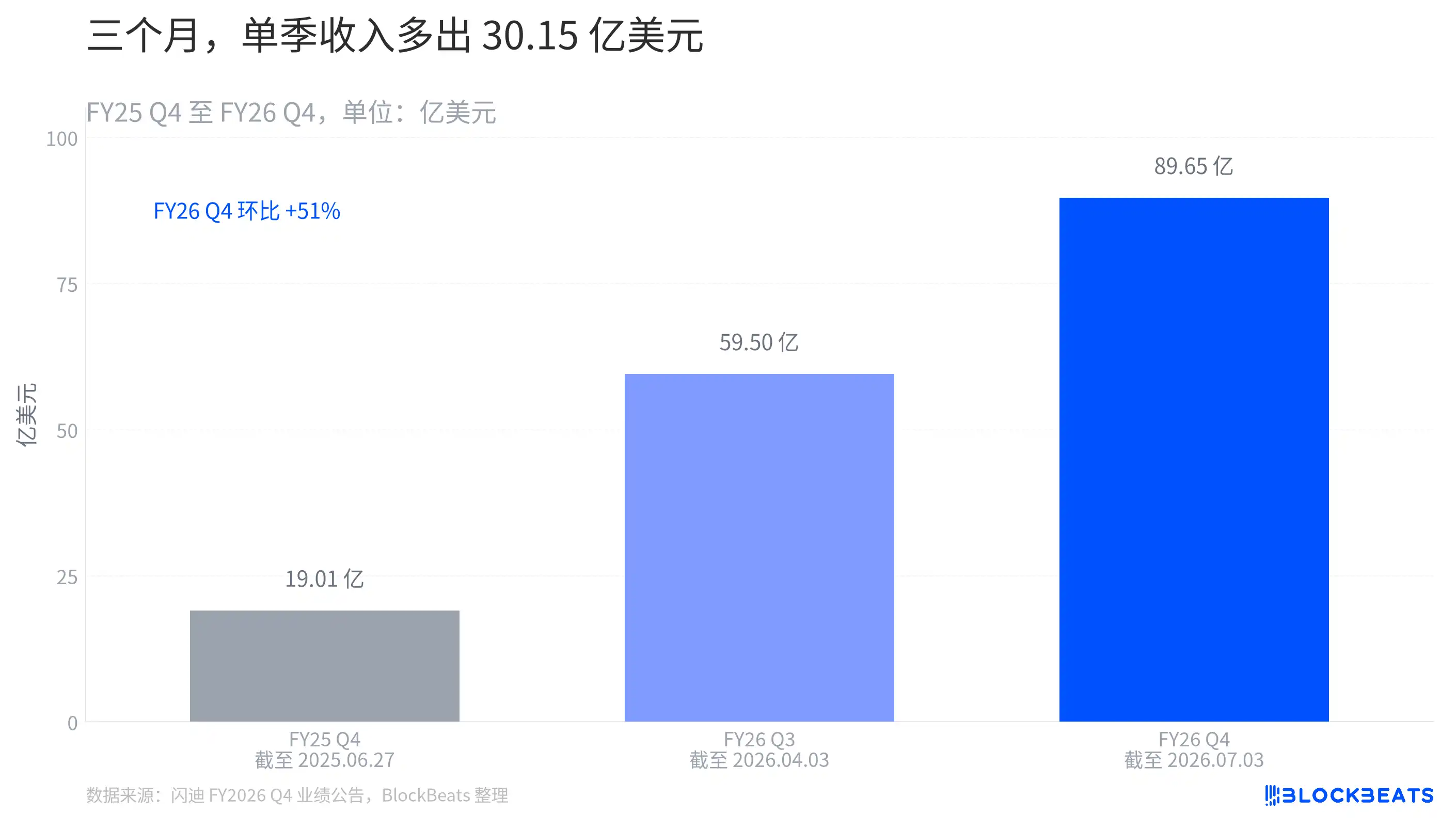
According to SanDisk's earnings announcement, FY2025 Q4 revenue was still $1.901 billion, while the latest quarter reached $8.965 billion. The steps in the chart are steep, but they are closer to the company's operating feel than "year-over-year growth."
The last bar is particularly interesting. The increase in revenue in the latest quarter compared to the previous quarter has already exceeded the entire quarter's revenue of FY2025 Q4. It translates the 51% quarter-over-quarter growth into a more intuitive picture. SanDisk is not adding a small segment to its original scale, but growing another past quarter of itself within three months.
The company's next-quarter revenue guidance midpoint has already crossed the $10 billion mark. That is a dashed line, representing management's current judgment, not a fact confirmed in advance by this article.
Why did almost all the new revenue stay in gross profit?
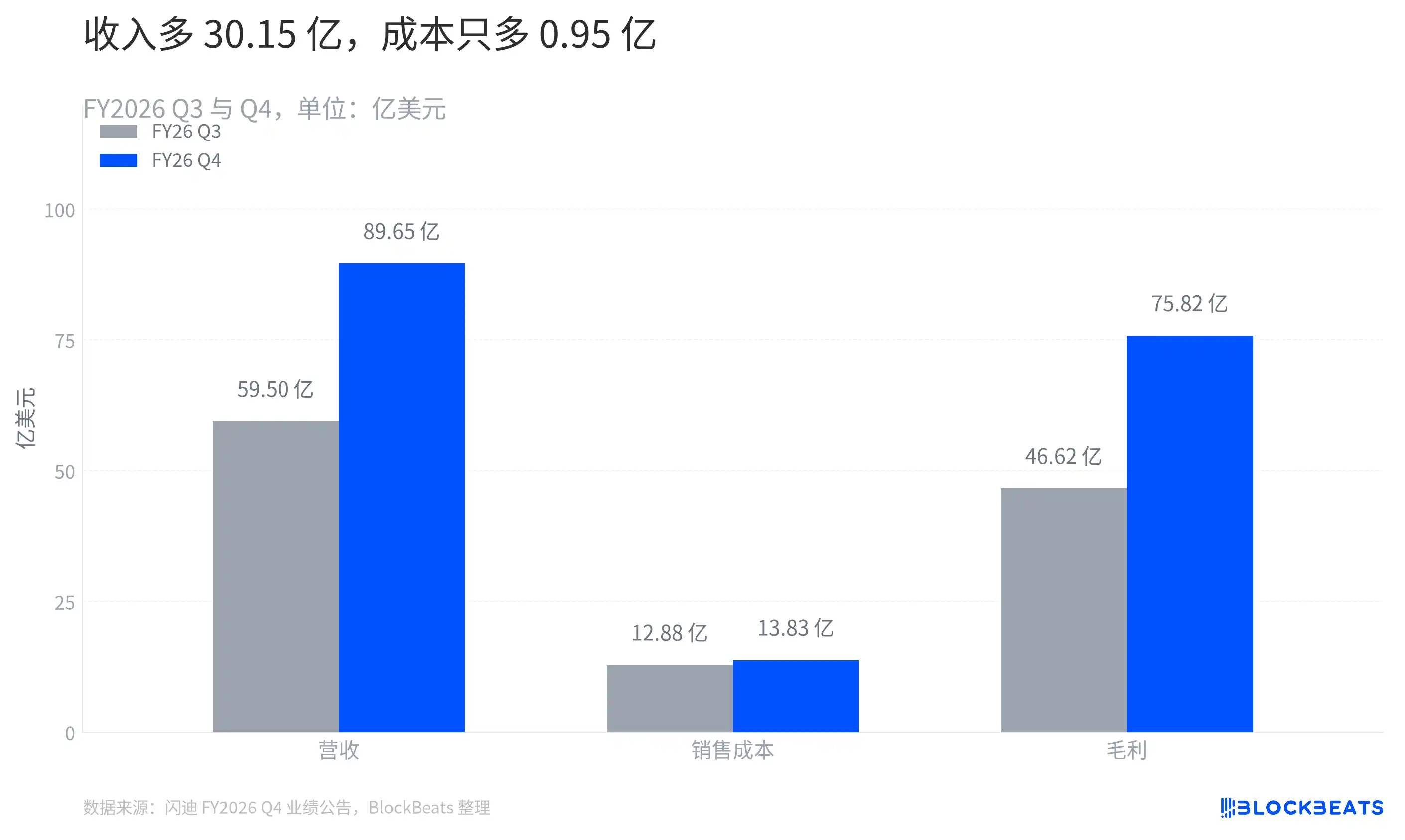
According to the company's announcement, FY2026 Q4 sold $3.015 billion more than the previous quarter, while cost of sales only increased by about $0.095 billion. The chart shows a clear mismatch. The blue bar for revenue stretches out, but the cost bar barely moves.
This is the change that a NAND manufacturer most needs to take seriously. The new revenue did not come with a proportional increase in manufacturing spending, and the gross margin continued to rise above 80%. Translating the book changes into plain language, for every new dollar of revenue, the vast majority stayed in gross profit.
Large profits still need to be examined separately. According to the company's reconciliation, GAAP net income and Non-GAAP net income differ by about $0.741 billion. The most prominent item is the $0.804 billion gain on equity securities that the company excluded from its Non-GAAP measures. This type of gain from valuation or disposal is not the same as selling more flash memory in the quarter, and not all the brightness in the GAAP income statement should be attributed to the core business.
Is data center the only protagonist?
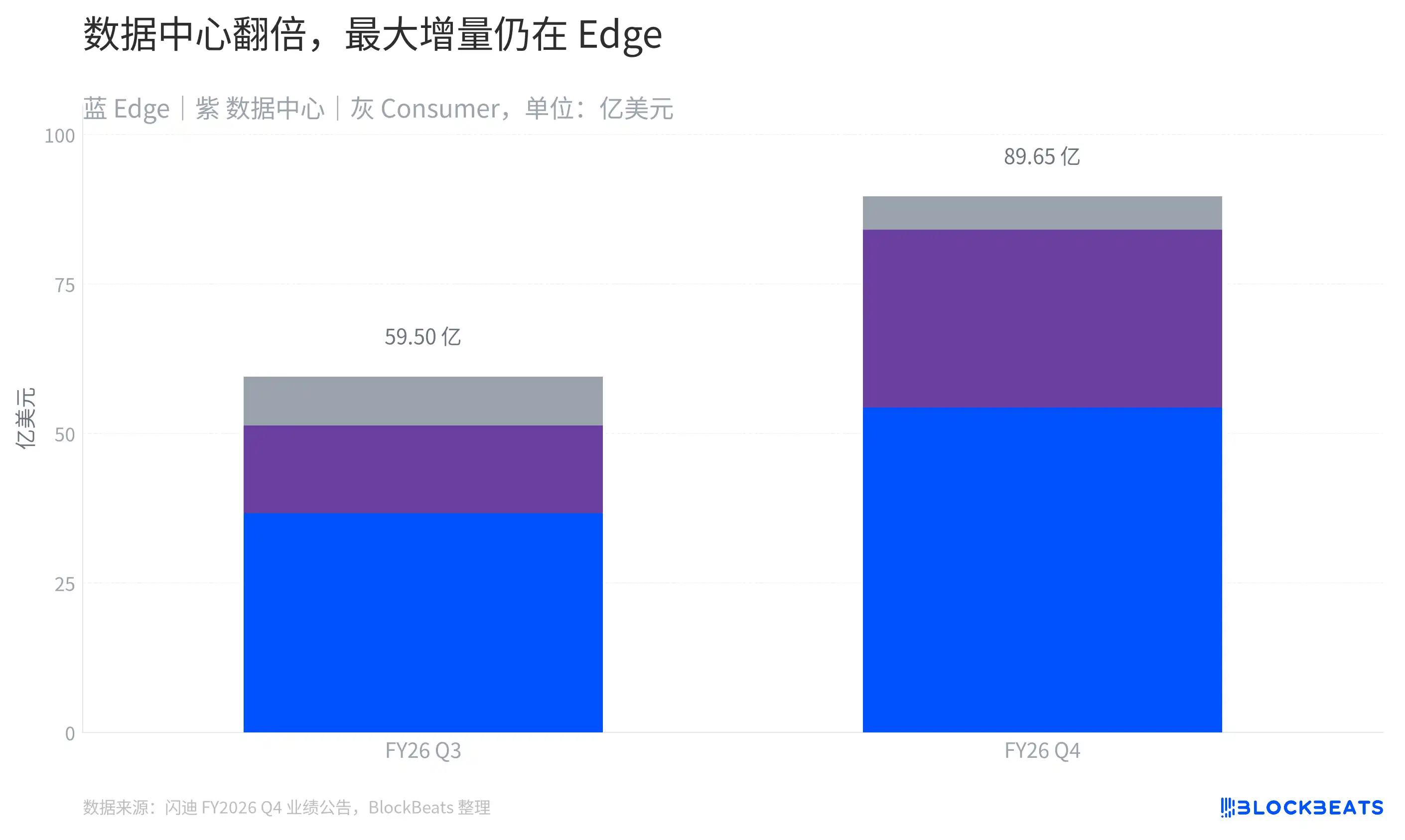
According to the company's announcement, data center revenue doubled this quarter, making it the easiest to become the protagonist in the AI narrative. But when looking at the three markets together, the blue Edge is still the largest base, and its increase in the quarter was slightly higher than data center.
This distinction is crucial. Data center provided the fastest speed, while Edge provided a larger revenue increment. The top Consumer segment actually thinned, indicating that this explosion is not all demand rising simultaneously, but different endpoints re-queuing with different intensities.
Summarizing it as "AI driving flash memory" is not wrong, but it misses the revenue structure. Data center makes growth more prominent, Edge continues to expand scale, and the decline in Consumer reminds readers that SanDisk has not turned every product line into the same curve.
What did prices do?
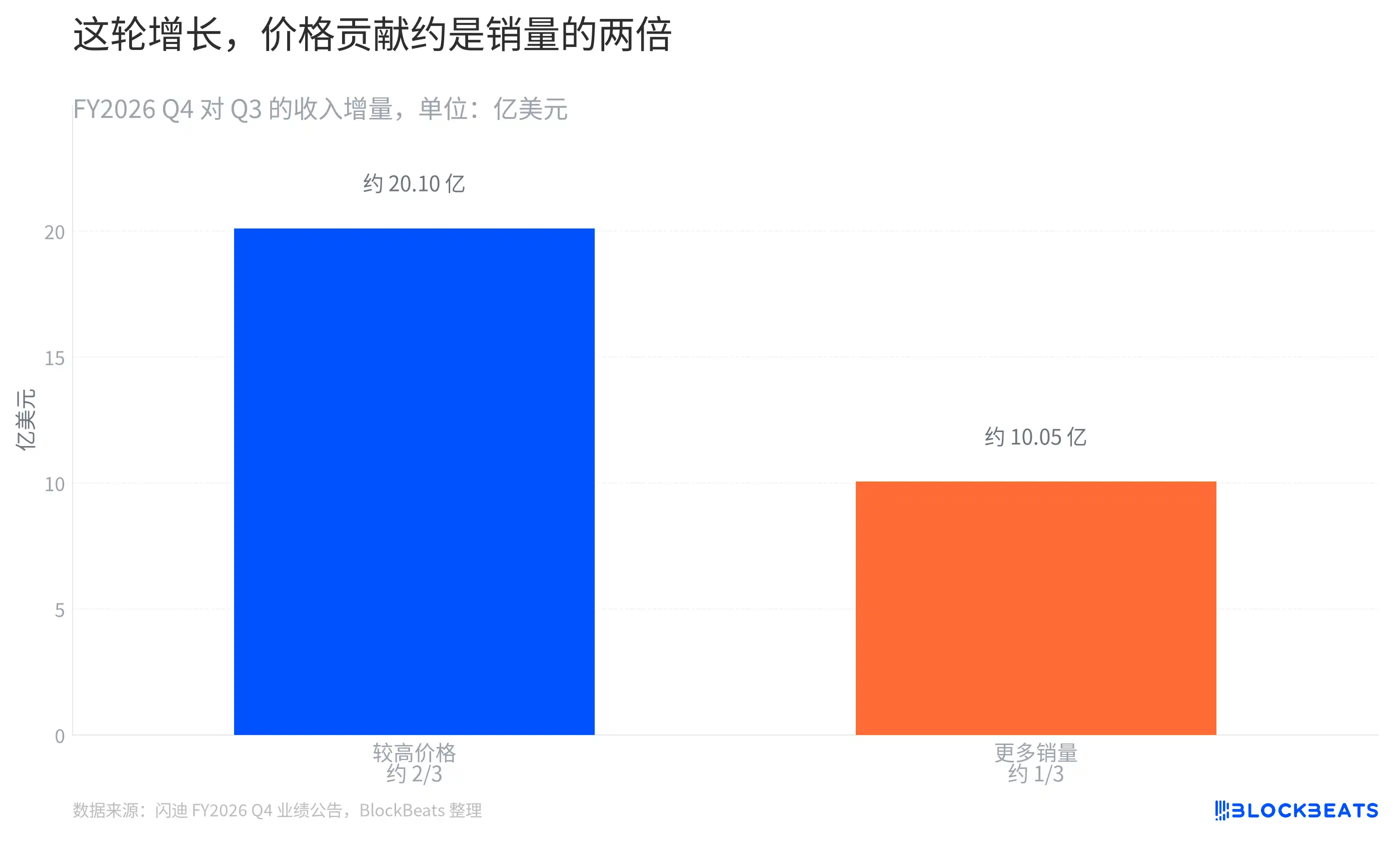
SanDisk gave a rare breakdown in its earnings announcement. This quarter's sequential revenue growth came about one-third from higher volume and about two-thirds from higher prices. Converting according to the company's stated proportions, the contribution from price is about twice that of volume.
The two bars in the chart are not separately disclosed audit segments, but rather placing "about two-thirds" and "about one-third" on the same scale. It at least shows that customers bought not only more NAND, but SanDisk also completed sales at higher unit revenue. Once price and product mix rise together, manufacturing costs do not need to increase proportionally, and the income statement will show the folding mentioned earlier.
SanDisk's latest second-quarter earnings report is not a single-line story that relies only on AI. Data center amplified the narrative, Edge preserved the largest increment, and price pushed new revenue into thicker profits.