After layers of security checks and with phone cameras covered with anti-peep film, Phoenix New Media Technology entered this data center in Ulanqab, Inner Mongolia. It hosts large-scale intelligent computing businesses for cloud vendors and AI companies, and is also a microcosm of China's AI industry competing for computing infrastructure.
Instead of the imagined dust, there was a low hum - the cold airflow of the intelligent computing center roaring in the cabins. Orange-and-white giant boxes were neatly arranged, still waiting for the insertion of cards.
"Today, it can be said that not a single card is idle. Delivery is productivity; faster delivery reflects greater customer value," introduced Wang Chaoyang, General Manager of Alibaba Cloud's Global Data Centers.
Since the beginning of this year, as
DeepSeek
and other AI newcomers have announced plans to build or co-build data centers, the industry is quietly shifting from the asset-light model of "renting machine rooms and buying computing power" to deep control of computing infrastructure. The corporate logic has also shifted from buying cards in the past to hoarding strategic assets, with 10,000 or 100,000 cards becoming the entry threshold.
Ulanqab has thus evolved into a key battlefield where AI giants compete for the high ground of computing power. From self-developed equipment in self-built machine rooms to modular "cabins" delivered in 100 days for leased machine rooms, a "new Foxconn" model for the AI era is emerging.
Visiting Ulanqab: What exactly is inside the intelligent computing center?
Ulanqab, a grassland city in central Inner Mongolia with an average annual temperature of only 4.3 degrees Celsius. In the middle of this year, a recruitment notice from
DeepSeek
brought it into the AI industry's spotlight.
In the past, it was known as the "Hometown of Chinese Potatoes." In 2013, when mobile internet was just emerging, Ulanqab introduced Huawei to build its first cloud data center, officially kicking off the era of big data. In the following years, the rise and fall of the internet evolved quietly here in symbols that humans cannot directly read, with Huawei, Alibaba, Apple, Kuaishou, Century Internet, and GDS successively settling in Ulanqab.
According to data released by the local government, as of the end of 2025, Ulanqab has signed 84 data center projects, of which 81 are intelligent computing centers, with a total investment exceeding 500 billion yuan.
In 2026, a new protagonist appeared.
DeepSeek
began large-scale recruitment for its intelligent computing center in Ulanqab and planned to build a super-large intelligent computing center with a total power of 1 gigawatt (GW), simultaneously recruiting IDC design and planning engineers.
Following the attention of the entire AI industry, a super-large intelligent computing center cluster that was originally hidden on the grassland was unveiled, and Phoenix New Media Technology also came to Ulanqab in August.
"One step west of Beijing is Ulanqab." Walking out of the high-speed rail station, besides the refreshing coolness, there were conspicuous red promotional banners.
It is 350 kilometers from Beijing, reachable by high-speed rail in less than two hours at the fastest, with a network latency of only 4 milliseconds. The temperature is low all year round, it is windy and dry, and it is not on an earthquake belt. Most importantly, it is a "lowland" for electricity prices, with green electricity accounting for 90% and electricity prices at 0.32-0.35 yuan per kilowatt-hour - the same machine room placed in Ulanqab can save 5 billion yuan in annual electricity costs compared to neighboring cities.
With these advantages combined, Ulanqab has become the largest intelligent computing cluster in the country, surpassing all East-Data-West-Computing nodes, and a true "Token Capital."
Alibaba Cloud's data center park is also in Ulanqab. Here, there are not only data centers self-built by Alibaba in the early years, but also a 5.0 cabin data center built in just 100 days with modular design - the latter now carries 80% of Alibaba Cloud's intelligent computing business.
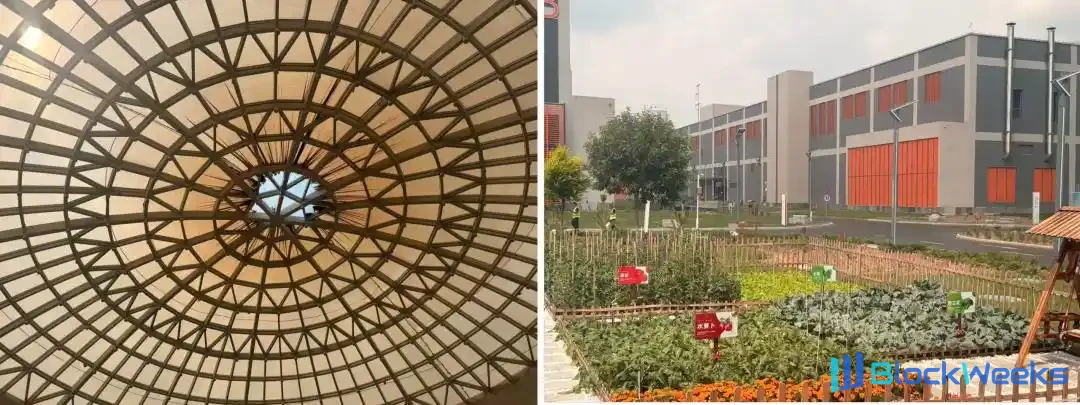
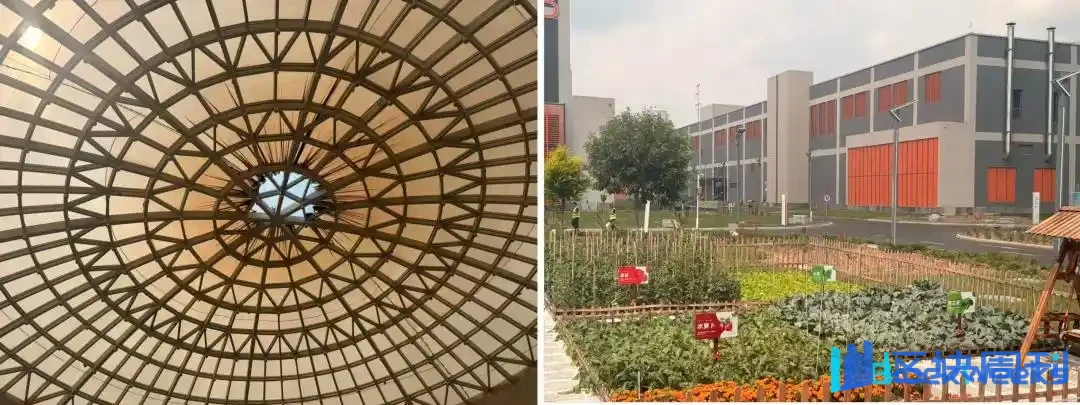
Left: The "yurt" added for heat insulation on the top of Alibaba's data center office building; Right: Exterior view of the data center
Here, we found that the construction of data centers is not just about "building houses." Just as
DeepSeek
is recruiting IDC design and planning engineers, there is much expertise involved. For example, Alibaba's self-built 2.0 architecture machine room in Ulanqab is the pinnacle of the previous generation of technology. To save electricity, Alibaba tested its self-developed Panama power supply here, extremely compressing the transformation stage; to save water, the machine room uses a closed system, and even uses the heat emitted by servers to heat equipment rooms in winter.
In the power distribution room, the guide told us, "In traditional machine rooms, the entire first floor is infrastructure, and the second floor is servers. But in our new 5.0 architecture, everything is 'flattened.'"
The so-called flattening "essentially turns engineering into factory, replacing engineering with products," explained Wang Chaoyang. From 10kV medium-voltage power distribution to self-developed Panama power supply, to lithium battery backup and liquid-cooled IT cabinets, everything is prefabricated in the cabin. On site, it is only necessary to hoist the cabin into place and connect the lines, just like assembling LEGO.
"In the past, building a data center required thousands of people working on site. Now it's a team of cranes pushing containers to the right position. Our limit is from zero building to delivery in four and a half months," the guide revealed. Although currently constrained by the pulsed shortage of upstream raw materials and components, the ideal 100-day "first 30 days of prefabrication" is sometimes difficult to perfectly time, the intermediate assembly process has already been optimized to the extreme.
DeepSeek also bets on seizing computing infrastructure
In the past few years, the competitive focus of large model companies has been on algorithms, data, and model parameters.
But entering the era of 10,000 or even 100,000-card training, computing power has transformed from "procurement resource" to a strategic asset that determines the survival of enterprises.
DeepSeek
's heavy bet is a microcosm of this trend. A harsh reality is facing all AI race contestants: the available computing machine rooms on the market have long been snapped up. The traditional construction cycle of 12 months or more cannot keep up with the exponential explosion of Token demand. In the context of the AI demand explosion, whoever can quickly have a large-scale, high-density, low-cost dedicated computing base will get the ticket to the next round of competition.
Moreover, the rise of Agents has also caused inference demand to surge. According to China's National Bureau of Statistics, the national daily Token call volume exceeded 140 trillion in March 2026. This requires even more data center construction.
The huge Token demand has led to the rise of data centers one after another. Phoenix New Media Technology saw many projects under construction in Ulanqab. In areas such as Yiwutang, Bayin, and Qahar Right Front Banner, besides internet companies like Huawei, Kuaishou, and Alibaba, a larger area is occupied by third-party data service providers such as Century Internet and CICC Data.
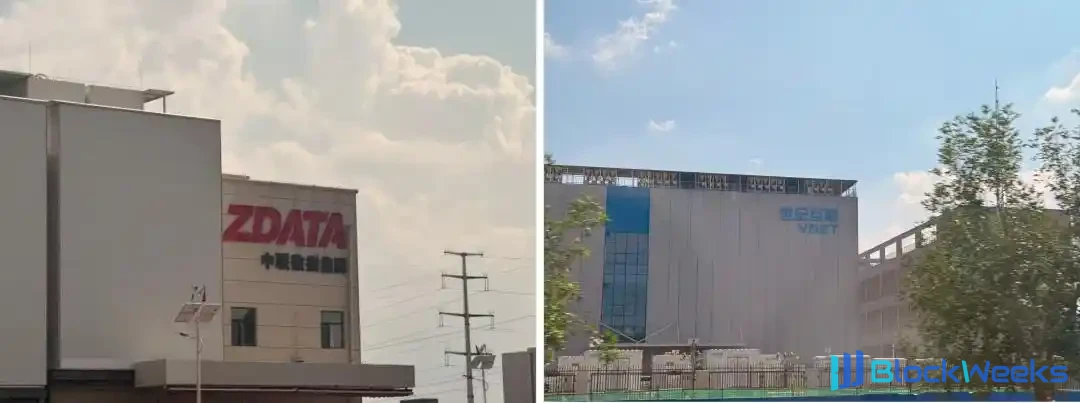
How can we make Token operate more efficiently has also become a new competitive point in the AI era.
Wang Chaoyang recalled that when the modular solution was first proposed, there was strong internal opposition, thinking the cost was too high. "But once the product is iterated and optimized, it will definitely come down." When it came to finding partners, resistance still existed. "One partner disagreed, saying the cost was too high. But when we opened it up, the cost per kilowatt was overestimated by more than one-third, and they later regretted it, having miscalculated." Wang Chaoyang said that now many partners have fully accepted it.
What made him feel the industry trend change even more was the reaction of competitors. "One of the biggest competitors took three months to basically learn it internally. Hearing that we were going to develop the next architecture, they were very nervous. Other partners are also asking when our new standard will come out." Not only domestically, but overseas operators are also following up. In his view, this solution has transformed from Alibaba's own exploration into a path that the industry is jointly adopting.
Alibaba Cloud has even bolder ideas about data center construction - "to become the Foxconn of this industry." Through the ODM model, the supply chain is made to carry out large-scale OEM production according to Alibaba's self-developed standards.
Inside the shelter, even a power module is highly standardized. The docent took the on-site air conditioner as an example: "On the market, they are all AC air conditioners, but converting AC to DC has losses. Alibaba specifically found a small manufacturer to customize DC air conditioners for this architecture." Wang Chaoyang later added that in this modular solution, "each module has been optimally debugged," and the Chinese supply chain can fully keep up. "Wherever we want to build in any major base, these manufacturers are willing to follow us to build factories locally."
Wang Chaoyang emphasized that modularization is useless if it doesn't reach over 90%. "If it only reaches 30% or 20%, it only solves some product problems. First, it cannot solve the overall cost problem; second, it cannot solve the overall delivery time problem." He also admitted that modularization has the practical challenge that "once it is finalized internally, it is hard to change." "Fortunately, we can now continuously iterate. Behind modularization must be versioning and standardization."
This ability to turn data centers into "standard products" may also shake up the landscape of the China-US AI competition. Wang Chaoyang also mentioned that China's manufacturing capacity is too "terrifying." You can easily find a few companies in Zhejiang to produce this kind of container data center. In an environment where overseas generally faces a shortage of industrial workers and delivery times of up to 30 months, using modular products exported from the Chinese supply chain will be a crushing advantage. "When the day comes when performance catches up with competitors, our Token cost price will definitely be a killer."
The end of AI is electricity
The end of computing power is electricity. All ultimate pursuits of extreme efficiency and cost control point to electricity.
"The same data center, placed in Ulanqab versus a neighboring city, can have a difference of 5 billion yuan in annual electricity costs," Wang Chaoyang said. When the scale of data centers is more than 10 times that of the past, and the power of a single cabinet often rushes to 1000 kilowatts (equivalent to the heat dissipated by more than 10,000 people), electricity prices have become the only key factor besides chips.
But cheap electricity does not just come by waiting. As AI enters the era of inference explosion, computing power demand shows a "two-way rush" - training loads move westward in "three-level depth" to pursue low-cost green electricity, while inference loads move eastward in "three-level descent" to be closer to economic circles.
This hits the biggest pain point currently: the coordination of computing and electricity. Wang Chaoyang observed that many so-called source-grid-load-storage projects are essentially for new energy consumption, not true computing power coordination. "Electricity delivery takes three to five years, but our computing power delivery has been compressed to 100 days. When Token is exploding at a quasi-exponential rate, planned coordination is crucial."
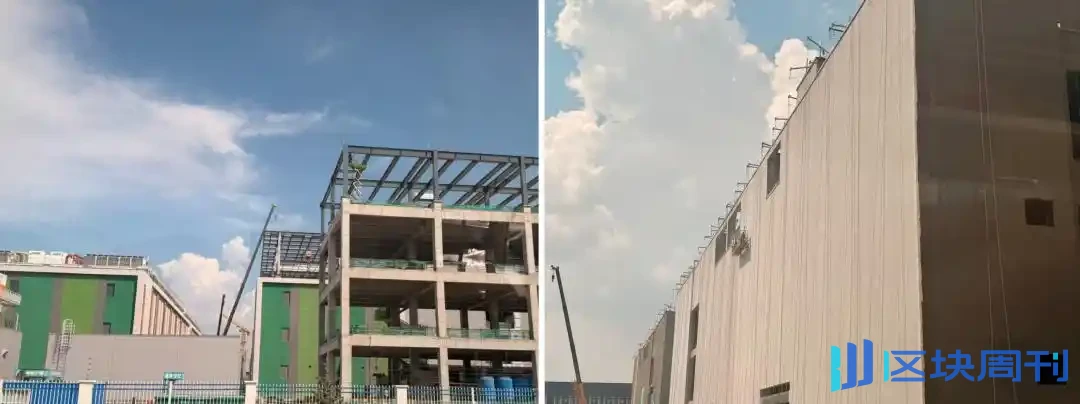
Caption: Buildings still under construction everywhere
He judged that the gap between current planned scale and actual demand is so large that it forces the industry to see explosive solutions within two years. "Power companies are excited now, but they don't know how to participate. In the future, data centers cannot be rigid loads; they must become flexible self-consistent systems, allowing computing power to adapt to electricity and achieve dynamic balance."
To find balance in water-scarce Inner Mongolia, Alibaba is also working hard on water consumption. In Ulanqab, all data centers use reclaimed water, and the WUE of benchmark projects is as low as 0.088, using almost no water. Wang Chaoyang admitted: "Using more water can save electricity, and the low pricing of water leads manufacturers to prefer water. But when building ultra-large-scale clusters, social costs must be considered, and the subtle critical point between optimal cost and greenness must be found."
From the "Potato Capital" to the "Computing Power Capital of China," Ulanqab is witnessing a rapid surge in computing infrastructure construction. When Alibaba Cloud and others turn data centers from a "civil engineering project" into "products" that can be mass-produced on factory assembly lines, and when new players like
DeepSeek
also start building their own computing power infrastructure along this path, a new paradigm of AI infrastructure supported by Chinese manufacturing is emerging.
In those orange-and-white shelters on the grassland, Token is being produced 24/7. And the next chapter of this computing power frenzy may be when these "Chinese solutions" flow to the world along the supply chain, and the true era of AI for all arrives.
This article is from the WeChat public account "Phoenix Net Technology," by Phoenix Net Technology.