Vera Research released an analysis covering over 200,000 news items paired with prediction markets, spanning from April 22 to June 30, 2026, matching more than 3,000 prediction markets. The core finding of the study is: before price movements, news that the AI tool Vera pre-ranked and flagged had a much higher probability of driving market movements than news it set aside.
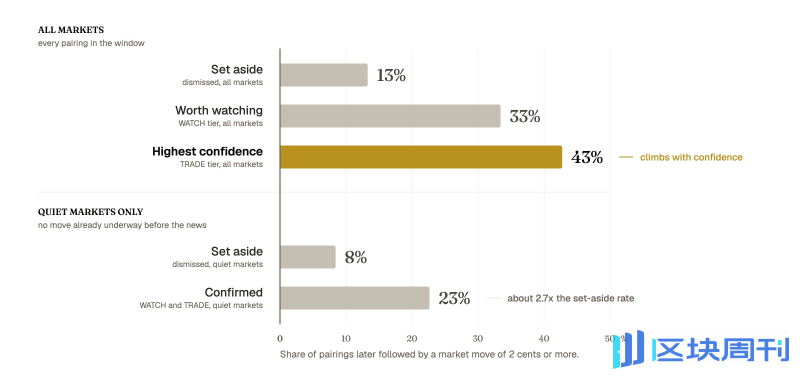
In stagnant markets, flagged news had about a 23% probability of moving prices by at least 2 cents, while set-aside news had only about 8%, roughly one-third of the former. Across the entire market, flagged news had a hit rate of about 35%, while set-aside news had 13%, a gap of about 21 percentage points.
More importantly, the hit rate increased with the tool's confidence. Among news flagged as "worth watching" by Vera, about 33% eventually drove market movements; while at the highest confidence "trade" level, the rate reached about 43%.
The study also ruled out mechanical biases. Even when simultaneously controlling for market category, odds extremity, and market movement state, flagged news still had a hit rate about 9 percentage points higher than set-aside news. This gap is far above the pre-set effective threshold.
Regarding timeliness, the study noted that flagged and unflagged news reached maximum movement at similar times (84 minutes vs. 86 minutes), indicating that stronger signals did not lead to faster market reactions.
Vera's ranking is based on pre-read scores at the time of news arrival, not post-hoc results. The study verified that the labels can be reconstructed from Vera's pre-news scores with over 99.9% accuracy, and the stored data contains no price outcome fields, ruling out "post-hoc scoring" bias.
Finally, the study emphasized that all numbers are reaction frequencies, not returns or accuracy rates. Two flaws in the data have been fixed and point in opposite directions, partially canceling each other out, and all conclusions still hold.