
Author: Black Mario
Recently, user @choc07_ has posted multiple times accusing that the DEXE crash may involve institutional dumping, and pointed the finger at DWF Labs, Falcon Finance, and Ceffu.
However, this matter currently does not have high attention on X. I think a large part of the reason is that the entire explanation involves complex on-chain transfers, institutional custody, MirrorX mirror trading, and market maker relationships. The information is very convoluted, and many people have not actually understood what happened.
So in this content, we will not rush to conclusions. We can break down all the currently confirmable addresses, transfer records, institutional relationships, and points of contention, and fully review what this matter is roughly about, and why DWF is suspected.
I hope this will be a version that everyone can understand.
What can be confirmed at present (you can read the full text and then come back to this conclusion):
During the DEXE crash, the Ceffu-labeled address transferred a large amount of DEXE to the Binance Deposit address;
DWF has a formal liquidity partnership with DeXe;
Falcon Finance is deeply associated with DWF, and officially supports DEXE collateral, Ceffu custody, and mirror trading.
DEXE token crashes over 90%
On July 12, 2026, the price of DEXE reached a high of approximately $49.43.
Subsequently, the price began to decline from July 13, especially on July 21, when DEXE once fell from about $46.93 to $5.648, a maximum drop of nearly 88%.
Calculated from the high of about $49.43, DEXE fell to a low of about $1.56 within 11 days, a cumulative decline of 96.8%.
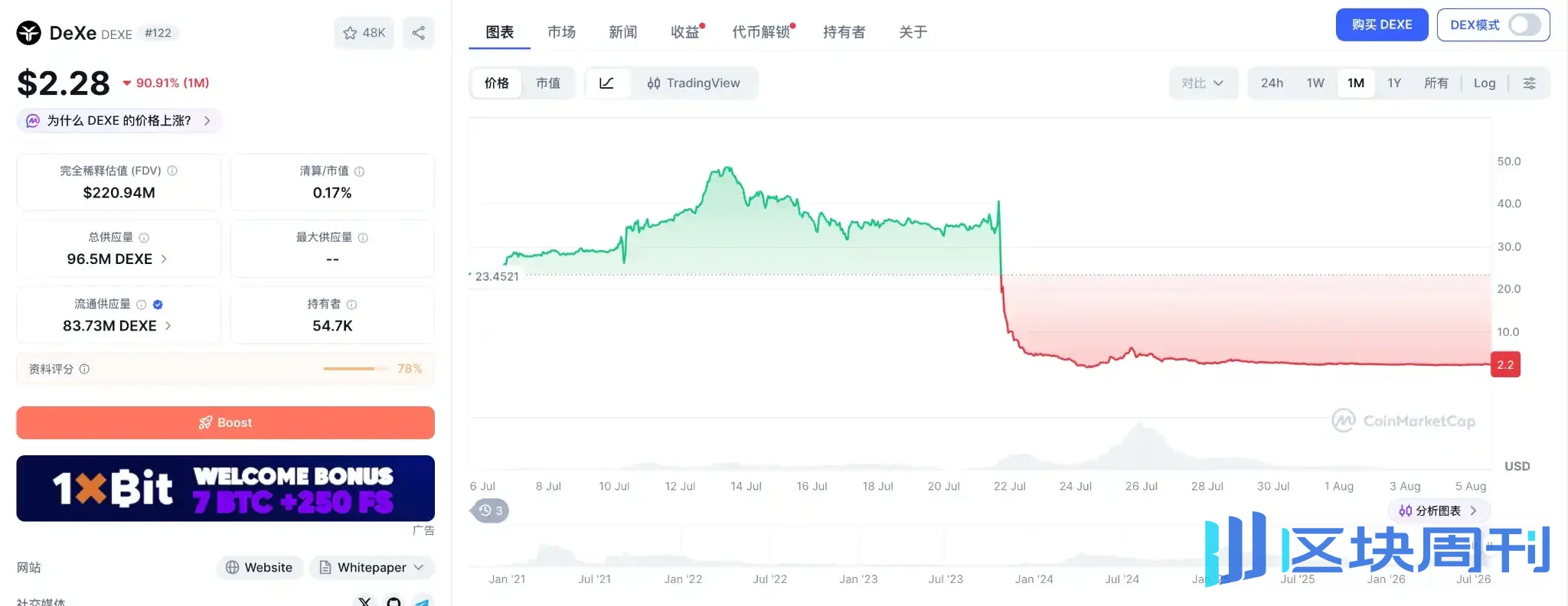
According to @choc07_'s tweet, his friend suffered a huge loss of nearly $1.7 million in DEXE trading during this period, and he believes DWF Labs is directly related to this crash.
https://x.com/choc07_/status/2084230250171605304
However, these DEXE tokens were not simply transferred directly from DWF's public wallet to the exchange, but may have gone through Falcon, Ceffu, and MirrorX, entering Binance's trading system in a way that is difficult to observe directly on-chain, and ultimately forming selling pressure.
This involves several roles, let's clarify them first.
Three key roles: DWF Labs, Falcon Finance, and Ceffu
1. DWF Labs: DeXe's liquidity partner
@DWFLabs is a well-known investment and market-making institution in the crypto market, whose business typically includes project investment, token market making, liquidity management, and secondary market trading.
In simple terms, when a project establishes a liquidity partnership with DWF, DWF may receive or borrow a certain amount of project tokens, and then deploy these tokens to different trading platforms to provide buy and sell depth for the market.
To control risks during market making, DWF may also simultaneously conduct spot trading, contract hedging, cross-exchange rebalancing, and inventory management.
Therefore, market makers do not simply place buy and sell orders on the order book. They usually actually hold a certain amount of tokens and have the ability to allocate assets, manage positions, and execute trades across multiple trading platforms.
In April 2024, the DeXe DAO passed a proposal to establish a liquidity partnership with DWF Labs. DWF officially confirmed that the cooperation has been approved by DeXe DAO governance and executed on-chain.
On-chain monitoring also shows that DWF previously received 300,000 DEXE tokens and subsequently staked them for a long term.
Therefore, this public information at least shows two things:
First, DWF is the officially introduced liquidity partner of DeXe.
Second, DWF has historically held and controlled a significant amount of DEXE, and has the conditions to participate in DEXE market making, rebalancing, hedging, and risk management.
These are the most important reasons for pointing the finger at DWF.
2. Falcon Finance: An asset management and yield protocol deeply associated with DWF
Falcon Finance itself is a protocol built around synthetic dollars, universal collateral assets, and yield strategies.
Users can deposit BTC, ETH, stablecoins, and other crypto assets into Falcon as collateral to mint its synthetic dollar USDf, thereby obtaining dollar liquidity without directly selling their original assets. Falcon then executes different yield and risk management strategies around these collateral assets.
Of course, Falcon does not simply lock users' collateral assets in some on-chain contract unchanged; it can also use institutional custody platforms and centralized exchange accounts to conduct hedging, basis trading, funding rate arbitrage, cross-market arbitrage, and liquidity management on the collateral assets.
DEXE is one of the officially supported collateral assets of Falcon.
That is, theoretically, a DEXE holder can deposit DEXE into Falcon and mint USDf. Falcon then, according to its own risk control and yield strategies, conducts custody, hedging, rebalancing, or trading on this portion of DEXE.
When the price of a collateral asset fluctuates significantly, overall risk exposure rises, or a preset risk threshold is triggered, Falcon can theoretically reduce exposure to the relevant asset, sell spot, adjust contract positions, or even liquidate collateral to ensure the solvency and system stability of USDf.
This means that Falcon not only has the conditions to accept DEXE, but also has the institutional and trading capabilities to dispose of DEXE, hedge, or sell under specific circumstances.
The relationship between Falcon and DWF is also very close.
Falcon has officially described itself as a protocol supported by DWF Labs. Andrei Grachev @ag_dwf, managing partner of DWF, is also one of the core leaders of Falcon. The two have significant overlap in core personnel, institutional resources, trading capabilities, and risk management systems.
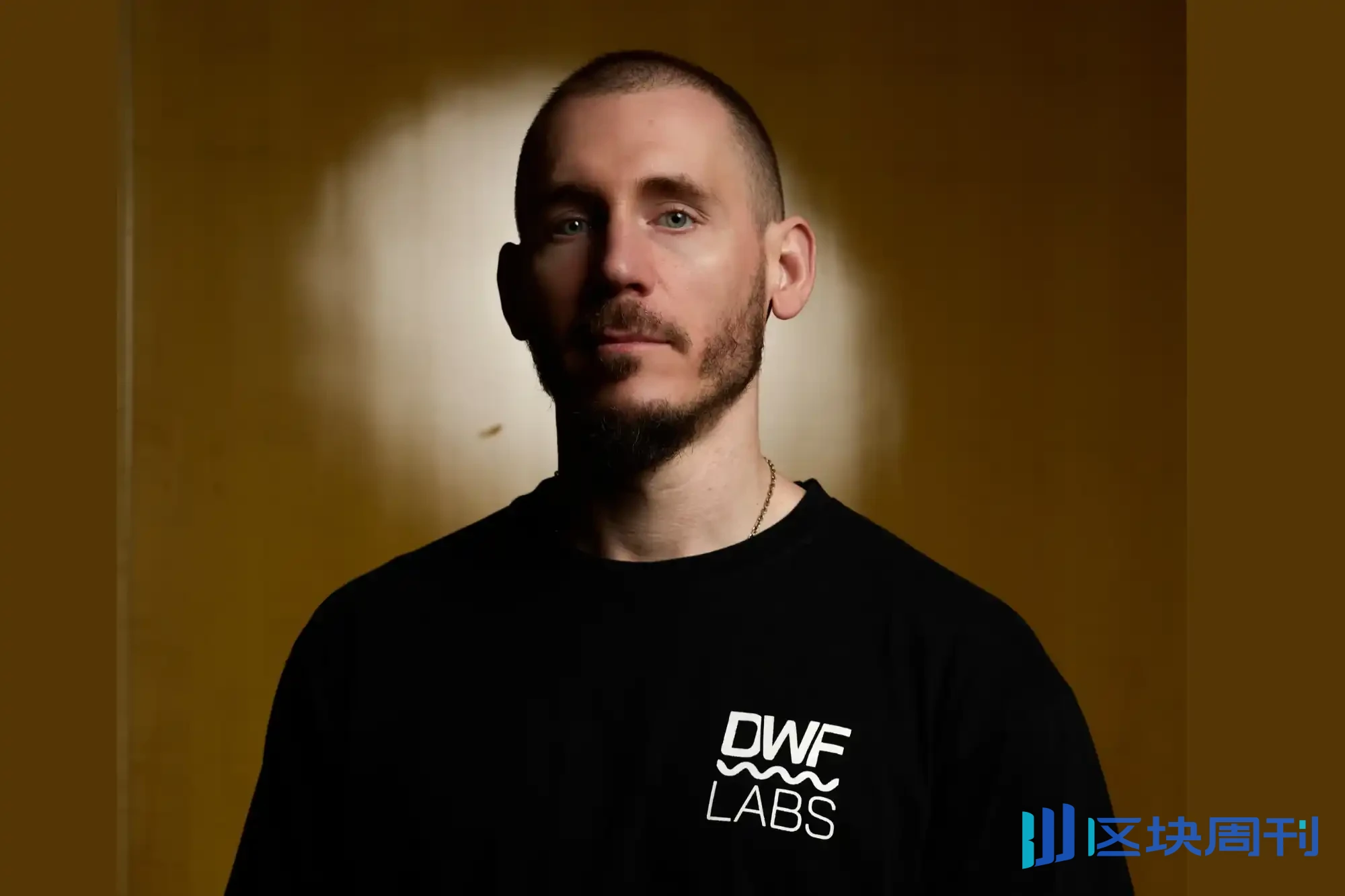
Andrei Grachev (Managing Partner of DWF Labs)
DWF has also publicly described Falcon as an extension of its asset pricing, risk management, and institutional trading capabilities.
Therefore, Falcon is not just a loosely connected project in DWF's ordinary investment portfolio; the relationship between the two is indeed much closer than that of a typical investor and investee.
3. Ceffu: A Key Platform Connecting Institutional Custody and Binance Trading
Ceffu is a digital asset custody platform for institutional clients, formerly known as Binance Custody.
Regular users are accustomed to keeping their crypto assets in their own on-chain wallets or directly depositing them into exchange accounts. However, when institutions manage large amounts of assets, they are often unwilling to keep all their funds in exchange hot wallets for extended periods.
On one hand, placing large amounts of assets directly on an exchange increases platform risk and counterparty risk; on the other hand, institutions also need to meet internal permission management, asset segregation, audit, compliance, and risk control requirements.
Therefore, Ceffu's service helps institutions store real assets in a relatively independent custody system, while through technology and settlement mechanisms, these assets can still be used for trading, hedging, and fund management.
The Ceffu-labeled address involved in this incident is:
0x3a3C006053a9B40286B9951A11bE4C5808c11dc8
This address has been labeled as Ceffu 2 by Etherscan.
DEXE was transferred from Ceffu to Binance in large quantities.
On the other hand, Ceffu is also crucial in this incident because it has a mirror trading mechanism with Binance called MirrorX.
Through MirrorX, institutions can map real assets held in Ceffu Prime Wallet to designated Binance sub-accounts at a certain ratio.
The real tokens remain in Ceffu's custody system, but institutions can first obtain corresponding mirror balances or trading limits on Binance for spot, margin, and derivatives trading.
This means that institutions do not need to transfer real tokens from Ceffu to Binance first, and they may also dump the price on Binance in advance.
That is:
Real DEXE remains in Ceffu
↓
Mapped to Binance sub-account via MirrorX
↓
Institution uses mirror balance for trading, hedging, or selling
↓
Then settle assets off-chain or on-chain
For this reason, institutions can complete trades on Binance in advance even while DEXE remains in the Ceffu address.
When subsequent settlement occurs, the real DEXE is transferred from the Ceffu address to Binance.
Therefore, the transfer time seen on-chain by external observers does not necessarily equal the actual selling time by the institution.
Now let's look at the three roles together; they each occupy different positions:
DWF Labs: Liquidity partner for DeXe, with token market-making, trading, and risk management capabilities.
Falcon Finance: Supports DEXE as collateral and can execute yield, hedging, and risk management strategies around the custodied assets.
Ceffu: Responsible for institutional asset custody and connects custodied assets to Binance trading accounts via MirrorX.
Therefore, the potential flow of funds related to DEXE in this incident is not a simple:
DWF wallet
↓
Binance
↓
Sell DEXE
It could also be a more complex path that is harder to confirm through public on-chain records:
A DEXE holder or related institution
↓
Deposit DEXE into Falcon or related asset management system
↓
Real DEXE is custodied by Ceffu
↓
Mapped to Binance sub-account via MirrorX
↓
Trade, hedge, or sell on Binance
↓
Then complete the settlement of real tokens afterwards
Since DWF is DeXe's liquidity partner, and Falcon is deeply associated with DWF, it is suspected that these DEXE tokens that were custodied, mapped, or ultimately transferred to Binance may be related to DWF or Falcon.
Evidence of Ceffu transferring a large amount of DEXE to Binance
The most core evidence at present is a custody address marked as Ceffu, which continuously transferred a large amount of DEXE to Binance's deposit address around the peak and crash of the DEXE price.
1. DEXE contract and Ceffu address involved
The token contract address of DEXE on Ethereum is:
0xde4EE8057785A7e8e800Db58F9784845A5C2Cbd6
On-chain verification: https://etherscan.io/token/0xde4ee8057785a7e8e800db58f9784845a5c2cbd6
The Ceffu address involved in this incident is:
0x3a3C006053a9B40286B9951A11bE4C5808c11dc8
This address has been marked by Etherscan as:
Ceffu 2
On-chain verification: https://etherscan.io/address/0x3a3C006053a9B40286B9951A11bE4C5808c11dc8
Therefore, at least it can be confirmed that these large DEXE transfers came from Ceffu's institutional custody system.
2. After July 13, 6 transfers of approximately 797,900 DEXE
On-chain analyst Ai Yi has compiled statistics on large fund flows during the DEXE crash.
Data shows that starting from July 13, 2026, Ceffu transferred a total of 6 batches to Binance:
797,917.24 DEXE
Calculated based on the token price at the time each on-chain transfer actually occurred, the total value of these DEXE at that time was approximately $6.15 million.
Related materials:
Ai Yi's original analysis on Ceffu transferring DEXE
https://x.com/ai_9684xtpa/status/2080677489383469496
On-chain data forwarded by Wu Blockchain:
https://x.com/wublockchain12/status/2080698854362734808
Foresight News: Ceffu transferred approximately 797,900 DEXE to Binance in 6 batches:
https://foresightnews.pro/news/detail/109461
Binance Square: Summary of DEXE crash and Ceffu transfers
https://www.binance.com/en-JP/square/post/348291840298913
The reason for starting statistics from July 13 is that DEXE reached a high of approximately $49.432 on July 12 and entered a decline phase starting from July 13.
Therefore, this set of data indicates that after DEXE began to decline from its historical high, the Ceffu custody system continuously transferred nearly 800,000 DEXE to Binance.
The timing of these transfers clearly overlaps with the entire decline phase of DEXE.
3. Since February 2026, a total of 8 paths, approximately 854,100 DEXE
In addition to the 6 transfers after July 13, another on-chain investigator expanded the time range to February 2026.
According to this set of statistics, from February 2026 to after the incident, the Ceffu address transferred a total of 8 fund paths to the Binance Deposit address:
854,149.537853 DEXE
Related investigation:
The 8 Ceffu transfer paths compiled by the on-chain investigator:
https://x.com/banbendaan/status/2083020239676256584
Related account page and subsequent records:
https://x.com/banbendaan
4. The largest transfer of approximately 719,700 tokens occurred on July 22
Among these transfers, the largest one occurred on July 22, 2026, with a quantity of approximately:
719,727 DEXE
The main paths tracked by the investigator include two types:
From Ceffu to Binance Deposit
and:
From Ceffu to the 0x98 intermediary address, and finally to Binance Deposit
Related investigations:
Review of the transfer path of 719,700 DEXE:
https://www.binance.com/en/square/post/348892685508641
Summary of the path of 854,100 DEXE transferred from Ceffu to Binance Deposit:
https://x.com/banbendaan/status/2083020239676256584
The intermediate address involved is:
0x98e50F194d975A9fcC25428433233dD876F51d32
Address verification:
Etherscan: 0x98e50 intermediate address:
https://etherscan.io/address/0x98e50F194d975A9fcC25428433233dD876F51d32
This address serves part of the intermediate transfer function between Ceffu and Binance Deposit. Some DEXE went directly from Ceffu to Binance's deposit address, while others first passed through 0x98e50… and then entered Binance.
5. The largest transfer occurred after the crash
The most severe drop in DEXE occurred on July 21.
On that day, DEXE fell from about $46.93 to about $5.648, with a maximum single-day decline of nearly 88%.
However, the largest transfer of 719,700 DEXE occurred on July 22, after the major crash.
If interpreted purely according to ordinary trading logic:
July 21: DEXE price crashed
↓
July 22: 719,700 DEXE transferred into Binance
Then, the tokens that entered Binance on July 22 obviously cannot directly explain the crash that had already occurred on July 21.
This is why investigators must introduce the MirrorX mechanism mentioned earlier. If these DEXE had been stored in Ceffu and mapped to Binance sub-accounts via MirrorX, the theoretical timeline might become:
Real DEXE remained in Ceffu
↓
Mapped in advance to Binance MirrorX sub-account
↓
Trading, hedging, or selling could have occurred on July 21 or earlier
↓
On July 22, the real DEXE was transferred to Binance for subsequent settlement
6. Small test transfers before large transfers
Before some large transfers or settlement operations, the intermediate address 0x98e50… conducted a small DEXE test.
One test transfer of approximately 2 DEXE, transaction hash:
0x59393f3a6919b54a38474f9fae3f95dade9da388e7cfb09f4843f159fb069b1c
On-chain verification:
Etherscan: Related transaction records:
https://etherscan.io/tx/0x59393f3a6919b54a38474f9fae3f95dade9da388e7cfb09f4843f159fb069b1c
Etherscan: Receiving address and related transaction records:
https://etherscan.io/address/0xA072A49B9DF8b07f493E38EE4991B7CbA7296593
From public records, it can be confirmed that this transaction was indeed initiated by the 0x98e50… address and entered the relevant receiving address.
Before institutions make large transfers, it is very common to conduct a small test transfer first, mainly to confirm:
Whether the address is correct;
Whether the deposit channel is normal;
Whether the token contract matches;
Whether the exchange can credit the account normally.
Therefore, this test transfer can indicate that there may be planned transfer preparations between the relevant addresses.
7. What do these on-chain evidences actually prove so far
Putting together what can be confirmed so far, roughly:
Ceffu 2 is a labeled institutional custody address
↓
This address continuously transferred DEXE to Binance during the DEXE decline phase
↓
After July 13, a total of 6 transfers, accumulating approximately 797,900 tokens
↓
Expanding to after February, a total of 8 paths were counted, approximately 854,100 tokens
↓
The largest transfer of approximately 719,700 tokens occurred on July 22
↓
Some of the funds went directly into Binance Deposit, and some went through 0x98e50 before entering Binance Deposit.
So, what can be confirmed from on-chain evidence is:
There is indeed a significant amount of DEXE in the Ceffu custody system;
These DEXE were transferred into Binance's deposit system around the time of the crash;
The transfer volume was sufficient to impact the DEXE market, which has relatively limited liquidity;
The largest transfer occurred after the main crash;
MirrorX can technically explain the time lag between "trades happening first and on-chain transfers appearing later."
Why is it believed to be related to DWF?
DWF itself is the market maker and liquidity partner officially introduced by DeXe, and historically has indeed received and controlled a large amount of DEXE, having actually participated in DEXE's liquidity management, token inventory, and market-making trading.
Therefore, whether from the perspective of cooperative relationships or asset access capabilities, DWF is one of the institutions most qualified to participate in DEXE market trading.
But this time, the Ceffu address transferred nearly 800,000 DEXE to Binance in total, which is significantly higher than the 300,000 DEXE that DWF has publicly held in the past.
That is to say, if these tokens are indeed related to DWF, they may not all come from DWF's publicly visible market-making wallets; behind them, there is likely another larger source of assets.
From the currently verifiable public information, cooperative relationships, and business paths, Falcon Finance is the only known system that can relatively completely explain how this large amount of DEXE entered Ceffu.
Falcon is currently the major protocol in public materials that explicitly lists DEXE as a collateral asset. Users or institutions can deposit DEXE into Falcon to mint USDf. According to Falcon's published deposit process, user collateral does not all remain in ordinary on-chain contracts but enters a third-party custody system, which explicitly includes Ceffu.
Falcon supports assets such as DEXE as collateral
https://falcon.finance/falcon-finance-hits-100m-tvl-in-closed-beta
Falcon user deposit and third-party custody process
https://docs.falcon.finance/mechanism/user-deposit-process
Falcon officially also explicitly discloses that it uses Ceffu and MirrorX as custody and OTC settlement infrastructure. Real assets can continue to be stored in Ceffu, while Falcon executes spot, leverage, derivatives trading, and risk hedging on centralized exchanges like Binance through mirrored positions.
At the same time, the DeXe project team itself can basically be ruled out of this large transfer path.
Currently, public on-chain records do not show that the DeXe Foundation or DAO treasury has deposited large amounts of DEXE into Ceffu; most project supply remains in the DAO treasury, team lockups, and other known contracts. DeXe officially also responded clearly that the Foundation and DAO treasury did not participate in this sale.
Other common market makers similarly lack similar public paths. Currently, there is no public record of institutions like Wintermute, GSR, or Jump using DEXE as a primary collateral or managed asset, nor have they been found to operate DEXE on a large scale through Ceffu.
Although Ceffu itself is a general institutional custody platform, theoretically, any institutional client holding a large amount of DEXE could deposit assets into Ceffu. Therefore, we cannot 100% rule out that some large Ceffu client, whose identity has not yet been disclosed, independently held and transferred this batch of DEXE.
But among the public information currently available, Falcon is the only known entity that simultaneously meets the following conditions:
Formally supports DEXE as a collateral asset;
Has the conditions to pool DEXE from different users and institutions;
Explicitly uses Ceffu for custody of user assets;
Explicitly uses MirrorX for OTC settlement and mirror trading;
Has the ability to execute trading, hedging, and risk management on Binance.
Among the currently public and verifiable cooperative relationships and business paths, the only entity with the capability and a reasonable scenario to pool and transfer nearly 800,000 DEXE into Ceffu is basically Falcon Finance, or large institutional clients who deposited DEXE through Falcon.
This also explains why the amount of DEXE entering Ceffu this time is much higher than the 300,000 DEXE holdings observable in DWF's public addresses. Falcon may pool and manage a larger scale of DEXE from project partners, institutional clients, and ordinary users, and these assets ultimately uniformly enter Ceffu's custody and settlement system.
And there are countless connections between Falcon and DWF.
Falcon's founder and Managing Partner Andrei Grachev is also a co-founder and Managing Partner of DWF Labs. Falcon is core-supported by DWF, and the two overlap heavily in management team, trading capabilities, risk control, and operational resources. DWF official has even described Falcon as an extension of its own asset pricing and risk management capabilities.
So the possible path is that a larger amount of DEXE is first pooled into the Falcon system, which is highly tied to DWF, then enters Ceffu custody, and completes trading and subsequent settlement on Binance through MirrorX.
Around the time of the DEXE crash, the Ceffu address indeed cumulatively transferred nearly 800,000 DEXE to Binance. This large capital flow highly matches Falcon's public business model of pooling DEXE, using Ceffu for custody, and mirror trading on Binance.
Has a "track record"
DWF is not the first time it has been questioned over issues such as token surges and crashes, market-making account trading, and selling at high prices.
Previously, multiple tokens including ESPORTS, SIREN, YGG, DODO, C98, and CYBER have experienced controversies highly similar to this DEXE incident.
Among them, the most typical and with the most complete public information is the YGG incident in 2023.
At that time, DWF, as an important partner and market maker for YGG, after Andrei Grachev publicly promoted YGG, the token price saw a noticeable rise. Subsequently, on-chain data showed that DWF-related addresses transferred nearly 5 million YGG to Binance in batches near the price high, and the YGG price then fell sharply.
In May 2024, the Wall Street Journal further reported that Binance's internal market surveillance team had investigated DWF's trading activities and determined that DWF had conducted over $300 million in suspicious wash trading in 2023, and was suspected of manipulating the prices of YGG and at least six other tokens.
The investigation team even formally recommended that Binance terminate its partnership with DWF, but Binance ultimately concluded that the evidence was insufficient, and the personnel responsible for the investigation were subsequently dismissed. DWF's public response at the time was almost identical to the current DEXE incident: denying market manipulation and characterizing the related questions as FUD driven by competitors.
Earlier tokens such as DODO, C98, and CYBER also experienced similar price patterns of "rapid short-term rises followed by quick falls" in 2023 after DWF announced partnerships or related fund addresses showed activity.
At that time, the community had already summarized a recurring pattern:
Obtaining a large number of tokens through OTC, investment, or market-making partnerships, then using market-making accounts to create trading volume and price momentum, then transferring tokens to exchanges at high prices, ultimately accompanied by significant price pullbacks.
And when the market raised questions about this, the related transactions were often explained as normal market-making, risk hedging, or inventory management.
Entering 2026, similar scripts have again appeared frequently.
In May, ESPORTS experienced a flash crash of over 90% in a single day, with its market cap evaporating by more than $100 million. On-chain data shows that about five days before the crash, approximately 19.9 million ESPORTS tokens, worth about $13.9 million at the time, were transferred to a Kraken address associated with DWF. The project team subsequently issued a statement directly accusing the market-making partner of selling tokens without authorization.
SIREN experienced two crashes of over 90% after a significant rise in June. On-chain analysis shows that a single entity's control ratio of SIREN once reached approximately 88.5%, with related wallet clusters pointing to DWF Labs. On-chain investigators such as ZachXBT have also publicly discussed the connections between these addresses and DWF multiple times.
This is also why DWF has once again become the primary suspect in the market after the DEXE crash.
Because whether it is participating in project market-making, holding a large number of tokens, establishing short positions, or selling spot at key time points, DWF's operations around DEXE this time indeed show obvious similarities to its past controversial trading patterns.
How did the parties respond?
Okay, the most important thing to add to DWF's response is that although it admitted to "opening shorts, closing shorts, and selling spot," it still did not answer the most critical trading details. The following version can directly replace the original DWF response section.
DWF: Admits to holding short positions and selling some DEXE spot
On August 4, Andrei Grachev, co-founder of DWF Labs, issued a statement regarding the DEXE trading. He stated that DWF bought a large amount of DEXE in 2024, sold a portion in 2025 and realized profits; around October 10, 2025, DWF again bought a large amount of DEXE, and in the first half of 2026, it hedged the unrealized gains by establishing short positions.
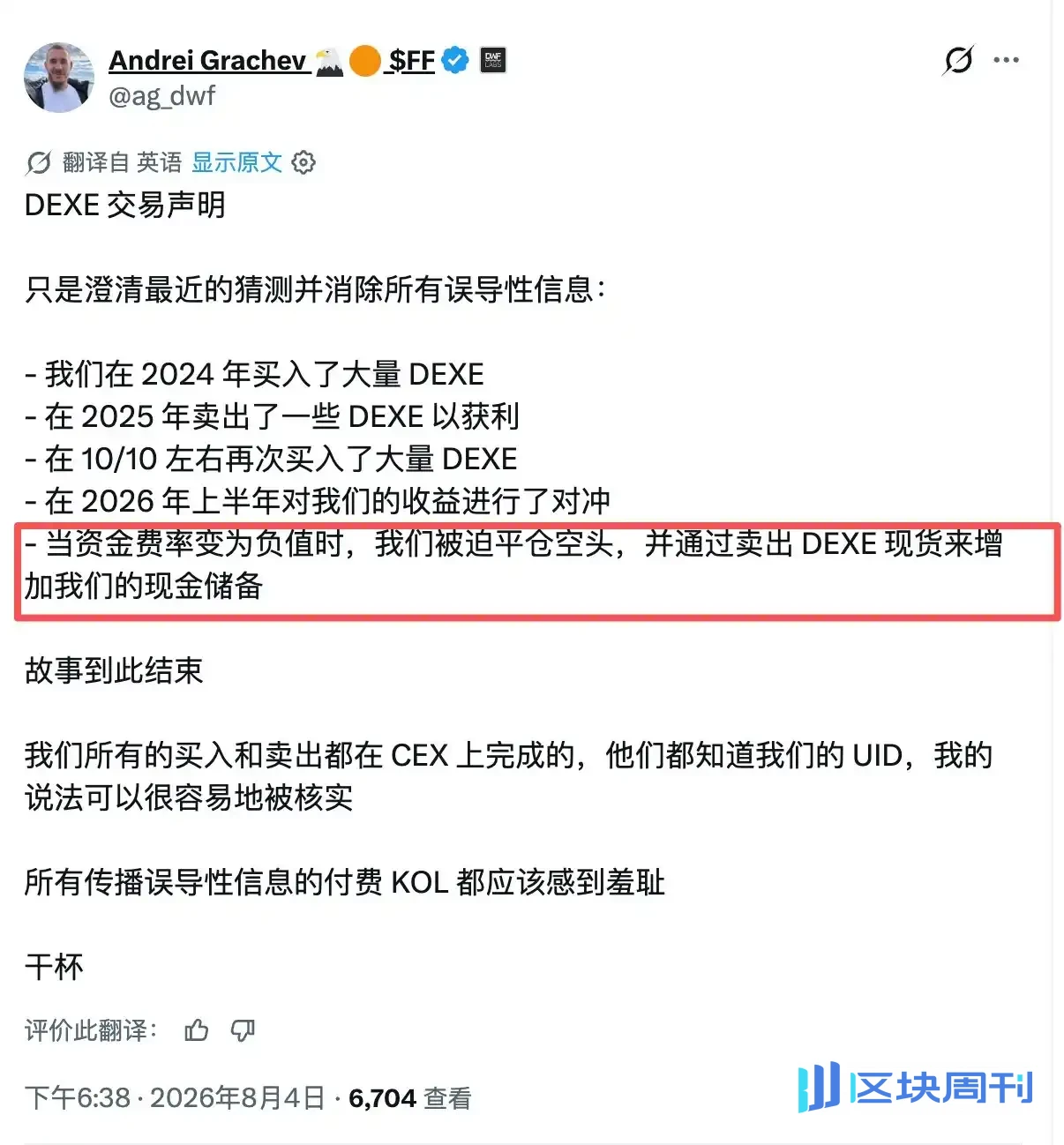
According to Andrei's explanation, later the funding rate for DEXE perpetual contracts turned negative, and continuing to hold short positions would incur high funding costs, so DWF chose to close the relevant short positions. At the same time, to increase cash reserves, DWF also sold a portion of its DEXE spot.
In other words, DWF did not deny that it traded and sold DEXE, but explained these operations as normal profit-taking, risk hedging, and cash management.
Andrei also emphasized that all of DWF's buys and sells occurred on centralized exchanges, and the relevant exchanges have DWF's account UID and complete trading records, which can be verified at any time.
DWF's original response:
https://x.com/ag_dwf/status/2084589747633111463
This statement confirmed several important facts previously speculated by the outside world: DWF not only held a large amount of DEXE for a long time, but also sold some spot, held short positions in DEXE, and closed shorts and reduced spot positions in the first half of 2026.
So the next thing that really needs to be clarified is at what time, at what price, and how much DEXE DWF actually sold, the size of its short positions, and whether these trades have a direct relationship with the sharp rise and fall of DEXE. Currently, there is no particularly clear evidence to prove this.
However, DWF's response still avoided several key issues.
Andrei did not disclose the specific number of DEXE tokens DWF sold, nor did he disclose the timing and average price of the spot sales, so the outside world cannot determine whether these sell orders were concentrated at the price peak or just before the crash.
DWF did not specify the size of its short positions, the opening time, opening price, and closing time, nor did it explain whether these short positions generated huge profits during the decline of DEXE.
DWF did not respond to whether it used Ceffu to custody DEXE, nor did it explain whether it controlled or used related Binance MirrorX sub-accounts. Andrei's statement also did not provide an explanation for the issue of Ceffu transferring nearly 800,000 DEXE to Binance around the crash.
DWF did not explain its specific relationship with Falcon Finance regarding this batch of DEXE assets. Whether Falcon held or managed a large amount of DEXE, whether it executed trades through Ceffu and MirrorX, and whether DWF's team was involved in the related trades, there are still no answers.
Although Andrei repeatedly emphasized that exchanges can verify all trades through UID, DWF did not proactively disclose the relevant account records, nor did it express willingness to accept independent third-party audits or publish desensitized trading data.
So DWF has admitted to participating in the buying, selling, and shorting of DEXE, but still has not provided sufficient trading details to prove that these operations were just ordinary risk management, rather than an important factor causing or amplifying the crash.
DeXe: Protocol was not attacked, Foundation and DAO treasury did not sell tokens
On July 28, the DeXe Protocol official also responded to the sharp price fluctuations.
DeXe stated that the protocol operated normally throughout the period of price fluctuations, with no exploits or other security incidents. The DeXe Foundation and DAO treasury did not sell DEXE during this round of market movement, nor did they derive any profits from this price fluctuation.
DeXe also stated that there is currently no verified explanation for why DEXE experienced such drastic rises and falls, so the project team will not speculate on the cause.
DeXe's official response:
https://x.com/DexeNetwork/status/2082113197956321310
DeXe's response basically severed the relationship between the project team and the selling pressure. At least from the official statements, it can be ruled out that the protocol was attacked, the Foundation directly sold tokens, or the DAO treasury dumped DEXE to the market.
However, DeXe did not respond to DWF's specific trading situation in this round of market movements, nor did it explain whether Falcon holds or manages a large amount of DEXE, who owns the tokens in the Ceffu address, and whether these assets were mapped to Binance for trading via MirrorX.
Falcon Finance: Has not yet responded to DEXE holdings and Ceffu transfer issues
Falcon Finance has not yet issued a special statement regarding the DEXE crash and the large Ceffu transfer.
Falcon is currently a key player in the entire path. It publicly supports DEXE as collateral, explicitly uses Ceffu for institutional custody, and can execute trading, hedging, and risk management on centralized exchanges through mirrored positions.
But Falcon has not yet explained how much DEXE collateral existed on the platform before the crash; whether a large amount of DEXE entered Ceffu custody; whether risk reduction, spot selling, or collateral liquidation was triggered during the crash; and whether the nearly 800,000 DEXE transferred from the Ceffu address to Binance came from assets managed by Falcon.
Binance and Ceffu: Have not yet stated whether MirrorX was used for this transaction
Binance and Ceffu have also not issued public responses to this incident.
Ceffu has not disclosed the client ownership of the relevant DEXE, nor has it stated whether these assets came from Falcon; Binance has not publicly disclosed the holders, trading records, and settlement information of the relevant MirrorX sub-accounts.
Therefore, external observers can currently only see that a large amount of DEXE was ultimately transferred from Ceffu to Binance Deposit, but cannot confirm whether these tokens were already mapped to Binance via MirrorX and traded before the on-chain transfer.
The community is also currently calling on Binance to verify the account UID mentioned by DWF. Since Andrei proactively stated that the exchange has complete records, Binance can theoretically confirm when DWF's buys, sells, short covering, and spot reductions occurred, and whether they directly coincided with the extreme market movements of DEXE.