Overview
Virtu Financial, M1X Global and Tradeweb have completed a landmark onchain repo transaction using a natively issued sovereign digital bond as collateral. Executed on Canton Network, the securities delivery, cash leg and return all settled atomically onchain, while the complete execution and repurchase cycle took less than 10 minutes.
The collateral was USDM1, a USD-denominated sovereign bond issued natively onchain by the Republic of the Marshall Islands. Unlike a stablecoin or tokenized money market fund, USDM1 is structured as a sovereign security and is backed 1:1 by short-dated U.S. Treasuries held through a bankruptcy-remote custody structure. The transaction was executed bilaterally between regulated institutional counterparties through Tradeweb without prime broker intermediation.
The importance of this onchain repo transaction goes beyond settlement speed. Tokenized assets have often been discussed in terms of issuance and secondary trading, but collateral utility is what connects them to the deeper machinery of institutional finance. By using a digital sovereign bond in a familiar secured-funding structure, the transaction demonstrates how tokenized securities could become productive balance-sheet assets rather than simply digital representations of traditional instruments.
The next question is whether that efficiency can be repeated at scale.
Key Takeaways
- Virtu Financial, M1X Global and Tradeweb completed a fully onchain repo using sovereign digital bond collateral.
- The entire repo and repurchase cycle settled in under 10 minutes.
- USDM1 is a sovereign digital bond issued by the Republic of the Marshall Islands, not a stablecoin.
- The security is backed 1:1 by short-dated U.S. Treasuries.
- Canton Network enabled atomic settlement of the securities and cash legs.
- The larger opportunity is faster collateral mobility, but one transaction does not prove market-wide scalability.
What Happened in the Onchain Repo Transaction?
What Did Virtu, M1X Global and Tradeweb Actually Complete?
The parties completed what Tradeweb described as the first fully onchain repo transaction in which the securities leg was a sovereign digital bond. The transaction was executed bilaterally on Tradeweb between regulated institutional counterparties and settled on Canton Network.
Every major component was completed onchain: the initial securities delivery, the cash leg and the later return. The complete repo cycle, including execution and repurchase, took less than 10 minutes.
That is important because the transaction replicated the economic structure of a conventional sovereign-collateralized repo while changing the infrastructure used to move the collateral and cash.
What Exactly Settled in Under 10 Minutes?
The figure refers to the full transaction cycle rather than a single blockchain transfer. The repo began with a transfer of the sovereign digital bond against cash and concluded with the repurchase leg returning the relevant assets.
This distinction matters for interpreting the headline. Saying that “a blockchain transaction took 10 minutes” would understate what was demonstrated. The test compressed a multi-step institutional financing workflow into one atomic onchain process.
However, the result should not be generalized into a claim that every traditional repo can now be settled in under 10 minutes. This was one specific transaction using digitally native infrastructure and counterparties prepared to operate within that architecture.
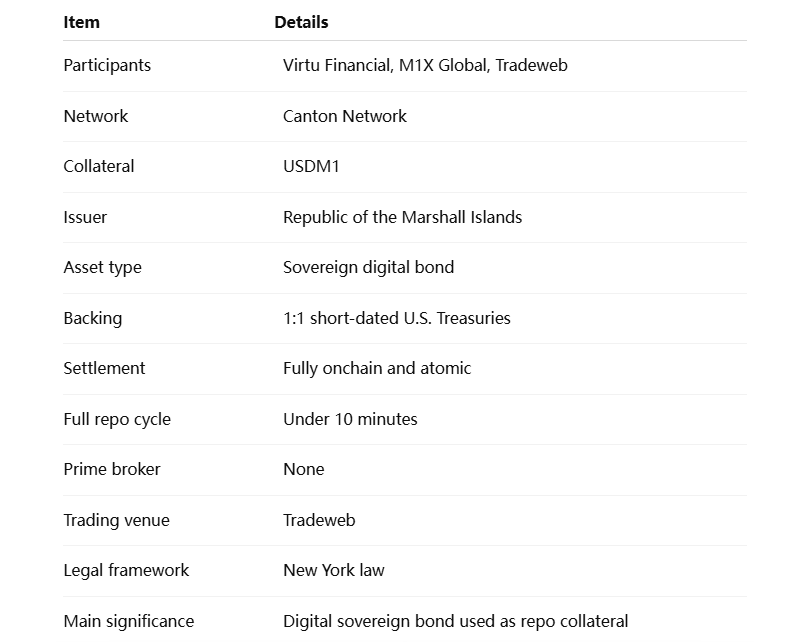
Transaction Snapshot
What Is USDM1?
Is USDM1 a Stablecoin?
No. USDM1 is a USD-denominated sovereign digital bond issued natively onchain by the Republic of the Marshall Islands. It is not a stablecoin, CBDC or tokenized money market fund.
The distinction matters because the asset carries the legal characteristics of a sovereign security. According to Tradeweb, USDM1 is structured under New York law in the style of a fully collateralized Brady bond and is secured on a 1:1 basis by short-duration U.S. Treasury instruments held in a bankruptcy-remote structure.
Holders therefore have a different legal relationship from holders of a corporate payment stablecoin. The instrument also pays a coupon, including when it is being used as margin or collateral.
Why Does the Legal Structure Matter?
Institutional repo markets depend on enforceable rights, standardized documentation and certainty about what happens during default. A digital token by itself is not sufficient if the holder cannot establish legally recognized ownership or collateral rights.
Tradeweb states that USDM1 is classified as a UCC Article 8 investment security and is structured with a first-priority perfected security interest in the underlying Treasury collateral. Its documentation was also designed to support title-transfer repo, collateral substitution and reuse under standard institutional frameworks including GMRA and ISDA arrangements.
This legal architecture is central to the transaction because large financial institutions cannot treat digital collateral solely as a technical object. They must understand how it behaves under insolvency, netting, custody and secured-financing law.
How Does an Onchain Repo Transaction Work?
What Is a Repo?
A repurchase agreement, or repo, is effectively a short-term secured financing transaction. One party transfers securities to another party in exchange for cash and agrees to repurchase those securities later at a predetermined price.
Economically, the securities function as collateral and the difference between the initial and repurchase price reflects the financing cost. Repo markets are a core source of short-term funding and liquidity in global fixed-income markets.
The structure is particularly important for government securities because highly liquid sovereign bonds are widely used as collateral across banks, dealers and institutional portfolios.
What Changes When Repo Moves Onchain?
Traditional repo workflows can involve separate systems for trade execution, collateral movement, cash settlement, recordkeeping and later repurchase. Each handoff requires coordination between market infrastructure providers and can create delays or reconciliation requirements.
An onchain repo transaction can potentially place several of those steps onto synchronized digital infrastructure. In the Virtu-M1X-Tradeweb transaction, Canton enabled both the securities and cash legs to settle atomically.
Atomic settlement means the relevant asset transfers are coordinated so that either the complete exchange occurs or neither side does. This reduces the risk that one party delivers collateral while the corresponding cash movement fails.
Why Does Atomic Settlement Matter?
Can It Reduce Settlement Risk?
Yes, in principle. One of the central risks in financial settlement is principal exposure between the moment one side of a trade transfers an asset and the moment the other side completes payment.
Delivery-versus-payment mechanisms are designed to minimize that problem. Atomic settlement extends that principle into blockchain infrastructure by coordinating multiple asset movements within the same transaction logic.
For an onchain repo transaction, this means cash and collateral do not need to rely on independent timing assumptions. That can reduce intraday settlement exposure and the operational need to reconcile whether each leg completed correctly.
The benefit becomes more meaningful when transaction sizes and institutional balance sheets grow.
Can It Improve Collateral Velocity?
Potentially, and this may be more important than raw transaction speed. Collateral velocity refers to how efficiently high-quality assets can be mobilized, transferred and reused across financial obligations.
Under slower settlement infrastructure, an asset may remain economically tied up while participants wait for settlement finality or move collateral across different systems. Faster atomic settlement can make the asset available for reuse sooner.
Tradeweb argues that the Canton transaction demonstrates same-day collateral reuse that is difficult under conventional T+1 infrastructure. If similar workflows scale, institutions could potentially reduce the amount of idle collateral they need to maintain and improve balance-sheet efficiency.
That would make tokenization relevant to treasury management and secured funding rather than merely to asset issuance.
Why Is This More Important Than Tokenizing a Bond?
From Digital Issuance to Productive Collateral
Issuing a bond onchain proves that a security can exist in digitally native form. Using that bond as collateral in a repo demonstrates something more economically meaningful: the asset can participate in an established institutional financing workflow.
CapabilityBasic Tokenized BondThis Repo TransactionDigital issuanceYesYesOnchain ownership recordYesYesSecondary transferPossibleYesUsed as financing collateralNot alwaysYesCash and security settle togetherNot alwaysYesRepurchase completed onchainRareYesFull cycle demonstratedVariesUnder 10 minutes
This is the shift from tokenization as representation to tokenization as infrastructure. Financial institutions care about an asset not only because they can hold it, but because they can finance it, pledge it, reuse it and incorporate it into liquidity management.
The repo transaction demonstrates that a sovereign digital bond can begin to perform those functions.
Why Is Sovereign Collateral Important?
Government securities sit at the center of modern collateral markets because they are widely recognized, liquid and often receive favorable regulatory treatment relative to riskier assets.
A digitally native sovereign security can therefore be more relevant to institutional finance than a token with uncertain legal status or limited collateral eligibility. USDM1 was specifically structured to bridge onchain settlement with the legal and capital frameworks institutions already use.
That does not mean it has the same liquidity or market depth as U.S. Treasuries. The transaction instead demonstrates that sovereign digital instruments can be designed to fit within familiar secured-funding practices.
Could Onchain Repo Compete With Traditional Repo Markets?
Where Does Onchain Infrastructure Have an Advantage?
Continuous collateral mobility is one potential advantage. Blockchain-based assets can theoretically move outside traditional settlement windows, allowing institutions to respond more quickly to funding and margin needs.
Atomic settlement can also reduce reconciliation between separate ledgers. If securities and cash move within compatible systems, participants may require fewer manual checks to determine whether both sides of the transaction completed.
Programmability adds another potential benefit. Collateral substitution, margining rules and asset movement can increasingly be embedded into digital workflows rather than managed through several disconnected operational processes.
Where Does Traditional Repo Still Have an Advantage?
Scale remains the largest difference. Traditional repo markets process enormous daily volumes with deep liquidity, standardized legal documentation, experienced intermediaries and mature risk-management frameworks.
Those systems have also been tested during periods of severe market stress. A small number of successful onchain transactions cannot yet demonstrate the same operational resilience.
Institutional adoption additionally depends on custody, interoperability, regulatory treatment and broad counterparty acceptance. A digital bond may be technically mobile but still have limited usefulness if only a small group of institutions can hold or finance it.
Onchain repo is therefore more likely to develop alongside existing infrastructure before it can challenge it at scale.
What Are the Main Limitations?
Does One Transaction Prove Scalability?
No. The transaction demonstrates feasibility, not market-wide adoption.
Tradeweb did not publicly disclose several commercial details that would be useful for evaluating scale, including the transaction’s notional value, repo rate and maturity. Without those figures, it is difficult to compare the economic size of the transaction with conventional repo activity.
The more important next step will be repetition. Multiple counterparties, larger transaction sizes and continued activity across different market conditions would provide stronger evidence that the workflow can operate as infrastructure rather than as a landmark demonstration.
What Legal and Liquidity Questions Remain?
Legal enforceability can vary across jurisdictions even when an instrument is carefully structured under New York law. Institutions operating internationally need clarity on custody, collateral recognition, insolvency treatment and close-out rights.
Liquidity is another constraint. The usefulness of collateral depends not only on legal status but on whether counterparties are willing to accept it and whether it can be sold or financed efficiently in stressed conditions.
Interoperability will also matter. Digital collateral becomes more valuable when it can move seamlessly across trading venues, custodians, settlement networks and financing markets rather than remaining isolated inside one technical ecosystem.
This Repo Shows Digital Bonds Are Becoming Financial Infrastructure
The importance of this onchain repo transaction is not simply that a sovereign bond was placed on a blockchain. It is that the digitally native security was used in the same type of secured-financing structure that sits at the center of institutional fixed-income markets.
USDM1 served as collateral, the cash and securities legs settled atomically on Canton Network, and the complete repo and repurchase cycle was completed in under 10 minutes. That moves the tokenization discussion beyond issuance toward collateral utility and balance-sheet efficiency.
The demonstration also highlights why legal structure matters as much as technology. USDM1 was designed as a sovereign investment security under New York law, backed 1:1 by short-dated U.S. Treasuries and structured for use within familiar institutional documentation. Without those characteristics, fast blockchain settlement alone would not make the instrument suitable for large financial counterparties.
The limitations remain substantial. One transaction does not establish deep liquidity, broad market acceptance or stress-tested operational resilience. Traditional repo infrastructure still operates at a scale that onchain markets have not approached.
Even so, the transaction offers a clearer view of where institutional tokenization may be heading. The next phase is not just about putting more securities onchain. It is about making those securities useful for financing, collateral and liquidity management—the functions that turn assets into financial infrastructure.
Sources
https://mof.gov.mh/usdm1-whitepaper/
Risk Disclaimer: This article is for reference only and does not constitute investment advice. The cryptocurrency market is highly volatile. Please make decisions cautiously based on your individual circumstances.