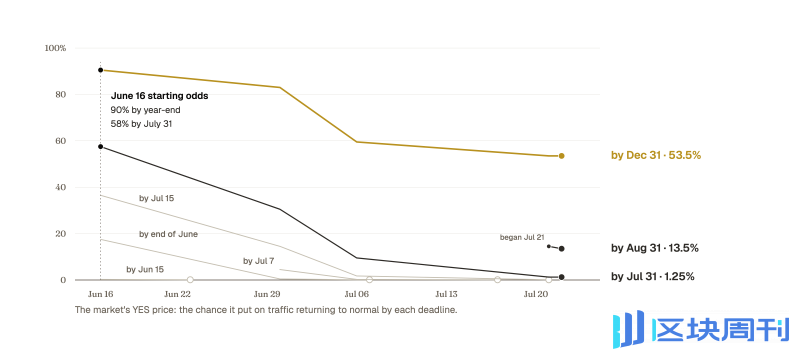
On June 16, traders on Polymarket still believed that the probability of shipping returning to normal in the Strait of Hormuz before the end of the year was as high as 90.5%, and the probability of recovery before July 31 was also 57.5%. However, in the five weeks that followed, the market began to "dismantle" the contracts one by one, starting from the nearest expiration dates.
Polymarket set up seven expiration contracts for the same question: by a certain date, will shipping in the strait return to normal? The four nearer deadlines—June 15, end of June, July 7, and July 15—successively fell to the "floor price" of 0.1%, and they fell strictly in order of expiration. By the final trade on July 22, the July 31 contract was only 1.25%, August 31 was 13.5%, and December 31 was 53.5%—roughly a coin toss.
This is not a market that "prices in a shock first, then repairs." On the contrary, the market has been continuously pricing this disruption as "permanent": each time a near-term contract expires, a hope is "retired," and the suspense is passed on to the next, more distant deadline. Prices can return to the starting point, but past deadlines cannot.
This research is not a sample, but a "census" of all seven Strait of Hormuz normalization contracts on Polymarket. Each curve is the market's own asking price, not a prediction. The study also deliberately did not compare oil prices: using 34 daily observations and 7 lags for lead-lag tests, neither direction reached a significant threshold, so no linkage conclusions are claimed.
It should be noted that this is an observation from one market and one institutional environment, and the order book is thin, with daily trades ranging from 78 to 229. The real test of whether prediction markets can lead traditional markets is the scenario of repricing discrete events, which is also the natural direction for next-step research. This article only makes a narrow conclusion that can be fully supported: documenting how a market "retires" a disruption step by step according to expiration dates.