Author | Golem (@web3_golem)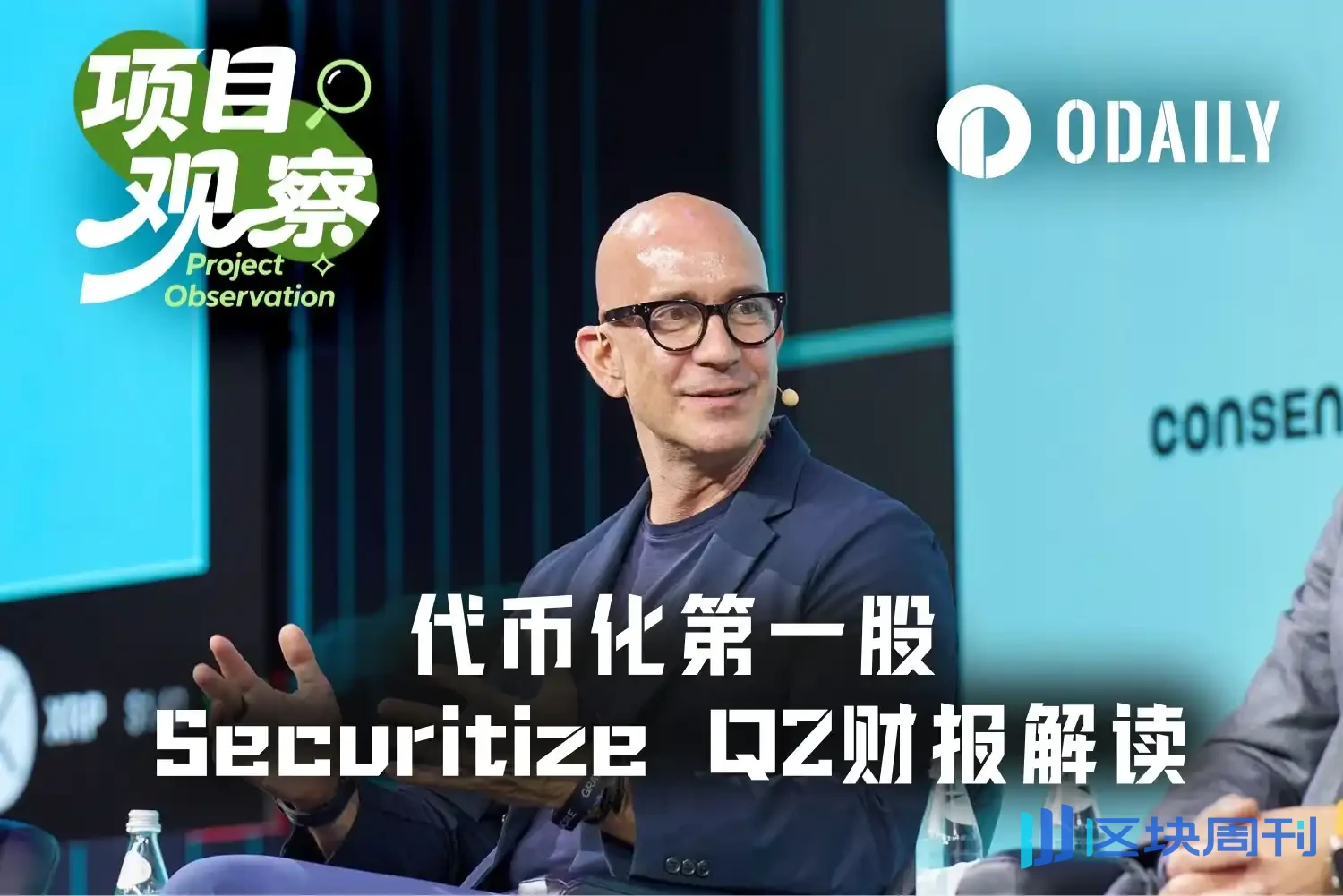
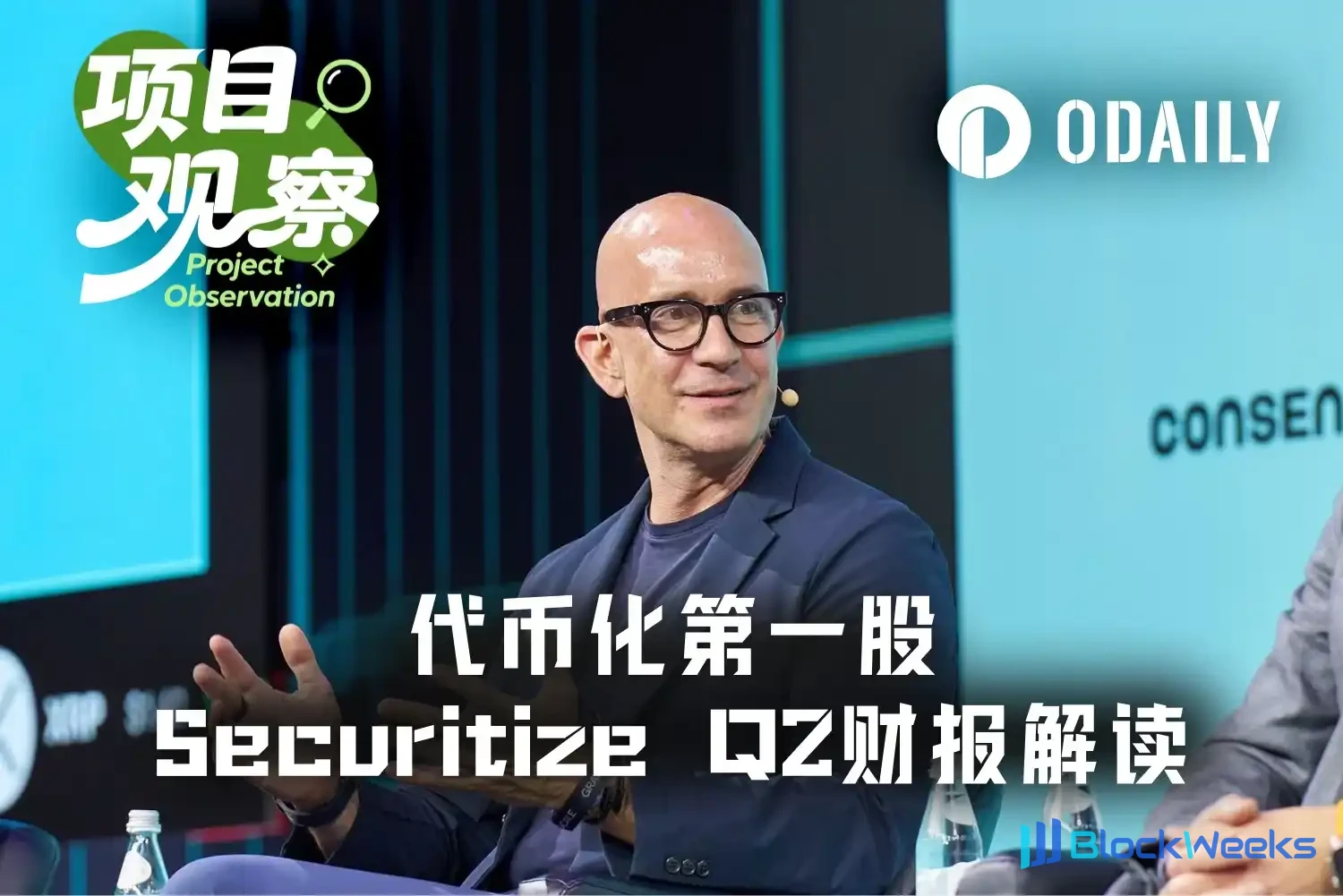
After the US stock market closed on August 12, tokenization company Securitize released its Q2 2026 earnings report, which was also its first performance report to the market since its listing in July. However, this report was not "good-looking." After the report was released, Securitize (SECZ) saw its after-hours stock price drop by more than 20% at one point.
The Q2 report showed that Securitize's second-quarter revenue was $14.43 million, down 5% year-over-year and 26% quarter-over-quarter, below analysts' expectations of $20.6 million; net loss was $21.68 million, with a loss of $2.37 per share, while the market expected a loss of $0.15.
Business performance was relatively good. Securitize's tokenized asset management scale reached a record $4.3 billion in the second quarter, up 9% year-over-year, with 7 tokenized assets each having over $100 million in assets under management; platform trading volume increased 147% year-over-year to $5.3 billion. However, in the second quarter, Securitize's total assets under administration (AUA) was $24.3 billion, down about 20%, meaning that while Securitize's tokenized asset management scale is growing, its traditional fund services assets under management are shrinking.
Trading volume increased 147% but revenue fell 5%, indicating that Securitize either significantly compressed trading fees to attract investors and tilted its asset portfolio toward zero-profit assets, or its platform business model remains unclear and cannot capture value from usage.
In short, Securitize, as the recognized first stock in tokenization platforms, has been seeing shrinking revenue, which is unacceptable to investors and is the biggest reason for its stock decline.
At 20:30 Beijing time on August 13, Securitize will hold its second-quarter earnings conference call. Whether it can pull the stock price back during trading hours depends on how Securitize CEO Carlos Domingo "spins" it.
Still Sticking to Compliance
Securitize is a company that is somewhat "stubborn." It has an extreme pursuit of compliance in tokenization, so in the second quarter of 2026, its biggest and most proud business progress was a large number of compliance partnerships.
For example, Securitize has established partnerships with Computershare and Continental, the first and third largest transfer agents in the United States, to jointly develop the tokenized stock market. This cooperation builds on Securitize's partnership with the New York Stock Exchange (NYSE) and can better help NYSE build a digital trading platform that offers tokenized stocks, but the launch date of this trading platform is still unknown.
At the same time, in terms of regulation, Securitize also received FINRA approval to compliantly custody tokenized securities; in the international market, Securitize was selected by Atlas Capital as a tokenization partner to launch USAFi under Dubai's VARA framework. USAFi is a digital security, and this is Securitize's first project to issue assets under Dubai's VARA asset-referenced virtual asset rulebook.
At the end of July, Securitize's subsidiary Securitize Capital also officially obtained the SEC registered investment adviser qualification, enabling it to work more closely with asset management companies and institutional investors on tokenized investment strategies. Securitize's US platform has now integrated four regulated businesses: SEC-registered investment adviser, SEC-registered broker-dealer, SEC-registered transfer agent, and fund administration services.
Apart from these partnerships, Securitize has not made much new progress at the specific business level. On July 2, Securitize listed on the US stock market and simultaneously tokenized its own stock SECZ on the Avalanche and Solana chains. This is Securitize's first major tokenized stock launched on-chain. Securitize CEO Carlos Domingo also stated that the company is actively advancing the tokenization of stocks and the possibility of tokenizing other companies' IPOs.
However, a month has passed, and SECZ remains the only tokenized stock launched by Securitize this quarter. Securitize's determination not to advance actual products until all compliance procedures are ready is consuming investors' patience.
No Actual Progress in Tokenized Stock Business
Securitize is still the largest tokenization platform. According to RWA.xyz data, the total market value of RWA issued by Securitize is approximately $5 billion, leading the second-place Ondo by about $1.4 billion.
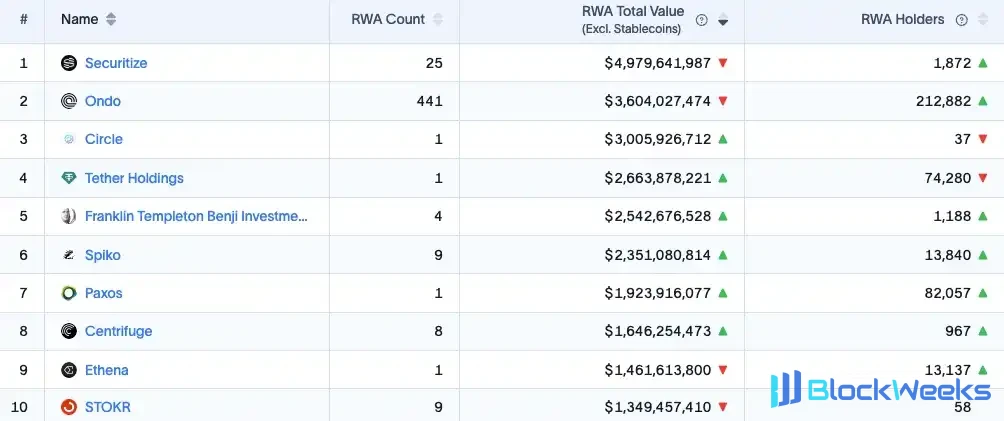
Ranking of total on-chain market value of RWA on tokenization platforms
But this fact has existed for a long time and is no longer information that can excite the market. Before listing, Securitize's business was mainly institutional, and the RWA assets it issued were basically bonds, private credit, and money market funds. Frankly speaking, the value of Securitize as the leader in tokenization platforms has already been reflected in its listing valuation, so after listing, the market mainly focuses on its business performance in the incremental market of new tokenized stocks.
According to RWA.xyz data, Securitize's tokenized SECZ is currently the tokenized stock with the highest on-chain circulating market value (on-chain issuance multiplied by stock price), but this data is clearly deceptive.
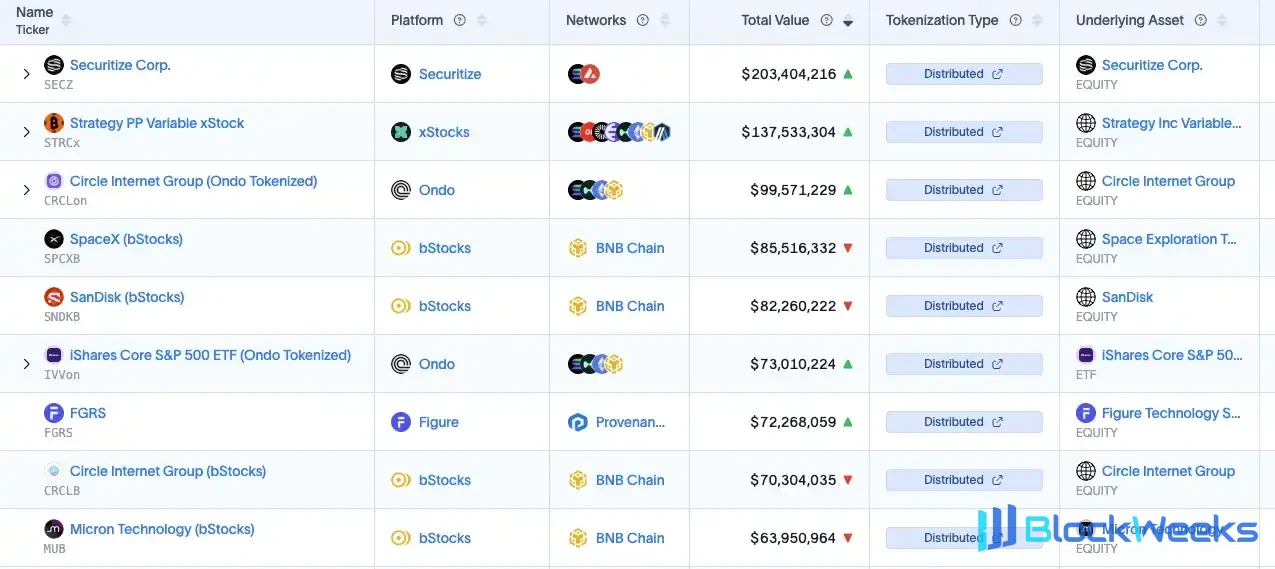
Ranking of on-chain market value of tokenized stocks
SECZ's issuance model is completely different from tokenized stocks on other platforms. On most platforms, the issuance process for tokenized stocks is that investors first submit purchase requests, and then the platform issues tokenized stocks to users on a 1:1 basis, with on-chain market value changing according to users' actual purchase demand. However, the issuance of SECZ tokenized stocks is entirely based on a one-time shareholder participation. At the time of listing, Securitize issued $260 million worth of SECZ tokenized stocks on-chain, all issued to shareholders, meaning no secondary investors participated in the purchase.
Therefore, SECZ's on-chain market value cannot serve as data support for the healthy development of Securitize's tokenized stock business. After excluding the SECZ factor, we basically cannot assess the market acceptance of Securitize's tokenized stocks or the differences in trading volume, issuance volume, and other data compared to other tokenization platforms, because Securitize's tokenized stock business has not truly started.
As of before the US market open on August 13, Securitize's market value had fallen to $1.28 billion. On the first day of listing, Securitize's market value approached $2 billion at its peak, and the closing price on the first day was $12.3, now down 36%.
In the early stage of listing, some analysts interpreted SECZ's decline as due to SPAC structural changes rather than fundamental deterioration. In mid-July, investment bank Benchmark reiterated its buy rating on SECZ and a target price of $16. However, the decline after this earnings report truly reflects investors' concerns about its shrinking revenue and future progress in the tokenized stock business.
There has always been a disconnect between the "tokenization compliance narrative" and the "secondary market reality" in the tokenized stock market. If the former is the standard, Securitize's current development is still steadily improving, but the current market mainly uses the latter as the standard, where market share, real trading volume, user numbers, and other metrics are much more important than the number of licenses.
Securitize hasn't yet had its "LeEco moment."
Recommended Reading
"Securitize, the First Tokenization Platform to Go Public, Lists Its Own Stock on Avalanche and Solana"