
Azuki is the name used for an NFT collection and a wider creative identity, but an on-chain token record, its associated artwork, the Azuki brand, and any current Azuki experience are separate things with separate documentary scope.
Azuki is a name that needs careful separation. The official Azuki NFT License Agreement uses “Azuki NFT” for Azuki-branded or themed non-fungible tokens created by or for Chiru Labs. The current Azuki About page describes Azuki Labs as the company behind an original anime IP spanning manga, trading cards, collectibles, and digital experiences. Those statements support a collection-and-creative-IP description. They do not turn every current or future item bearing an Azuki name into the same asset, product, right, or promise. The question “what is azuki nft” should be answered by separating the Azuki NFT record from claims about azuki nft utility and ecosystem, because those claims depend on current terms and documented services.
What Is Azuki
In this profile, the Azuki NFT collection means the collection-level subject addressed by the official license, not a guaranteed catalogue of all present offerings. The license page is a primary source for its own definitions and licensed-rights language. The current About page is a primary source for the company’s stated creative-IP framing. Neither page, by itself, establishes a permanent collection count, a current availability status, a particular technical configuration, or the status of a later release.
The word “collection” can hide several layers. At one layer, an NFT is a blockchain-tracked token. At another, there is artwork associated with a particular token. There are also names, logos, characters, website content, and product or media materials that may be governed by different rights. Treating all of those layers as one object would erase the central boundary that the official license tries to draw between token ownership and intellectual-property ownership.
The Collection and Its On-Chain Record
An on-chain record can help identify a token and the history attached to that record, but it is not a complete legal or editorial explanation. It does not automatically establish copyright ownership, trademark permission, a right to use a character in commerce, project membership, voting power, access to an experience, or entitlement to future content. A careful description therefore names the record as one layer and keeps the rights question tied to the relevant current official document.
The source materials also have different time horizons. A license page can define rights and conditions at the revision shown on that page. A current site page can describe a brand or creative direction at the time it is published. A public chain record can show a technical record. None of these sources alone freezes future site content, collection metadata, company policy, or external arrangements. Publication language should state what the source supports rather than convert it into a timeless claim.
How Token Ownership Differs From Intellectual-Property Rights
The official license makes a mechanism difference explicit: a lawful owner has personal-property rights in the token underlying an Azuki NFT, while the owner does not thereby own the associated artwork, brand, or other intellectual property except for the license’s stated permissions. This is a source-bound summary of the license page, not a general legal conclusion for every jurisdiction or every similarly named digital item.
That distinction matters because a token and its art can travel together in ordinary discussion while still having different legal roles. The token record is the owned personal property described by the license. The artwork is used under a license with conditions. The Azuki name and related marks are separately reserved. A profile that says only “the holder owns Azuki” is too imprecise to show which of those layers it means or which rights, if any, are actually granted.
Azuki
The license page presently available on the official site describes non-exclusive, worldwide, royalty-free permissions for personal, non-commercial use of a holder’s associated Azuki NFT Art, subject to lawful ownership and compliance with the agreement. It also describes a conditional commercial-use permission for the associated art. These are permissions within a written license, not a transfer of all intellectual property and not a blanket authorization for every visual element, name, or future use case.
The same document puts material limits around that commercial-use language. It says that Azuki trademarks are not granted, and it describes special treatment for third-party content in collaborations. It also reserves rights not expressly licensed. Accordingly, the label “commercial rights” should never be shortened into a claim that every holder owns the brand, may use every logo, or may use every component of any related artwork without checking the current applicable terms and the particular item’s context.
The Azuki Ecosystem and Documentation Boundaries
“Ecosystem” is useful here as an organizing word, but it is not a substitute for a legal definition. The current About page frames Azuki as original anime IP spanning manga, trading cards, collectibles, and digital experiences. That supports saying that the name is used across a broader creative setting. It does not establish that all of those materials are part of the original NFT collection, that they have identical terms, or that a collection holder has a right in every named area.
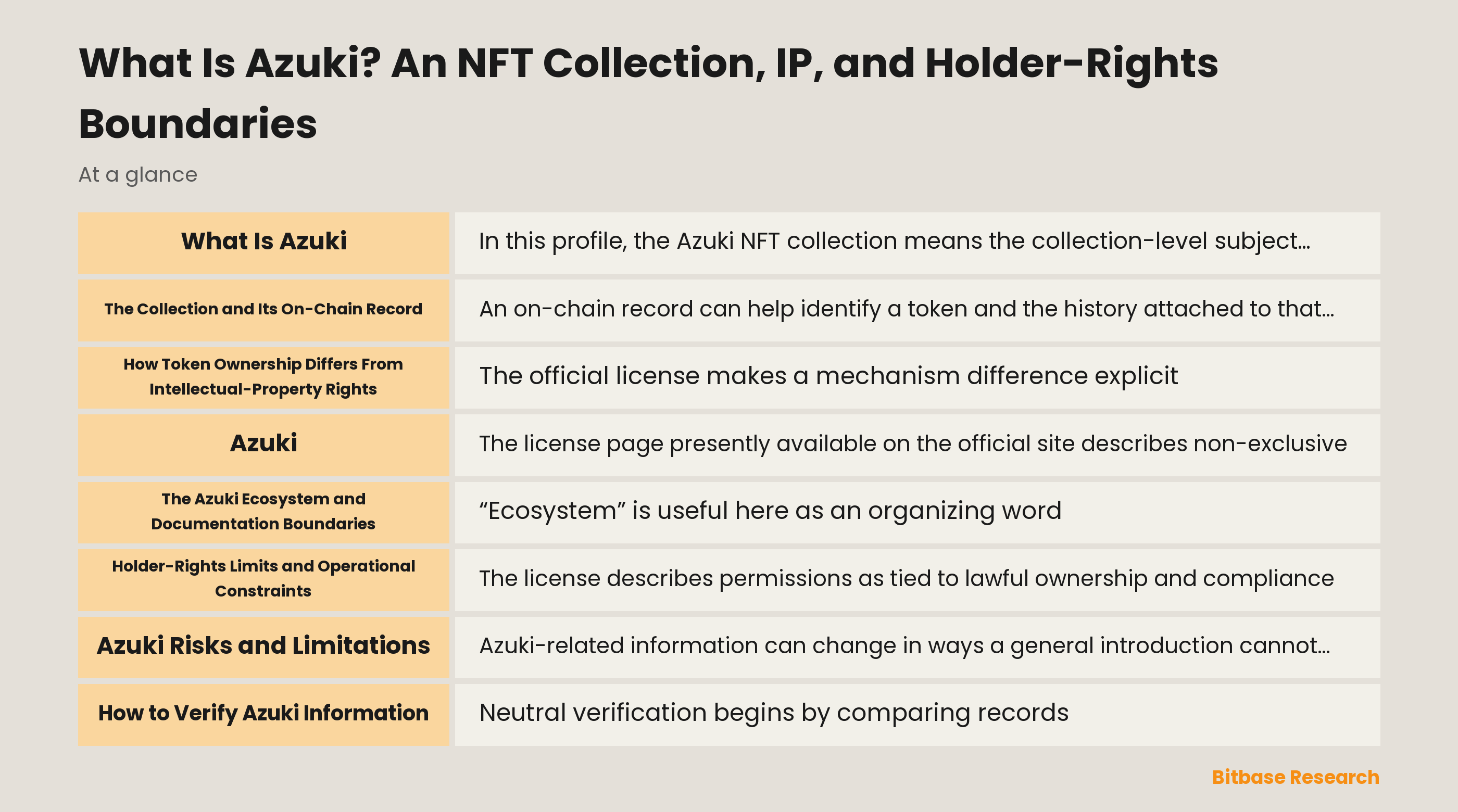
Documentation boundaries are especially important when a project uses one recognizable name across media. A collection license supports statements about the licensed artwork associated with a covered Azuki NFT. A site’s About page supports the company’s stated IP framing. Current product, event, media, or community pages can only support the narrow facts they actually state. They should not be used to infer standing access, endorsement, participation rights, future releases, or a continuing relationship beyond their own published terms.
Holder-Rights Limits and Operational Constraints
The license describes permissions as tied to lawful ownership and compliance, and it says that the license for associated art passes to a new owner when ownership of the corresponding NFT changes. This makes the license conditional rather than a free-standing asset that can be separated from the relevant token. It also means that a historical screenshot, a copied image, or a community assertion cannot by itself establish who currently holds a license or what the current version permits.
Holder status also has limits that are easy to overstate. The additional-features section says the company may choose to make features, access, content, items, or other benefits available, while stating that it has no duty or obligation to provide them. That supports a cautious rule: an NFT ownership record is not, by itself, proof of an ongoing service, a guaranteed benefit, a governance role, compensation, an employment-like relationship, or a right to dictate project decisions.
Azuki Risks and Limitations
Azuki-related information can change in ways a general introduction cannot safely predict. The official terms say that the company may change or update terms and that site information need not be accurate, complete, or current. The license page itself contains an update mechanism. Collection descriptions, metadata presentation, associated services, availability, third-party material, and policy language should therefore be treated as release-date questions rather than permanent facts carried forward from an older page.
There are technical and provenance risks as well as rights-boundary risks. The current terms describe blockchain, digital-asset, security, custody, software, network, metadata, and third-party-service risks in general terms. An image, a social post, a copied token name, or an unaffiliated page can be misleading. An NFT record also cannot substitute for a review of the license and the source page that describes the relevant asset or feature. No overview can guarantee authenticity, continued functionality, or legal effect.
How to Verify Azuki Information
Neutral verification begins by comparing records, not by assuming that a familiar image proves scope. Before publication, compare the official collection material and current license revision with the official collection identifier, then compare any stated contract address with the corresponding record in a block explorer. This is a record-comparison check only. It does not direct any asset or site interaction.
A second check is to match the claim to the source. Use the license for the art-and-IP boundary, the current terms for site and product conditions, and the current About page for the broader creative-IP description. Confirm whether the current terms still point to the same collection materials and whether the official source has changed its wording. A block explorer can corroborate a technical record, but it does not decide trademark permission, copyright ownership, or the scope of a license.
Conclusion
Azuki is most accurately introduced as a collection-level NFT subject with a licensing framework and a name that also appears within a broader creative-IP setting. The official sources support separating the token record from associated art and from the Azuki brand. They also support describing current manga, trading-card, collectible, and digital-experience language as an About-page framing, rather than treating it as a single immutable collection specification.
The practical interpretive rule is to keep ownership, license, and ecosystem language in separate sentences. Ownership of the relevant token does not automatically convey ownership of the artwork or marks. A license does not automatically create access, benefits, governance, or a guarantee that a feature will continue. A broad brand description does not establish the legal terms of every asset or product that may use the same name.
For a release-ready profile, identify the source and its date, explain only the narrow claim it supports, and label changing information for a fresh check. This approach explains why Azuki can be discussed as an NFT collection and as part of a broader creative identity without overstating holder rights, intellectual-property permissions, technical facts, or future availability.
Disclaimer: This article is educational content from Bitbase Academy, provided for information only. It explains what a project does and what role its token plays in that system; it does not constitute investment, trading, tax, or financial advice, and it is neither a recommendation nor an endorsement of any project or token. Bitbase has not carried out due diligence on the project described here, and mentioning it does not mean Bitbase lists or supports the asset. Crypto assets carry significant risk, including price volatility, thin liquidity, smart-contract failure, regulatory uncertainty, and the possible loss of their entire value. Written as of August 2026; a project's status, tokenomics, team, and contracts can change at any time. Verify everything yourself through official channels, the contract address, and a block explorer, and beware of imitation sites and phishing links.
References
[1] Azuki NFT License Agreement www.azuki.com
[2] About Azuki Labs www.azuki.com
[3] Azuki Terms & Conditions www.azuki.com
[4] Azuki official website www.azuki.com