Yield Basis is an Ethereum-oriented onchain liquidity design that documents a leveraged automated market maker construction intended to reduce impermanent-loss exposure for selected volatile assets. YB is its documented governance and incentive token.
The phrase yield basis crypto can refer to a protocol, its stated liquidity design, or the YB token. Those are related but different subjects. This explanatory profile separates the protocol claim from a present-state assertion, and describes the construction without instructions for interacting with any product.
What Is Yield Basis?
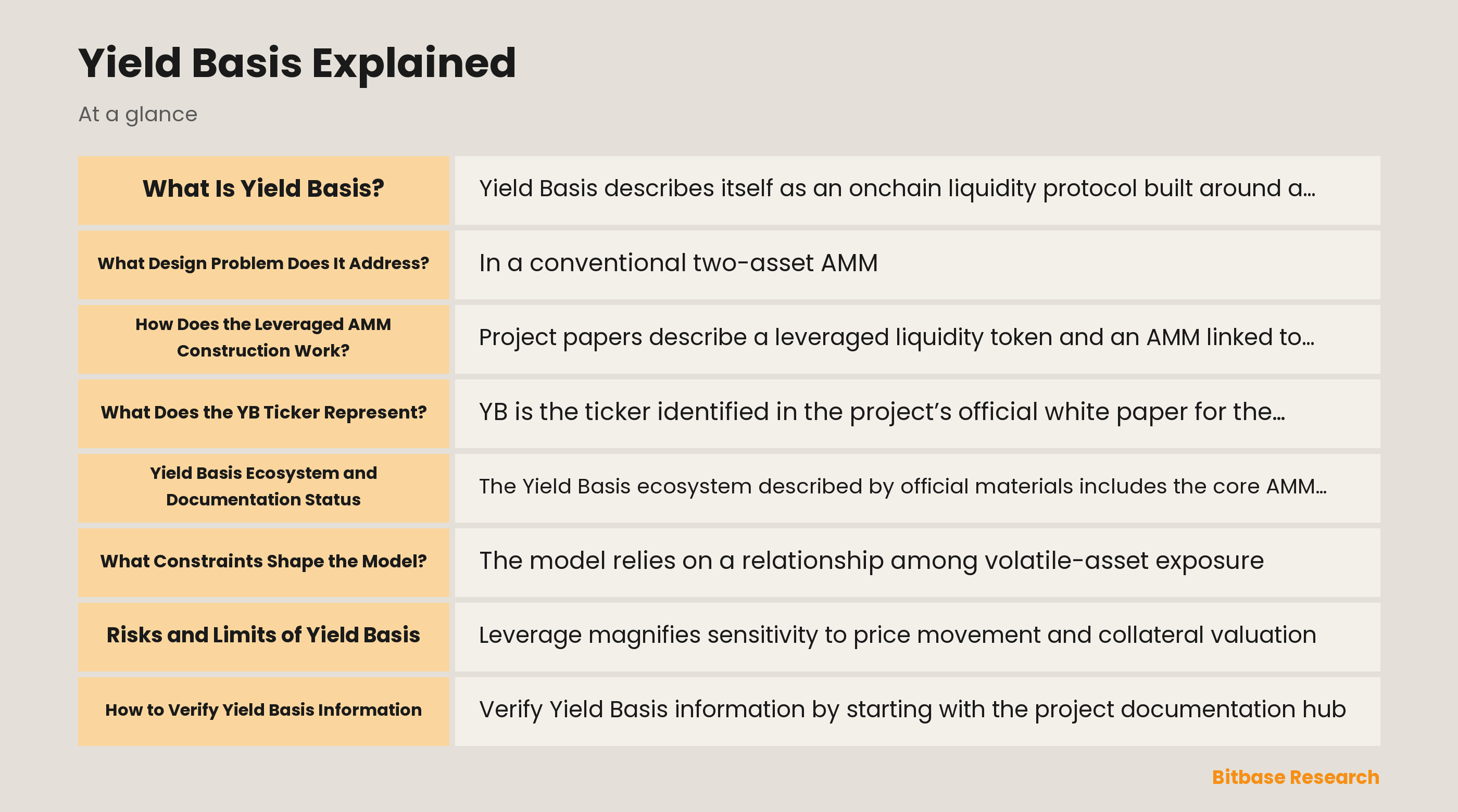
Yield Basis describes itself as an onchain liquidity protocol built around a leveraged AMM construction. Its published material frames the design as an attempt to address impermanent loss, the divergence that can arise when an AMM holds assets whose relative price changes. The design is associated with Ethereum and with Curve-style two-asset pool infrastructure in the project material. It is not a separate blockchain, and it should not be reduced to its governance token, an interface, or a single deployed pool.
The wording "reduce" or "address" impermanent loss is important. It states a design objective and model claim, not a universal promise that loss, imbalance, delay, or adverse execution cannot occur under changing market conditions.
What Design Problem Does It Address?
In a conventional two-asset AMM, trading changes the pool inventory as relative prices move. A liquidity position can therefore end with a different asset mix from its starting mix, and its value can differ from simply retaining the initial assets. This is commonly called impermanent loss, although the path and eventual outcome depend on market movement and pool mechanics. Yield Basis documents a construction that seeks to keep leveraged liquidity exposure closer to a chosen relationship with a volatile asset while routing the other side through stablecoin debt and AMM accounting. The proposal is therefore about exposure management within a specific set of contracts and parameters, not the elimination of every market risk.
An impermanent-loss model also does not answer every practical question. Oracle inputs, fee behavior, pool imbalance, collateral valuation, debt conditions, and the speed of price changes may materially affect how a design behaves.
How Does the Leveraged AMM Construction Work?
Project papers describe a leveraged liquidity token and an AMM linked to collateral represented by a two-asset liquidity-pool share. The construction uses stablecoin borrowing against that collateral and targets a constant leverage relationship, described in official material as 2× by default in the model. At a high level, the AMM tracks collateral, debt, an oracle-related price input, and an invariant. Trades and rebalancing logic change the composition of the system according to its rules. The intended effect is to make volatility and trading activity part of the economic model while managing directional exposure differently from an unleveraged pool.
This is not a claim that an oracle price is always correct, that rebalancing is immediate, or that a target leverage can always be maintained. The relationships depend on contract logic, external pool behavior, debt conditions, and configured parameters.
What Does the YB Ticker Represent?
YB is the ticker identified in the project’s official white paper for the YieldBasis token. That white paper describes YB as an ERC-20 governance and incentive token in the YieldBasis ecosystem, while a vote-escrowed representation is discussed separately in its governance design. Governance and incentive functions are distinct from the leveraged AMM itself. A token role can concern decision-making or allocation rules, but it does not establish ownership of an issuer, a right to a fixed payment, or a statement about value.
Token characteristics, allocation terms, supply mechanics, contract identifiers, governance rights, and applicable conditions are dynamic facts. They require direct review of current official material on the publication date.
Yield Basis Ecosystem and Documentation Status
The Yield Basis ecosystem described by official materials includes the core AMM codebase, research paper, documentation hub, white paper, and a project-hosted discussion forum. These materials serve different purposes: a technical paper explains a model, code shows an implementation surface, and forum posts may record ongoing ideas or proposed changes.
The official forum shows that pool analysis, parameter changes, and capacity discussions have continued after initial documentation. A proposal or a technical discussion is not by itself proof that a change is adopted, deployed, available, or applicable to every pool.
For publication, current deployed contracts, supported assets, oracle arrangements, collateral rules, leverage targets, liquidation conditions, and parameter values should be checked against matching first-party records. This article intentionally does not present time-sensitive values or identifiers as permanent facts.
What Constraints Shape the Model?
The model relies on a relationship among volatile-asset exposure, collateral, stablecoin debt, and the AMM’s price and fee mechanics. Its behavior may differ when liquidity becomes imbalanced, the price scale follows the market slowly, or the asset and oracle prices diverge. Official project discussion has described capacity as a constraint connected to the availability of stablecoin credit or liquidity. That is a design and scaling consideration, not evidence that capacity, access, or liquidity is assured at a particular time.
Parameters such as amplification, fees, adjustment steps, borrowing rates, and the allocation of fees toward rebalancing influence behavior. A parameter change can improve one modeled condition while creating a different tradeoff elsewhere; no static configuration can be presumed appropriate across all volatility regimes.
Risks and Limits of Yield Basis
Leverage magnifies sensitivity to price movement and collateral valuation. If debt, collateral, or the relevant price relationship moves unfavorably, liquidation-related mechanisms or other adverse outcomes may become relevant under the governing contract rules. The exact thresholds and procedures are dynamic and should not be inferred from a general description. Oracle risk is central because the construction uses price information in accounting and adjustment logic. Delayed, unavailable, manipulated, inaccurate, or differently scoped data can cause a mismatch between protocol calculations and surrounding market conditions.
Smart-contract risk remains even when code is public or documented. Logic defects, integration failures, upgrade or governance decisions, external dependency changes, and unexpected interactions can affect a system. Public documentation does not guarantee security, legality, availability, liquidity, or any outcome.
Volatility and parameter risk are equally material. Fast moves can create imbalance, temporary divergence, fee and rebalancing effects, or conditions that differ from simulations. Collateral, stablecoin, and external-pool dependencies introduce their own risks, including changes to their rules or market behavior.
How to Verify Yield Basis Information
Verify Yield Basis information by starting with the project documentation hub, the official leveraged-liquidity paper, the official code repository, and the project-hosted forum. Read each source for its date, authorship, and scope, rather than treating a slogan or an unaffiliated listing as a complete project description.
For the YB ticker, use the project’s official white paper and compare it with current project material. For any claimed contract address, first confirm that it is published in an official project context for the relevant network, then compare it with the corresponding block explorer record. A block explorer can display recorded data but cannot alone prove identity or present operating status.
Treat current contracts, token metadata, governance configuration, supported assets, oracle sources, collateral rules, liquidation settings, and pool parameters as publication-day verification items. A missing, inconsistent, or stale official record is a reason not to state a detail as current.
Conclusion
Yield Basis is best understood as a documented leveraged-AMM approach to an impermanent-loss problem, coupled with collateral, stablecoin debt, oracle-driven accounting, and configurable rebalancing mechanics. YB is the project’s documented governance and incentive ticker, not a substitute name for every protocol component.
The useful boundary is between a claimed design objective and a verified current condition. The construction has leverage, liquidation, oracle, collateral, parameter, volatility, smart-contract, and dynamic-status risks that remain relevant even when the underlying mechanism is clearly described. Current official records should be checked before publication.
Related market pages
- YB: View price · Perpetual market
Disclaimer: This article is educational content from Bitbase Academy, provided for information only. It explains what a project does and what role its token plays in that system; it does not constitute investment, trading, tax, or financial advice, and it is neither a recommendation nor an endorsement of any project or token. Bitbase has not carried out due diligence on the project described here, and mentioning it does not mean Bitbase lists or supports the asset. Crypto assets carry significant risk, including price volatility, thin liquidity, smart-contract failure, regulatory uncertainty, and the possible loss of their entire value. Written as of August 2026; a project's status, tokenomics, team, and contracts can change at any time. Verify everything yourself through official channels, the contract address, and a block explorer, and beware of imitation sites and phishing links.
References
[1] YieldBasis documentation hub docs.yieldbasis.com
[2] YieldBasis official white paper docs.yieldbasis.com
[3] Yield Basis leveraged liquidity paper github.com
[4] Yield Basis core code repository github.com
[5] Yield Basis project forum forum.yieldbasis.com