Walrus is documented as a decentralized, programmable blob-storage system coordinated through Sui. To answer “what is walrus crypto” clearly, separate the storage design, the public nature of blobs, the role of erasure coding, and WAL’s documented token role instead of treating a project label as a guarantee about data, a service, or a current network condition.
What Is Walrus?
Walrus describes its system as storage for blobs: immutable arrays of bytes that can represent different kinds of data. The useful starting point is not a file-management workflow but a data model. A blob has an identifier derived from its contents, so changing the represented bytes results in a different identifier rather than silently changing an earlier blob.
The official documentation also binds blobs to objects on Sui. That relationship gives the storage system a programmable coordination layer for records about blobs and system state. It does not mean that every item associated with Walrus, every interface using its name, or every external claim about an object has the same properties.
Walrus is therefore best understood as infrastructure with several separate pieces: content-addressed blobs, encoded storage data, a Sui-based coordination layer, and applications or services that may use those pieces. Keeping the layers distinct prevents a broad label such as “decentralized storage” from becoming an unsupported claim about confidentiality, availability, or suitability for a particular dataset.
What Problem Does Walrus Aim to Address?
Traditional application data needs more than a place to sit. An application may need to identify an exact version of data, express a storage relationship through programmable records, and inspect whether the bytes returned correspond to a documented identifier. Walrus frames blobs and their identifiers as building blocks for those types of data relationships.
The documentation describes erasure coding as a way to distribute encoded pieces of a blob across storage infrastructure rather than relying on one complete copy held in one place. This architecture is about how data is represented and recovered under stated conditions. It is not a promise that a particular object, service endpoint, or application will always be reachable.
Another part of the problem is coordination. Walrus documentation assigns Sui a role in managing metadata, system orchestration, and other onchain records related to the storage system. That can make certain state transitions observable, but observability is not the same thing as an audit of application code, a legal record, or a guarantee about information outside the protocol.
How Does Walrus Work?
At a high level, a blob is processed through an erasure-coding design documented by Walrus as RedStuff. The encoded result is divided into pieces, called slivers, associated with shards in the storage system. This lets the architecture discuss recovery and data availability in terms of a threshold model rather than treating a single storage location as the whole system.
Sui provides the coordination layer around that storage design. The official material describes records for blob-related state, storage resources, committee information, and events. A careful reading is that Sui helps coordinate and record parts of the system; it does not place the original bytes of every blob directly into the blockchain or make an external application automatically trustworthy.
Walrus also describes certificates and a point of availability in its documentation. These terms are useful because they distinguish a documented system state from an informal assertion that data has merely been prepared somewhere. Their scope remains important: a certificate, an event, or a blob identifier should be read with the applicable network, epoch, object, and current documentation context.
Content addressing adds a separate property. When a blob identifier is tied to the represented content, a later version is a new content reference rather than an overwrite of the previous bytes. This can support provenance-oriented designs, but it does not tell a reader whether an application’s labels, access logic, source data, or surrounding claims are accurate.
What Does WAL Do in the Walrus System?
WAL is the ticker used on the official Walrus token page for the system’s native token. That page describes roles around payments, network security, and governance. These are documented protocol roles, not a universal statement about every wallet display, external asset label, interface, or application connected to the broader ecosystem.
A query such as “walrus tokenomics and use cases” needs two distinct lenses. Token roles belong to the protocol’s documented economic and governance design, while use cases concern what builders or applications may do with programmable blob storage. Conflating those ideas can turn an explanation of system roles into a claim about a particular service, outcome, or user decision.
WAL should not be treated as a shortcut for verifying an external record. A ticker does not identify a universal contract address, prove that an interface is official, or establish the permissions of a network object. Current official material and the matching network context are necessary whenever a precise role or technical record matters.
Walrus Ecosystem and Use Cases: What the Documentation Shows
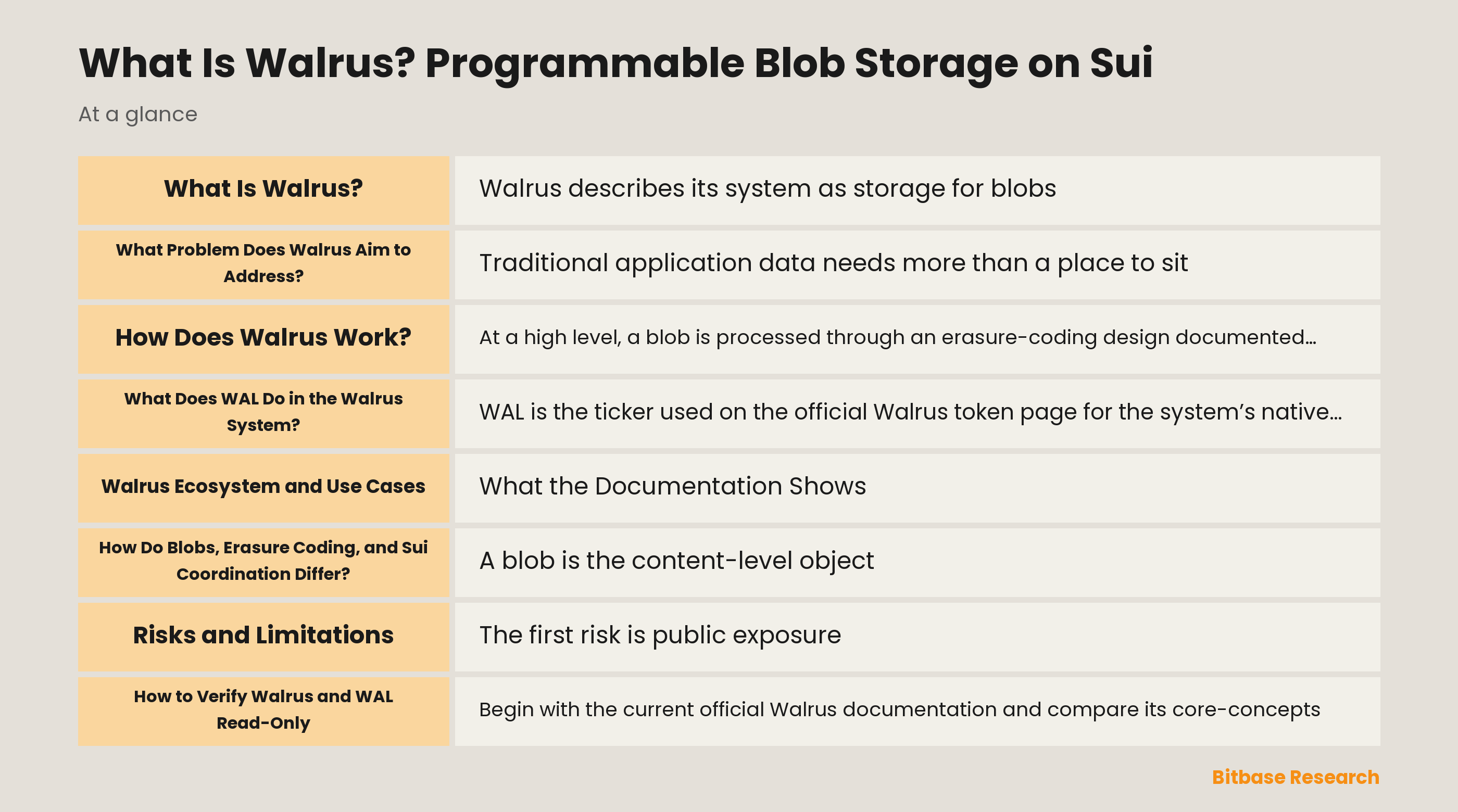
The Walrus ecosystem can include applications, developer tools, storage-oriented services, and integrations that use the underlying blob and Sui coordination model. The official documentation presents blobs as a flexible data primitive, which helps explain why people discuss content, application data, and programmable records in the same ecosystem. It does not authenticate a third-party product or establish its current adoption, permissions, or reliability.
Use cases should be read as context rather than instructions. Content versioning, reproducible references, and application-managed data are examples of the kinds of design questions a blob system can address. They do not establish that every data type is appropriate for a public storage setting, nor do they make an external application’s data handling or policy choices part of the Walrus protocol.
For this reason, “walrus crypto” is a narrower subject than the phrase can suggest. The project’s public documentation speaks to storage concepts and WAL’s documented role, while an individual application may introduce its own contracts, user experience, and data choices. Those additional layers require their own current review instead of being assumed from the Walrus name.
How Do Blobs, Erasure Coding, and Sui Coordination Differ?
A blob is the content-level object: it represents a specific immutable array of bytes and has a content-derived identifier. Erasure coding is the storage-level technique: it turns that content into distributed encoded pieces so that the system can reason about reconstruction and fault conditions. Neither term alone describes the full coordination state of the network.
Sui coordination is a third function. Official Walrus materials describe Sui objects, events, storage-related records, and committee state as parts of the coordination layer. This is different from the role of encoding itself: the chain can make certain protocol records inspectable, while the encoded slivers relate to the distributed storage of the blob’s data.
WAL is a fourth, distinct concept. It is the native token described by the official project page, whereas a blob ID identifies content and a Sui object identifies a protocol record in a particular context. Treating those identifiers as interchangeable would obscure what each one can and cannot demonstrate.
Risks and Limitations
The first risk is public exposure. Walrus documentation states that blobs are public and that the system does not natively provide confidentiality. A content-derived identifier is not a secret, and a storage architecture should not be described as private merely because it uses cryptography or distributed components.
The second risk concerns time and conditions. Storage periods, epochs, committee composition, network parameters, and the status of individual records can change. A high-level explanation of erasure coding does not prove a particular blob’s current availability, and a historical page does not substitute for reviewing the current official context.
There is also a verification risk around names and interfaces. A similarly named token, an unaffiliated service, or an incomplete object record can look convincing without establishing a connection to the documented system. This article makes no assurance about code quality, access controls, data residency, audit scope, or the condition of any asset or application.
How to Verify Walrus and WAL Read-Only
Begin with the current official Walrus documentation and compare its core-concepts, glossary, data-security, and WAL-token materials. Check the domain, page title, date context, and whether a statement describes a stable concept, a current parameter, or a condition that depends on a particular network and epoch.
For a blob-related claim, distinguish the blob ID, the relevant Sui object, and the statement being made about availability or duration. If an official source identifies a current record to inspect, compare the matching network and object information read-only in a Sui block explorer. Do not rely on a copied identifier, an unverified contract address, or a social-media label as proof by itself.
For WAL, confirm the ticker and documented role on the official project material before treating an external label as relevant. Then verify that any claimed network context matches the official documentation and the appropriate read-only record. A mismatch in domain, network, object type, or time context is a reason to stop and seek current clarification rather than fill the gap with an assumption.
The Bottom Line
Walrus is documented as programmable blob-storage infrastructure coordinated through Sui. Its design separates content-addressed blobs, erasure-coded storage data, protocol coordination records, and WAL’s documented token role. That separation is the clearest way to explain the system without turning one technical property into a general guarantee.
The appropriate conclusion is conditional and current-source based: public exposure, storage duration, network parameters, and technical records all matter. Before relying on a specific statement, compare the latest official material with the relevant read-only Sui record, and keep the scope of the claim limited to what those sources actually support.
Related market pages
- WAL: View price · Spot market · Perpetual market
Disclaimer: This article is educational content from Bitbase Academy, provided for information only. It explains what a project does and what role its token plays in that system; it does not constitute investment, trading, tax, or financial advice, and it is neither a recommendation nor an endorsement of any project or token. Bitbase has not carried out due diligence on the project described here, and mentioning it does not mean Bitbase lists or supports the asset. Crypto assets carry significant risk, including price volatility, thin liquidity, smart-contract failure, regulatory uncertainty, and the possible loss of their entire value. Written as of August 2026; a project's status, tokenomics, team, and contracts can change at any time. Verify everything yourself through official channels, the contract address, and a block explorer, and beware of imitation sites and phishing links.
References
[1] Walrus Fundamentals (official documentation) docs.wal.app
[2] RedStuff Encoding Algorithm (official documentation) docs.wal.app
[3] Data Security (official documentation) docs.wal.app
[4] Glossary (official documentation) docs.wal.app
[5] WAL Token (official Walrus website) walrus.xyz