Zebec is an evolving project associated with a time-aware model for payment flows: instead of treating an amount as visible only at isolated dates, a defined amount can be measured as accruing across time. Its public materials also use the name Zebec Network and describe ZBCN as a governance and utility token, but those labels belong to distinct layers that need to be read separately.
The name Zebec can appear in company communications, network-oriented documentation, token material, and product descriptions. None of those uses automatically proves the status or scope of another. This explainer focuses on the conceptual model of a streaming flow, the boundary between a network narrative and a product layer, and the matters that must be checked again on the publication day.
What Is Zebec?
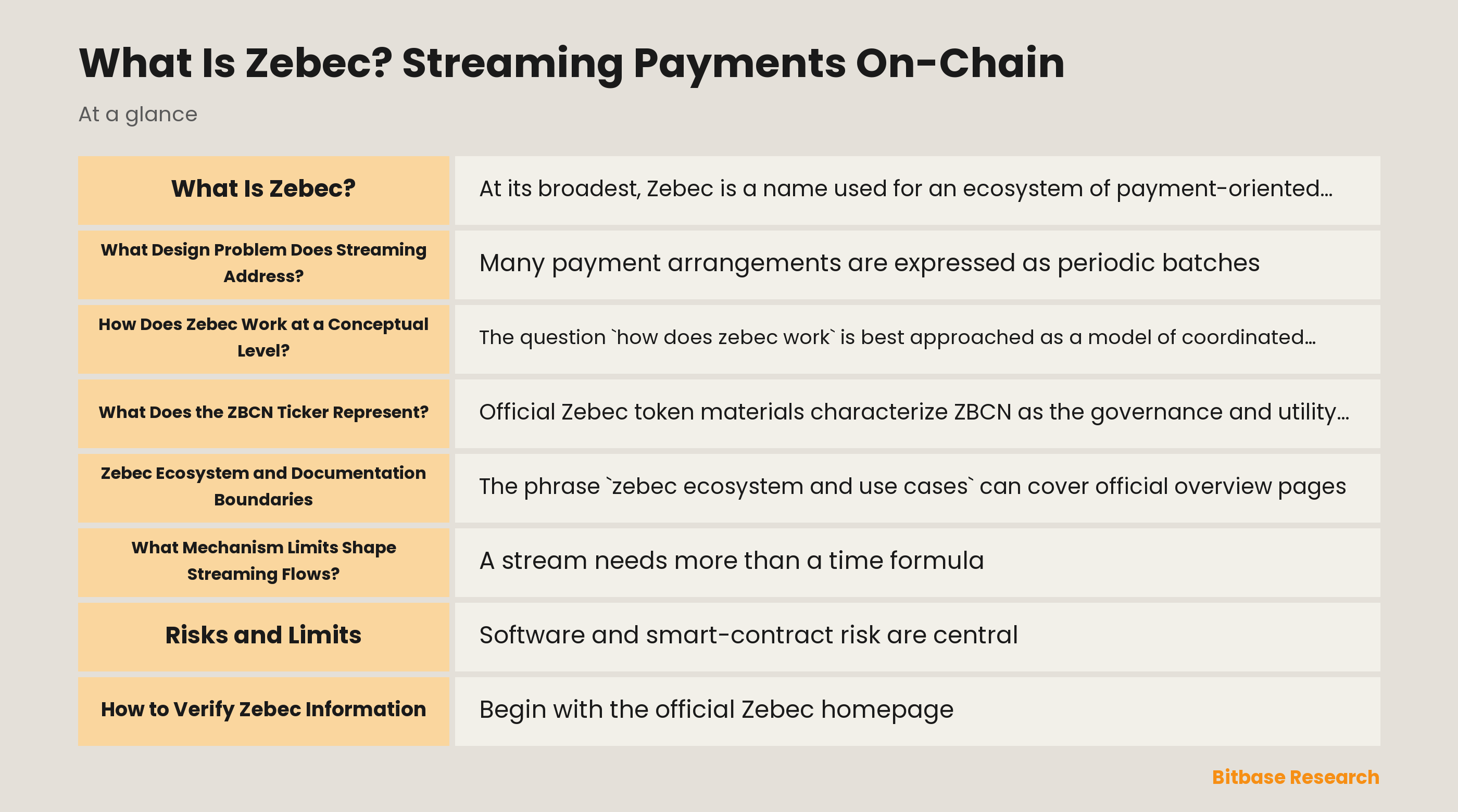
At its broadest, Zebec is a name used for an ecosystem of payment-oriented technology and documentation centered on continuous or streaming flows. Asked plainly, `what is zebec network` is not answered merely by naming a chain, an interface, or a token. The phrase can describe a network-level ambition, a set of technical components, and a group of products that may use those components. A careful description separates the conceptual flow model from any particular implementation.
A streaming payment is a way of representing an entitlement or allocation over time. Rather than treating the whole amount as becoming visible only at one periodic moment, the model can calculate a portion as time elapses according to defined terms. That does not mean a blockchain necessarily records a separate state change every second. A system can derive a continuously changing amount from timestamps and rules, while recording state only at selected points. The concept describes time-based accounting, not a promise of settlement in a particular currency or under every condition.
What Design Problem Does Streaming Address?
Many payment arrangements are expressed as periodic batches: work or service is measured during one interval, then an aggregate amount is accounted for at a later interval. That approach can be practical, yet it gives a coarse view of how an amount relates to elapsed time. A streaming model tries to make the time relationship explicit. It can define a start, an end, a rate of accrual, and conditions that affect the flow, so the amount associated with the elapsed portion is intelligible before the interval closes.
The design challenge is broader than timing. A usable system must distinguish the economic agreement, the rule that calculates an accrued amount, the record of system state, and the final outcome of a payment process. These layers may advance at different times. Continuous measurement does not remove counterparty risk, system dependencies, fees, changing terms, or applicable law. It simply offers a different primitive for expressing a time-sensitive obligation or allocation.
How Does Zebec Work at a Conceptual Level?
The question `how does zebec work` is best approached as a model of coordinated layers rather than a single action. One layer describes the rule for a flow, such as its time window and the conditions that govern it. A second layer measures the elapsed period and derives the amount associated with that period. A third layer records or reconciles state under the relevant technical rules. In an on-chain design, smart contracts can provide part of the shared accounting logic, while surrounding services can provide interfaces, monitoring, and other operational functions.
This separation matters because a network-level description and a product-level description are not interchangeable. “Network” may refer to infrastructure, standards, relationships among components, or a broader project identity. A product layer is a particular arrangement of those components for a defined context. The same streaming idea can be expressed with different timing assumptions, data inputs, chain environments, or administrative rules. High-level documentation therefore explains a design vocabulary; it does not by itself establish the exact behavior of every current component.
What Does the ZBCN Ticker Represent?
Official Zebec token materials characterize ZBCN as the governance and utility token of the Zebec Network. In that framing, the ticker identifies a cryptoasset associated with the project's governance and utility model. It should not be treated as the name of every technical component, as a description of a payment flow itself, or as evidence of a fixed legal or economic outcome. “Governance” and “utility” are project-defined terms whose practical scope can depend on current documentation and rules.
The same official materials are dated documents, and their terminology has evolved alongside the project. For publication, the exact ticker designation, governance process, token function in a specific component, chain identifiers, contract or mint identifiers, supply and distribution information, and fee treatment all require a fresh official-source review. A ticker alone cannot establish authenticity, current role, authorization, or the state of a related product. Treat it as an identifier whose meaning must be anchored to the relevant current document.
Zebec Ecosystem and Documentation Boundaries
The phrase `zebec ecosystem and use cases` can cover official overview pages, token documentation, technical material, and dated project announcements. These source types support different claims. A technical explanation can illuminate a mechanism; a homepage can state a broad project orientation; a token page can describe the project's own token framing. None should be stretched into a claim that every named component is active, available in every place, integrated everywhere, or governed by identical rules.
The useful boundary is between an ecosystem narrative and verified product facts. Product names, operational status, supported chain environments, geographic scope, terms, integration coverage, and organizational relationships are dynamic. They should be confirmed from current first-party material when publishing. Older documents can still be valuable for understanding why a mechanism was proposed, but age, document scope, and later changes determine how much present-day weight they carry.
What Mechanism Limits Shape Streaming Flows?
A stream needs more than a time formula. Its design must specify a source of time, a start and end condition, how changes are handled, the unit being accounted for, the bounds on the amount, and the rule for recording state. The amount calculated as having accrued is not automatically the same thing as a finalized balance record. If state is updated only when a technical event is recorded, an apparently continuous display may be a calculation from timestamps rather than a sequence of continuous ledger updates.
On-chain systems add further constraints. Network capacity, confirmation behavior, fees, software logic, dependencies, and the handling of exceptional conditions can affect when a record is observed or reconciled. A smart contract can enforce only the rules encoded in it and only within the environment on which it depends. Streaming also cannot independently establish whether an off-chain service was performed, whether a business arrangement remains valid, or whether every external system will treat a record in the same way.
Risks and Limits
Software and smart-contract risk are central: defects, upgrades, configuration mistakes, dependency failures, and unexpected behavior can affect accounting or recordkeeping. Infrastructure risk also matters when a design relies on networks, data sources, servers, clocks, or monitoring systems. Documentation, public code, and historical descriptions may help analysis, but they do not establish complete security, availability, or correctness for a particular deployment.
There is also a conceptual payment-flow risk. A continuous formula does not prove that a counterparty will remain able to meet an obligation, that a legal relationship has a particular effect, or that a calculated amount will become final on a particular schedule. Asset denomination can introduce additional uncertainty, and a delayed or interrupted technical environment can make records differ from expectations. ZBCN's official governance-and-utility framing likewise does not turn the token into a settlement promise, a return-bearing product, or an assurance about transaction outcomes.
How to Verify Zebec Information
Begin with the official Zebec homepage, the official documentation, the ZBCN tokenomics page, the official tokenomics blog post, and the official white-paper location. Compare publication dates, document versions, and the claim each source is actually making. Separate a conceptual statement about continuous flows from a statement about an individual product. Also distinguish a current official page from a historical announcement, because both may remain accessible while describing different moments in the project's development.
On the publication day, recheck the project identity and official domains; ZBCN's exact designation and documented governance scope; current token functions; chain and network identifiers; contract or mint identifiers; supply and distribution; fee logic; audit scope; product and deployment status; integration coverage; partner statements; jurisdictional or legal restrictions; and current terms. If official sources conflict, omit the disputed claim or describe the discrepancy with dates rather than silently selecting one version.
Conclusion
Zebec is most clearly understood through the idea of a payment flow whose accounting can be measured over time. That idea is useful because it separates a time rule from the periodic batch model, but it does not collapse the distinct stages of calculation, state recording, and final outcome. An on-chain implementation can make parts of that logic transparent and programmable without erasing its technical and operational limits.
Zebec Network and the product layer should be described with equal care. Network language can refer to a broader infrastructure or project narrative, whereas a product is a specific implementation with a current scope that may change. ZBCN is officially framed as a governance and utility token, yet that classification is not a statement of payment finality, legal effect, or any assured result.
The durable conclusion is methodological: read official material by date and scope, use it to explain the documented mechanism, and recheck mutable facts immediately before publication. That keeps `what is zebec network`, `how does zebec work`, and `zebec ecosystem and use cases` grounded in evidence rather than in assumptions about present availability or outcomes.
Related market pages
- ZBCN: View price · Spot market
Disclaimer: This article is educational content from Bitbase Academy, provided for information only. It explains what a project does and what role its token plays in that system; it does not constitute investment, trading, tax, or financial advice, and it is neither a recommendation nor an endorsement of any project or token. Bitbase has not carried out due diligence on the project described here, and mentioning it does not mean Bitbase lists or supports the asset. Crypto assets carry significant risk, including price volatility, thin liquidity, smart-contract failure, regulatory uncertainty, and the possible loss of their entire value. Written as of August 2026; a project's status, tokenomics, team, and contracts can change at any time. Verify everything yourself through official channels, the contract address, and a block explorer, and beware of imitation sites and phishing links.
References
[1] ZBCN Tokemonics docs.zebec.io
[2] Zebec Network White Paper docs.zebec.io
[3] Zebec Network (ZBCN) Tokenomics zebec.io
[4] Zebec Network Homepage zebec.io