Zora Network is the name used in Zora’s official materials for an Ethereum optimistic Layer 2 architecture built with the OP Stack. A useful explanation of zora network separates that L2 from Zora’s creator-facing protocol and services, and separates both from $ZORA, an ERC-20 documented on Base. These subjects are related, but they are not interchangeable technical objects.
What Is Zora Network?
Zora’s current network terms describe Zora Network as an optimistic Layer 2 rollup on Ethereum. At a high level, a rollup processes activity in an L2 environment and represents it to Ethereum through batches and associated contracts. That is an architectural description of execution and settlement. It is not a promise that every product, interface, contract, or historical feature connected to the Zora name is presently available or supported.
The same terms describe Zora Network as open-source software built with the OP Stack. They distinguish the deployed network software and contracts from Zora’s services, and they do not treat an initial deployment as proof that one entity permanently operates or controls every deployed component. This distinction is important because a familiar project name can refer to an L2 architecture, a set of contracts, developer tooling, and a user-facing application at different times.
For that reason, Zora Network is best approached as a technical and historical infrastructure term. It describes how a creator-oriented ecosystem used an Ethereum L2 design to organize onchain publishing and minting contexts. It does not establish the current status of a particular content format or application route. Any statement about present support must come from a dated, product-specific official source.
What Problem Does Zora Network Address?
Creator-oriented onchain systems need a way to associate media, identities, editions, profiles, or other content-linked records with smart-contract logic. They also need applications to discover and display those records. When every interaction is handled directly in a base-layer context, the constraints of that layer can shape how an application is designed. An L2 architecture addresses this by organizing many interactions in a separate execution context and anchoring summarized results to Ethereum.
The historical creator-minting context should be understood as infrastructure, not as a statement about the value, authenticity, or continuing availability of any content item. The narrower technical question is whether a public contract system can represent a creator or content-linked record under transparent rules. The answer depends on the precise protocol version, the network where it is deployed, contract permissions, and the current rules of an application using it.
Zora’s current developer materials emphasize Coins Protocol, SDKs, and tools for building creator-related experiences. That makes terminology especially important. An SDK helps a program use a protocol; a protocol defines contract behavior; a network supplies execution and settlement context; and a service chooses which features to expose. These layers can work together without becoming the same thing.
How Does Zora Network Work?
An optimistic rollup separates L2 execution from Ethereum’s base-layer execution. The L2 keeps track of its own activity and state, while batches and commitments are submitted to Ethereum. This arrangement does not mean that Ethereum disappears from the design. Instead, Ethereum remains the layer to which the rollup anchors the relevant records and where the rollup’s settlement and dispute model connect to base-layer contracts.
Zora’s network terms describe a sequencer role that organizes activity into batches, compresses information, and sends it to Ethereum contracts. They also describe a verifier-oriented role around detecting a discrepancy between the L2 history and state. These are architectural roles, not directions to run software. The actual release, deployment, configuration, availability, and administrative arrangements are all time-sensitive and should be checked only against current official materials.
The OP Stack is the open-source framework named in Zora’s documentation for this design. Being built with that framework identifies a technical family of components and interfaces; it does not prove that every deployment uses identical settings or follows an identical upgrade history. A high-level L2 label therefore cannot replace a review of the particular contracts, source version, and dated documentation relevant to a specific question.
What Does ZORA Do in the Zora System?
Zora Network, Zora Protocol, and $ZORA are three different layers of the broader Zora context. Zora Network refers to the L2-oriented infrastructure described in the network terms. Zora Protocol refers to creator- and content-related contract tools and rules that applications can use. Zora services are the interfaces and offerings through which people may encounter some of those tools. A service, a protocol, and a network can be connected without one proving the status or behavior of the others.
$ZORA, whose ticker is ZORA, is documented in official token materials as an ERC-20 on Base, an Ethereum Layer 2. The cited materials also state that the token does not provide governance rights or a claim on equity in Zora or its products. Those documented boundaries prevent a common category mistake: a token associated with a project name is not automatically a network’s gas asset, a control right, an ownership interest, or a technical requirement for every creator-facing feature.
The official sources used here do not document ZORA as the gas token of Zora Network, so this article does not make that claim. Nor does its Base placement make Base and Zora Network the same network. An official regulatory document says Zora Network historically served as a default network for Zora Protocol before Base replaced it, while current network terms still describe a Zora Network L2 architecture. That dated tension should be preserved as a verification boundary, not hidden by merging the names.
Zora Network Ecosystem and Creator Infrastructure
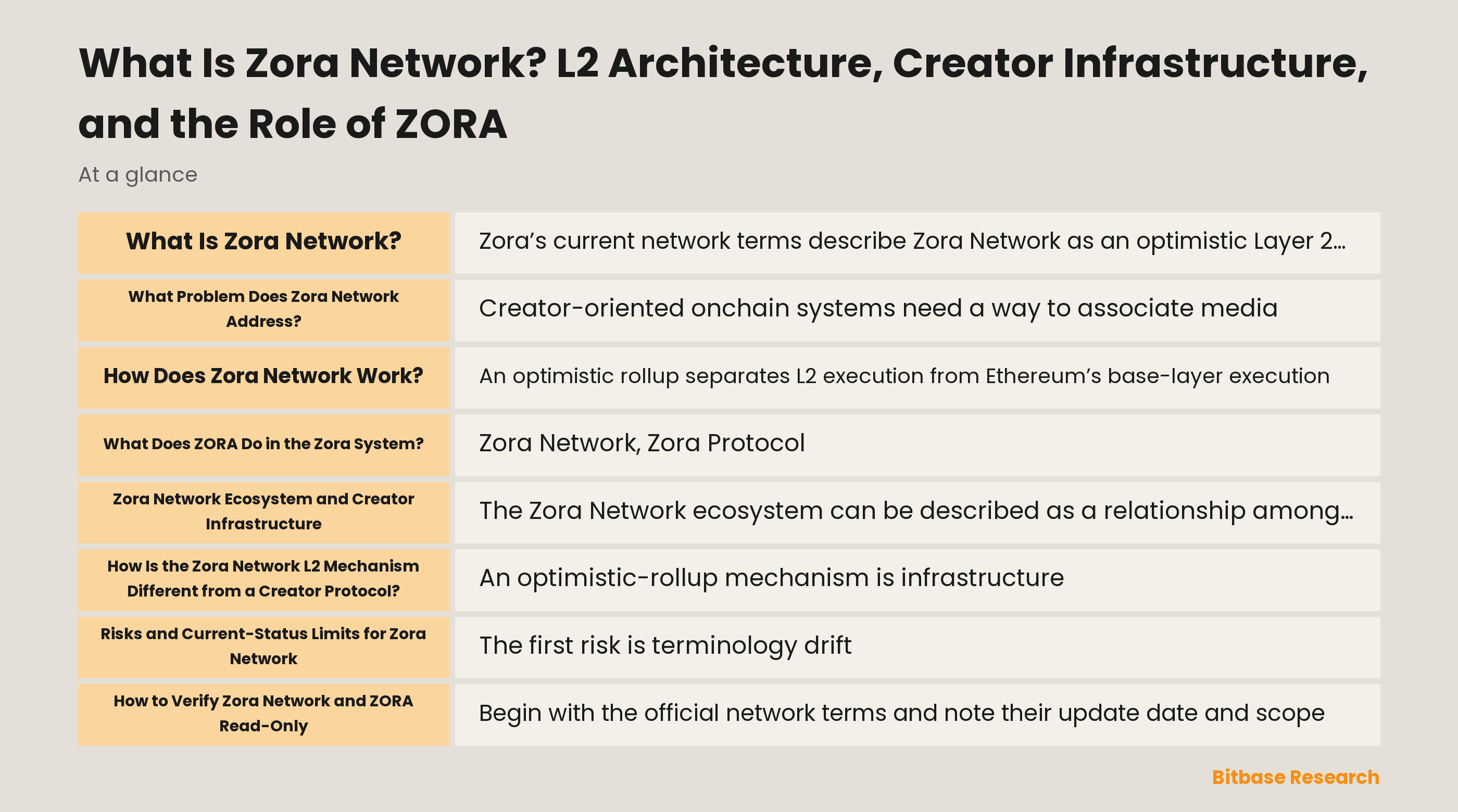
The Zora Network ecosystem can be described as a relationship among infrastructure layers rather than as a permanent list of applications. A creator-facing protocol can provide contract conventions; developer tools can help programs work with those conventions; an L2 can supply an execution and settlement context; and an interface can present selected features. Each layer has its own versioning, permissions, dependencies, and support status.
In that setting, “creator minting” refers to creating public, contract-based records associated with a creator, content item, profile, or other cultural object. It does not establish ownership of underlying intellectual property, authenticity of uploaded material, or a continuing right to use an interface. A contract record and the product experience around it are separate: the application may index, display, filter, or discontinue a feature without changing the historical meaning of an earlier L2 architecture.
Current developer documentation centers on Coins tools, while an official regulatory document says Zora applications no longer support NFTs and that Base replaced Zora Network as the historical default for the Zora Protocol. The article therefore does not treat historical NFT-oriented minting, current creator-token tooling, and the L2 architecture as one unchanged product. The appropriate current question is always which asset type, network, contract system, and application feature an official source is actually describing.
How Is the Zora Network L2 Mechanism Different from a Creator Protocol?
An optimistic-rollup mechanism is infrastructure. It concerns L2 execution, the organization of activity into batches, state commitments, fault or dispute handling, and the way those elements connect to Ethereum. Its central question is how a chain-like system processes and anchors activity; it does not decide what a creator profile, content object, or associated record should mean.
A creator protocol is application-level logic. It defines smart-contract structures and interfaces through which creator- or content-related records can be represented. Such a protocol can have different deployments and can be accessed through more than one application. Changes in supported products do not turn a protocol into an L2, just as an L2 can support many applications without making their individual rules part of its settlement layer.
The distinction is not a platform comparison. It is a method for asking better questions. Questions about a record’s contract rules belong to the protocol and its deployment; questions about batching and settlement belong to the L2 architecture; questions about ZORA belong to the Base ERC-20 documentation. Keeping these subjects separate reduces the risk of importing a claim from one layer into another.
Risks and Current-Status Limits for Zora Network
The first risk is terminology drift. “Zora” can point to a company, services, developer tools, a creator protocol, an L2 architecture, or an ERC-20. The official materials cited for this article are not all framed at the same date or product layer. Treating them as one object can lead to incorrect statements, such as describing a Base token as a Zora Network gas token or assuming that a historical default network is a current application route.
There are technical limits as well. An L2 architecture description does not establish that every related contract is current, source-verified, configured identically, or free of vulnerabilities. Open-source code can have version differences; contracts can have permissions or upgrade paths; indexers can show stale data; and an optimistic-rollup design depends on its deployed commitments and dispute mechanisms. A project label or repository cannot substitute for a scoped review of the exact artifact in question.
The ZORA boundary adds another reason for care. Token materials, contract metadata, legal disclosures, and product support can change. This article deliberately omits supply, allocation, address, valuation, and market statements. Its durable educational point is narrower: ZORA is a documented Base ERC-20 that must be kept distinct from the Zora Network L2 architecture and from creator-facing protocol functionality.
How to Verify Zora Network and ZORA Read-Only
Begin with the official network terms and note their update date and scope. Determine whether a page is describing an L2 architecture, a service condition, or a particular implementation detail. Then compare that description with the current developer documentation and the official token materials. A difference in wording is evidence of a source boundary, not a gap that should be filled with an assumption.
For ZORA, compare the identity and intended network in official token materials with the current official token-contract repository and a read-only block explorer record on Base. The relevant facts are the published contract address, the matching network, code-verification information when it is available, and whether the official source and explorer point to the same current artifact. This is a reading and comparison path only; it does not call for an interactive request or any asset movement.
For Zora Network, distinguish a high-level architecture statement from a record about a particular deployment. A terms page can describe the L2 model, a repository can identify public code, and a block explorer can show a chain record. None by itself proves product availability, creator rights, security, or the status of another layer. If official dates or statements conflict, retain the conflict and seek an editorial decision before publishing a current-state claim.
The Bottom Line
Zora Network is most accurately described as the OP Stack-based optimistic L2 architecture documented in Zora’s network materials, with a creator-infrastructure and historical minting context. It is not synonymous with Zora Protocol, a particular interface, or ZORA. This layered view makes the phrase “zora network” useful because it points to a specific technical subject rather than a broad brand label.
ZORA is a separate Base ERC-20 with documented boundaries that do not make it the gas token of Zora Network or a governance or equity right. The official record contains an important status limitation: one source describes a Network L2 architecture, while another says the historical default for Zora Protocol was replaced by Base. A publication should keep that distinction visible and re-check dated official sources before asserting a current product state.
Related market pages
- ZORA: View price · Perpetual market
Disclaimer: This article is educational content from Bitbase Academy, provided for information only. It explains what a project does and what role its token plays in that system; it does not constitute investment, trading, tax, or financial advice, and it is neither a recommendation nor an endorsement of any project or token. Bitbase has not carried out due diligence on the project described here, and mentioning it does not mean Bitbase lists or supports the asset. Crypto assets carry significant risk, including price volatility, thin liquidity, smart-contract failure, regulatory uncertainty, and the possible loss of their entire value. Written as of August 2026; a project's status, tokenomics, team, and contracts can change at any time. Verify everything yourself through official channels, the contract address, and a block explorer, and beware of imitation sites and phishing links.
References
[1] Zora Terms of Service and Zora Network Supplemental Terms (official) support.zora.co
[2] ZORA Tokenomics (official) support.zora.co
[3] ZORA MiCAR Whitepaper (official) support.zora.co
[4] Zora developer documentation (official) docs.zora.co
[5] Zora Token Contracts (official source repository) github.com
[6] Zora official source-code organization github.com