Babylon documents a Bitcoin-native security protocol that combines Bitcoin-script conditions with Babylon Genesis coordination; BABY is the documented native token of Babylon Genesis.
People researching babylon tokenomics and use cases, or searching for babylon crypto, need to separate a documented protocol design from a guarantee about assets, outcomes, availability, or future development. This profile explains the mechanisms described in Babylon’s official materials without providing a staking, release, reward, cross-network movement, or software-use procedure.
What Is Babylon?
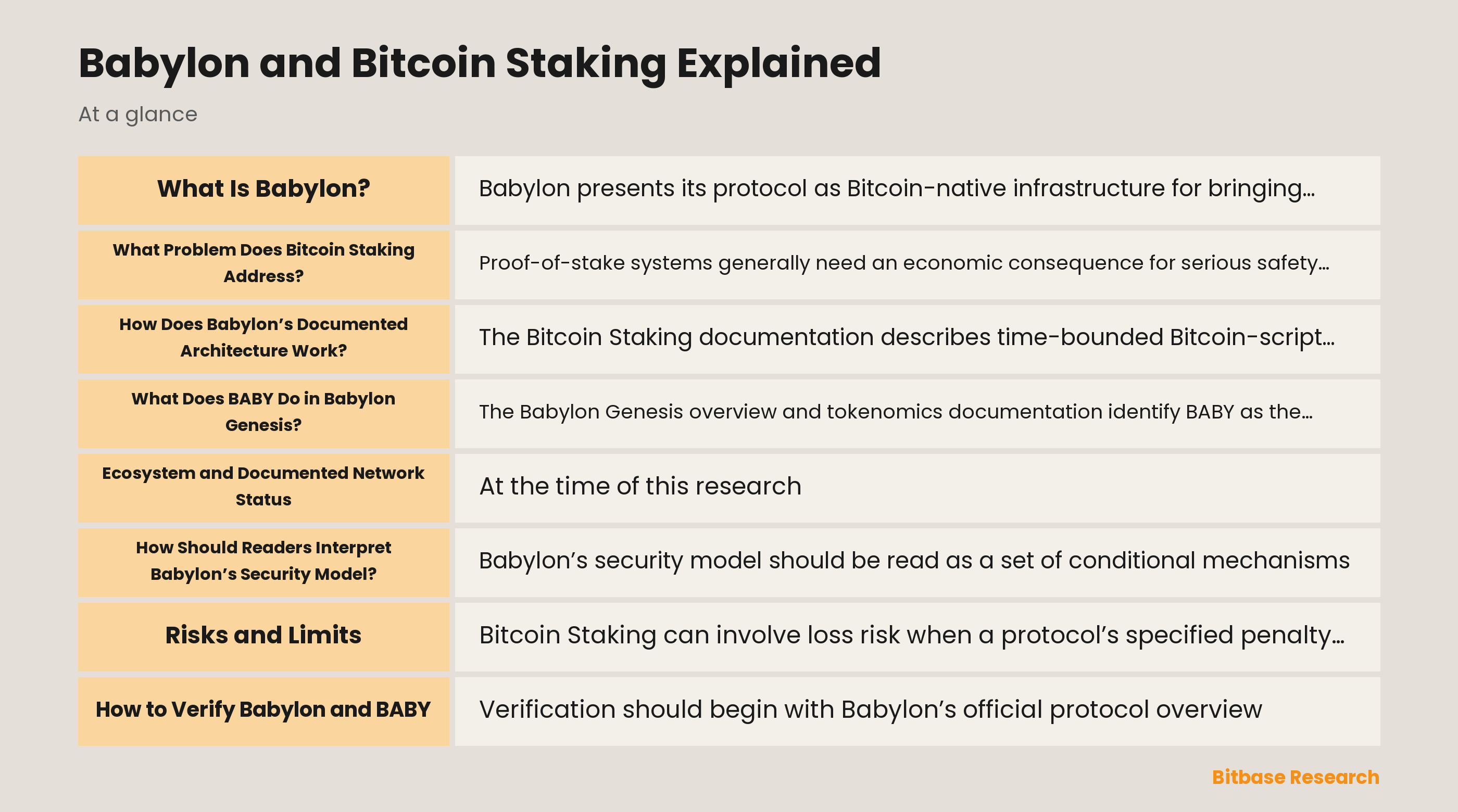
Babylon presents its protocol as Bitcoin-native infrastructure for bringing Bitcoin economic security into a broader proof-of-stake setting. Its documentation describes Bitcoin Staking as a design in which Bitcoin-script conditions and a coordinating chain are used to make Bitcoin collateral relevant to the security of selected systems. That description concerns a protocol model, not a statement that every implementation or participant has the same risk profile.
Babylon Genesis is documented as the coordination layer for that model. The official overview describes it as a Cosmos SDK-based chain that tracks relevant staking state, coordinates finality-related roles, and connects the Bitcoin-oriented security design with the Babylon ecosystem. A coordination layer is an architectural role; it should not be treated as proof that a particular application, integration, or security property is available in every context.
What Problem Does Bitcoin Staking Address?
Proof-of-stake systems generally need an economic consequence for serious safety failures. Babylon’s materials frame Bitcoin Staking as an attempt to make native Bitcoin usable as security collateral without redefining Bitcoin itself as a proof-of-stake asset. The stated goal is to give systems that adopt the design an additional source of economic security while retaining a defined relationship with the Bitcoin chain.
That goal does not eliminate the difficult parts of shared security. A protocol still depends on correctly specified rules, reliable implementation, relevant chain conditions, and the behavior of the parties recognized by its design. It is more precise to say that Babylon documents a way to express economic penalties and finality incentives than to say that Bitcoin Staking makes a system automatically secure.
How Does Babylon’s Documented Architecture Work?
The Bitcoin Staking documentation describes time-bounded Bitcoin-script conditions built on Bitcoin’s UTXO model. It also describes a slashing path, Extractable One-Time Signatures (EOTS), and a covenant committee as parts of the mechanism intended to make specified security faults economically consequential. These are technical design components, and their presence in documentation does not independently establish that a particular deployment is correctly configured or free of defects.
Babylon Genesis is described as the place where the protocol coordinates recognized Bitcoin staking information and finality-related activity. The design also refers to Finality Providers, validators, checkpointing, and monitoring components. Those names identify roles in the architecture, but they do not mean that all roles have identical authority, that every external dependency is available, or that the resulting system has no operational or governance risk.
What Does BABY Do in Babylon Genesis?
The Babylon Genesis overview and tokenomics documentation identify BABY as the native token of Babylon Genesis. The materials assign it roles connected with transaction fees, on-chain governance, and the proof-of-stake security model of the Genesis chain. This is a description of the token’s stated protocol role; it is not an assertion about its value, suitability, or any result associated with holding it.
The official documentation also describes a dual-staking model in which BTC-related security and BABY-related proof-of-stake security are distinct but coordinated. Keeping those roles separate is important. Bitcoin staking is not the same thing as BABY’s role in Babylon Genesis governance and chain security, and the existence of both mechanisms does not demonstrate adoption, liquidity, or a financial outcome.
Tokenomics documents discuss initial supply, distribution, inflation, and release arrangements. These are economic-design statements that can be revised through official processes and can change in practical effect as network rules evolve. They should be read alongside current official materials rather than used as a permanent substitute for the latest chain information or governance record.
Ecosystem and Documented Network Status
At the time of this research, Babylon’s official Chain Information page lists Babylon Genesis Mainnet with chain identifier `bbn-1`, as well as a separate testnet entry. Its official launch material records the earlier Phase-2 mainnet rollout and Bitcoin Staking activation. These sources establish what Babylon’s documentation currently presents; they are not a substitute for a publication-day check of live availability, supported functions, or any current restriction.
The ecosystem description includes the Babylon protocol, Babylon Genesis, Bitcoin-oriented security components, and documentation for governance and technical infrastructure. The boundary matters because a historical announcement, a protocol paper, and a current network record answer different questions. A cautious profile keeps each source in its own time context instead of turning a past milestone or a planned capability into an unqualified present-tense statement.
How Should Readers Interpret Babylon’s Security Model?
Babylon’s security model should be read as a set of conditional mechanisms. The documentation describes how an identified safety violation can be associated with a protocol-defined economic penalty and how Bitcoin timestamping can be used in the coordination model. That is different from a promise that Bitcoin assets, finality, software, outside services, or any individual decision will be safe in all circumstances.
Several assumptions remain material: the correctness of Bitcoin-script logic, the behavior and incentives of recognized roles, the operation of Babylon Genesis, relevant Bitcoin-chain conditions, and the governance processes that can change parameters or software. Technical architecture can reduce or redistribute particular risks, but it cannot remove implementation mistakes, dependencies, adversarial behavior, or uncertainty about how a rule will perform under stress.
Risks and Limits
Bitcoin Staking can involve loss risk when a protocol’s specified penalty conditions are triggered, as well as software, consensus, timing, governance, and information risks. A reader should not infer asset safety from the word “native,” from the existence of a Bitcoin-script condition, or from an explanation of a penalty mechanism. The proper question is what official rules apply at a particular time and what assumptions those rules require.
There are also information risks. Chain identifiers, release versions, token parameters, governance decisions, software scope, audit materials, finality-provider information, and documentation pages can change. A description of a mainnet entry does not prove that every service is available, that every integration is current, or that a later protocol change has the same properties described in an earlier document.
How to Verify Babylon and BABY
Verification should begin with Babylon’s official protocol overview, Bitcoin Staking documentation, Babylon Genesis overview, tokenomics material, and Chain Information page. Together, those sources should consistently distinguish Babylon from Babylon Genesis and identify BABY as the native token of the Genesis chain. An unaffiliated directory, copied post, or similarly named token is not an equivalent source of identity information.
Where Babylon’s official documentation lists a Babylon Genesis block explorer, compare the documented chain identity, including `bbn-1`, with the same official chain-information context before relying on a chain record. A block explorer can help inspect public records, but it cannot by itself prove a project relationship, current product scope, safety property, or the accuracy of an unofficial statement. A missing or conflicting official record is a reason to pause and re-check primary materials, not to infer an answer.
Conclusion
Babylon is best understood from its official materials as a Bitcoin-native security protocol with a coordinating Babylon Genesis chain and a documented Bitcoin Staking design. BABY is the native token described for Babylon Genesis, with stated roles in fees, governance, and the chain’s proof-of-stake security model. Neither fact turns the protocol architecture into an assurance about security, availability, or any financial outcome.
Before publication, re-check Babylon’s official chain status, BABY parameters, current protocol scope, applicable rules, and any officially published chain record. Separating stable architectural explanation from time-sensitive network details makes the profile more accurate and keeps it within the evidence supplied by first-party materials.
Related market pages
- BABY: View price · Perpetual market
Disclaimer: This article is educational content from Bitbase Academy, provided for information only. It explains what a project does and what role its token plays in that system; it does not constitute investment, trading, tax, or financial advice, and it is neither a recommendation nor an endorsement of any project or token. Bitbase has not carried out due diligence on the project described here, and mentioning it does not mean Bitbase lists or supports the asset. Crypto assets carry significant risk, including price volatility, thin liquidity, smart-contract failure, regulatory uncertainty, and the possible loss of their entire value. Written as of August 2026; a project's status, tokenomics, team, and contracts can change at any time. Verify everything yourself through official channels, the contract address, and a block explorer, and beware of imitation sites and phishing links.
References
[1] Babylon Protocol Overview (official documentation) docs.babylonlabs.io
[2] Bitcoin Staking (official documentation) docs.babylonlabs.io
[3] Babylon Genesis Overview (official documentation) docs.babylonlabs.io
[4] Babylon Genesis Tokenomics (official documentation) docs.babylonlabs.io
[5] Babylon Genesis Chain Information (official documentation) docs.babylonlabs.io
[6] Phase-2 launch round up (official Babylon announcement) babylonlabs.io