Berachain is an EVM-identical Layer 1 whose documented design combines Ethereum-compatible execution, BeaconKit consensus architecture, and Proof of Liquidity (PoL) economic coordination. Readers asking “what is berachain” are usually looking for more than a token label: they need to separate the chain’s execution environment, its incentive design, and the distinct roles of BERA, WBERA, and BGT.
What Is Berachain?
Berachain is a Layer 1 blockchain that its official documentation describes as EVM-identical. In practical terms, that claim is about the execution environment: Solidity contracts and familiar Ethereum tooling are intended to work against the same EVM rules rather than requiring a separate smart-contract language or an unrelated runtime. EVM-identical is an architecture claim, not a guarantee that every application, deployment, or external tool behaves safely on its own.
The chain’s public technical description separates execution from consensus. Berachain uses Bera-Reth, a lightly modified Reth implementation, for smart-contract execution, while BeaconKit provides a modular consensus framework. That separation matters because an application can be compatible with the EVM at the execution layer while the chain still makes its own choices about validator coordination, block production, software releases, and protocol upgrades.
The third piece is Proof of Liquidity, usually shortened to PoL. PoL is not a replacement name for the EVM or for BeaconKit. It is Berachain’s documented economic coordination system for routing network emissions and incentives through validators, applications, Reward Vaults, and activity regarded by the protocol as useful. Keeping those three layers distinct makes the project easier to evaluate: execution answers how contracts run, consensus answers how the network coordinates, and PoL describes an incentive design around that network.
What Problem Does Berachain Aim to Solve?
A conventional Layer 1 has to balance several linked concerns: developers need a usable execution environment, validators need a way to participate in consensus, and applications need enough infrastructure and liquidity to operate. Those concerns are related but not identical. A chain can be technically compatible with familiar tools yet still leave applications and users to solve incentive alignment through separate arrangements that may not be visible at the protocol layer.
Berachain’s documentation frames PoL as an attempt to make emissions part of a recurring coordination loop rather than treating them only as a cost of security or a short-lived activity subsidy. The stated design routes a portion of the network’s incentive flow toward Reward Vaults and participating applications, with the objective of connecting validator decisions and application activity to the broader chain economy. This is a protocol design goal, not independent evidence that a particular application produces durable value or that a given incentive will remain available.
That framing also explains why Berachain uses several related assets instead of assigning every task to one token. The native asset, a wrapped representation, and a non-transferable governance-and-rewards asset have separate documented roles. A reader should therefore avoid collapsing BERA, WBERA, and BGT into one generic “Berachain token” category; doing so would hide the mechanisms the documentation asks readers to distinguish.
How Does Berachain Work?
At the execution layer, Berachain aims to preserve compatibility with Ethereum’s EVM and its standard developer interfaces. A smart contract’s code still needs to be reviewed in the context of the particular deployment, permissions, upgrade path, and external dependencies. Compatibility makes an interface familiar; it does not eliminate the normal risks of contract logic, oracle assumptions, administrator controls, or incorrect integrations.
At the consensus layer, BeaconKit is the framework that connects an EVM execution environment with the consensus process described in Berachain materials. The official documentation characterizes it as modular and based on CometBFT-related consensus components. Rather than treating this as a performance slogan, it is more useful to ask which software version, validator set, network configuration, and upgrade rules apply to the deployment being examined at a given time.
PoL adds an economic path around that technical stack. Official materials describe validators staking BERA to help secure the chain and producing blocks, then describe WBERA emissions flowing partly to validator operators and partly through the reward-allocation system toward Reward Vaults. The mechanism does not make outcomes automatic: the relevant contracts, parameters, application eligibility, and governance decisions determine how a particular path operates and can change over time.
What Does BERA Do in the Berachain System?
BERA is the official ticker for Berachain’s native gas and validator-staking token. The native asset pays transaction fees on the network and is the asset validators use in the documented active-set and block-production design. Those statements identify protocol roles; they do not describe a purchase, staking, or participation instruction, and they do not establish a value judgment about the asset.
The documentation also distinguishes native BERA from WBERA, a 1:1 wrapped form used in parts of the PoL emission and contract system. BGT has another documented role as the governance-and-rewards asset used within PoL. These names are easy to confuse because all three are connected to the same chain, but they are not interchangeable identifiers. When reading a contract page, an interface, or a proposal, first establish which asset it actually names before inferring what rules apply.
BERA’s role is also not the same thing as the mechanism of PoL. BERA is used for gas and validator staking; WBERA appears in documented emissions flows; BGT is used for specific governance-and-reward functions. This separation is precisely why a project introduction should name the ticker in context instead of reducing the network to a token symbol.
Ecosystem and Adoption: What the Documentation Shows
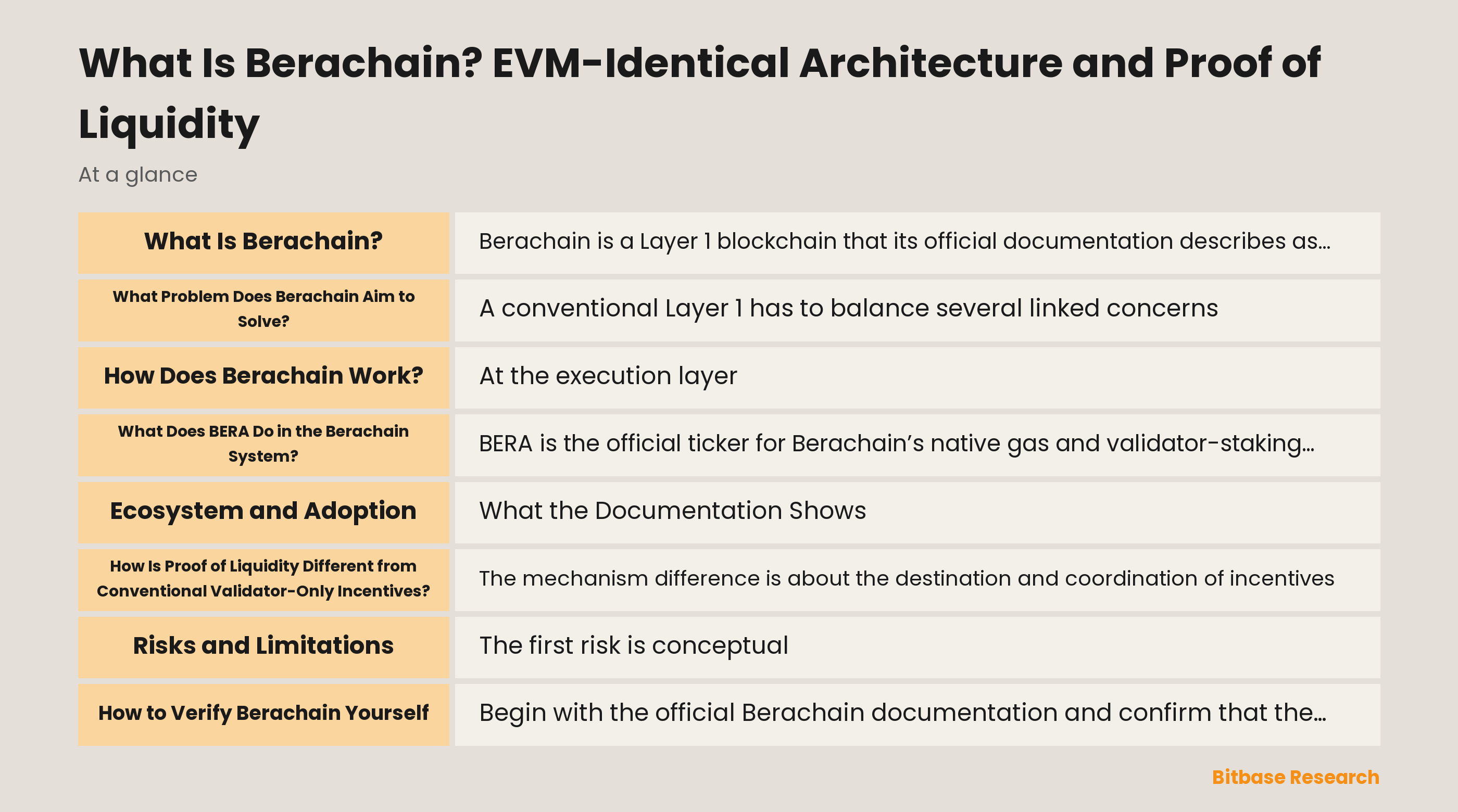
The official ecosystem material identifies native applications and protocol components such as BEX, Bend, HONEY, Reward Vaults, and the governance system. Their presence helps illustrate how the project’s documentation connects execution, liquidity, and incentives, but a list of names is not evidence that every component has the same maturity, security posture, liquidity conditions, or operational status. Each contract and application must be reviewed separately.
For that reason, this article does not turn ecosystem references into a count of users, a performance ranking, a measure of decentralization, or a claim about future adoption. The relevant question for a reader is narrower: which component is being discussed, on which network, under which contract address and permissions, and how does its stated behavior connect to PoL? Official documentation can establish an intended architecture; current on-chain records and versioned code are needed to inspect a specific deployment.
How Is Proof of Liquidity Different from Conventional Validator-Only Incentives?
The mechanism difference is about the destination and coordination of incentives, not a claim that one chain is universally better than another. In a validator-only incentive model, protocol rewards are principally associated with securing and producing blocks. Berachain’s PoL documentation describes a broader path in which validators still use BERA for chain security while some emissions are routed through allocation contracts and Reward Vaults toward applications and eligible activity.
That creates more moving parts than a simple “validators receive everything” description. The contracts that allocate rewards, the criteria for eligible vaults, incentives supplied by applications, validator choices, and governance parameters all affect the actual path. The model may align some participants’ incentives, but it can also add dependencies and decision points that must be examined in their current, deployed form.
It is also important not to confuse PoL with proof that liquidity itself is safe, permanent, or fairly distributed. Liquidity can be fragmented, contracts can have different permissions, and incentive rules can change. The useful analytical question is whether a documented incentive route matches the specific application and contract a reader is assessing, not whether a broad label settles every technical or economic question.
Risks and Limitations
The first risk is conceptual: EVM-identical, BeaconKit, and PoL refer to different layers, so an accurate statement about one does not automatically establish a result about another. An EVM-compatible application can still contain a vulnerability; consensus-client software can require upgrades; and an incentive design can operate differently from a simplified diagram. Readers should inspect the exact code, contract, configuration, and governance context rather than relying on a project-wide description.
There are also contract and governance risks. A Reward Vault, token wrapper, or core allocation contract may have permissions, upgrade mechanisms, dependencies, and conditions that differ from another component. Official documentation lists contract addresses, but an address alone does not reveal whether the interface is current, whether source code is verified, or which implementation sits behind a proxy. Those details require a current, read-only comparison between the official deployment table and the relevant block-explorer page.
Finally, the PoL design depends on changing inputs: validator behavior, application activity, reward allocation, software releases, and governance decisions. Documentation can describe the intended rule set at a point in time, but it is not a substitute for checking the effective contracts and parameters. No audit conclusion is made here; an audit report, when present, has to be located through the named auditor and matched to the exact code and deployment it covers.
How to Verify Berachain Yourself
Begin with the official Berachain documentation and confirm that the architecture page, BERA token page, deployed-contract table, and official code organization all point to the same project context. Read the date and scope of each page. Separate a high-level design description from an address registry, a source repository, and a record of a particular on-chain contract; each proves a different kind of fact.
For the native asset, first note that BERA is native to Berachain and is not presented as a single ERC-20 contract address. The official deployment table lists WBERA, the 1:1 wrapped representation, at `0x6969696969696969696969696969696969696969`. Compare that exact published address with the corresponding Berascan block explorer page, checking the network, label, code-verification information where available, and any proxy relationship. This is a read-only verification path and requires no interactive transaction.
For PoL or an application component, locate the exact official contract entry rather than assuming that a similarly named address is correct. Then compare its address and implementation information in the block explorer with the linked official source or ABI. Treat unexpected redirects, mismatched network names, unexplained permission changes, or requests for an interactive action as reasons to stop and re-check the source chain before drawing a conclusion.
The Bottom Line
Berachain is best understood as three connected but distinct layers: an EVM-identical execution environment, BeaconKit consensus architecture, and a Proof of Liquidity incentive design. This framing is more precise than treating the project only as a token or only as an application ecosystem. It also gives readers a way to separate architecture claims from the deployment-specific facts that must be checked independently.
BERA is the native gas and validator-staking asset, while WBERA and BGT have different documented functions inside the wider system. The most reliable next step is not an action recommendation but a source check: start from official documentation, identify the exact asset or contract, and compare its current on-chain record through the stated read-only block-explorer path.
Related market pages
- BERA: View price · Spot market · Perpetual market
Disclaimer: This article is educational content from Bitbase Academy, provided for information only. It explains what a project does and what role its token plays in that system; it does not constitute investment, trading, tax, or financial advice, and it is neither a recommendation nor an endorsement of any project or token. Bitbase has not carried out due diligence on the project described here, and mentioning it does not mean Bitbase lists or supports the asset. Crypto assets carry significant risk, including price volatility, thin liquidity, smart-contract failure, regulatory uncertainty, and the possible loss of their entire value. Written as of August 2026; a project's status, tokenomics, team, and contracts can change at any time. Verify everything yourself through official channels, the contract address, and a block explorer, and beware of imitation sites and phishing links.
References
[1] What is Berachain? (official documentation) docs.berachain.com
[2] What is Proof of Liquidity? (official documentation) docs.berachain.com
[3] BERA Token (official documentation) docs.berachain.com
[4] Deployed Contract Addresses (official documentation) docs.berachain.com
[5] BeaconKit (official documentation) docs.berachain.com
[6] Berachain official source-code organization github.com