Billions Network describes a privacy-oriented identity platform in which people and AI can prove selected facts without placing the underlying personal data into a public profile.
Billions Network is most safely introduced as a privacy-oriented digital identity platform. Its official material says that people and AI can prove who they are online without revealing the personal data behind a proof, using zero-knowledge proof technology. That is narrower than calling it a universal identity standard, a guarantee against fraud, or a token-first product. A careful profile separates the platform's stated purpose, the privacy technique used to support a proof, the applications that present the service, and the independently documented BILL asset.
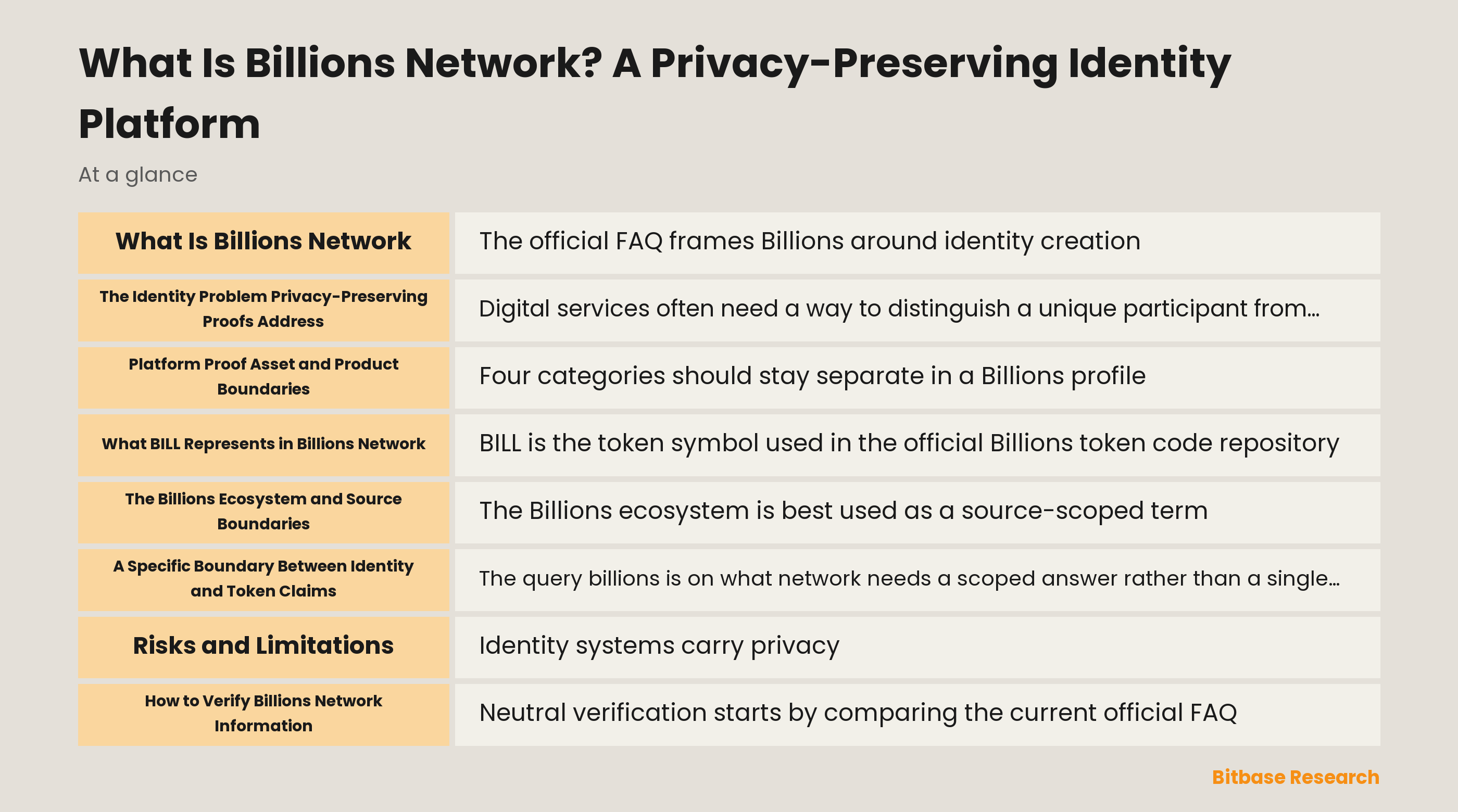
What Is Billions Network
The official FAQ frames Billions around identity creation, verification, and the reuse of privacy-oriented credentials. It describes a basic level intended to show that an account is a unique human and a stronger document-based verification level where supported. These descriptions support an explanation of identity assurance levels, not a promise that every person, document, jurisdiction, or application will receive the same outcome. Verification availability, supported evidence, and applicable conditions are time-sensitive product facts that need a release-day check.
An identity proof is not the same thing as publishing an identity record. In the project framing, zero-knowledge proofs are meant to let a person demonstrate a selected property while limiting disclosure of the underlying information. That mechanism can be explained without assuming that every data element is hidden in every implementation, that every relying service accepts the same proof, or that privacy outcomes are identical in every context. The precise claim must remain within the scope of the official product material.
The Identity Problem Privacy-Preserving Proofs Address
Digital services often need a way to distinguish a unique participant from duplicate, automated, or impersonating accounts. A privacy-preserving proof approach attempts to address that need without turning every interaction into a public dossier. Billions presents identity as a user-controlled credential context rather than simply a visible profile page. This describes a design goal. It does not establish that a proof resolves all trust, safety, compliance, access, or governance questions that a service may face.
The value of a proof depends on what is being proved, which official verification method is in scope, and whether the receiving application recognizes that proof. A statement that an account has passed one published level should not be expanded into a claim about nationality, legal status, ownership, reputation, creditworthiness, or suitability. Those are different assertions with different evidence requirements. Keeping the claimed attribute narrow is especially important when identity language appears next to token or campaign language.
Platform Proof Asset and Product Boundaries
Four categories should stay separate in a Billions profile. The platform is the identity service and its stated privacy model. The proof is the cryptographic or verification result described for a particular purpose. The application is a mobile or web interface through which an identity-related service may be presented. The asset is BILL, which has its own code and deployment records. Evidence for one category does not automatically establish facts about the other three.
The official FAQ distinguishes a registration or community-facing surface from the identity wallet where identity information is managed. It also says that the identity wallet is not a custodial asset service and that users retain their private keys. That supports a product-boundary explanation, not a recommendation to use a particular interface or a claim about a reader's account safety. Interfaces, labels, account migration status, and regional support can change and should not be frozen as permanent product facts.
What BILL Represents in Billions Network
BILL is the token symbol used in the official Billions token code repository. The repository describes an ERC-20 design with 18 decimals, a transparent proxy pattern, ERC-20 Permit support, and a TimelockController with a stated two-day delay. Those are code-repository descriptions of the token design. They do not make BILL the identity proof itself, do not convert a proof into a token entitlement, and do not prove present product availability, circulation, or user eligibility.
The same official repository lists token deployments for Ethereum and Billions Mainnet and separately lists a Billions Mainnet StakingRewards deployment. The Billions explorer identifies the listed Billions Mainnet token entry as Billions Network Token with the BILL symbol and shows a proxy implementation. These records are useful for a network and contract boundary. They do not, without a current primary explanation of bridge relationships, prove that one address is the sole canonical representation or that every network representation has identical supply behavior.
The Billions Ecosystem and Source Boundaries
The Billions ecosystem is best used as a source-scoped term. The official site supports claims about the identity platform, its FAQ supports claims about stated product surfaces and privacy framing, the token repository supports code-design statements, and the network explorer supports the identifier it displays. None of these sources alone is a permanent catalogue of applications, integrations, partners, access regions, or campaigns. An article should say which source supports which kind of claim instead of treating the ecosystem as one undifferentiated fact.
A product page can describe an identity app, a web identity wallet, and a community-facing interface at the same time. Those labels do not mean that the app is the protocol, that every interface has the same feature set, or that a campaign-related screen establishes an asset role. The article should describe the distinction rather than infer a universal lifecycle from a screen name. Product state, terms, integrations, account treatment, and interface availability all belong to a dated release-day review.
A Specific Boundary Between Identity and Token Claims
The query billions is on what network needs a scoped answer rather than a single unqualified label. The official token repository lists an Ethereum deployment and a Billions Mainnet deployment, while the Billions explorer records the latter as a BILL token contract. The page does not by itself establish a default network for every use case, an interoperability rule, or a bridge guarantee. A publication should identify the network attached to each cited address and avoid inferring a relationship that the current official material does not spell out.
The official token repository describes a proxy and Timelock-controlled upgrade model, and its related staking design includes administrative and pause-related capabilities. This is a technical governance boundary, not a conclusion that the token or related contracts are unsafe, audited for every purpose, or permanently unchanged. Conversely, the existence of source code and an explorer record does not establish that a particular interface, campaign, or service is active. Code facts and consumer-product facts need separate dates and sources.
Risks and Limitations
Identity systems carry privacy, security, and availability risks even when they use privacy-preserving techniques. An implementation may have software defects, inaccurate inputs, unsupported document types, user-device issues, key-loss consequences, service outages, or changing legal and regional constraints. A proof can also be interpreted differently by different applications. A concise project profile cannot certify security, establish legal effect, or guarantee that a credential will be accepted in a specific context. It should describe the mechanism without promising an outcome.
Token and network facts are dynamic as well. Source revisions, implementation upgrades, administrative roles, bridge arrangements, audit statements, token distribution facts, interface labels, product terms, and applicable restrictions can change after publication. The official repository's design statements should not be transformed into a claim that a live deployment is immutable or that all network representations behave the same way. Where a release needs a changing fact, the relevant official page and its date must be checked again.
How to Verify Billions Network Information
Neutral verification starts by comparing the current official FAQ, token overview, source repository, and the project explorer, while keeping their scopes separate. For the token record, compare the contract address named in the official repository with the corresponding record in the official block explorer, and record the network shown beside each identifier. The point is to compare current primary records, not to rely on similarly named tokens, copied identifiers, or a search-result label.
Before release, recheck product terminology, identity-verification scope, supported regions, current terms, published code revision, proxy and governance information, contract address records, and any statement about availability. Treat interface labels and time-bounded community activity as mutable information rather than as protocol law. If the article needs a detail about supply, audits, bridges, permissions, or product access, cite the current official source that covers exactly that detail. This is publication quality control, not a direction to use a product.
Conclusion
Billions Network can therefore be described conservatively as a platform for privacy-oriented identity proofs for people and AI. Its official materials support a distinction between the identity service, the proof model, product interfaces, and the BILL token records. The identity claim should stay focused on selective proof and user-controlled data framing. The asset claim should stay focused on the separately documented token design and network identifiers. This separation produces a more useful and more accurate introduction.
The central interpretive rule is that an identity platform is not a token, a privacy proof is not a public identity dossier, and an application screen is not a permanent protocol statement. A code repository may support a contract-design claim, while an explorer may support a network-specific identifier, but neither alone proves live product access or an economic result. Likewise, a product FAQ may describe current intent without proving timeless availability. Matching each sentence to its source scope avoids overstating the project.
For publication, retain only the documented identity purpose, the zero-knowledge proof framing, the distinction between product surfaces and the BILL asset, and the network-specific contract boundary. Recheck any changing implementation, product, governance, availability, legal, regional, audit, supply, or relationship fact on the release day. Do not convert a dated interface description into a promise, and do not let a ticker substitute for the identity mechanism. That approach explains Billions Network without turning dynamic documentation into an assurance.
Disclaimer: This article is educational content from Bitbase Academy, provided for information only. It explains what a project does and what role its token plays in that system; it does not constitute investment, trading, tax, or financial advice, and it is neither a recommendation nor an endorsement of any project or token. Bitbase has not carried out due diligence on the project described here, and mentioning it does not mean Bitbase lists or supports the asset. Crypto assets carry significant risk, including price volatility, thin liquidity, smart-contract failure, regulatory uncertainty, and the possible loss of their entire value. Written as of August 2026; a project's status, tokenomics, team, and contracts can change at any time. Verify everything yourself through official channels, the contract address, and a block explorer, and beware of imitation sites and phishing links.
References
[1] Billions FAQs billions.network
[2] Billions Token Overview billions.network
[3] BillionsNetwork/billions-token official repository github.com
[4] Billions explorer BILL contract record explorer.billions.network