Brave Browser is browser software, Brave Rewards is a separate optional feature, and Basic Attention Token, identified by the ticker BAT, is a token used in the documented attention-based model. They are related, but they are not the same product or set of rights.
Brave Browser and Basic Attention Token are often placed under one short label, yet the label hides important distinctions. Brave Browser is software for browsing the web. Brave Rewards is a separately named optional feature associated with a documented attention-based model. BAT is the Basic Attention Token, whose official ticker is BAT. A reader searching for brave browser crypto or asking what is brave browser crypto is usually asking about this relationship, not about a single browser-native asset. Likewise, the phrase brave browser tokenomics and use cases should not be treated as permission to turn changing supply, allocation, availability, or service assertions into permanent facts.
What Is Brave Browser and Basic Attention Token
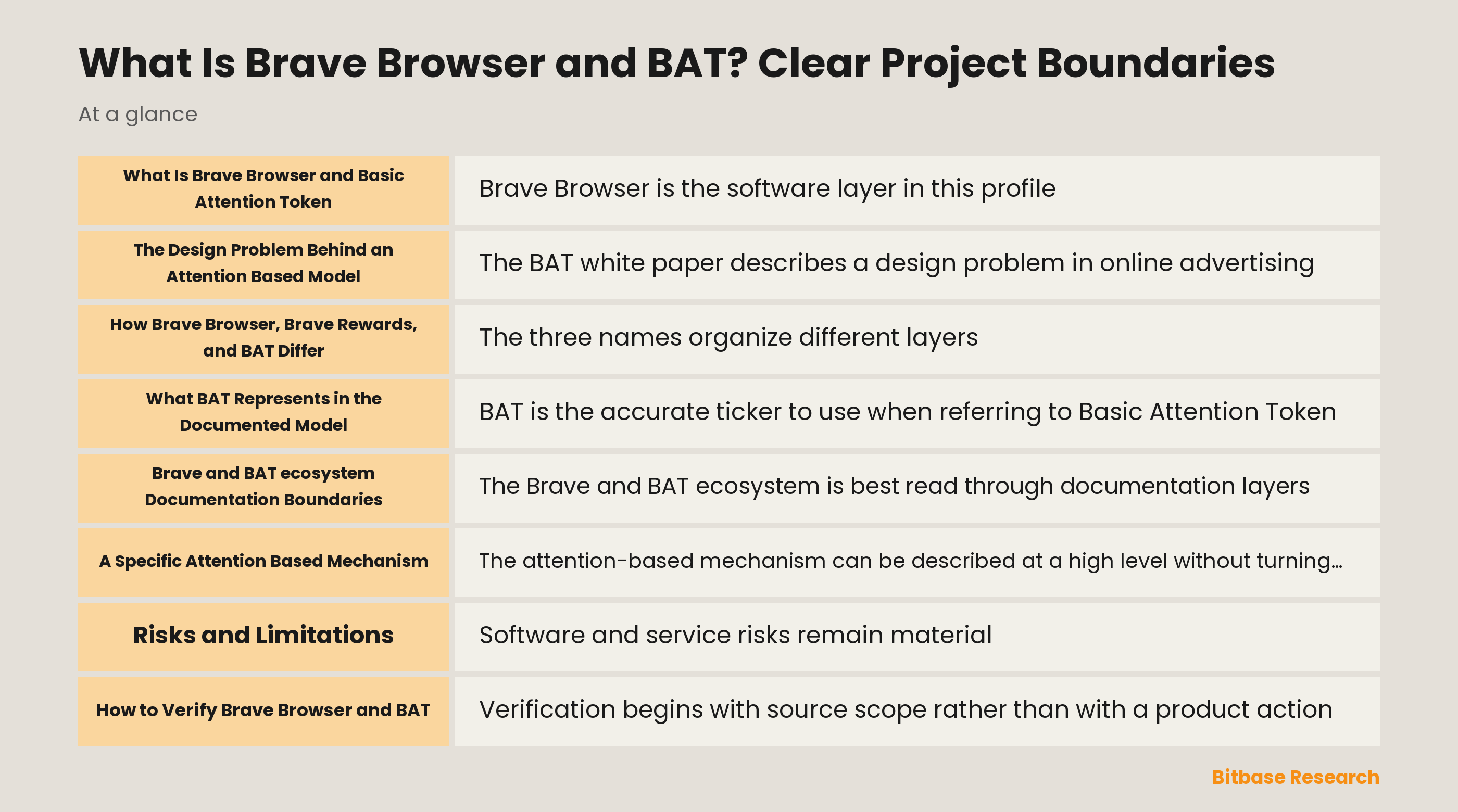
Brave Browser is the software layer in this profile. Official Brave materials present it as a browser with privacy-oriented design goals, while the browser as software remains distinct from any token. A browser can have many functions, release versions, device targets, and policy conditions without those facts changing what BAT is. This distinction matters because a statement that describes the browser does not automatically describe an optional feature, a token standard, a public-chain record, or a current service condition. Product scope, supported devices, regional availability, and implementation status are all matters for a publication-day review.
Basic Attention Token is the token identity in the project materials, and BAT is its ticker. The official project description frames BAT around a digital attention economy involving users, advertisers, publishers, and creators. Brave Rewards is a named feature connected to that broader model, but it is not another name for the browser and it is not another name for BAT. The feature's current terms, availability, and technical arrangements can change. Using browser software alone does not establish BAT availability, token-based access, or control over any part of the project.
The Design Problem Behind an Attention Based Model
The BAT white paper describes a design problem in online advertising: attention is measured and monetized through systems that can involve tracking, opaque intermediaries, fraud concerns, and weak alignment among the people and organizations involved. Its proposed model is historical design material, not a universal statement about every web page or every current release. The useful point for a project introduction is the problem framing. The model seeks to make attention a more explicit unit in a privacy-oriented advertising arrangement instead of treating every browsing signal as a transferable profile for outside parties.
That objective does not mean that privacy, measurement, or economic outcomes become automatic. A documented attention model still depends on the software implementation, the rules governing the feature, the context in which an advertising format is offered, and the safeguards used to limit data exposure. The original design language should be read as an explanation of intended architecture and incentives, not as proof that every participant sees the same option or that a particular feature is available everywhere. Current product behavior, legal conditions, and regional coverage must be checked at publication time rather than inferred from the design goal.
How Brave Browser, Brave Rewards, and BAT Differ
The three names organize different layers. Brave Browser refers to the browser software. Brave Rewards refers to a distinct, optional feature described by Brave. BAT refers to the token used in the attention-economy materials. Keeping those layers separate prevents several common errors: calling the browser itself a token, describing the feature as if it were universally active, or implying that possession of BAT grants a browser function or a project right. The relationship is architectural and programmatic, not evidence of automatic access, ownership, compensation, governance power, or a uniform user experience.
The phrase brave browser crypto is therefore best treated as shorthand with no single technical meaning. In official materials it can point to BAT, to the Brave Rewards feature, or to their connection with the browser, depending on context. It does not establish a separate token named after the browser, and it does not collapse all browser functions into blockchain functions. The more precise question is which layer a source is describing. A browser release note, an attention-model explanation, and a BAT page can each be authoritative about different things while none of them alone proves the current status of the others.
What BAT Represents in the Documented Model
BAT is the accurate ticker to use when referring to Basic Attention Token. Official BAT materials describe it as a token connected to a user-first attention economy and to the accounting relationships contemplated by that model. The project materials also identify BAT as an ERC-20 token. These are role and identity descriptions within the documented model. They do not establish a software function, participant status, or entitlement. The ticker does not convert Brave Browser into a blockchain protocol, and it does not make every browser activity a token activity. Any current technical representation should be confirmed in primary materials on the publication date.
A ticker role has limits. BAT should not be presented as automatically giving its holder an entitlement to browser software, advertiser activity, creator activity, revenue, a feature, governance, or a benefit. The official documentation can explain why BAT appears in the model, but it does not justify assigning rights that the relevant current terms do not state. Supply information, distribution descriptions, chain representations, contract identity, and active utility statements are time-sensitive matters. They belong in a fresh source review, not in an evergreen assertion based on a historical article or a search phrase about tokenomics.
Brave and BAT ecosystem Documentation Boundaries
The Brave and BAT ecosystem is best read through documentation layers. The Brave Rewards page explains the named feature and its attention-model framing. The BAT site explains the token's project identity. The white paper supplies the original design rationale. A Brave status article describes a particular historical moment, while the support center is an official place to assess current product boundaries. Each source has a different scope. An ecosystem overview is not evidence that every named participant, integration, device path, or service state remains current.
Documentation boundaries are especially important here because browser software, a feature, and a token can evolve at different speeds. A historical article may preserve useful context but cannot establish present availability. A support page may describe a limitation without defining the token's long-term role. A token landing page may state a direction without proving a current implementation detail. Claims about integrations, partners, geographic coverage, custody arrangements, product surfaces, and technical connections should be treated as publication-day review items. The existence of an ecosystem does not by itself establish that a particular relationship is active, safe, permitted, or available to everyone.
A Specific Attention Based Mechanism
The attention-based mechanism can be described at a high level without turning it into an interaction guide. The white paper and Brave materials describe a model in which relevant attention signals are handled with privacy as a design objective, and in which BAT serves as the named token within that model. The important conceptual difference is between using attention as an accounting input and exporting a comprehensive browsing profile. Official descriptions emphasize that some matching and processing can occur locally rather than requiring a general transfer of browsing history to an outside advertising system.
That mechanism is conditional rather than absolute. Local processing does not mean that every data point is private in every context, that all software components have identical protections, or that every disclosure route disappears. The protection described by a product depends on implementation quality, feature rules, device and operating-system behavior, network conditions, user choices, and the information a web service independently collects. The appropriate description is limited: the project materials describe a privacy-oriented attention model. They do not establish universal anonymity, complete secrecy, or permanent immunity from data, software, or operational failure.
Risks and Limitations
Software and service risks remain material. Browser code can contain defects, security issues can emerge, websites can behave differently as standards change, and a privacy-related feature can have limitations that are specific to a device, region, or release. A design goal also does not guarantee that every surrounding advertiser, publisher, creator, or web service follows the same practices. The browser, the optional feature, and the token should each be assessed within their own technical and policy boundaries. Current availability or compatibility must never be inferred merely from the project name or from an older official description.
BAT-related risk also includes confusion about identity and status. A ticker can be imitated, a token label can be attached to an unrelated record, and a historical explanation can be mistaken for a current product commitment. Contract representation, token supply and allocation, chain support, audits, integrations, and legal treatment are dynamic facts that require current first-party confirmation. Regulatory and regional effects are not universal conclusions that can be derived from the token's existence. No token description should imply a return, an entitlement, an automatic benefit, or a guarantee that a feature is available or appropriate in a particular place.
How to Verify Brave Browser and BAT
Verification begins with source scope rather than with a product action. The official Brave Rewards page is relevant to the named feature and the attention-model explanation. The official BAT site and white paper are relevant to BAT identity and design background. The historical State of the BAT article should be read with its publication date in view, and the official support center is relevant to current limitations. Comparing the language and date of these sources helps separate an enduring project definition from a time-bound statement about a release, service, or ecosystem relationship.
For token identity, an official contract address or a public block explorer record can be compared with the current official documentation and then treated as a publication-day recheck, not as a standing instruction or a substitute for source context. The comparison should confirm that the stated ticker, network representation, and record belong to the official project material being discussed. It should not be used to infer a product status, a permission, a feature entitlement, or a future outcome. The same publication-day review should cover supply and allocation disclosures, current terms, product availability, audit statements, supported environments, and regional limits.
Conclusion
Brave Browser, Brave Rewards, and BAT form a related but deliberately separable profile. The browser is software. Brave Rewards is an optional feature with conditions that can change. BAT is the Basic Attention Token identified by the ticker BAT and described in official materials as part of an attention-based model. Explaining the project through those boundaries is more accurate than calling every Brave-related capability a token function or treating BAT as a general entitlement to the browser or its services.
A careful answer to brave browser tokenomics and use cases avoids static figures and promotional assertions. It can explain that BAT has a documented role in a privacy-oriented attention economy while reserving supply, allocation, representation, availability, and current utility for a dated primary-source review. The phrase what is brave browser crypto is best answered by identifying the layers involved, not by assuming that browser use, a feature setting, and token status are interchangeable. This preserves the difference between a product explanation and an assertion about participation or access.
For a durable introduction, the important discipline is to match each statement to its source and time frame. Recheck official domains, the project and ticker identity, the official contract address, supply and allocation disclosures, technical and audit status, product and feature availability, supported environments, regional conditions, and any ecosystem relationship on the publication date. That boundary keeps the article descriptive: it explains the documented model, its limitations, its risks, and its verification standard without giving custody or product-operation guidance.
Related market pages
- BAT: View price · Spot market · Perpetual market
Disclaimer: This article is educational content from Bitbase Academy, provided for information only. It explains what a project does and what role its token plays in that system; it does not constitute investment, trading, tax, or financial advice, and it is neither a recommendation nor an endorsement of any project or token. Bitbase has not carried out due diligence on the project described here, and mentioning it does not mean Bitbase lists or supports the asset. Crypto assets carry significant risk, including price volatility, thin liquidity, smart-contract failure, regulatory uncertainty, and the possible loss of their entire value. Written as of August 2026; a project's status, tokenomics, team, and contracts can change at any time. Verify everything yourself through official channels, the contract address, and a block explorer, and beware of imitation sites and phishing links.
References
[1] What is Brave Rewards?, Brave brave.com
[2] Basic Attention Token official project site basicattentiontoken.org
[3] Basic Attention Token White Paper basicattentiontoken.org
[4] State of the BAT, Brave blog brave.com
[5] Brave Help Center support.brave.com