Brevis is infrastructure for verifiable computation over blockchain data. Its ZK coprocessor pattern lets an application ask a question about historical on-chain activity, run the heavier computation away from the destination chain, and return a result with a proof for on-chain checking. This guide separates that technical role from the BREV token and explains what should still be verified independently.
What Is Brevis?
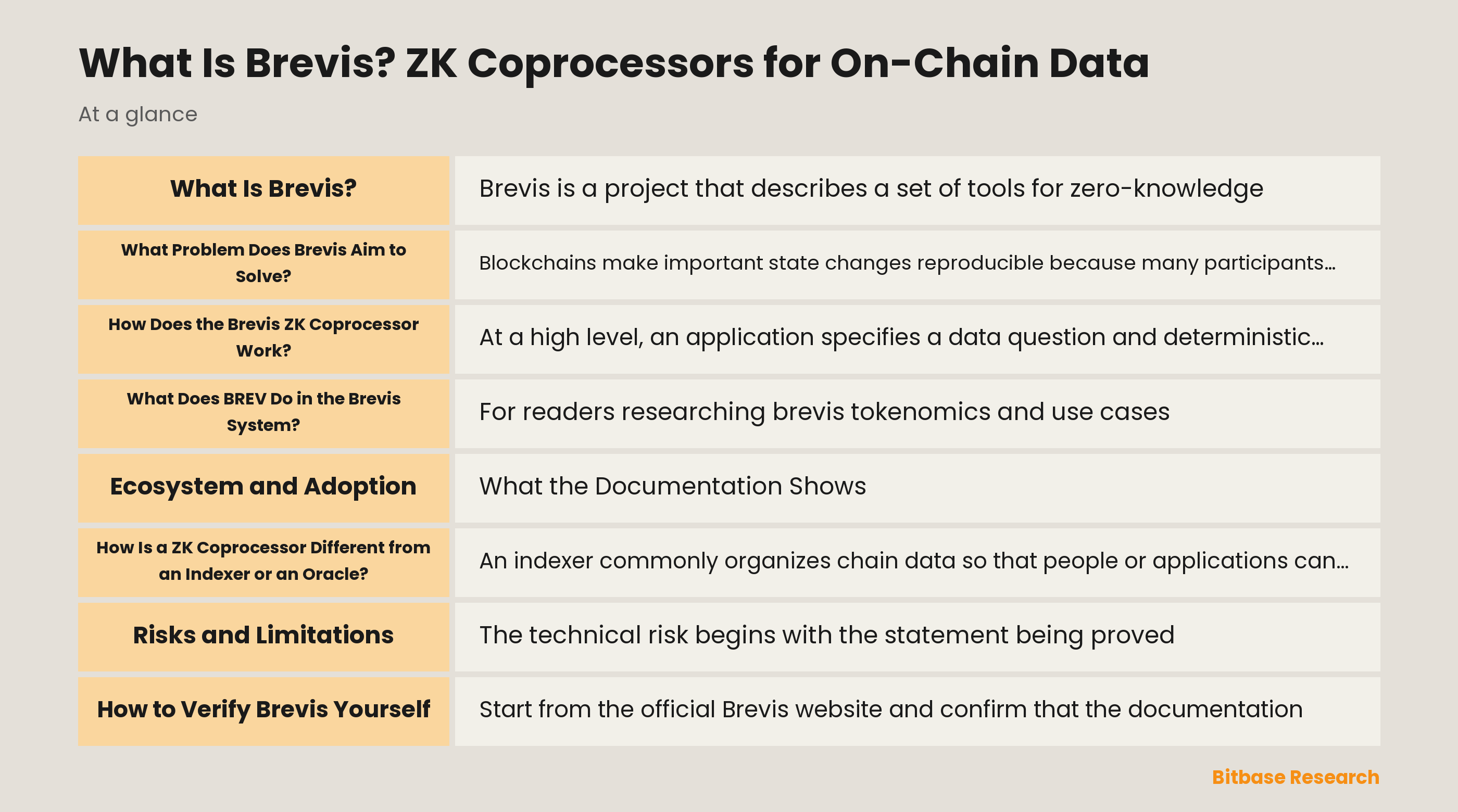
Brevis is a project that describes a set of tools for zero-knowledge, or ZK, computation. In the ZK coprocessor use case, an application does not ask a smart contract to scan a long chain history inside a single transaction. Instead, it defines a calculation about specified on-chain records and receives a compact proof that a verifier contract can check. The intended result is not a new source of truth; it is a way to make a defined computation over relevant blockchain data verifiable.
The name Brevis and the ticker BREV should not be treated as interchangeable. Brevis can refer to the technical stack, including a ZK Data Coprocessor and proving infrastructure, while BREV is the token described in Brevis materials for ProverNet. Searches for brevis crypto or what is brevis crypto therefore need two answers: what the computation system is meant to do, and what the documented token role is within a particular network design.
A coprocessor is also not simply an archive node, an analytics dashboard, or a general promise that every data result is correct. A useful request must state which chain data, time range, rules, and output are relevant. The proof can bind a result to the relation encoded by that request and its accepted inputs. It does not decide whether the application chose a sensible rule, a safe contract, or an appropriate response to the result.
What Problem Does Brevis Aim to Solve?
Blockchains make important state changes reproducible because many participants execute and validate the same rules. That property is valuable, but it makes a history-heavy question awkward to process directly in an application contract. A rule such as “did this address satisfy a defined condition over past activity?” may require reading events, balances, or state from many earlier blocks. Repeating that work in a limited on-chain execution environment can be costly, slow, or impractical.
An off-chain indexer can make such a query convenient, but a contract that simply accepts the indexer’s answer has to trust the service or add another verification design. The ZK coprocessor approach tries to change that trade-off. A prover performs the defined work off-chain and sends the output with cryptographic evidence that the programmed relation was satisfied. The destination contract can check the evidence rather than recomputing the full history itself.
That distinction matters because “verifiable” is narrower than “automatically safe.” The result is only as meaningful as the accepted source data, the circuit or program, the verifier, and the application rule that consumes it. Historical on-chain data can be cryptographically tied to chain state under the design’s assumptions, yet an application can still use the wrong block range, misunderstand finality, encode a flawed eligibility rule, or behave poorly when a proof arrives late.
How Does the Brevis ZK Coprocessor Work?
At a high level, an application specifies a data question and deterministic computation. Depending on the supported environment and the integration, the inputs may cover historical transactions, events, storage, balances, or other state that can be linked to the relevant chain history. The request also defines the output that matters to the application: for example, a Boolean condition, an aggregate, or a classification derived from the stated rules. Defining that statement precisely is a security requirement, not clerical detail.
A prover then performs the requested work outside the destination contract and produces a proof for the resulting statement. The result and proof are passed to a verifier path that checks the cryptographic conditions before an application uses the result. This shifts most computational work away from on-chain execution, but it does not eliminate operational dependencies. The integration still has to handle data availability, proof generation time, accepted chain confirmations, verifier upgrades, retries, and the consequences of an unavailable or rejected result.
What Does BREV Do in the Brevis System?
For readers researching brevis tokenomics and use cases, the first point is that BREV is the official ticker used in Brevis’s ProverNet materials. A dated official token announcement describes BREV as a utility and governance asset. In that documented ProverNet design, it is used as a payment medium for proof-related services, as economic collateral connected with prover participation, and as the governance token for specified network parameters. Those are system roles, not a statement about value, suitability, or future conditions.
The same documents need to be read with their dates and scope. A December 2025 announcement described some roles in an initial deployment context and a possible later dedicated-rollup context. A January 6, 2026 Brevis announcement said that ProverNet mainnet and BREV had gone live and described payments, staking, and governance as active there. This article treats those as dated project statements, not as an instruction to acquire, stake, delegate, claim, or use the token, and not as proof that every future implementation will retain the same parameters.
Ecosystem and Adoption: What the Documentation Shows
An ecosystem entry is most useful when it identifies a concrete workload and the proof boundary, rather than when it presents a logo list as a performance verdict. Brevis materials describe work that can include zkVM programs, historical-data coprocessor queries, and proof aggregation. A reader evaluating an integration should look for the exact chain, contract, data commitment, program statement, verifier route, and failure behavior relevant to that integration instead of inferring those details from a project-wide label.
The status of an ecosystem also changes over time. In its January 6, 2026 announcement, Brevis stated that ProverNet had reached mainnet and that BREV was live. That announcement is useful documentary context, but it is not an independent measurement of adoption, decentralization, latency, security, or service continuity. The article therefore does not repeat user counts, proof counts, partner totals, or performance claims; each deployment needs its own current technical and on-chain review.
How Is a ZK Coprocessor Different from an Indexer or an Oracle?
An indexer commonly organizes chain data so that people or applications can retrieve it efficiently. That can be valuable, but an indexer response alone is not necessarily a proof that a contract can verify. In the coprocessor pattern, the important addition is evidence for a defined computation over accepted inputs. The evidence can let a verifier contract check the output without rerunning the entire historical scan, while the application still remains responsible for choosing its data sources and business rule.
An oracle is often discussed as a mechanism for delivering data or an assertion to a contract, especially when the information originates outside the destination chain. A historical on-chain query has a different central problem: identifying committed chain data and proving a computation over it. The categories can overlap in a full application, so labels alone are not enough. The practical questions are what data is authenticated, what statement is proved, what contract verifies it, and what happens when that path fails or changes.
Risks and Limitations
The technical risk begins with the statement being proved. A sound proof cannot rescue an unsound program, an incorrect data selection rule, a weak verifier integration, or an unsafe application action. Historical data also brings finality and reorganization considerations, and a request may have limits on supported chains, block ranges, data types, or proof latency. Contract upgrades, dependencies on proving infrastructure, and differences between an announced architecture and a specific deployed instance are additional reasons to review the exact implementation.
There are also operational and governance limitations. A proving marketplace or coordination layer can depend on prover availability, incentives, deadlines, software releases, and parameter changes. The BREV roles described in official materials are network-specific and can change through the mechanisms those materials describe. No audit conclusion is made here: a project page or a document link is not a substitute for locating a named auditor’s report, checking its scope, and matching it to the current contracts. Treat changing documentation, token mechanics, and contract addresses as facts to re-check rather than permanent assumptions.
How to Verify Brevis Yourself
Start from the official Brevis website and confirm that the documentation, repository, and any dashboard you consult are linked from that official entry point. Read the source date and distinguish a technical description, a launch announcement, and a future-looking proposal. For a ZK coprocessor integration, identify the named chain, the historical data being committed, the program or circuit statement, the verifier contract, and the application action that follows verification. If those pieces are not documented clearly, do not fill the gaps with marketing language.
For BREV or an integration contract, use the chain and contract address currently published in the relevant official documentation, then compare that exact address in a block explorer. Check the network, contract creation details, verified source status where available, and the relationship between the contract and the documentation. Look for audit reports on the named auditor’s own site and confirm their coverage instead of relying on a badge alone. Treat look-alike domains, sponsored search results, and prompts to connect a wallet while researching as stop signals until the source can be independently confirmed.
Conclusion
Brevis is best understood as an approach to verifiable computation: historical on-chain data and a defined calculation can be processed away from the destination contract, with a proof returned for checking. That can reduce the need for a contract to repeat a large history scan, but it does not remove the need to examine the statement, input authentication, verifier, and downstream application rule.
BREV is the official ticker used for the ProverNet token roles described in dated Brevis materials. Those roles should be read as system documentation, not as a reason to take action. A careful reader should verify the current technical documents, chain-specific contract address, block explorer record, and any audit scope before relying on a particular Brevis deployment or token-related claim.
Related market pages
- BREV: View price · Spot market · Perpetual market
Disclaimer: This article is educational content from Bitbase Academy, provided for information only. It explains what a project does and what role its token plays in that system; it does not constitute investment, trading, tax, or financial advice, and it is neither a recommendation nor an endorsement of any project or token. Bitbase has not carried out due diligence on the project described here, and mentioning it does not mean Bitbase lists or supports the asset. Crypto assets carry significant risk, including price volatility, thin liquidity, smart-contract failure, regulatory uncertainty, and the possible loss of their entire value. Written as of August 2026; a project's status, tokenomics, team, and contracts can change at any time. Verify everything yourself through official channels, the contract address, and a block explorer, and beware of imitation sites and phishing links.
References
[1] Brevis: A Smart ZK Coprocessor for Blockchains (official technical article, 2023-09-28) blog.brevis.network
[2] Brevis ProverNet Whitepaper v2.0 (official) brevis.network
[3] Introducing $BREV Token (official announcement, 2025-12-24) blog.brevis.network
[4] Brevis ProverNet Mainnet and $BREV Are Live (official announcement, 2026-01-06) blog.brevis.network
[5] Brevis ProverNet documentation (official introduction) provernet-docs.brevis.network
[6] Initialize Prover Account (official ProverNet documentation; chain and contract verification context) provernet-docs.brevis.network