Casper Network is a public Proof-of-Stake smart-contract platform whose documentation describes an account-based state model, execution after consensus, and WebAssembly-based computation. This guide explains the system without treating its native CSPR unit as an investment thesis or a prompt to take action.
What Is Casper Network?
Casper Network is a public, permissionless blockchain platform for smart contracts. Its official technical material describes a Proof-of-Stake design with accounts, global state, transactions, validator consensus, and programs that can execute in a WebAssembly, or Wasm, environment. That combination is the starting point for understanding the project: it is a network for recording state changes under shared rules, not a single application or a token by itself.
The name can refer to the protocol, its node software, its documents, and an evolving collection of contracts and applications. CSPR is the native unit named in Casper material, but a native unit is only one part of the system. Keeping the network, its execution model, and CSPR’s documented roles separate makes it easier to assess a technical claim without turning a protocol description into a recommendation.
People looking for casper ecosystem and use cases should begin with this boundary. A possible application can use Casper’s account model, contracts, state, and execution environment, while the network’s own correctness depends on consensus rules, node behavior, accepted transactions, and the current protocol configuration. A logo, a general category label, or a token symbol does not prove that a particular contract is official, safe, active, or suited to a particular purpose.
What Problem Does Casper Network Address?
A shared application needs participants to agree on which state changes count and in what order they become final. In an account-based system, a transaction can request code execution that reads or writes defined state. The network must validate the request, place it in the process that leads to a proposed block, reach consensus on the block, and then execute the included work according to the applicable rules. The chain’s value is the reproducible record produced by that process, not a claim that every application built on it is trustworthy.
Casper’s design documentation emphasizes execution after consensus. That ordering matters when reasoning about an application: a transaction can be accepted for consideration, yet the relevant state transition is only determined under the network’s validation, consensus, and execution rules. The model also separates an account’s context from stored Wasm that a transaction may call, so a reader should not assume that every piece of code has the same authority over account data or state.
How Does Casper Work?
An answer to how does casper work starts with the path from transaction to state. Official documentation says a node validates a transaction, places it into a proposed block, and propagates that block through the network. Validators use the selected consensus protocol to agree on finalized blocks; the Wasm associated with the transaction is then executed in the described execution model. This is a simplified flow, not a substitute for the current protocol specification, node version, or chainspec.
The account model supplies a context for user-originated transactions, while global state holds network data. Casper documents describe unforgeable references, or URefs, as capability-bearing references used to control access to stored values. A contract may receive a valid reference through defined boundaries, but a program cannot create arbitrary authority merely by inventing a similar-looking identifier. That distinction is relevant to design review because a contract’s behavior depends on the references it receives and the permissions the runtime recognizes.
The 2.0 documentation also describes Zug as a consensus protocol option and explains that protocol choices are configured through a chainspec. Its description uses leaders, proposals, signed messages, quorums, committed rounds, and skippable rounds to explain how safety and liveness are pursued under stated assumptions. These are protocol-level concepts, not an assurance that a particular deployment, validator set, contract, or application will behave as expected. Current configuration and release status should be checked afresh.
What Does CSPR Do in the Casper Network?
CSPR is the official ticker for the native token named in Casper Network material. The technical documentation describes native tokens as part of the mechanism for paying for computation and for the economic participation associated with validator selection. It also states that the underlying indivisible units are motes. These are system functions; they do not establish a value claim, a suitability claim, or a reason to acquire or use CSPR.
For that reason, CSPR should not automatically be treated like a token deployed as a single third-party smart-contract address on another chain. The official design material presents it as the Casper Mainnet’s native unit and explains its accounting in motes. A reader evaluating a claim about CSPR should first identify the relevant Casper network and then verify the public on-chain record, rather than accepting a copied symbol, a look-alike asset, or an unverified address as proof of origin.
The role can also change with network configuration and releases. Documentation about validator selection, consensus economics, token accounting, and runtime behavior describes a model at a specified version and date. It is useful for understanding the intended system, but it does not remove the need to check the current official documentation and the corresponding on-chain data before relying on any statement about a live deployment.
Ecosystem and Adoption: What to Look For
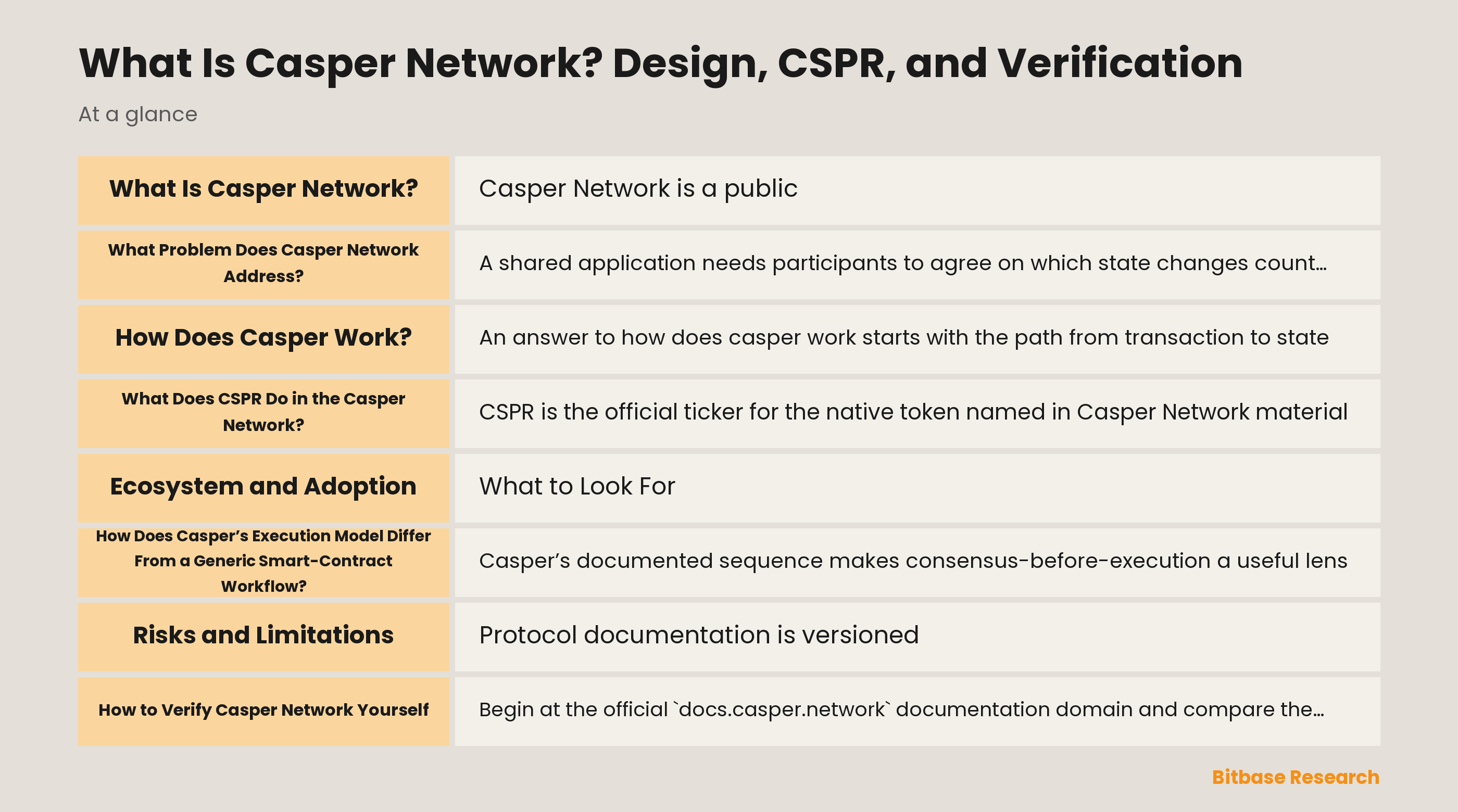
The Casper ecosystem is best examined as a collection of separately verifiable deployments rather than a single scorecard. Useful questions include which network a contract targets, what Wasm or other supported execution environment it uses, which entity or package identifier is documented, what state it can access, and how its behavior is constrained. Those questions are more durable than copying a list of project names, because a deployment can be upgraded, paused, replaced, or documented differently over time.
Use cases follow from the platform’s ability to execute defined programs against shared state, not from a generic promise that every use is validated. A developer might use a contract for a defined workflow, and an organization might use a public ledger for an auditable state transition, but the meaningful details remain the transaction rules, authorization, code, and failure behavior. Official site material and code may help locate those details, while independent review is still required for any particular contract.
How Does Casper’s Execution Model Differ From a Generic Smart-Contract Workflow?
Casper’s documented sequence makes consensus-before-execution a useful lens. A node first handles a valid transaction in the block-production and consensus process, and execution is performed after the block reaches the protocol’s stated stage. This differs from a vague description that treats submission, execution, and finality as one indistinguishable event. Separating the stages helps a reviewer ask where an application obtains its inputs, when a state transition becomes final, and which implementation version defines the outcome.
The Wasm runtime and URef-based access model add another layer to that review. Wasm code needs host functions to affect global state, and URefs carry access rights that the runtime checks in context. Neither property is a blanket security guarantee. A program can still contain flawed business logic, unsafe authorization choices, faulty upgrade controls, or assumptions that fail after a protocol change. The technical model tells a reader where to inspect; it does not replace inspecting the actual code and deployment.
Risks and Limitations
Protocol documentation is versioned, and a network’s configuration, node release, consensus implementation, validator set, and contract interfaces can change. A description of Zug, Highway, execution semantics, or token accounting should therefore be read with its version and publication date. Treating an older explanation as a permanent description of the running network can lead to incorrect conclusions about finality, permissions, or supported features.
Smart-contract and operational risks remain separate from the network’s general design. A contract can expose a weak authorization rule, mishandle a URef, rely on an unverified external component, or use upgrade authority in a way that changes behavior. A transaction can also fail under its own validation or execution conditions. Nothing in a high-level account of Proof-of-Stake, Wasm, or consensus proves that a named application has been audited, that its controls are appropriate, or that it will remain available.
There is also a verification risk around names and symbols. A page, social account, binary, contract, or asset can imitate Casper branding or the CSPR ticker. Official links can change, and a search result can be sponsored or stale. The safer approach is to begin at an official domain, compare identifiers across official documentation and read-only chain data, and stop when a claim cannot be tied to a source, a version, and a specific network record.
How to Verify Casper Network Yourself
Begin at the official `docs.casper.network` documentation domain and compare the Network Design, What is Casper, Consensus, and Zug pages with their visible version or update information. Confirm that links to source code or explorer services originate from a Casper-controlled official entry point. Read-only review should distinguish a general technical explanation from a release note, a chainspec, and a claim about one deployed contract.
For CSPR, first confirm that the claim concerns Casper Mainnet’s native unit rather than a similarly named asset elsewhere. The official material consulted for this article does not publish a single canonical CSPR token-contract address, so an address alone is not a sufficient test. Use the CSPR.live block explorer linked by official Casper material to inspect a trusted public key, account hash, transaction hash, block hash, or documented contract package and compare the network identifier and record details without signing, approving, or submitting anything.
When checking a contract or application, obtain its identifier from current official documentation or from a source that the project itself identifies, then compare that exact identifier in the block explorer. Look for the network, entity or package information, transaction history, source-verification status where available, and version relationship to the documentation. Do not treat a familiar name, a copied address, or a prompt to connect an account as verification; unresolved discrepancies are a reason to pause rather than fill in missing facts.
The Bottom Line
Casper Network is a Proof-of-Stake smart-contract platform whose official material describes accounts, global state, consensus before execution, and a Wasm-based execution environment. CSPR is its documented native ticker and participates in the system’s accounting and validator-related economics, but those documented roles are not investment or usage advice.
The most reliable way to understand a particular Casper claim is to separate protocol design from a specific deployment. Check the current official version, the relevant network, the exact code or contract identifier, and the corresponding read-only chain record. That discipline is more informative than an unsupported adoption claim and avoids mistaking a symbol or marketing statement for technical proof.
Related market pages
- CSPR: View price
Disclaimer: This article is educational content from Bitbase Academy, provided for information only. It explains what a project does and what role its token plays in that system; it does not constitute investment, trading, tax, or financial advice, and it is neither a recommendation nor an endorsement of any project or token. Bitbase has not carried out due diligence on the project described here, and mentioning it does not mean Bitbase lists or supports the asset. Crypto assets carry significant risk, including price volatility, thin liquidity, smart-contract failure, regulatory uncertainty, and the possible loss of their entire value. Written as of August 2026; a project's status, tokenomics, team, and contracts can change at any time. Verify everything yourself through official channels, the contract address, and a block explorer, and beware of imitation sites and phishing links.
References
[1] Casper Docs — Network Design docs.casper.network
[2] Casper Docs — What is Casper? docs.casper.network
[3] Casper Docs — Consensus in a Casper Network docs.casper.network
[4] Casper Docs — Zug Consensus docs.casper.network
[5] Casper Docs — Block Explorers docs.casper.network
[6] Casper Network — CSPR www.casper.network
[7] casper-network/casper-node github.com