Cetus is documented as a concentrated-liquidity protocol whose current official site is built around Sui, while older official materials also describe a Sui and Aptos context. CETUS is the protocol token symbol cited by the official site.
This profile answers cetus ecosystem and use cases, cetus protocol, and how does cetus work as questions about documented components and design. It is an explanatory profile, not a guide to acquiring an asset, connecting an account, or using an interface. Current product scope, deployed packages, asset types, and version history require a separate first-party review at publication.
What Is Cetus?
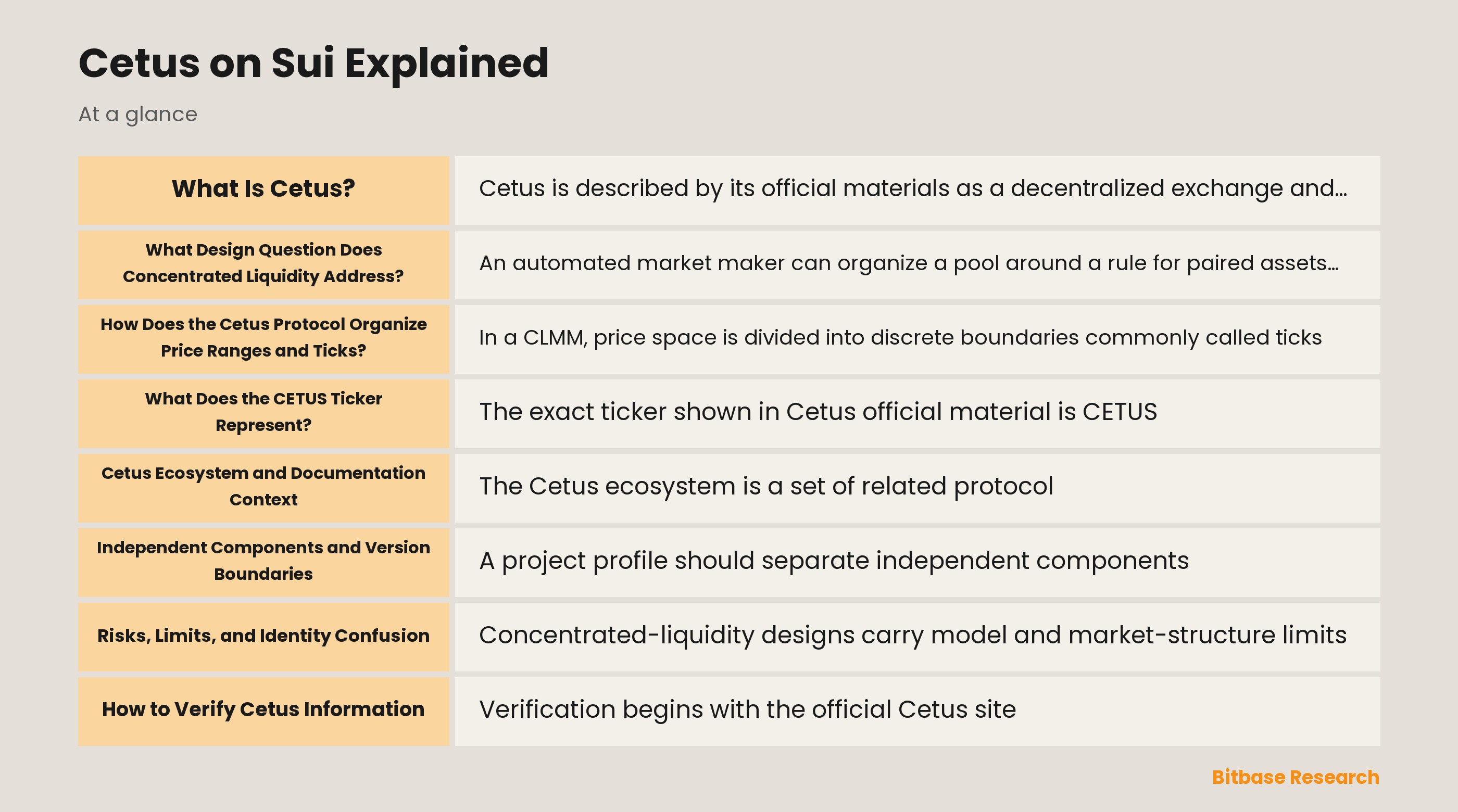
Cetus is described by its official materials as a decentralized exchange and liquidity protocol built with a concentrated liquidity market maker, often abbreviated CLMM. In this article, “protocol” refers to the onchain smart-contract system and related components described in official materials, not to a promise that every named feature has one status or operates under identical conditions.
The current Cetus site presents the project as built on Sui. Its older documentation describes a broader Move-based setting that includes Sui and Aptos. This distinction is useful: a historical description of supported networks is not proof of present deployment scope, and the network, package, and interface status of a particular component are facts to check when publishing.
What Design Question Does Concentrated Liquidity Address?
An automated market maker can organize a pool around a rule for paired assets rather than around an order book. A concentrated-liquidity design changes how the pool represents available liquidity: instead of treating it as uniformly active across all theoretical relative prices, it associates liquidity with selected intervals.
This model is intended to make the location of liquidity explicit. A position can be associated with a lower and upper boundary, so the model has a way to distinguish liquidity that is relevant within an interval from liquidity outside that interval. That design framing does not say an interval will remain relevant, that an asset relationship will be stable, or that any economic outcome will follow.
How Does the Cetus Protocol Organize Price Ranges and Ticks?
In a CLMM, price space is divided into discrete boundaries commonly called ticks. A tick is a bookkeeping boundary, while a tick interval is the span between selected boundaries. Cetus documentation describes concentrated liquidity and pools with fee tiers; the exact tick spacing, calculation rules, and parameter values belong to the relevant version and must not be inferred from a general overview.
When the model processes a change in the pool state, the active interval and its surrounding tick boundaries matter to the accounting logic. Liquidity associated with a range is not conceptually identical to liquidity assigned to every possible relative price. This is a mechanism description only. It does not predict execution quality, depth, availability, or a result for any asset pair.
What Does the CETUS Ticker Represent?
The exact ticker shown in Cetus official material is CETUS. The official site also refers to a dual-token arrangement involving CETUS and xCETUS. Those labels should not be collapsed into one identity: a ticker, a coin type, a contract package, a versioned object, and a web-page label can each identify different things.
CETUS is therefore best described here as the protocol token symbol presented in official materials, without drawing conclusions about price, valuation, ownership, rights, availability, or a personal outcome. Token supply, distribution, governance scope, coin type, network-specific asset identifier, and any current role are publication-day matters that require confirmation from a matching official source.
Cetus Ecosystem and Documentation Context
The Cetus ecosystem is a set of related protocol, interface, documentation, and developer-facing materials rather than one indivisible component. The current official site highlights CLMM-based pools and names additional modules, while the terms distinguish onchain contracts from offchain or hybrid supporting systems. Each statement should be read in the scope of the page that makes it.
Sui provides the immediate technical context emphasized by the current site. Sui's official documentation describes an asset-oriented programming model powered by Move, and Cetus's public materials point to Move-oriented work. This helps explain why package identity, object state, and package versions matter when evaluating a claim about a deployed component.
Older first-party documentation also mentions Aptos. That historical material supports a careful statement about the project's earlier multi-network documentation, not an assertion that a particular feature, asset, or contract is currently deployed there. The official site and the official documentation should be read together, with dates and version context retained.
Independent Components and Version Boundaries
A project profile should separate independent components. A CLMM pool, its tick data, a token type, a Move package, a routing or interface service, and a documentation page do not have the same identity or upgrade path. A change to one component does not by itself establish the condition of another.
Move and Sui make this separation especially important because onchain assets and objects have explicit types and because packages can have version histories. A public identifier can be copied, misread, superseded, or associated with an unintended network. The presence of source code or a published identifier is evidence to examine, not evidence that every implementation detail remains unchanged.
Risks, Limits, and Identity Confusion
Concentrated-liquidity designs carry model and market-structure limits. A selected range can cease to cover the relevant relative-price interval, and a pool can be affected by changing asset relationships, fees, tick parameters, state transitions, or external conditions. These are risks of the model and surrounding environment, not claims about a particular outcome.
There are also smart-contract and version risks. Code can contain defects, dependencies can change, an upgrade or package relationship can be misunderstood, and onchain objects can be interpreted incorrectly. The official terms themselves describe technical, network, and third-party dependency risks; official documentation does not turn those risks into guarantees about security, availability, execution, or results.
Identity risk deserves equal attention. Similar names, symbols, pages, screenshots, package identifiers, and alleged asset types can be presented out of context. A copied label or a search result is not sufficient to establish that an asset, package, or interface is the official Cetus component described in a source.
How to Verify Cetus Information
Verification begins with the official Cetus site, its linked documentation, the official CetusProtocol code organization, and the relevant Sui documentation. Check the publication date, the named network, and whether a page is describing a historical concept, an active interface, an onchain package, or an offchain supporting component. These sources should agree on the specific claim being made.
If an official source supplies a contract address, package ID, coin type, or object ID, preserve its exact network and version context. Then compare the cited identifier with the corresponding block explorer record for that same network. A block explorer can show recorded data, but it cannot alone establish official identity, current scope, correctness, security, or future behavior.
Do not fill gaps with names that merely look similar. Recheck CETUS asset identification, package and object references, documentation revisions, parameter descriptions, and component status on the publication date. A missing, conflicting, or stale official record is a reason to limit the statement rather than to assume continuity.
Conclusion
Cetus is best understood as a documented CLMM-oriented protocol whose current official presentation centers on Sui and whose earlier documentation also references Sui and Aptos. Its explanatory core is the organization of pool liquidity across selected relative-price ranges and discrete tick boundaries, together with separate onchain and supporting components.
The exact token ticker is CETUS, but a symbol alone is not an identity check. A careful project profile keeps token labels, Move packages, pool state, versions, asset types, and interfaces distinct; treats current status conservatively; and verifies official records without turning that research into operational instructions.
Related market pages
- CETUS: View price · Perpetual market
Disclaimer: This article is educational content from Bitbase Academy, provided for information only. It explains what a project does and what role its token plays in that system; it does not constitute investment, trading, tax, or financial advice, and it is neither a recommendation nor an endorsement of any project or token. Bitbase has not carried out due diligence on the project described here, and mentioning it does not mean Bitbase lists or supports the asset. Crypto assets carry significant risk, including price volatility, thin liquidity, smart-contract failure, regulatory uncertainty, and the possible loss of their entire value. Written as of August 2026; a project's status, tokenomics, team, and contracts can change at any time. Verify everything yourself through official channels, the contract address, and a block explorer, and beware of imitation sites and phishing links.
References
[1] Cetus official site www.cetus.zone
[2] Cetus documentation, Introduction cetus-1.gitbook.io
[3] Cetus Protocol Terms of Use www.cetus.zone
[4] CetusProtocol CLMM interface repository github.com
[5] Sui documentation docs.sui.io