ChainOpera AI is documented as an AI-agent ecosystem whose materials describe a Super AI App, infrastructure layers, and an AI-native protocol; COAI is its stated native utility token.
Readers searching for ChainOpera AI COAI tokenomics and use cases, asking what is ChainOpera AI COAI, or using the short label COAI crypto need to distinguish a documented design from a verified present-day operating result. This profile explains the mechanisms that the project’s own materials describe, without making a claim about model quality, availability, decentralization, partnerships, or future delivery.
What Is ChainOpera AI?
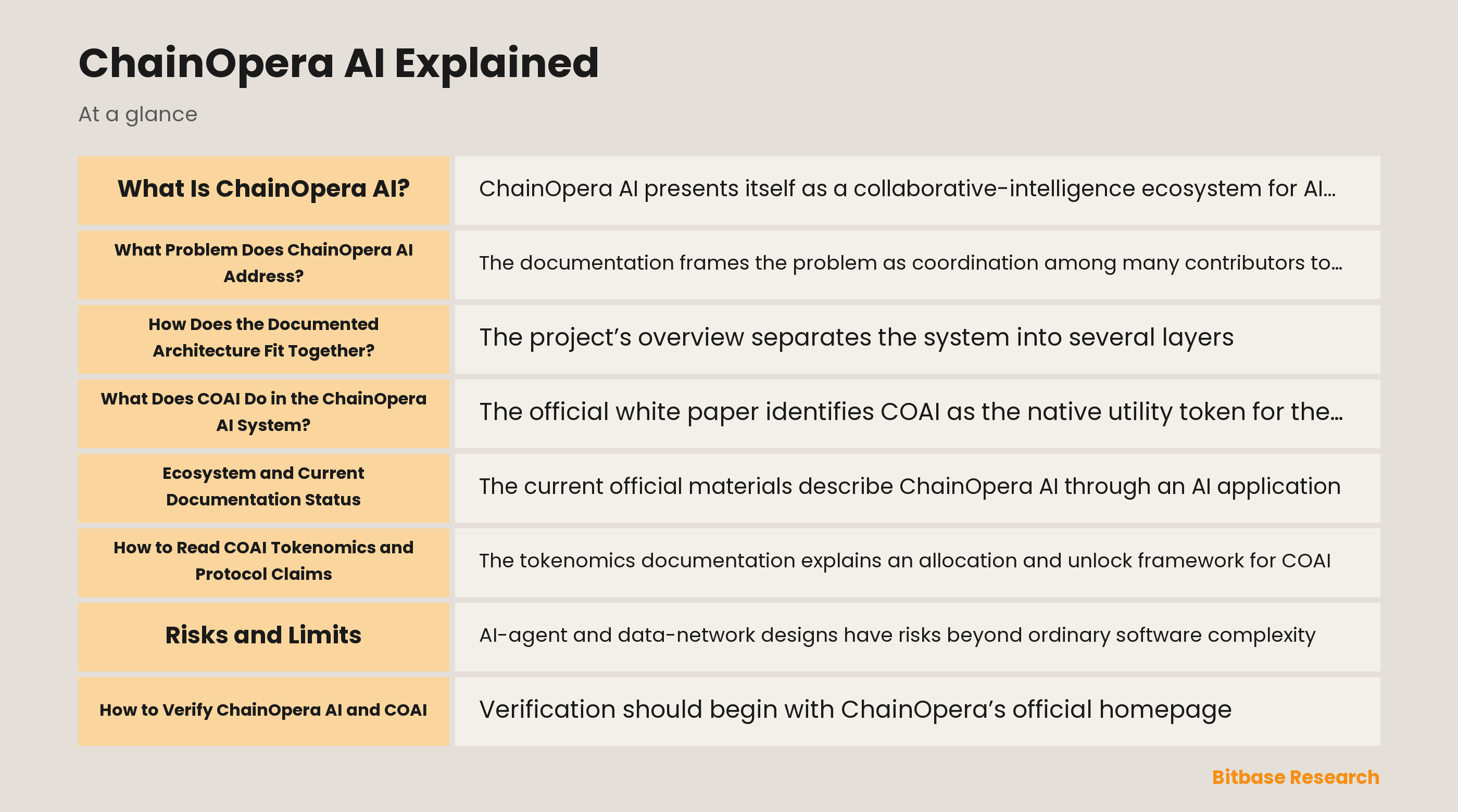
ChainOpera AI presents itself as a collaborative-intelligence ecosystem for AI agents. Its official overview groups the idea into a user-facing AI environment, an agent-focused social and creation layer, model-and-compute infrastructure, and a blockchain-oriented protocol layer. That is an architectural description: it explains how the project frames the relationship among people, agents, data, models, and computing resources.
The useful starting point is therefore not an assumption that every component has the same maturity. The official homepage, documentation, and white paper use related but not identical language, with some pages describing current materials and others describing intended evolution. A careful profile should preserve that distinction rather than turn a technical vision into a guarantee about a live network.
What Problem Does ChainOpera AI Address?
The documentation frames the problem as coordination among many contributors to AI systems. An agent ecosystem can involve people who create agent logic, people who use an agent, and providers of compute, models, or data. Without shared records and common rules, it can be difficult to describe who contributed what, how a service is recognized, or how different pieces are meant to interact.
ChainOpera’s materials propose a common environment in which these roles can be connected and their contributions can be recorded or acknowledged. That is a protocol-level objective, not proof that every contribution can be measured fairly in practice. Attribution, privacy, data quality, and the meaning of an AI contribution remain difficult technical and governance questions even when a project documents a mechanism for addressing them.
How Does the Documented Architecture Fit Together?
The project’s overview separates the system into several layers. The AI application and agent-social descriptions concern how agents are presented and discovered. The developer-oriented materials describe tooling for agent creation, while the model-and-compute materials describe resources that may support AI work. The protocol layer is presented as the place where participation and attribution can be made more transparent.
These layers should be read as complementary parts of one documented architecture, not as evidence that a single system controls every model, dataset, or resource involved in an agent workflow. A layer can be described in a white paper while its exact scope, permissions, security assumptions, and availability continue to evolve. The materials themselves also place parts of the protocol and chain design in a forward-looking context.
What Does COAI Do in the ChainOpera AI System?
The official white paper identifies COAI as the native utility token for the ChainOpera AI ecosystem. It describes COAI as a common medium for coordinating access to ecosystem services, recognizing documented contributions, and supporting participation in the ecosystem’s shared development. This is the project’s stated functional role for the ticker COAI.
The same materials connect COAI with several participant categories, including people using AI services, creators of agents or applications, and providers of compute, models, or data. The important distinction is that a description of possible roles does not demonstrate that a particular service, contribution record, or community process is currently available to every participant. It also does not establish a result from merely holding the token.
The token-utility note expressly frames COAI as a functional utility within the ecosystem rather than equity, a revenue claim, or a promise of financial return. That statement helps define the intended boundary of the token’s role. It does not eliminate technical, governance, legal, or implementation uncertainty, and it should not be expanded into a broader assurance about any jurisdiction or user situation.
Ecosystem and Current Documentation Status
The current official materials describe ChainOpera AI through an AI application, an agent-focused social layer, a developer-facing layer, model and compute resources, and a protocol narrative. The project also connects its history to the FedML open-source work and discusses collaborative intelligence as a longer-term direction. These are useful context markers for reading the ecosystem description.
At the same time, the official roadmap and the Proof-of-Intelligence material use future-oriented language for aspects of protocol evolution and an L1 AI chain. This article therefore treats those items as documented plans or research direction, not as confirmation of a particular launch phase, network condition, agent inventory, contributor count, model capability, or security property. Those facts need a fresh official check at publication time.
How to Read COAI Tokenomics and Protocol Claims
The tokenomics documentation explains an allocation and unlock framework for COAI, while the token-utility documentation explains the intended functional relationship between COAI and ecosystem participation. Those are different kinds of statements. Allocation text concerns a published economic design; utility text concerns the role a token is meant to play within a system. Neither category alone establishes product adoption, service quality, or future implementation.
It is also important to keep protocol language at its stated level of certainty. The white paper describes Proof of Intelligence and an evolution toward an L1 AI chain, but descriptions of validation, attribution, privacy, and coordination are not independent evidence that the design has achieved every stated property in a live environment. For a project profile, it is more accurate to say that the documents set out these mechanisms than to declare them completed facts.
Risks and Limits
AI-agent and data-network designs have risks beyond ordinary software complexity. Inputs can be incomplete or misleading, model behavior can be unreliable, attribution methods can be contested, and interfaces can create confusing boundaries between automated output and human judgment. A protocol description does not remove those limitations, and no model result should be treated as a promise of accuracy or suitability for a particular decision.
There are also project-specific information risks. Roadmap language, token parameters, chain identifiers, contract addresses, product availability, governance processes, security reviews, and documentation pages can change. Materials that describe a future protocol feature or a planned ecosystem role should not be read as a statement that the feature is available, audited, broadly adopted, or operating in a particular way today.
How to Verify ChainOpera AI and COAI
Verification should begin with ChainOpera’s official homepage, documentation, and white paper, which should consistently identify the project name and the ticker COAI. The official token-utility and tokenomics pages are the relevant starting points for the stated role of the token. A copied description, a social-media post, or an unaffiliated directory is not a substitute for those primary materials.
If an official project channel later provides an on-chain identifier, compare the published contract address with the record on the corresponding block explorer and confirm that the chain and ticker match the same official announcement. Treat an absent or conflicting official identifier as a reason to pause rather than infer the answer. This is a verification principle, not a guide to obtaining, using, or connecting to any service.
Conclusion
ChainOpera AI is best understood from its documentation as a proposed collaborative AI-agent ecosystem with several described layers and an evolving protocol narrative. Its official materials identify COAI as the native utility token intended to coordinate access, contribution recognition, and ecosystem participation. The article does not treat these descriptions as evidence of guaranteed model performance, network maturity, or future delivery.
For publication, confirm the current official wording for COAI, the relevant chain or contract identifier if one is formally provided, and the current product and protocol status. Keeping those checks separate from the stable architectural explanation makes the profile more useful and less likely to overstate what the available first-party materials establish.
Related market pages
- COAI: View price · Perpetual market
Disclaimer: This article is educational content from Bitbase Academy, provided for information only. It explains what a project does and what role its token plays in that system; it does not constitute investment, trading, tax, or financial advice, and it is neither a recommendation nor an endorsement of any project or token. Bitbase has not carried out due diligence on the project described here, and mentioning it does not mean Bitbase lists or supports the asset. Crypto assets carry significant risk, including price volatility, thin liquidity, smart-contract failure, regulatory uncertainty, and the possible loss of their entire value. Written as of August 2026; a project's status, tokenomics, team, and contracts can change at any time. Verify everything yourself through official channels, the contract address, and a block explorer, and beware of imitation sites and phishing links.
References
[1] ChainOpera AI official homepage chainopera.ai
[2] What is ChainOpera AI? (official documentation) docs.chainopera.pro
[3] Overview and Token Utility (official white paper) paper.chainopera.ai
[4] COAI Tokenomics (official white paper) paper.chainopera.ai
[5] Proof-of-Intelligence Design and L1 Evolution (official white paper) paper.chainopera.ai
[6] ChainOpera AI Roadmap (official white paper) paper.chainopera.ai