Curve Finance documents an automated market-making protocol whose StableSwap curve is intended for assets expected to remain close in relative value, while CRV and veCRV describe a separate token and DAO mechanism with material limits.
Readers researching curve finance, Curve Finance ecosystem and use cases, or how does curve work should distinguish a mechanism description from a statement about an asset, an outcome, or a current product condition. This profile explains the mechanism found in Curve's official materials and keeps operational, financial, and time-sensitive boundaries explicit.
StableSwap is the central topic here. It is a mathematical invariant that shapes how a pool responds as included asset balances change. That is different from a claim that two assets will always preserve a relationship, that a pool will remain balanced, or that a deployment will keep a particular characteristic.
Curve Finance refers here to the broader protocol and documentation context. CRV is the official ticker for the native Curve token. veCRV, or vote-escrowed CRV, describes a time-based token state used in the DAO mechanism. None of those labels is an instruction to connect an account, move assets, or take part in a protocol process.
What Is Curve Finance?
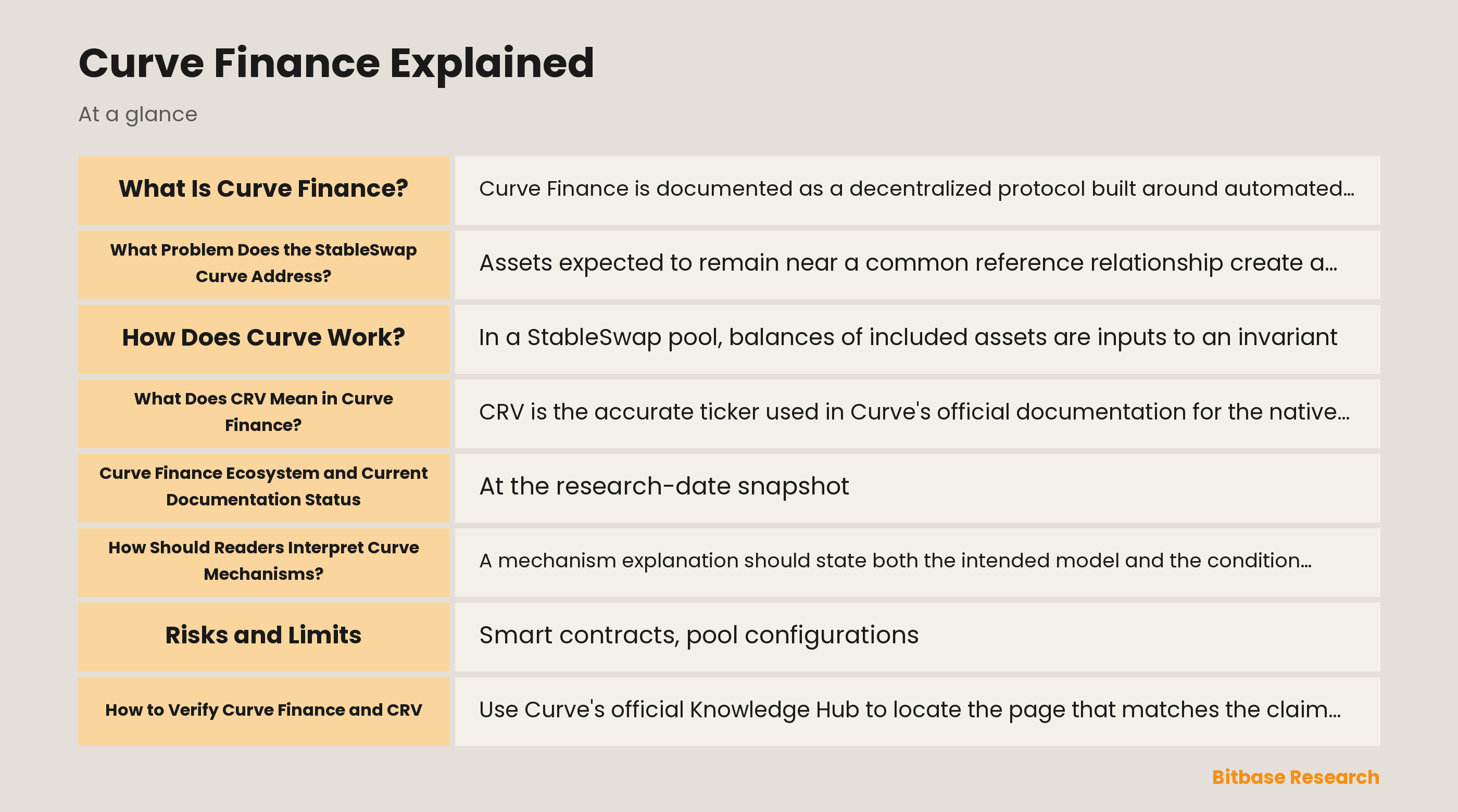
Curve Finance is documented as a decentralized protocol built around automated market makers and pools of digital assets. For a mechanism profile, the key point is that contracts apply pre-defined mathematical rules to pool balances. An interface, a social post, or a token listing is not a complete explanation of those rules.
Curve's official materials distinguish pools intended for assets expected to hold similar relative values from designs for assets whose values move more independently. StableSwap belongs to the first category. It is therefore a design built around an asset-relationship assumption, not a universal model for every possible combination.
The protocol name does not turn that assumption into a fact. A stablecoin can lose its peg, a derivative can diverge from its reference asset, and a pool can become imbalanced. StableSwap changes the contract's mathematical response around these conditions, but it does not restore a peg or verify the quality of an underlying asset.
What Problem Does the StableSwap Curve Address?
Assets expected to remain near a common reference relationship create a specialized liquidity problem. A rigid fixed-ratio rule can become fragile when balances change, while a purely constant-product-like rule does not necessarily reflect the near-reference premise. StableSwap was designed to have a flatter response near the intended balance and a different response as the pool moves farther from it.
The official StableSwap paper describes this construction through an invariant. Near the balance point, the curve approximates amplified constant-sum-like behavior. At more extreme imbalance, it moves toward constant-product-like behavior. This transition matters because a strictly fixed-value line cannot describe every state once the assumed relationship is no longer close.
The geometry does not make similarity permanent. It writes an assumption into the pool design: the assets must remain close enough for liquidity concentrated around that relationship to be meaningful. If the assumption weakens, both the mechanism's behavior and the distribution of pooled assets can change substantially.
How Does Curve Work?
In a StableSwap pool, balances of included assets are inputs to an invariant. The invariant determines the curve on which those balances are evaluated and, in turn, the relationship used by the contract when balances change. This is a mathematical explanation of a rule's response to pool states, not guidance about what a reader should do.
A parameter commonly called the amplification coefficient influences how strongly the curve resembles its flatter near-balance region. It is a configuration input, not a promise of a particular result. Different pools, asset definitions, contract versions, fees, and administrative parameters can lead to different behavior even when they use the same StableSwap label.
The curve is not an external source of truth. It does not independently confirm a peg, the solvency of an issuer, the condition of a wrapped asset, or the absence of market stress. Pool balances, configuration assumptions, and surrounding assets remain relevant to how the mechanism behaves.
The phrase Curve Finance ecosystem and use cases therefore belongs to a documentation context, not an operational one. It can describe the relationship among the DEX mechanism, token pages, DAO materials, cross-chain descriptions, and security pages without implying that every named component is available, suitable, or unchanged at a given time.
What Does CRV Mean in Curve Finance?
CRV is the accurate ticker used in Curve's official documentation for the native Curve token. The documentation places CRV in the protocol's token and DAO context. That identification should remain separate from StableSwap: CRV is not the equation governing pool balances, and an invariant does not establish a token outcome.
veCRV stands for vote-escrowed CRV. In the documented model, CRV subject to a time lock corresponds to a non-transferable veCRV position whose amount reflects both the CRV amount and the remaining duration. As the end of the lock approaches, the associated veCRV amount declines. This describes a state relationship, not a suggestion to create, extend, or manage one.
Official materials connect veCRV with DAO voting power and protocol coordination functions. Exact rules, parameter values, voting matters, allocation mechanics, and token status are time-sensitive. The existence of CRV or veCRV must not be expanded into a claim about governance results, revenue, liquidity, yield, availability, or a holder's entitlement.
Curve Finance Ecosystem and Current Documentation Status
At the research-date snapshot, Curve's official Knowledge Hub organizes material around the Curve DEX, ecosystem tokens, veCRV, DAO and governance, cross-chain Curve, and audits and security. This structure helps locate the right type of source. It is not evidence that every page, contract, network, or feature has the same current status or scope.
The Curve Finance ecosystem includes more than a single StableSwap pool. Official documentation separates protocol mechanics from token information, governance records, security material, contract deployments, and developer-facing material. An accurate overview preserves those boundaries instead of using one category to make an unsupported statement about another.
Documentation is a living source. Navigation labels, contract deployments, network coverage, token mechanics, parameters, audit records, and governance rules can change. Before publication, a time-sensitive statement should be checked against the corresponding official page and its date rather than inferred from an older overview or a third-party summary.
How Should Readers Interpret Curve Mechanisms?
A mechanism explanation should state both the intended model and the condition that model assumes. StableSwap is meaningful where assets are expected to remain close in relative value; that expectation is a design input, not a verification result. Similarly, veCRV describes a time-weighted governance mechanism, not a forecast of influence or a fixed bundle of rights.
It helps to separate stable facts from changing facts. The StableSwap invariant, the meaning of the CRV ticker, and the non-transferable time-decay concept of veCRV can be explained in a limited scope. Current deployments, contract addresses, parameter settings, ecosystem composition, token data, audit status, and governance decisions require a fresh official check.
Use cases should be described as protocol contexts, not personal actions. A reader can understand why a curve focuses liquidity around a close asset relationship and why a DAO uses a time-weighted token state without receiving instructions for exchanges, pool activity, token handling, or governance participation.
Risks and Limits
Smart contracts, pool configurations, governance systems, and integrations can contain defects, vulnerabilities, or mismatches between documentation and deployment. Curve's official materials publish audit scopes and dates, but an audit record covers a defined scope at a defined time. It does not establish that all contracts, configurations, future changes, or surrounding dependencies are free of risk.
Asset-assumption risk is central to StableSwap. A peg or close relationship can weaken or fail because of issuer, market, technical, custody, or other conditions. When that occurs, the concentrated-liquidity premise can be unfavorable, pooled balances can become highly skewed, and losses or other adverse outcomes may occur. The curve is not a guarantee of stability, liquidity, safety, or recovery.
There are also information and governance limits. Token mechanics, network deployment records, DAO rules, administrative powers, contract addresses, audit coverage, and documentation can change or be misunderstood. A historical security event, if discussed elsewhere, should be tied only to a dated official account and the named component; this profile makes no attribution of cause or fault and makes no security promise.
How to Verify Curve Finance and CRV
Use Curve's official Knowledge Hub to locate the page that matches the claim under review: the StableSwap paper for invariant mechanics, the CRV and veCRV pages for token terminology, and the security pages for dated audit scope and risk language. Confirm that the source addresses the same contract family, network, and date as the statement. A general homepage does not substitute for a technical or historical source.
For a token or deployment fact, compare the official statement's name, ticker, network, and contract address with the relevant official deployment record and an independently readable block explorer record. The identifiers, source date, and scope should agree. If evidence is absent, conflicts, or refers to a different version, leave the claim unmade rather than fill the gap with an inference.
Conclusion
Curve Finance is best understood here as a documented automated market-making protocol whose StableSwap invariant is designed around assets expected to remain close in relative value. The curve combines a flatter near-balance region with a response that changes as imbalance grows, but it does not prove a peg, eliminate risk, or establish a continuing condition for any pool.
CRV is the official native-token ticker, while veCRV is the documented vote-escrowed, time-decaying state used in Curve's DAO mechanism. Keeping the StableSwap model, token terminology, ecosystem documentation, risk boundaries, and current-status verification separate produces a more accurate account of Curve Finance.
Related market pages
- CRV: View price · Spot market · Perpetual market
Disclaimer: This article is educational content from Bitbase Academy, provided for information only. It explains what a project does and what role its token plays in that system; it does not constitute investment, trading, tax, or financial advice, and it is neither a recommendation nor an endorsement of any project or token. Bitbase has not carried out due diligence on the project described here, and mentioning it does not mean Bitbase lists or supports the asset. Crypto assets carry significant risk, including price volatility, thin liquidity, smart-contract failure, regulatory uncertainty, and the possible loss of their entire value. Written as of August 2026; a project's status, tokenomics, team, and contracts can change at any time. Verify everything yourself through official channels, the contract address, and a block explorer, and beware of imitation sites and phishing links.
References
[1] Curve Knowledge Hub: What is Curve? docs.curve.finance
[2] StableSwap: efficient mechanism for Stablecoin docs.curve.fi
[3] Curve Knowledge Hub: DEX overview docs.curve.finance
[4] Curve Knowledge Hub: CRV docs.curve.finance
[5] Curve Knowledge Hub: veCRV docs.curve.finance
[6] Curve Knowledge Hub: Security Audits docs.curve.finance
[7] Curve Knowledge Hub: Pool risks docs.curve.finance