DAO Maker is described in its own application and documentation as a launchpad and venture-platform-style service; its published allocation material separates platform framing from the rules and variables that a particular offering may use.
DAO Maker is best introduced by separating the labels used in its own materials. The current application page uses launchpad branding, while the linked documentation calls the service a VC platform and describes public and private launchpad offerings. Those are first-party descriptions of the service's intended role. They do not independently establish the quality, status, legal treatment, security, availability, or outcome of a particular offering, feature, project, or account. A neutral profile therefore explains the documented framing without converting a marketing label into a permanent fact about every activity associated with the name.
What Is DAO Maker
What is DAO Maker in this narrow sense? It is a project and application whose official materials frame it around launches and a venture-platform-style function. The phrase does not mean that DAO Maker is a single protocol rule, a single project offering, or a guarantee about a listed project. The application, documentation, offering pages, terms, and technical records serve different purposes. Keeping that separation is important because a page that introduces the platform cannot, by itself, verify the current terms or technical state of a later, specific event. DAO Maker is distinct from MakerDAO, whose official materials address the Maker Protocol and MKR, and from The DAO, the separate Ethereum project from 2016. This is name disambiguation only; it makes no comparison or assertion about affiliation, performance, or security.
The most durable description is therefore source-bounded. The app home page supports the statement that DAO Maker presently presents launchpad navigation. The documentation home page supports the statement that its authors use a VC-platform description and distinguish public from private offerings. Neither source is a universal substitute for a project's own materials, current eligibility terms, live implementation, or independent risk review. A profile should say what a source calls the service, then stop at the scope of that source. The search query what is dao maker crypto requires separation: DAO Maker’s platform identity is not by itself a complete statement of dao maker tokenomics and use cases, which require dated, event-specific source material.
The Platform Framing in Official Materials
Official wording gives the platform a high-level role, but an offering is a separate, time-bound arrangement. An offering page can have its own project description, schedule, eligibility conditions, allocation method, release conditions, and technical dependencies. Any of those details may be revised, withdrawn, limited by territory, or superseded. For that reason, the launchpad or venture-platform framing explains context rather than conferring an entitlement, a quality assessment, or a prediction about what a particular project will do.
Allocation models matter because they describe how a defined offering may divide a limited allocation among recorded inputs or platform-defined variables. They are not a description of a project's technology, a statement about a token's economic characteristics, or a measure of merit. The same word, such as allocation, can hide substantial differences between documented models. A careful reader first asks which offering type and which document version is being discussed, then treats the explanation as a description of rules rather than a reason to expect a particular result.
Why Allocation Models Need Careful Reading
The DAO Maker documentation separates public and private offering systems. That distinction is useful at a conceptual level, but the public/private labels do not settle current access, geographic scope, identity checks, timing, or any project-specific condition. The documentation also has visible update dates, which is a reason to treat its formulas and terminology as publication-version material. A profile should not silently carry a rule from an older explanatory page into a current offering without a same-day check of the relevant official materials.
The private-offering page describes a hybrid model in which a platform-defined measure called DAO Power and a recorded contribution are factors in allocation. It describes a total allocation being divided conceptually into a Guaranteed Allocation component and an Excessive Allocation component. This supports a narrow educational point: the documentation describes more than one variable and more than one allocation bucket. It does not establish that the same ratio, definitions, conditions, technical implementation, or consequences apply to every historical or future offering.
DAO Maker and Documented Allocation Models
The same private-offering material also describes a lottery variant with weighting, and it describes a result-verification flow involving off-chain calculation and a smart contract. That is a description of the documentation's stated mechanism, not an independent audit of code or an assurance that a current event uses that mechanism. The public-offering page instead says DAO Power does not determine public allocations and explains a share-based model. The important mechanism difference is not which label sounds stronger; it is that the documents attach different variables to different offering contexts.
DAO Maker and its documented allocation models should be read as a vocabulary of conditional rules. In the private material, DAO Power is described as a unit connected to allocation size, while the public material describes shares as the relevant allocation expression. These are platform terms, not universal blockchain concepts. A term's name does not reveal every input, exception, cap, timing rule, or consequence. It is also not a statement that a person will receive a result, retain a result, or experience the same treatment in another offering. Where the current terms of a particular private offering expressly apply Strong Holder Offering, it denotes an offering-specific condition that relates future unlocks to DAO Power recorded for that offering. It establishes neither a current entitlement nor any operational step.
The DAO Maker Ecosystem and Its Scope
A model can be transparent in explanation yet still be bounded in evidence. A formula or worked example can illustrate the relationship among variables, but it cannot prove that inputs were recorded correctly, that an offering's final configuration matches the example, or that related code is unchanged. Documentation can make a system easier to inspect without eliminating implementation, operational, identity, legal, timing, or third-party risks. This article therefore describes model categories and deliberately omits thresholds, figures, procedural actions, and project-specific terms that must be checked at release time.
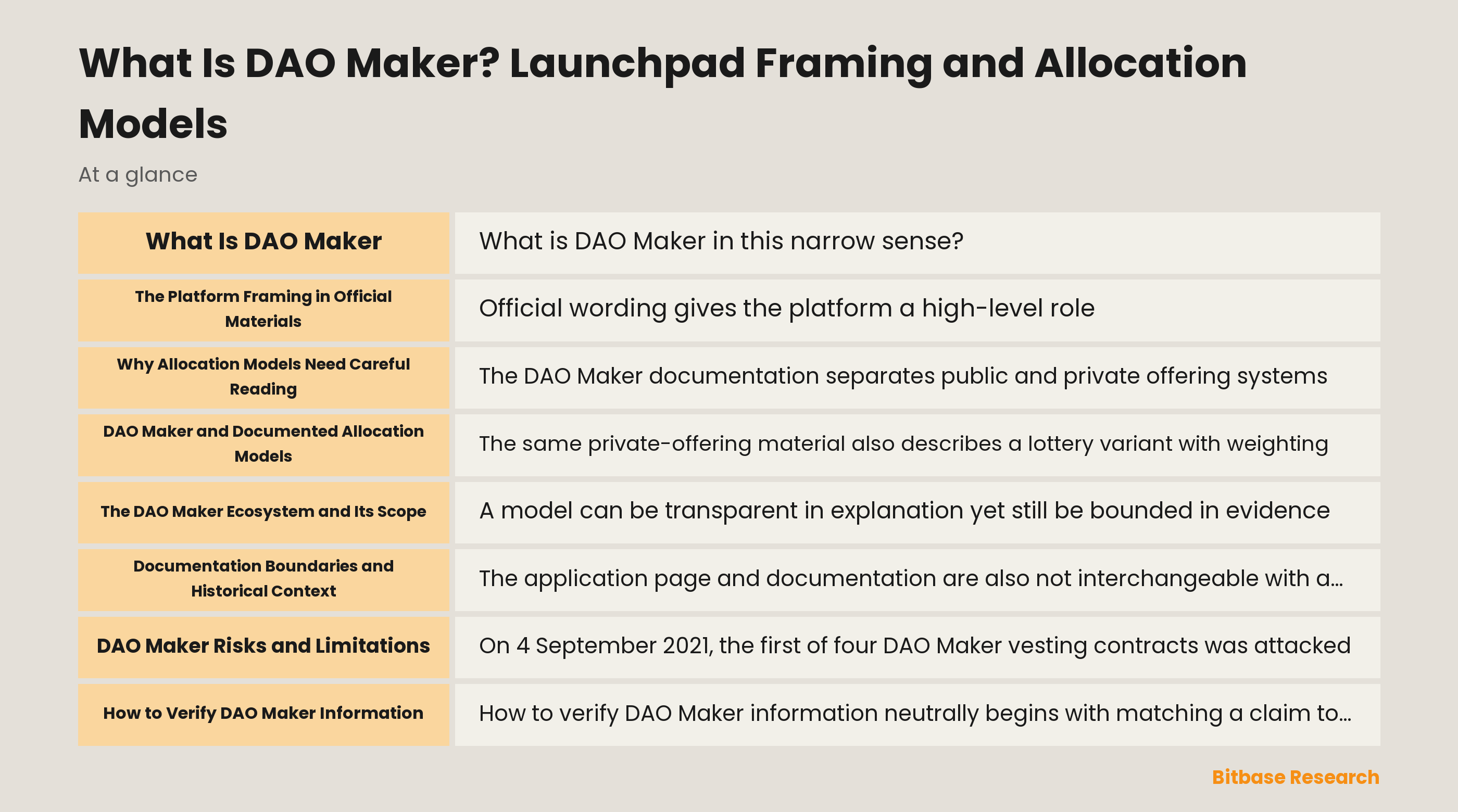
The DAO Maker ecosystem is an umbrella phrase for the app, documentation, launchpad context, and whatever additional modules or project pages the official materials present at a given time. It is not a promise that every named module is active everywhere, is suitable for every reader, or has identical rules. A project page in that ecosystem is evidence of a page's own published content, not permanent proof of affiliation, ongoing support, technical integration, or current availability. Separate sources should support separate claims.
Documentation Boundaries and Historical Context
The application page and documentation are also not interchangeable with a featured project's materials. DAO Maker may describe an offering framework, while a project page may state terms or technical claims specific to that project. Conversely, a project statement cannot establish that DAO Maker's general model still applies unchanged. This boundary protects against a common category error: treating an ecosystem label, a project listing, and an allocation rule as if they were one static object. Each has a different author, scope, update cycle, and verification path.
Documentation boundaries are especially important for historical content. A past launch list, an archived explanation, an old formula, or a previous feature label can show that a statement was published at a particular time. It does not show that the same arrangement remains live. Likewise, a source that explains a model cannot by itself establish current supply, distribution, code identifiers, audit scope, governance arrangements, legal treatment, territorial availability, or external relationships. Those are separate, changeable facts requiring current sources with matching scope.
DAO Maker Risks and Limitations
On 4 September 2021, the first of four DAO Maker vesting contracts was attacked. A founder-authored statement dated 6 September 2021 attributes the cause to a missing initialization check and describes the contemporaneous response. It evidences only reported history and response, not present security, remediation, or availability.
DAO Maker risk and limitations extend beyond any one historical event. Documentation may be stale or incomplete; allocation logic can be conditional; implementation and operations can contain errors; and a project's facts can change independently of the platform. A published audit statement, governance description, project relationship, or territorial notice has a defined scope and date, not an automatic guarantee. Readers should also distinguish a documented allocation method from suitability, legal effect, security, or an economic outcome. This is descriptive material, not personalized advice.
How to Verify DAO Maker Information
How to verify DAO Maker information neutrally begins with matching a claim to the official page that actually covers it. When an official source names a contract address, compare that record with the relevant official documentation and the corresponding block explorer entry, including network and publication date. This is a record-comparison check only. It does not direct anyone to participate, make a transaction, use an application, or rely on an identifier that has not been reconfirmed by the official source.
Before publication, separately recheck the official application domain, the linked documentation version, the exact offering type, current terms, territory and eligibility notices, and whether the cited project page is still current. Recheck any live code reference, allocation variables, formulas, technical disclosures, audit statements, governance descriptions, project relationships, token terms, release conditions, and availability against first-party material published for that specific event. If a fact cannot be matched to a current primary source, describe the uncertainty or leave it out.
Conclusion
DAO Maker can be described accurately as a service whose own materials use launchpad and venture-platform language and publish explanations of more than one allocation model. The private documentation centers a platform-defined variable and a hybrid allocation structure; the public documentation describes a separate share-based structure. That distinction explains the documents without asserting that any particular event is open, current, identical to an example, or appropriate for a reader.
The central interpretive rule is scope. Branding explains self-description. A system page explains a documented model. A project page explains a project-specific publication. A dated historical statement explains only what was publicly said at that time. None of those sources alone can settle the current technical condition, current legal position, current allocation rules, or future outcome of an offering. Neutral verification keeps those evidence boundaries visible rather than filling gaps with assumptions.
For a publication-ready profile, name DAO Maker's documented framing, explain the distinction between private-variable and public-share models, flag the historical and operational risk boundary, and separate each dynamic fact for release-day confirmation. This approach gives readers a useful conceptual map while avoiding instructions, promises, static token claims, or unstated assumptions about present terms. It also leaves room for a current official source to correct, narrow, or replace an older description.
Disclaimer: This article is educational content from Bitbase Academy, provided for information only. It explains what a project does and what role its token plays in that system; it does not constitute investment, trading, tax, or financial advice, and it is neither a recommendation nor an endorsement of any project or token. Bitbase has not carried out due diligence on the project described here, and mentioning it does not mean Bitbase lists or supports the asset. Crypto assets carry significant risk, including price volatility, thin liquidity, smart-contract failure, regulatory uncertainty, and the possible loss of their entire value. Written as of August 2026; a project's status, tokenomics, team, and contracts can change at any time. Verify everything yourself through official channels, the contract address, and a block explorer, and beware of imitation sites and phishing links.
References
[1] DAO Maker application homepage app.daomaker.com
[2] Welcome to DAO Maker, DAO Maker Docs dao-maker-1.gitbook.io
[3] Private Offering System, DAO Maker Docs dao-maker-1.gitbook.io
[4] Public Offering System, DAO Maker Docs dao-maker-1.gitbook.io
[5] DAO Power, DAO Maker Docs dao-maker-1.gitbook.io
[6] Token Metrics, DAO Maker Docs dao-maker-1.gitbook.io
[7] Founder-authored dated statement (Sep. 6, 2021): Removing all Smart Contract Risk & Tech Team Tokens, Christoph Zaknun medium.com
[8] MKR Governance 101, MakerDAO makerdao.com
[9] The DAO hack: story of Ethereum Classic, ethereum.org ethereum.org