Elixir is documented as a modular network for coordinating liquidity infrastructure and settlement-related data, while ELX is its native utility and governance token. This overview separates those network concepts from the distinct deUSD synthetic-dollar product and describes the architecture only at a conceptual level.
The phrase Elixir can refer to a network, its documentation, and products that its documentation connects to the network. Those are related but not interchangeable identities. A careful project profile begins with that distinction because a network architecture, a token, and a synthetic-dollar asset can have different rules, dependencies, and current status. This article describes documented design ideas rather than a route for using any product.
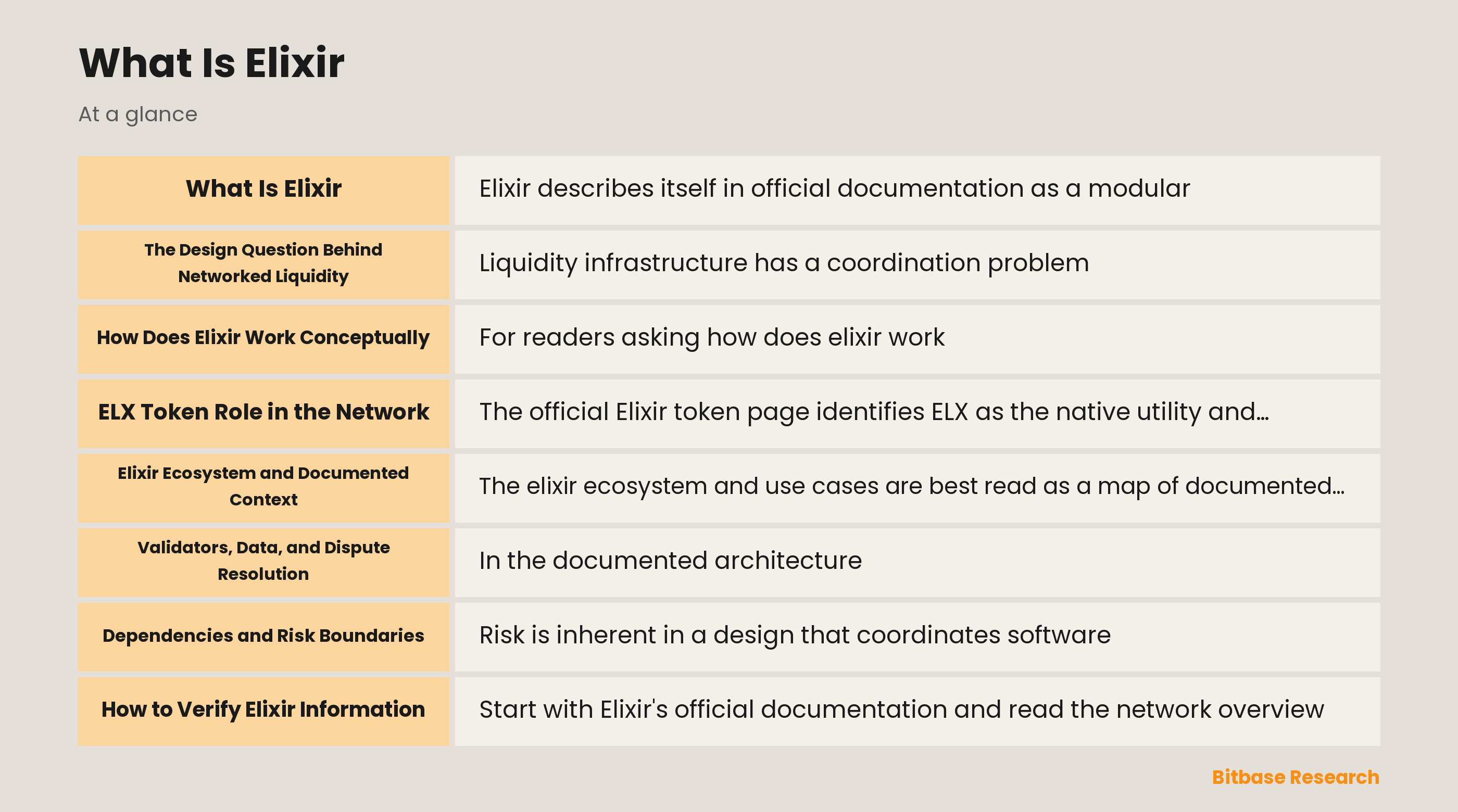
What Is Elixir
Elixir describes itself in official documentation as a modular, high-throughput network intended to coordinate institutional-liquidity infrastructure. In plain language, modular means that several specialized components can contribute distinct jobs instead of one component doing all computation, message handling, and dispute handling. The word does not itself establish how any live market or asset will behave.
Its materials describe a networked setting in which data, validator decisions, relay functions, and dispute processes are organized around a shared protocol design. This is useful as an architectural description: it explains why the project discusses both liquidity-related activity and a validator set. It is not evidence that a particular venue, asset, or integration is presently available or suitable.
The Design Question Behind Networked Liquidity
Liquidity infrastructure has a coordination problem. Participants may need consistent information about orders, inventory, settlement conditions, and the state of a system even when those observations originate in separate places. A network design can define how inputs are collected, how proposed outputs are checked, and how a disagreement is handled without treating every participant as one central operator.
The Elixir documentation frames this through modular components rather than through a single pooled balance. That framing matters because an order book, a data feed, a validator decision, and a settlement record are different kinds of objects. Describing them separately reduces the temptation to turn a technical architecture into a broad claim about depth, execution quality, or continuous availability.
How Does Elixir Work Conceptually
For readers asking how does elixir work, a high-level answer is that the published architecture separates data aggregation, validators, relay functions, and an auditor-controller dispute layer. Inputs can be combined into a defined data frame, validators can reach a protocol-defined consensus result, and relay functions can carry the resulting proposal onward. The exact code, configuration, and live participants require current documentation.
Official architecture materials also discuss order-book-related activity and market-making logic. Conceptually, this means a protocol can specify how proposed liquidity or order information is generated and checked across network actors. It does not mean that this article supplies an order-book method, a market-making strategy, access path, or an assurance about results under changing conditions.
ELX Token Role in the Network
The official Elixir token page identifies ELX as the native utility and governance token of the Elixir ecosystem. Its documented roles include supporting consensus-related economic security and governance. That identity decision is important: ELX is the native token ticker used for this profile, whereas deUSD is described separately as a synthetic-dollar asset.
Token roles explain a protocol vocabulary, not a valuation. The documentation's references to governance and validator economics describe how the design intends to align certain network actors with protocol rules. They do not establish token supply, distribution, contract details, future rights, market conditions, or a reason to acquire or use ELX; those are all facts that need publication-day review.
Elixir Ecosystem and Documented Context
The elixir ecosystem and use cases are best read as a map of documented relationships rather than as a list of promises. Elixir's materials connect the network with deUSD and with liquidity-oriented infrastructure. Each named relationship has its own implementation, counterparties, technical assumptions, and timing, so a project name alone does not establish the state of a particular connection.
deUSD should remain distinct in this map. Official pages call it a synthetic dollar and describe mechanisms related to its backing and operation, while ELX has the network-token identity stated above. This article does not restate collateral composition, asset lists, mint conditions, or cross-network representations because those details can change and must be checked from current primary materials before publication.
Validators, Data, and Dispute Resolution
In the documented architecture, validators are network actors that participate in consensus. An aggregator can prepare data for them, and relay functions can handle the movement of a proposal after the relevant consensus process. This division of roles is a way to describe accountability and information flow; it does not tell a reader to operate infrastructure or take any protocol action.
The same materials describe auditors and a controller as a dispute-oriented layer. At a conceptual level, an auditor examines whether submitted outputs conform to the protocol's expected rules, while a controller can apply the design's dispute outcome. The scope of these controls, their implementation, and any historical performance are not assumed here and should not be inferred from the existence of the terms.
Dependencies and Risk Boundaries
Risk is inherent in a design that coordinates software, validators, market makers, data inputs, and external networks. A validator set can have liveness, concentration, implementation, or incentive dependencies. A market-maker process can depend on models, operational controls, counterparties, and the quality or timing of inputs. These are categories for interpretation, not findings that any specific actor has failed.
deUSD introduces separate design dependencies, including the character of its backing arrangements, counterparties, and any oracle or valuation inputs used in documented mechanisms. A bridge can add message, representation, and cross-network dependencies. Governance can change parameters or priorities through its defined process. None of these categories provides a guarantee about a token, a synthetic dollar, or network outcomes.
How to Verify Elixir Information
Start with Elixir's official documentation and read the network overview, technical architecture, and ELX token-role page together. Check the page date and distinguish descriptive architecture from announcements or proposals. For a token reference, compare the official ticker with the current official contract-address disclosure and the relevant block explorer, while treating every network and contract identifier as time-sensitive.
For deUSD, integration, custody or reserve language, audit materials, and any claimed product state, use the current official page that specifically addresses that subject. Confirm the scope rather than assuming that a report covers every component, and record any legal or geographic restrictions exactly as published. This is a verification principle, not a sequence for accessing a product or moving an asset.
Conclusion
Elixir is best understood from its documented architecture: a modular network that coordinates data, validators, relay functions, and dispute handling for liquidity-oriented infrastructure. ELX is the official native utility and governance ticker, while deUSD is a separate synthetic-dollar product in the project's documentation. Keeping those identities separate prevents a common category error.
The architecture can clarify what the project is attempting to organize, but it cannot settle dynamic questions about contracts, supply, collateral, integrations, audits, restrictions, or current availability. Those questions belong to primary-source checks on the day of publication. A technical description is therefore a starting point for reading evidence, not an outcome claim.
The practical reading discipline is simple: identify the component, identify the documented mechanism, identify its dependencies, and verify the current source that applies to that component. This preserves the distinction between a network design, a token role, and a separate asset. It also keeps risk visible without turning an educational profile into product instructions or an investment view.
Related market pages
- ELX: View price
Disclaimer: This article is educational content from Bitbase Academy, provided for information only. It explains what a project does and what role its token plays in that system; it does not constitute investment, trading, tax, or financial advice, and it is neither a recommendation nor an endorsement of any project or token. Bitbase has not carried out due diligence on the project described here, and mentioning it does not mean Bitbase lists or supports the asset. Crypto assets carry significant risk, including price volatility, thin liquidity, smart-contract failure, regulatory uncertainty, and the possible loss of their entire value. Written as of August 2026; a project's status, tokenomics, team, and contracts can change at any time. Verify everything yourself through official channels, the contract address, and a block explorer, and beware of imitation sites and phishing links.
References
[1] Elixir Docs: About Elixir docs.elixir.xyz
[2] Elixir Docs: The ELX Token docs.elixir.xyz
[3] Elixir Docs: Network Architecture docs.elixir.xyz
[4] Elixir Docs: Fraud Proofs docs.elixir.xyz
[5] Elixir Docs: FAQ docs.elixir.xyz
[6] Elixir Docs: Audits docs.elixir.xyz