Falcon Finance describes a universal-collateral design centred on USDf, a synthetic dollar, while FF is its separate native governance and utility token.
For readers searching for falcon finance crypto, the first useful distinction is between the protocol name, the FF token, USDf, and sUSDf. They are related labels in official material, but they do not name the same asset or carry the same documented role. This profile is explanatory: it summarizes first-party descriptions and highlights questions that need a current source check.
What Is Falcon Finance?
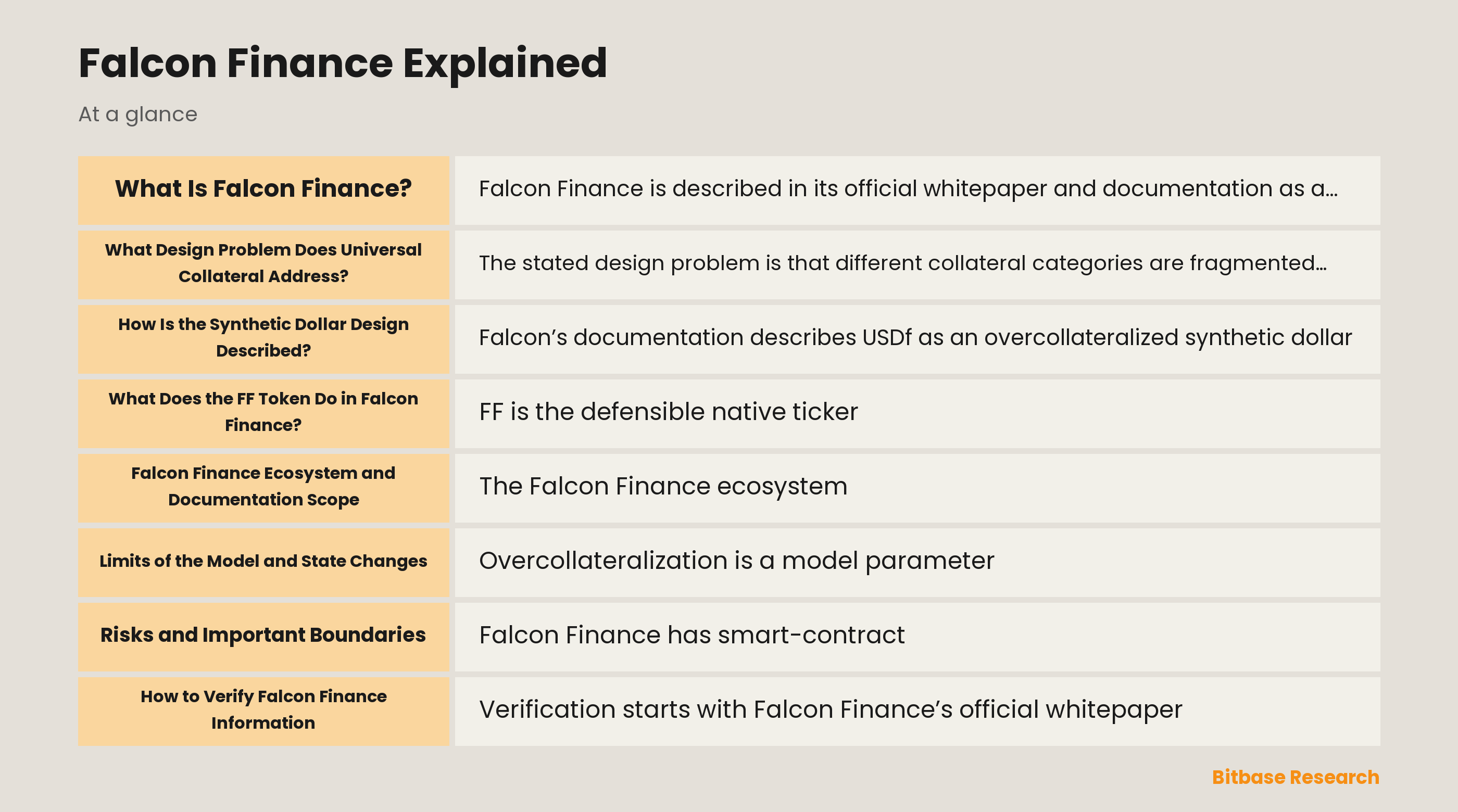
Falcon Finance is described in its official whitepaper and documentation as a universal-collateral infrastructure. Its documented design seeks to organize eligible digital assets and certain tokenized real-world assets around USDf, a synthetic-dollar unit. “Universal” is a design ambition and a category label; it does not mean every asset, jurisdiction, or interface is included at every time.
The project materials distinguish several layers. USDf is the overcollateralized synthetic dollar. sUSDf is documented as a separate yield-bearing form associated with the USDf system. FF is the native governance and utility token. Confusing a protocol unit with FF can turn a description of system accounting into an incorrect claim about the native token.
Falcon Finance also describes offchain and onchain elements. That boundary matters: a blockchain record may show a token contract, while custody arrangements, counterparties, market strategies, administrative controls, legal agreements, and operational processes may sit outside that record. A profile should not imply that all relevant facts are visible on one chain.
What Design Problem Does Universal Collateral Address?
The stated design problem is that different collateral categories are fragmented by asset type, venue, settlement arrangement, and risk profile. Official communications discuss stablecoins, digital assets, and tokenized instruments as categories that may be considered within a common collateral framework. This is an account of a proposed organization of collateral, not proof that every listed category is currently accepted.
Collateral valuation is central to such a design. The value assigned to a collateral position can depend on reference prices, market depth, volatility assumptions, haircuts, concentration limits, timing, and the terms governing the instrument. A tokenized representation of an asset also introduces questions about the issuer, the underlying claim, custody, transfer restrictions, and governing jurisdiction.
The word “collateral” should not be read as a guarantee of recoverability. Valuation can move quickly, price inputs can be delayed or disputed, and a legal or custodial claim can differ from a technical token balance. Official documents can state a framework, but the actual eligible set and its parameters are time-sensitive facts.
How Is the Synthetic Dollar Design Described?
Falcon’s documentation describes USDf as an overcollateralized synthetic dollar. In broad terms, the design associates USDf with collateral whose stated value is intended to exceed the synthetic-dollar amount. The project also describes neutral-market and hedging approaches intended to reduce directional exposure. These descriptions identify a model; they do not establish a fixed ratio or a stable outcome.
The model introduces dependencies beyond the token contract. Its operation can rely on custody of underlying assets, valuation feeds, derivatives venues, funding conditions, counterparties, settlement, and internal or external risk controls. A hedge may reduce one exposure while creating basis, execution, counterparty, liquidity, or operational exposure elsewhere.
Official material discusses strategies involving funding and market-neutral positioning. Funding is not a guaranteed source of income: rates can change sign, spike, diverge across venues, or be unavailable under stress. Counterparty performance and the ability to transfer or settle assets may likewise differ from ordinary market conditions.
What Does the FF Token Do in Falcon Finance?
FF is the defensible native ticker: Falcon Finance’s whitepaper and token-launch announcement describe FF as the protocol’s native governance and utility token. Its documented governance role concerns participation in decisions about protocol direction, such as upgrades, parameters, and specified economic or ecosystem matters. The exact scope of governance must be read from current official materials.
FF is not USDf and it is not sUSDf. USDf is the synthetic-dollar unit described by the protocol, while sUSDf is a separate unit whose official description relates it to the USDf system. These labels should not be substituted for one another in a project profile, token table, or search-oriented introduction.
“Utility” and “governance” are role descriptions, not promises of ownership, payment, voting outcome, access, value, or performance. Rules may be changed through governance or administration, and a token’s practical role can vary by contract, network, interface, and date. Publication should therefore avoid presenting FF mechanics as permanent.
Falcon Finance Ecosystem and Documentation Scope
The Falcon Finance ecosystem, as presented in official sources, includes documentation for USDf, sUSDf, collateral and risk material, a smart-contract directory, a whitepaper, and news or governance communications. These sources have different purposes. A whitepaper explains a model, while a contract directory identifies a published address for a stated network and time.
Official updates also discuss expanded collateral categories and integrations. Such announcements are not a substitute for a current eligibility list or legal analysis. In particular, a tokenized treasury, equity, commodity, or credit instrument may carry issuer, custodian, transfer, tax, disclosure, and jurisdictional limitations that are independent of the Falcon protocol description.
The ecosystem is therefore best read as a set of related documents and components, not a claim that each component is available, suitable, interoperable, or legally accessible for every reader. Current networks, supported assets, contract deployments, governance status, and documentation revisions all require a publication-day check.
Limits of the Model and State Changes
Overcollateralization is a model parameter, not a universal protection. Its usefulness depends on how collateral is valued, how quickly a system can react, how hedges behave, and whether parties can perform during stressed conditions. A buffer can be consumed by rapid price moves, gaps, delayed settlement, fees, or a mismatch between a reference price and realizable value.
The USDf peg is another design objective rather than a fact that can be assumed. Depeg risk can arise when market pricing, collateral valuation, hedging, arbitrage capacity, redemption conditions, or confidence diverge. Official descriptions of stabilization mechanisms do not guarantee that USDf will equal any particular external price.
State-change risk also matters. Governance votes, multisignature administration, contract upgrades, pauses, configuration changes, oracle replacements, revised collateral criteria, legal restrictions, or service-provider decisions can change the system’s behavior. Readers should treat dates, parameters, and named integrations as versioned information.
Risks and Important Boundaries
Falcon Finance has smart-contract, oracle, software, operational, custody, counterparty, market, funding, and legal risks. An oracle can provide stale, incorrect, unavailable, or contested data. A contract can contain an error or interact unexpectedly with another component. Multisignature and governance arrangements may create authorization and concentration risks even when they are publicly described.
Collateral risk includes volatility, correlation, concentration, valuation disputes, custody failure, and differences between a token and the legal rights it is said to represent. Where credit, treasury, commodity, or equity-linked instruments are involved, issuer solvency, documentation, transfer restrictions, settlement, and jurisdiction can become material. No chart, attestation, or onchain balance independently resolves all of those questions.
Funding and counterparty risks are particularly relevant to a strategy that uses market positions. A counterparty may fail, restrict transfers, change terms, or be unable to settle. Funding rates and hedge relationships may move adversely. Redemption risk includes timing, eligibility, cooldown, asset-availability, and market-stress considerations; it should not be simplified into an assumption of immediate or equivalent value.
How to Verify Falcon Finance Information
Verification starts with Falcon Finance’s official whitepaper, its USDf and collateral-risk documentation, the FF launch material, and the official smart-contract directory. Check that the source identifies the same project, describes FF as the native governance and utility token, and distinguishes it from USDf and sUSDf. Record the page date and scope before treating a statement as current.
For a published contract address, first match the address, token label, and named network on the official smart-contract page. Then compare the same address on the corresponding block explorer, while recognizing that an explorer displays recorded data rather than proving project identity, legal status, custody, or current product conditions. Do not infer an address from a logo, search result, or unaffiliated post.
The same caution applies to collateral lists, oracle sources, proof or reserve statements, policies, and governance materials. A conflicting, stale, or missing official record is a reason to omit the assertion until it is resolved. This is a source-verification method, not a direction to use any service or authorize any transaction.
Conclusion
Falcon Finance is best understood as a documented universal-collateral and synthetic-dollar design. USDf is the protocol’s synthetic-dollar unit, sUSDf is a distinct documented unit, and FF is the native governance and utility ticker supported by the whitepaper, launch material, and official contract directory.
The important analytical boundary is between a stated mechanism and a verified present condition. Collateral valuation, custody, funding, counterparties, redemption terms, peg behavior, oracle inputs, legal rights, and state changes can all affect the model. Re-check official sources before publication and describe them conservatively rather than treating the design as a guaranteed result.
Related market pages
- FF: View price · Spot market · Perpetual market
Disclaimer: This article is educational content from Bitbase Academy, provided for information only. It explains what a project does and what role its token plays in that system; it does not constitute investment, trading, tax, or financial advice, and it is neither a recommendation nor an endorsement of any project or token. Bitbase has not carried out due diligence on the project described here, and mentioning it does not mean Bitbase lists or supports the asset. Crypto assets carry significant risk, including price volatility, thin liquidity, smart-contract failure, regulatory uncertainty, and the possible loss of their entire value. Written as of August 2026; a project's status, tokenomics, team, and contracts can change at any time. Verify everything yourself through official channels, the contract address, and a block explorer, and beware of imitation sites and phishing links.
References
[1] Falcon Finance Whitepaper falcon.finance
[2] USDf Synthetic Dollar Documentation docs.falcon.finance
[3] Collateral Acceptance and Risk Framework docs.falcon.finance
[4] FF Token Launch Announcement falcon.finance
[5] Official Smart Contracts Directory docs.falcon.finance