Fleek Network was a project name for a decentralized edge-computing design, while Fleek's current official material describes a centralized AI inference company. FLK connects to the same Fleek brand story, but its current official role belongs to the modern Fleek ecosystem and should not automatically be treated as proof of a live version of the older edge network.
That distinction is the starting point for an accurate answer. Older Fleek material described a Web3-oriented edge platform and its planned economic design. A 2026 company update instead describes Fleek Network as part of Fleek's earlier decentralized-infrastructure period and explains that the company has shifted its focus to AI.
This profile therefore uses two time labels. “Historical Fleek Network” means the documented edge-network design in the earlier material. “Current Fleek” means the company and AI inference product described on its current official site. Separating those labels prevents an old architecture page from being read as a statement about a present service.
What Is Fleek Network?
Fleek Network was the name used for a decentralized edge-computing project in earlier Fleek documentation and source-code materials. Its stated purpose was to support decentralized web services through a distributed edge-oriented architecture. The name belongs to the history of the Fleek brand, but a historical project description alone does not establish the present state of any network, service, or technical component.
The current official Fleek update is important context. It says that Fleek spent years building decentralized web infrastructure, including Fleek Network, and later transitioned toward AI. The current site describes Fleek as a company operating an AI inference platform rather than as a decentralized protocol. That is a material change in framing, not a minor wording variation.
For that reason, “what is Fleek Network” has a time-sensitive answer. It can refer to the earlier edge-computing design, its documentation, and its open-source work. It should not be used as a shortcut for asserting that every historic component remains available, unchanged, or governed by the same rules today.
What Problem Did Fleek Network Aim to Address?
The older project material framed the problem as a mismatch between decentralized applications and conventional web infrastructure. It described a need for web-facing services that could be organized across an edge-oriented environment rather than depending on a single centrally controlled delivery path. This was a design goal, not evidence that a particular application would always be reachable or suitable for a particular use.
In that historical framing, the edge layer was meant to make decentralized web services easier to compose around activities such as content delivery, request handling, and application-side computation. These are categories of workload, not promises about results. A category name does not prove the reliability, permissions, data handling, or current availability of a specific implementation.
The problem statement also needs a time boundary. Earlier material sometimes discussed future phases, experimental work, or intended service categories. Those statements are useful for understanding the project thesis, but they are not a substitute for current documentation. A careful reader should distinguish an architectural ambition from a presently documented product capability.
How Did Fleek Network Work?
The historical design described an edge-oriented system in which services could use distributed computing and networking resources. Its documentation discussed services as modular programs with defined tasks, along with records and cryptographic techniques intended to support the protocol's design. That explanation is about the structure described in the project material, not an instruction to run software or interact with a service.
One useful way to understand the design is to separate its layers. A service layer describes the task that an application requests. An edge layer describes where work is intended to be handled. A protocol layer describes the rules and records that are meant to coordinate participants. Treating those layers as the same thing would obscure which claim belongs to which part of the design.
The question “how does fleek network work” therefore has two answers that should not be merged. Historically, it was documented as an edge-computing architecture for decentralized services. In the current official company narrative, Fleek has redirected its product work toward AI inference. The current page must take priority whenever a statement concerns present availability or product behavior.
What Does FLK Mean in the Fleek Story?
FLK is the ticker used on current official Fleek pages for the Fleek token. Those pages associate FLK with the modern Fleek ecosystem and identify it as an ERC-20 record on Base. The article deliberately does not reproduce a contract identifier because a reader should obtain that value from the current official page at the time of review, rather than rely on a static article.
Historical official Fleek Network material also connected FLK with the earlier network's economic design. However, that material described an early stage and explicitly treated many parameters as changeable. It supports the historical relationship between the Fleek Network name and FLK, but it does not prove that an old role, schedule, or protocol assumption remains current.
The present official FLK page uses a different context: Fleek says it operates a centralized AI inference platform and describes FLK as a utility token for that platform. This means that a label reading “fleek network crypto” needs interpretation. It may point to an older Web3 project discussion, the current Fleek token page, or an unrelated label, so the date and source domain matter.
Fleek Network Ecosystem and Use Cases
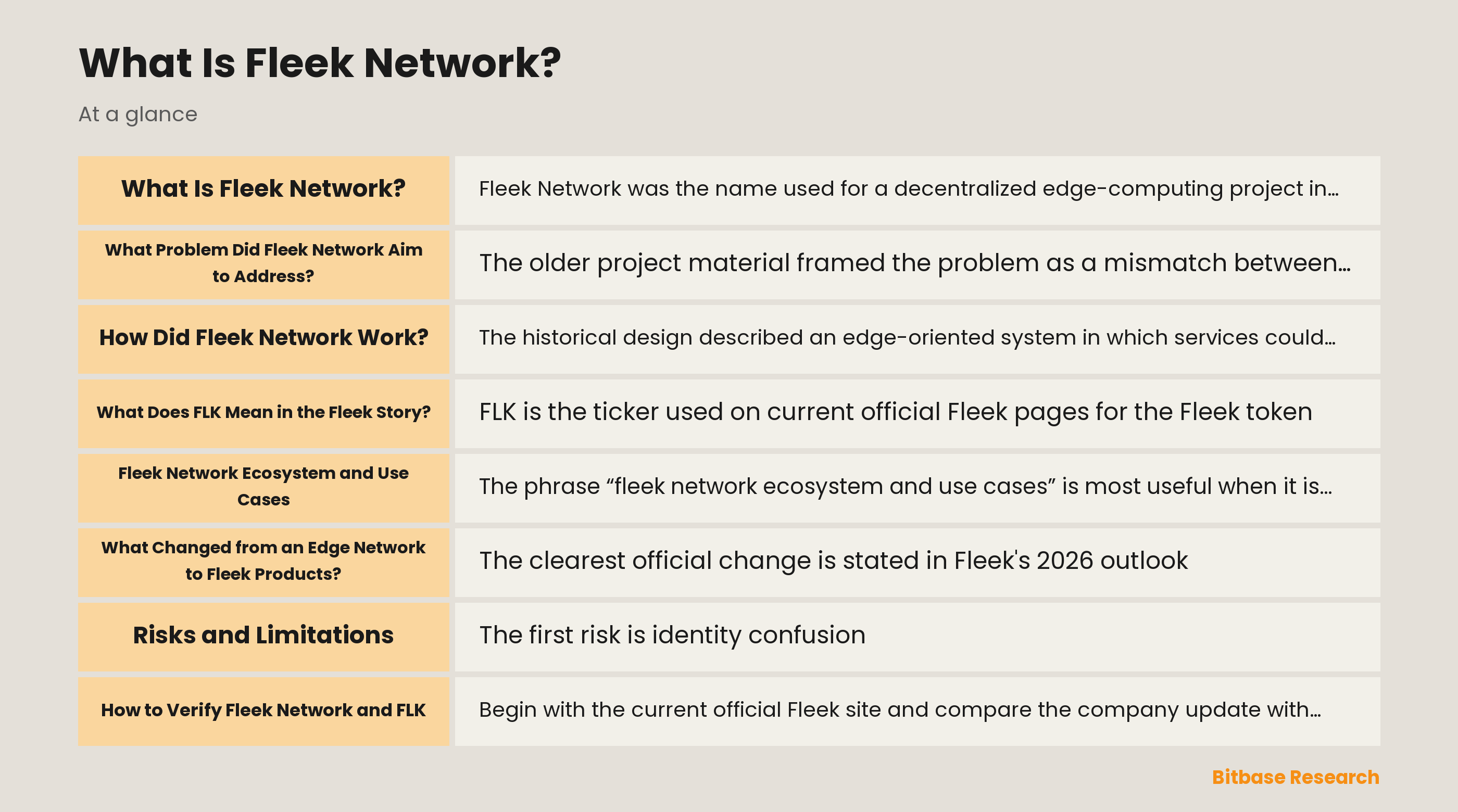
The phrase “fleek network ecosystem and use cases” is most useful when it is separated into historical and current scopes. Historical material discussed a Web3 edge environment for decentralized web services, including categories such as content-oriented delivery, compute-oriented services, naming-related functions, and application support. These categories explain the intended scope without proving a current public offering for each one.
Current official Fleek material instead centers on AI inference and related platform services. It uses the same Fleek brand and includes FLK in the current platform narrative, but it does not turn the historical edge-network documents into a description of the current product. The product boundary must be read from current official pages, not inferred from a retained token ticker.
An ecosystem is also not a single object with fixed membership. Source repositories, product pages, integrations, documentation, and externally named assets can all change independently. This article does not count activity, rank platforms, or recommend an interaction. It only explains the documented relationship among the historical project, the current company, and the FLK label.
What Changed from an Edge Network to Fleek Products?
The clearest official change is stated in Fleek's 2026 outlook: the company says it moved from decentralized infrastructure toward AI during 2025. It names Fleek Network among the previous infrastructure efforts, then describes a newer direction focused on an efficient inference layer. This is why current and historical sources must be read as different time slices.
The domain change reinforces that caution. Earlier Fleek Network documentation routes now lead to the newer Fleek site, where the visible product description is AI-focused. A redirect can preserve brand continuity, but it does not preserve every factual statement from the old destination. Readers should not treat an old path as confirmation that the old feature set is active today.
FLK is the connective identifier across those materials, but it does not erase the product transition. The older sources explain why FLK appears in discussions of Fleek Network. The newer official sources explain the present token context. A sound project profile presents both facts and leaves current technical status to the latest first-party record.
Risks and Limitations
The first risk is identity confusion. “Fleek,” “Fleek Network,” an old edge-computing document, and a current AI platform may be used in the same conversation even though they describe different periods or layers. A similarly named asset, reposted page, or outdated summary may combine them incorrectly. The relevant check is always which official page supports the precise statement being made.
The second risk is time confusion. Historical testing notes, projected phases, and earlier architecture diagrams can be informative, but they are not present-tense evidence. Current product availability, technical implementation, access controls, token mechanics, and contract records are changeable facts. No historical source in this profile is treated as a guarantee about any of them.
The third risk is over-reading a token label. A ticker can establish only so much: it may identify an official asset in a defined context. It does not authenticate a third-party interface, establish a service's safety, or confirm that an old technical role is still active. This profile makes no audit conclusion and no claim that a reader should use any product or asset.
How to Verify Fleek Network and FLK
Begin with the current official Fleek site and compare the company update with the current FLK page. Confirm whether the source describes historical Fleek Network, current AI products, or the token itself. Check the publication context and wording, especially when a page uses future-oriented language or refers to an earlier phase of development.
For FLK, use only a current Fleek-controlled page to obtain the applicable contract address and network label. Then compare those details read-only in the matching block explorer. The network name, contract address, token symbol, visible verification details, and any implementation relationship should agree. This comparison requires no account connection or approval.
For a historical edge-network claim, inspect the official source repository and the dated documentation context. If an older documentation path now redirects, treat that as a reason to seek a current statement rather than fill the gap with an assumption. A mismatch of name, date, network, or product scope is a reason to stop the review until a first-party source resolves it.
Conclusion
Fleek Network is best understood as the historical edge-computing project in Fleek's earlier decentralized-infrastructure period. Its documentation explains an intended architecture for decentralized web services, but current official material says Fleek has shifted toward a centralized AI inference platform. That transition is central to any accurate description.
FLK links the historical and current Fleek narratives, yet its current official context belongs to the modern Fleek ecosystem. The responsible approach is to distinguish those time periods, use the latest official page for current facts, and verify any contract address through a matching read-only block explorer before relying on it.
Related market pages
- FLK: View price
Disclaimer: This article is educational content from Bitbase Academy, provided for information only. It explains what a project does and what role its token plays in that system; it does not constitute investment, trading, tax, or financial advice, and it is neither a recommendation nor an endorsement of any project or token. Bitbase has not carried out due diligence on the project described here, and mentioning it does not mean Bitbase lists or supports the asset. Crypto assets carry significant risk, including price volatility, thin liquidity, smart-contract failure, regulatory uncertainty, and the possible loss of their entire value. Written as of August 2026; a project's status, tokenomics, team, and contracts can change at any time. Verify everything yourself through official channels, the contract address, and a block explorer, and beware of imitation sites and phishing links.
References
[1] Fleek 2026 Outlook (official company update) www.fleek.sh
[2] FLK: The Fleek Token (official) www.fleek.sh
[3] FLK Token (official documentation) www.fleek.sh
[4] Fleek Network organization (official source code) github.com
[5] Fleek Network Testnet: Everything You Need to Know (historical official post) blog.fleek.network
[6] Legacy Fleek Network Docs (historical official documentation entry) docs.fleek.network