Folks Finance is documented as a DeFi protocol with Algorand roots and a later multichain hub-and-spoke design; FOLKS is the protocol's native token ticker.
Readers looking for folks finance, Folks Finance tokenomics and use cases, or what is Folks Finance may encounter Algorand material alongside newer crosschain documentation. Those sources concern related layers, but they should not be collapsed into one timeless statement. This profile distinguishes documented mechanisms from claims about present status, market conditions, or personal outcomes.
Official documentation says Folks was initially a DeFi protocol on Algorand and later evolved toward a multichain hub. That history is useful because an Algorand contract system, a crosschain accounting design, and a native token with deployments on multiple networks are separate matters. Each has its own records, dependencies, and revision cycle.
This profile is explanatory. It does not describe how to obtain an asset, connect an account, authorize an action, or operate a protocol feature. Network lists, parameters, contract records, governance decisions, and interfaces require a fresh first-party review on the publication date.
What Is Folks Finance?
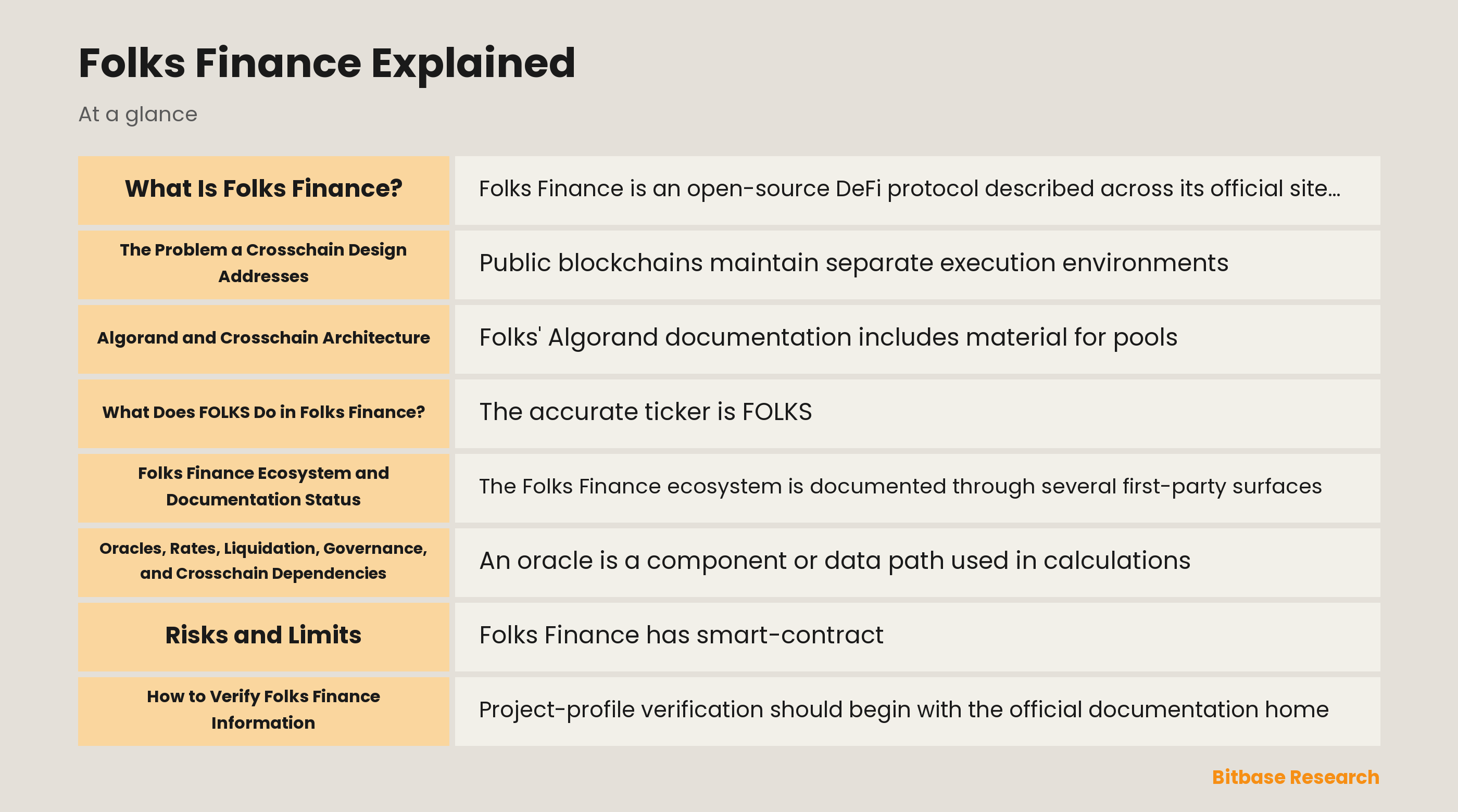
Folks Finance is an open-source DeFi protocol described across its official site and documentation. Its documentation home separates material for an Algorand application, an xChain application, and a point system. The official site characterizes the protocol as smart contracts on public blockchains, while the documentation provides a history that begins with Algorand.
At a high level, the published materials describe markets whose balances, collateral rules, and debt accounting are organized by contract logic. This language identifies a technical arrangement. It does not establish that every market has identical terms, that a particular interface is reachable, or that a parameter will remain unchanged.
The project is best understood as a set of components rather than a single interchangeable website or a single token. Materials about Algorand, xChain, token utility, governance, and contract identifiers address different parts of that set. The scope of any deployed component is a current-state question.
The Problem a Crosschain Design Addresses
Public blockchains maintain separate execution environments, state, and asset representations. A system that coordinates across them must account for messages, confirmation assumptions, external services, and the possibility that information is delayed or inconsistent between networks. That is an architectural problem before it is an interface problem.
Folks documentation describes a hub-and-spoke model that uses messaging-layer technology. In this description, a hub coordinates part of the system's logic or accounting and connected networks form spokes. The model explains an intended relationship among components; it is not evidence that each possible route or asset relation is active at a given moment.
The phrase unified liquidity is therefore a design label, not a claim that all assets are interchangeable or that settlement has no constraints. Asset configuration, message delivery, oracle inputs, local execution, and protocol parameters can still affect a recorded state. Each dependency creates a distinct boundary for analysis.
Algorand and Crosschain Architecture
Folks' Algorand documentation includes material for pools, loans, oracle applications, liquid governance, and contracts. The developer contracts page publishes Algorand-related application and asset identifiers. An identifier is only meaningful when it is paired with the stated network, component, and date; it should never be inferred from a name alone.
The xChain documentation describes a multichain hub-and-spoke architecture that leverages messaging layers. This supports a conservative statement about the documented design. It does not establish the current availability of every network, asset, bridge path, or interface, because integrations can be changed, paused, or described at different times.
Crosschain architecture also separates local action from a message or state recognized elsewhere. A difference in finality, a messaging fault, an unsupported representation, a changed dependency, or delayed data can alter the relationship between components. The design coordinates across boundaries; it does not erase them.
What Does FOLKS Do in Folks Finance?
The accurate ticker is FOLKS. The official token documentation calls FOLKS the native asset of the Folks Finance protocol and says that, in the protocol's crosschain architecture, it uses the NTT standard. The official site describes FOLKS as a coordinating layer associated with utility, governance, and alignment mechanisms.
FOLKS is not identical to the protocol, an Algorand application identifier, or every asset referenced in a market description. A ticker is a token designation. It does not by itself demonstrate ownership of an entity, entitlement to revenue, a fixed governance effect, or any conclusion about value.
The official utilities page lists areas that include governance, fee-related treatment, xGov voting, and future utilities. That same source warns that some listed utilities might not yet be live. The careful interpretation is that the page documents intended or conditional roles whose activation, eligibility, and parameters must be confirmed from current official material.
Folks Finance Ecosystem and Documentation Status
The Folks Finance ecosystem is documented through several first-party surfaces. The documentation landing page groups Algorand, xChain, and point-system material; the token pages address FOLKS; the contracts page records Algorand identifiers; and the official site provides broader protocol and legal-context statements. These surfaces are complementary, not interchangeable.
An ecosystem label can conceal important distinctions. An Algorand pool, a crosschain message path, a governance process, and a token deployment may rely on different code, parameters, participants, and update schedules. A recent timestamp on one page does not prove the current status of a different component.
Official pages may name technology providers or display integrations. Such a reference documents the relationship at the page's stated time and scope. It does not establish a continuing service, a complete coverage list, security, legal treatment, or a particular result. Supported networks and assets are always publication-day verification items.
Oracles, Rates, Liquidation, Governance, and Crosschain Dependencies
An oracle is a component or data path used in calculations, often for asset prices. Folks' Algorand contracts page lists oracle applications, and its architecture material describes calculations that rely on configured values. A feed can be delayed, inaccurate, unavailable, manipulated, or interpreted differently by linked components, which makes oracle design a central dependency rather than a background detail.
The published interest-rate model describes variable and stable borrow-rate calculations using utilization and configured thresholds. Utilization is a relationship between recorded debt and recorded liquidity in a pool. A formula describes conditional logic; it is not a fixed-rate statement, because balances, parameters, implementation versions, and governance choices can alter the result.
The liquidation documentation describes a rule triggered when a total borrowed amount exceeds a calculated borrowable amount and explains a process involving debt and collateral. That is a risk-control mechanism that depends on prices, inputs, thresholds, timing, and ordering. It does not predict when a condition will arise or how every component will behave during rapid change.
Governance is another dependency. Official material associates FOLKS with governance, while the forum contains governance-related records. Proposals, voting procedures, participant rules, and outcomes require their own current review. A token role does not guarantee that a proposal will pass, that a decision will be implemented, or that parameters will remain stable.
The NTT and messaging-layer descriptions add crosschain dependencies to this picture. Token deployment records, message verification, network finality, and external infrastructure can all be relevant. A bridge or messaging layer does not replace checking the exact network, official contract address, and component context.
Risks and Limits
Folks Finance has smart-contract, oracle, parameter, governance, liquidity, market, and external-dependency risks. Documentation can explain intended logic but cannot determine how code, data feeds, participants, or connected networks behave under stress. Older documentation can also remain publicly visible after an implementation or configuration changes.
Crosschain risks include message delay, verification failure, chain disruption, finality differences, asset-representation mismatch, and changes to external services. These risks can combine. For example, a delayed message or price input may change accounting assumptions while a connected network is subject to separate conditions.
Interest-rate and liquidation mechanisms are sensitive to utilization, prices, thresholds, timing, and configuration. Governance can modify relevant rules through its own process. Legal and regulatory treatment can vary by jurisdiction, asset, interface, counterparties, and facts; a technical label is not a jurisdiction-specific legal classification.
There is also identity risk. Names, logos, social posts, token symbols, and alleged contract addresses can be copied. A claim about FOLKS or a crosschain deployment needs matching first-party documentation and a corresponding record in the relevant block explorer for the stated network.
How to Verify Folks Finance Information
Project-profile verification should begin with the official documentation home, the FOLKS token page, the utilities page, the developer contracts page, the interest-rate and liquidation architecture pages, and the official site. Read each page for date, scope, and qualifications. In particular, the utilities warning prevents a list of described functions from being treated as a live-status assertion.
For a contract address, asset identifier, or application identifier, first establish the network and component it is claimed to represent. Compare it with the matching official contracts or token source, then examine the corresponding block explorer record for that same network. A block explorer can show public chain data, but it alone cannot establish project identity, current support, legal status, or future behavior.
Keep protocol facts distinct from token facts. Supply, distribution, token deployments, supported chains, parameters, message routes, oracle sources, governance rules, and interface restrictions are publication-day review items. If an official source does not clearly support a current claim, it is safer to describe the item as documentation history or omit it.
Conclusion
Folks Finance is documented as an Algorand-rooted DeFi protocol with a later multichain hub-and-spoke direction. FOLKS is the official ticker for its native token. Its sources describe token roles connected to utility, governance, and coordination while also warning that some listed utilities might not yet be live.
The clearest reading is by boundaries: Algorand components, crosschain architecture, FOLKS, oracles, interest-rate logic, liquidation, governance, and external dependencies each require separate evidence. A fresh first-party review is necessary before presenting dynamic details as current.
Related market pages
- FOLKS: View price · Perpetual market
Disclaimer: This article is educational content from Bitbase Academy, provided for information only. It explains what a project does and what role its token plays in that system; it does not constitute investment, trading, tax, or financial advice, and it is neither a recommendation nor an endorsement of any project or token. Bitbase has not carried out due diligence on the project described here, and mentioning it does not mean Bitbase lists or supports the asset. Crypto assets carry significant risk, including price volatility, thin liquidity, smart-contract failure, regulatory uncertainty, and the possible loss of their entire value. Written as of August 2026; a project's status, tokenomics, team, and contracts can change at any time. Verify everything yourself through official channels, the contract address, and a block explorer, and beware of imitation sites and phishing links.
References
[1] Folks Finance official documentation docs.folks.finance
[2] FOLKS token documentation docs.folks.finance
[3] FOLKS utilities documentation docs.folks.finance
[4] Folks Finance contract documentation docs.folks.finance
[5] Interest rate model docs.folks.finance
[6] Liquidation architecture docs.folks.finance
[7] Folks Finance official site www.folks.finance