Fuel Network is a protocol stack designed for Ethereum rollups, with an emphasis on execution architecture and developer tooling. This guide to the fuel ecosystem and use cases starts with the fuel network itself and asks, in plain language, how does fuel work when a rollup needs to execute transactions, identify dependencies, and expose an implementation for inspection.
This article treats implementation details, deployment status, and the FUEL token as separate claims to check rather than interchangeable evidence about the project.
The useful starting point is to separate several layers that are often compressed into one label: the FuelVM execution environment, the UTXO-based transaction model, the Sway language and toolchain, network and settlement assumptions, and the FUEL token's documented coordination roles. Each layer addresses a different question, and none alone proves that a particular application, contract, or deployment is secure or appropriate.
What Is Fuel Network?
Fuel describes itself as an operating system purpose built for Ethereum rollups. In that framing, it is not simply a single application or a generic transaction queue. It is a collection of execution, programming, client, and network components intended to help rollups organize how transactions are processed. The official introduction places parallelization, state-minimized execution, and interoperability under the PSI label, but those terms still need to be examined at the level of a concrete implementation.
The name Fuel can refer to related but distinct things: the protocol and network, the FuelVM, the Fuel Core client implementation, the Sway language, the surrounding software tools, and the FUEL token. Treating every occurrence of the name as the same object can produce category errors. A language repository does not establish the state of a network, and a token page does not establish how a particular contract was compiled or configured.
What Problem Does Fuel Network Address?
Many execution environments must determine whether transactions touch overlapping state before they can safely process work in parallel. If dependencies are unknown or too broad, systems often have to use a more serial path. Fuel's documentation describes a design in which transactions declare strict state access through a UTXO model, allowing full nodes to map dependencies before execution. The intended result is a clearer basis for deciding which work may be processed independently.
That design addresses an execution-planning problem, not every problem that a rollup or application can have. Parallel execution does not validate an application's business logic, choose trustworthy input data, ensure that a sequencer remains available, or guarantee a user's result. It also does not remove the need to inspect settlement assumptions, data availability, upgrade controls, fault handling, and the exact versions of the client and contracts involved.
How Does Fuel Network Work?
At a high level, FuelVM is the virtual machine that processes Fuel transactions. The official introduction explains that it uses a UTXO model with strict state access lists so full nodes can identify what a transaction touches and map dependencies before execution. A UTXO represents an unspent transaction output; processing a transaction consumes defined inputs and creates defined outputs. That structure is part of the information used to reason about conflict and independence.
Fuel also supplies Sway, a domain-specific language created for the FuelVM, along with tooling such as Forc, Fuelup, SDKs, and a client implementation called Fuel Core. These pieces make up a development environment rather than a promise about any program written with them. A contract can still contain flawed assumptions, an integration can use the wrong network parameters, and an application can mis-handle a valid execution result. Technical design should therefore be read together with the actual code and deployment record.
What Does FUEL Do in the Fuel Network?
FUEL is the exact ticker stated in Fuel's official token documentation. That documentation describes FUEL in connection with the sequencing network, chain-resource payments, and application-specific sequencing. It also describes an intended progression of sequencer decentralization. These are documented system roles and planning statements, not an assessment of value, a recommendation to take action, or evidence that every future implementation will preserve the same parameters.
The tokenomics page also records a total initial supply, allocation categories, release schedules, and an annual inflation configuration described as being set by the sequencer validator set. Those details are time-sensitive protocol material. They should be checked against the current official page and the relevant network state whenever they matter, because an allocation table or configuration note does not independently establish current balances, control arrangements, or the behavior of a specific contract.
Fuel Ecosystem and Use Cases
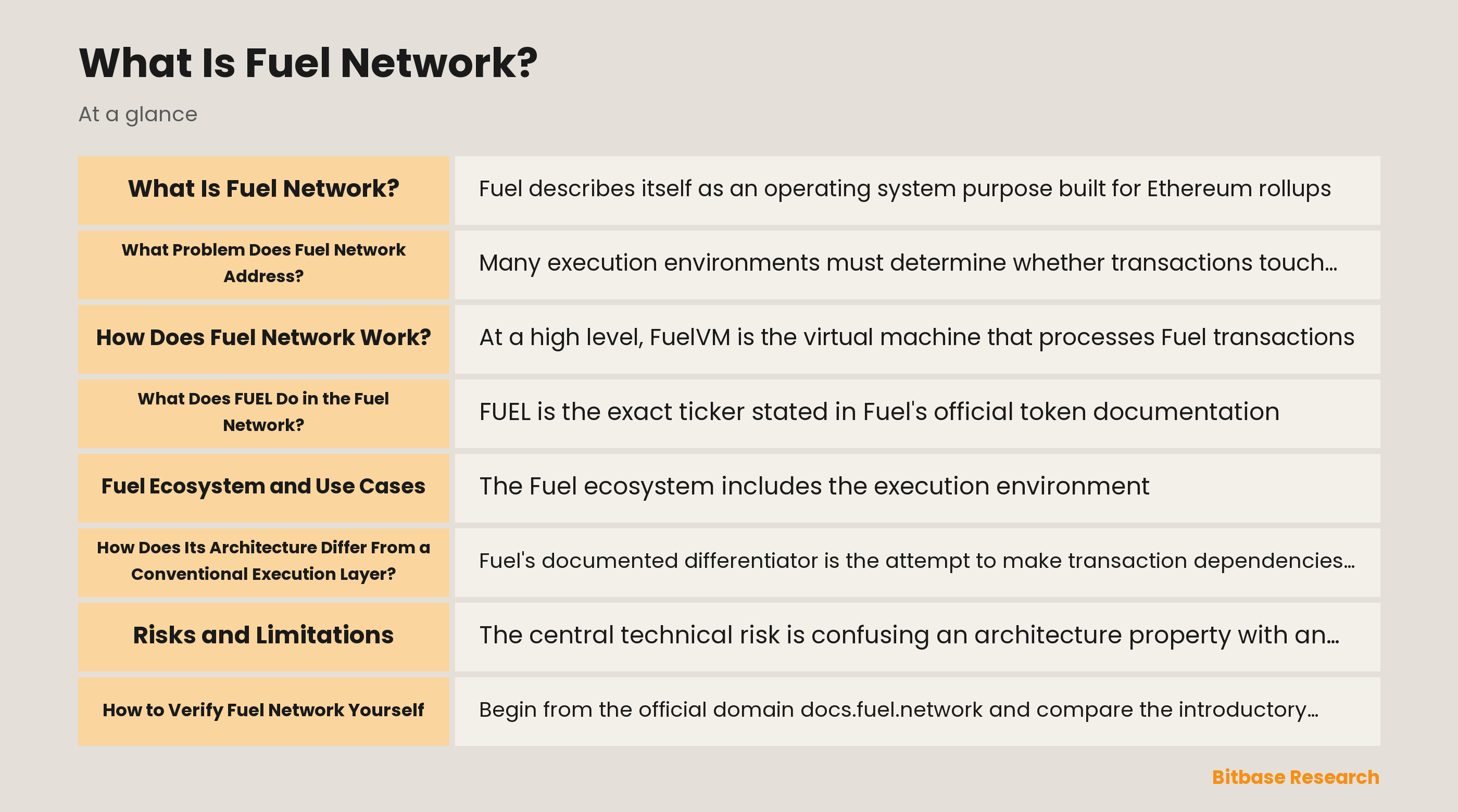
The Fuel ecosystem includes the execution environment, a client implementation, the Sway language, development tools, SDKs, specifications, and interfaces for inspecting network data. A reasonable use-case discussion begins with the workload rather than a logo list: which state objects does an application touch, which dependencies are declared, what execution result is expected, where is that result settled, and what software version is actually running? Those questions make the architecture more concrete without implying a performance or adoption claim.
Fuel's official materials also point readers to an explorer and verified-addresses documentation. These are useful for evidence gathering because they distinguish documentation claims from a network record. They are not substitutes for testing an application or evaluating its controls. A public explorer can show a transaction, contract, block, or identifier, but it cannot by itself prove that a front end is trustworthy, that off-chain services are correct, or that a contract's intended behavior matches a reader's assumptions.
How Does Its Architecture Differ From a Conventional Execution Layer?
Fuel's documented differentiator is the attempt to make transaction dependencies explicit enough for parallel processing through a UTXO-based model and strict state access lists. In a conventional account-oriented execution setting, a transaction may be harder to classify in advance when its read and write effects are not expressed in the same way. FuelVM uses its own model and instruction environment, so analysis should focus on the actual semantics of a Fuel transaction rather than treating an EVM mental model as a complete substitute.
Another difference is the vertical relationship among the execution environment, Sway, tooling, and the client. That can make it easier to reason about the intended development stack, but integration choices still matter. A program may call external services, use application-specific sequencing, depend on a particular settlement configuration, or introduce custom code paths outside the core execution model. The system design does not eliminate the need for a case-by-case review of each dependency.
Risks and Limitations
The central technical risk is confusing an architecture property with an application guarantee. Parallelism can be useful only when dependencies are identified correctly and when the underlying implementation handles conflicts as designed. A bug in a contract, a faulty state assumption, an unsafe upgrade, a compromised interface, or a failure in an external dependency remains a risk even if the virtual machine processes transactions according to specification.
There are also operational and governance limitations. The official documentation describes evolving sequencing and token-related arrangements, while concrete networks and contracts can change through releases, configuration, and authorized controls. Availability, censorship resistance, data publication, finality, and the scope of any security review are implementation-specific questions. This article does not infer a project-wide audit status from the presence of documentation or public code.
How to Verify Fuel Network Yourself
Begin from the official domain docs.fuel.network and compare the introductory explanation with the stable documentation for the specific component under review. For code, identify the relevant official repository, release, and client version rather than relying on a copied name or a search advertisement. The official materials identify FuelVM, Fuel Core, Sway, and the network explorer as different resources, so verify that a claim refers to the correct object.
For a read-only FUEL identity check, the official token overview publishes the address 0x675b68aa4d9c2d3bb3f0397048e62e6b7192079c. Compare that full contract address, its Ethereum network label, and its displayed metadata against the official page and a block explorer. For Fuel-side infrastructure, use the official verified-addresses page to distinguish Fuel Mainnet contract IDs from Ethereum Mainnet contracts, then inspect the selected record without approving a transaction, granting a permission, or following an imitation site.
The Bottom Line
Fuel Network is best understood as an execution-focused stack for Ethereum rollups. Its documentation emphasizes FuelVM, a UTXO-based approach to transaction dependencies, the Sway language, and an integrated development environment. The design can make certain execution questions more explicit, but it does not answer every security, availability, governance, settlement, or application-level question on its own.
FUEL is the official ticker for the token described in Fuel's token documentation, where it has stated roles related to sequencing and chain resources. The prudent reading is layered: check the official documentation date, identify the exact network and component, compare a published contract address with a read-only block explorer, and keep architecture claims distinct from claims about a particular deployment or application.
Related market pages
- FUEL: View price
Disclaimer: This article is educational content from Bitbase Academy, provided for information only. It explains what a project does and what role its token plays in that system; it does not constitute investment, trading, tax, or financial advice, and it is neither a recommendation nor an endorsement of any project or token. Bitbase has not carried out due diligence on the project described here, and mentioning it does not mean Bitbase lists or supports the asset. Crypto assets carry significant risk, including price volatility, thin liquidity, smart-contract failure, regulatory uncertainty, and the possible loss of their entire value. Written as of August 2026; a project's status, tokenomics, team, and contracts can change at any time. Verify everything yourself through official channels, the contract address, and a block explorer, and beware of imitation sites and phishing links.
References
[1] Fuel Docs: What Is Fuel docs.fuel.network
[2] Fuel Docs: Fuel Token Overview docs.fuel.network
[3] Fuel Docs: Tokenomics docs.fuel.network
[4] Fuel Docs: Verified Addresses docs.fuel.network
[5] Fuel Docs: Glossary docs.fuel.network
[6] FuelLabs/fuel-core github.com
[7] FuelLabs/sway github.com