GUNZ is a game-focused Layer 1 blockchain, while GUN is the separately named native protocol token described in its official materials.
The search phrases gunz tokenomics and use cases, gunz crypto, and what is gunz crypto all require the same distinction. GUNZ names a chain and infrastructure context, GUN names a token, Gunzilla Games names a developer and publisher, Off The Grid names a particular game, and a game asset is a separate object whose status depends on the relevant rules and records. Keeping those nouns separate is more useful than treating a project name as a complete description of every related product or digital object.
What Is GUNZ
GUNZ is described by its official materials as a game-focused Layer 1 blockchain developed by Gunzilla Games. Its stated purpose is to provide blockchain-native infrastructure for games, including a setting in which game-related records can be organized. That description identifies the chain-level role. It does not make GUNZ identical to the company that develops games, to a particular title, to every asset associated with a title, or to the GUN token.
A careful profile also separates a documented architecture from a live operational assertion. Network state, game participation, integrations, legal terms, and geographic availability can change. This article therefore uses GUNZ as a mechanism and documentation topic, rather than asserting that a particular service, asset, or feature is currently available to a particular audience.
The Design Problem GUNZ Addresses
Games commonly need to distinguish game rules, asset metadata, player-facing services, and network records. A game chain proposal addresses the design question of how some of those records can be organized in a shared technical environment without making the chain itself equal to the game experience. The design is about the relationship between an infrastructure layer and applications that may use it.
This distinction matters because an on-chain record can describe a technical state without proving every consequence that a reader might associate with it. Game functionality, content rules, access conditions, creative rights, and service continuity can depend on separate systems and terms. A chain can make certain data inspectable while leaving those other questions outside the scope of the record itself.
How the GUNZ Chain Is Organized
Official GUNZ materials describe an independent, EVM-compatible Layer 1 that uses Avalanche-related infrastructure concepts. In practical terms, EVM compatibility describes a technical interface family, while Layer 1 identifies the chain as its own network context. Neither label should be stretched into a guarantee about performance, security, future scope, or compatibility with a particular game service.
The official description also discusses a permissioned smart-contract deployment model. That is a useful mechanism-level distinction: deployment authority may be governed by an approval model rather than assumed to be open to every address. The current permission design, authorized parties, validator arrangement, code version, and network configuration are publication-day facts that require current primary-source review.
What GUN Does in GUNZ
GUN is the official ticker used for the native protocol token and native coin in GUNZ materials. Official descriptions associate GUN with the chain's fee unit and with roles inside the GUNZ context. This identifies a documented technical and ecosystem role. It does not mean that GUN is the name of the chain, the name of every game asset, or a proxy for the legal or functional status of a specific game.
The phrase tokenomics is often used as though a ticker alone establishes a complete economic description. It does not. Current supply, allocation, emission, contract identity, cross-network representation, and any stated utility boundaries must be checked against current official material on the publication date. A short project profile should not fill gaps in those records with assumptions.
GUNZ Ecosystem and Documentation Boundaries
The GUNZ ecosystem can be understood as a set of related but distinct layers: the chain, the developer and publisher, individual games, technical services, and game assets. A statement about one layer should not automatically be carried to another. For example, a game title can use infrastructure without becoming the chain itself, and an asset record does not turn every gameplay rule into a network rule.
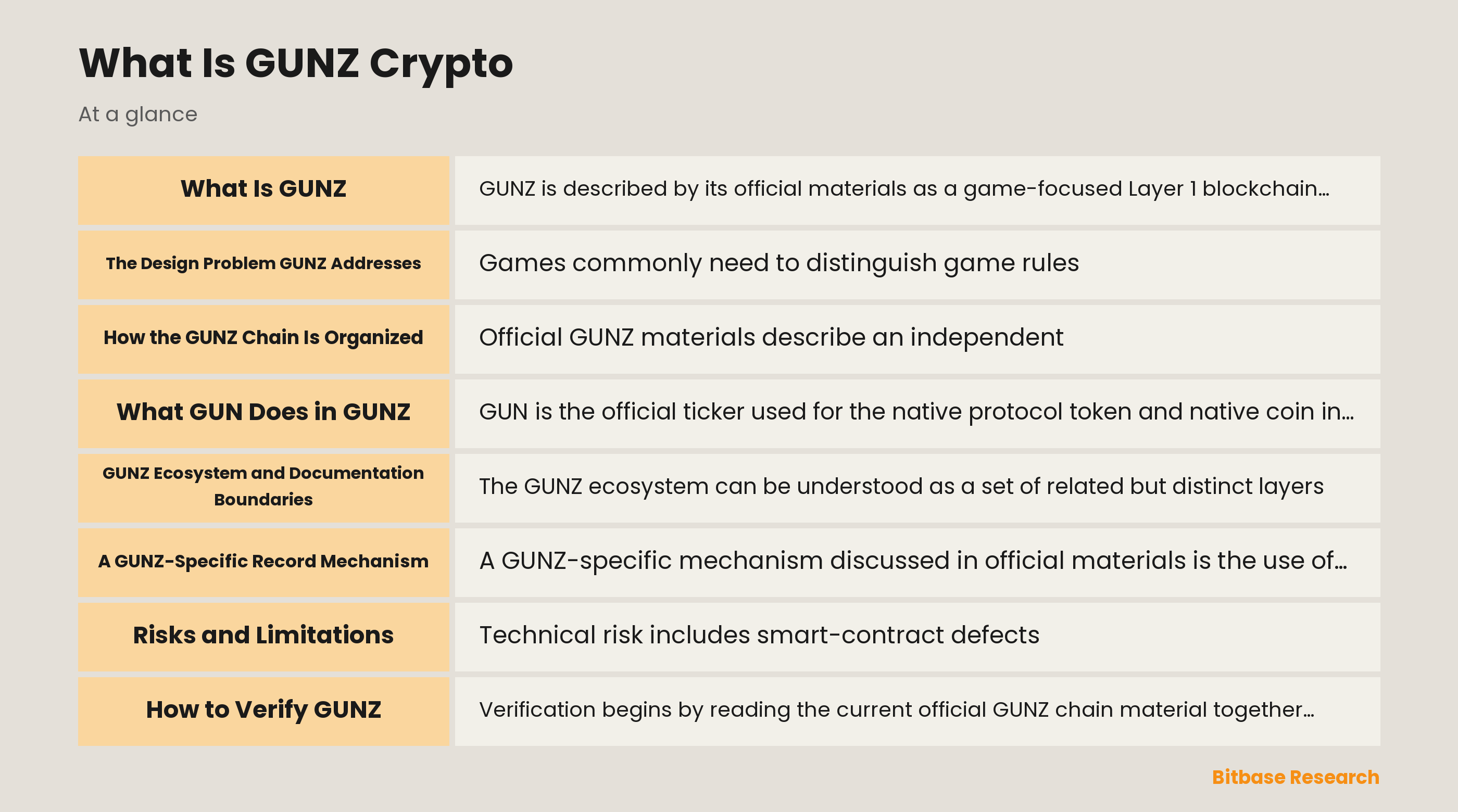
Documentation is especially important at the boundaries between those layers. A general architecture page may explain a design goal, while a game page may describe a title, and a technical page may describe chain parameters. Product state, integrations, permissions, audits, game coverage, and regional terms are all time-sensitive facts. They should be rechecked rather than inferred from a general ecosystem diagram or a historical announcement.
A GUNZ-Specific Record Mechanism
A GUNZ-specific mechanism discussed in official materials is the use of blockchain records for game-related digital items and their histories. The mechanism can make it possible to distinguish an item record from a purely internal database entry. Even so, a record is not automatically a statement about game balance, content access, creative ownership, legal treatment, or continued support by a game service.
The permissioned deployment model is another important boundary. It means that the technical question is not only what an EVM-compatible chain can express, but also who is currently authorized to deploy or administer relevant code. That distinction is useful for analysis, yet the exact permissions, contracts, audits, and implementation details must remain subject to a current source review.
Risks and Limitations
Technical risk includes smart-contract defects, key or permission failures, validator or network faults, software changes, and failures in connected services. A game-focused chain can also inherit risk from the application layer: game servers, content policies, identity systems, and asset metadata can affect the practical meaning of an otherwise valid on-chain record.
There are also semantic and legal limits. A technical record does not by itself establish intellectual-property rights, a guaranteed game function, a permanent service commitment, or unrestricted regional availability. Documentation can change, and the meaning of an asset can depend on rules that sit outside the chain. These limits are reasons to preserve the distinction between the network, the developer, a game, an asset, and the GUN ticker.
How to Verify GUNZ
Verification begins by reading the current official GUNZ chain material together with the official GUNZ overview and the issuer's current announcements. The reviewer should confirm that GUN is still identified as the official ticker and that the source date and scope support the specific statement being made. Similar names, copied summaries, and historical pages are not sufficient identity evidence.
A current contract address or block explorer record should be matched only to an official deployment or network statement, with the relevant network explicitly identified. The same publication-day review should cover the chain's current status, permission model, token parameters, supply and allocation disclosures, audit scope, integrations, legal terms, and any regional limits. This is a source-checking standard, not a product-use procedure.
Conclusion
GUNZ is best described as a game-focused blockchain infrastructure context, not as a synonym for Gunzilla Games, Off The Grid, every related asset, or GUN. The official ticker for the native protocol token is GUN, while the chain and the token answer different identification questions.
The architecture is most useful when read in layers. The chain can provide a technical record environment, a developer can create games, a title can apply its own rules, and an asset can have its own recorded identity. None of those layers automatically supplies the status, rights, availability, or behavior of the others.
Before publication, recheck first-party materials for network and product status, official token identity, contract and chain details, supply and allocation information, deployment permissions, validator and audit information, supported game scope, integrations, legal terms, regional restrictions, and the current meaning of any asset-related statement. That final review keeps a mechanism explanation from becoming an unsupported assertion about a changing system. A final editorial check should map each assertion to the layer it addresses. A statement about the GUNZ chain belongs with current technical material; a statement about Gunzilla Games belongs with company material; a statement about Off The Grid belongs with title-specific material; and a statement about a game asset belongs with the applicable record and rules. This mapping prevents a shared brand name from being treated as proof of a feature, entitlement, current availability, or legal status. When primary sources differ in date or scope, the narrower, newer source should guide publication wording. The purpose is accurate classification and evidence, not an instruction to use a network, game, token, or asset.
Related market pages
- GUN: View price · Spot market · Perpetual market
Disclaimer: This article is educational content from Bitbase Academy, provided for information only. It explains what a project does and what role its token plays in that system; it does not constitute investment, trading, tax, or financial advice, and it is neither a recommendation nor an endorsement of any project or token. Bitbase has not carried out due diligence on the project described here, and mentioning it does not mean Bitbase lists or supports the asset. Crypto assets carry significant risk, including price volatility, thin liquidity, smart-contract failure, regulatory uncertainty, and the possible loss of their entire value. Written as of August 2026; a project's status, tokenomics, team, and contracts can change at any time. Verify everything yourself through official channels, the contract address, and a block explorer, and beware of imitation sites and phishing links.
References
[1] GUNZ Layer 1 overview and GUN token role, GUNZ gunbygunz.com
[2] GUNZ platform overview and official token naming, GUNZ gunbygunz.com
[3] GUNZ L1 mainnet technical documentation, GUNZ dev-test.gunbygunz.com
[4] GUNZ Announces GUN Token Expansion to Solana, GUNZ gunbygunz.com
[5] GUNZ Layer-1 Blockchain Ecosystem Whitepaper, GUNZ storage.gunbygunz.com