
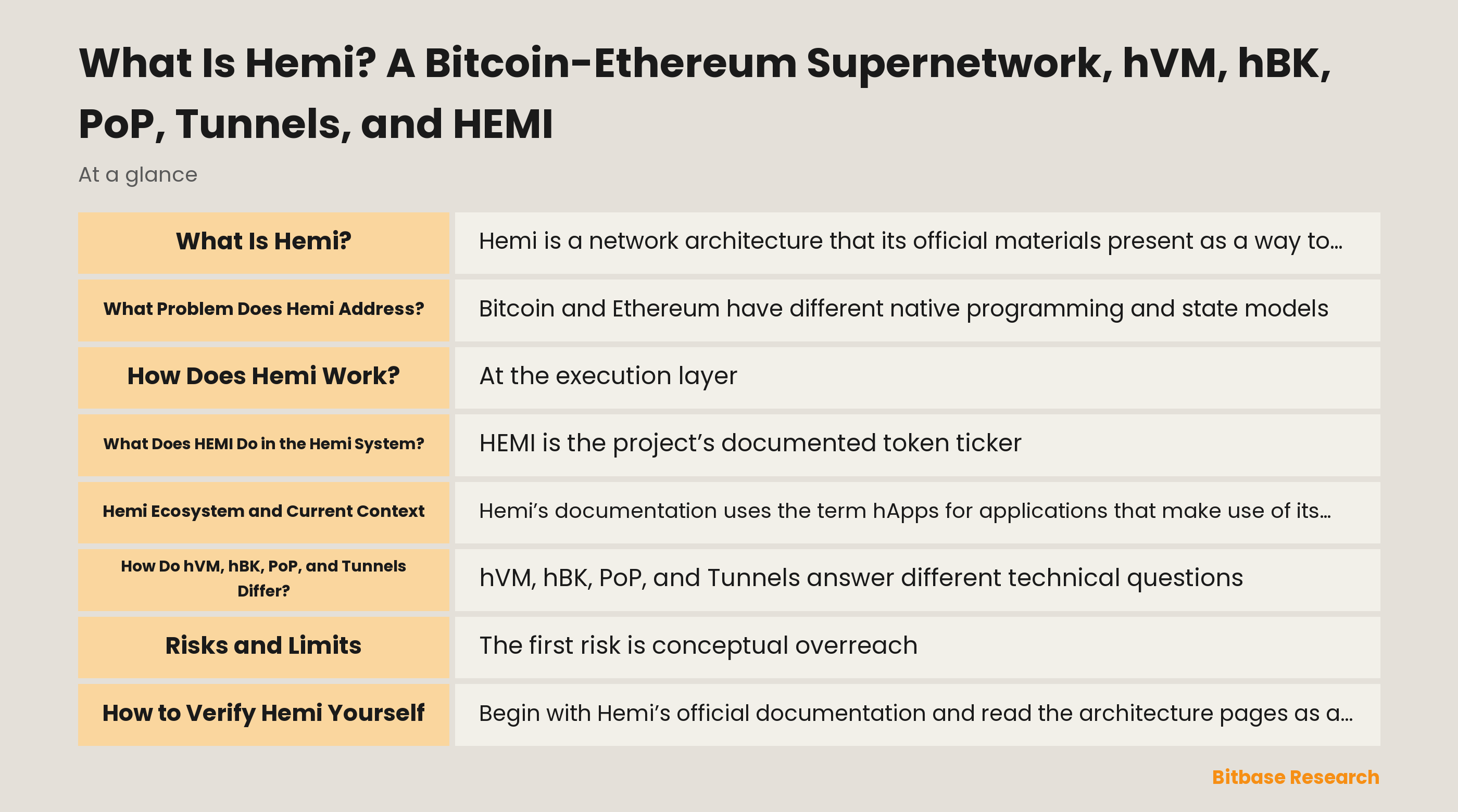
Hemi is a documented Bitcoin-Ethereum supernetwork design that separates several ideas often collapsed into one label: the hVM makes Bitcoin state visible to an EVM environment, hBK is a developer-facing layer over that capability, Proof-of-Proof connects Hemi state to Bitcoin, Tunnels concern cross-system portability, and HEMI has a distinct documented token role. ETH, not HEMI, is the gas token identified in Hemi’s current network documentation.
What Is Hemi?
Hemi is a network architecture that its official materials present as a way to treat Bitcoin and Ethereum as parts of a shared supernetwork rather than as unrelated destinations. That framing is about how the protocol is designed to combine Bitcoin-aware data handling, Ethereum-compatible execution, and a finality model tied to Bitcoin. It does not mean that Bitcoin and Ethereum have become one chain or that every application automatically has the same security properties on every layer.
The project is easiest to understand by separating the names that appear around it. Hemi is the network-level design. The Hemi Virtual Machine, usually called hVM, is the component that gives an EVM environment documented awareness of processed Bitcoin data. The Hemi Bitcoin Kit, or hBK, is a higher-level developer interface that works with hVM. Proof-of-Proof, abbreviated PoP, concerns how Hemi relates its state to Bitcoin. Tunnels describe a family of portability and communication mechanisms rather than a synonym for the entire protocol.
This distinction matters because a project name can otherwise hide the actual question. Someone may be asking about a Bitcoin-aware execution environment, a developer library, a cross-system mechanism, or the HEMI token. Those are connected topics, but they are not interchangeable. A careful introduction should identify which layer is being discussed before making a claim about its purpose or its limits.
What Problem Does Hemi Address?
Bitcoin and Ethereum have different native programming and state models. Bitcoin’s design is centered on its own transaction and consensus model, while Ethereum’s EVM made programmable smart contracts a central interface. Applications that need information or assets across those environments often have to account for separate data views, separate finality assumptions, and an additional communication design. None of those concerns disappears merely because an interface gives them one brand name.
Hemi’s documented response is to make processed Bitcoin state available inside an EVM-oriented environment and to relate Hemi’s own consensus story to Bitcoin through PoP. In that model, a program on Hemi can be designed around Bitcoin-aware information without treating an external data relay as its only conceptual source. The whitepaper and technical documentation describe the goal as interoperability at the protocol-design level, not as a promise that every cross-chain use case has identical trust, latency, or operational characteristics.
The problem is therefore broader than moving a token from one screen to another. It includes how a program obtains and interprets Bitcoin-related state, how that state is made deterministic for Hemi execution, and how the network expresses its security and finality assumptions. Those questions should be kept distinct from user-interface convenience, promotional claims, or any conclusion about a particular application.
How Does Hemi Work?
At the execution layer, Hemi documents hVM as an EVM extended with Bitcoin awareness. Its description centers on an indexed Bitcoin node that is made visible to the EVM through protocol-specific components. The important idea is not that a smart contract becomes a Bitcoin node, but that the Hemi environment is designed to expose a processed view of Bitcoin information to contracts in a deterministic form.
The documentation describes a Tiny Bitcoin process and a Processed Bitcoin View. In broad terms, Bitcoin data is processed in a way that lets Hemi nodes use the same defined view during state transitions. Custom precompile interfaces are then the documented boundary through which contracts can request relevant data. That architecture is different from simply placing arbitrary off-chain information into a contract, because the protocol specifies how the relevant Bitcoin state is represented for the Hemi environment.
An architecture description is not a blanket assurance about any application that uses it. The actual behavior of a contract still depends on its code, permissions, inputs, dependencies, and deployment. The hVM’s current implementation, supported data, interface surface, and network status should also be read as versioned facts. A system can provide a sophisticated data path while individual applications still require their own technical review.
What Does HEMI Do in the Hemi System?
HEMI is the project’s documented token ticker, but it should not be confused with Hemi’s network gas token. The current Hemi network materials identify ETH as the currency symbol and gas token for the network. That distinction is fundamental: a token can have roles in coordination, security-related mechanisms, settlement design, governance, or incentives without being the token used to pay the network’s ordinary gas fees.
Official HEMI token materials describe roles associated with the network’s coordination and longer-term protocol mechanisms. The precise form of those roles can depend on the current implementation, contracts, governance arrangements, emissions rules, and whether a named mechanism is active on a given network. For that reason, this article treats HEMI as a documented system token with facts that need current-source verification, not as a shortcut for describing every part of Hemi.
Search language can blur these boundaries. A query for hemi tokenomics and use cases should lead a reader to current official token material rather than to an assumption that an allocation, distribution, or mechanism is permanent. Hemi coin is an informal label, not evidence that HEMI is the network fee unit. Likewise, what is hemi crypto is best answered as an architecture-and-role question, not as a trading prompt or a statement about value.
Hemi Ecosystem and Current Context
Hemi’s documentation uses the term hApps for applications that make use of its Bitcoin awareness or dual-network design. The ecosystem is therefore better understood as a set of possible application and infrastructure relationships around hVM, hBK, PoP, and Tunnels than as a single product. A name in an ecosystem list says that a component is associated with a documented context; it does not establish its current availability, audit scope, permissions, or maturity.
For the same reason, an ecosystem description should not become a count of activity, an adoption ranking, or a forecast. An application may use Hemi’s execution environment without relying on every Hemi mechanism, and a tunnel design may have deployment-specific assumptions that do not apply to an hBK-based data query. Reading the relevant official documentation and the particular deployment record is more informative than treating a broad ecosystem label as a complete risk assessment.
How Do hVM, hBK, PoP, and Tunnels Differ?
hVM, hBK, PoP, and Tunnels answer different technical questions. hVM is the execution and Bitcoin-state-awareness layer. hBK is a set of higher-level tools or contracts intended to make selected hVM capabilities easier for developers to use. PoP is a consensus and finality design that relates Hemi network state to Bitcoin. Tunnels concern portable assets or messages across systems and must be evaluated in their own implementation context.
That separation prevents a common category error. hBK does not replace PoP, because a developer interface is not a consensus mechanism. PoP does not turn every Tunnel into the same construction, because a tunnel can have specific contracts, validation conditions, and operational dependencies. hVM does not by itself describe who controls an application, what a contract can upgrade, or whether a particular asset representation has the properties a user expects.
Together, the components describe an intended stack: Bitcoin-aware information for execution, a simpler builder-facing layer, a Bitcoin-linked finality story, and mechanisms for portability. The fact that they fit into one design does not remove the need to examine each boundary separately. Technical descriptions should be matched to the relevant version, network, and contract rather than extended into a universal claim.
Risks and Limits
The first risk is conceptual overreach. Calling Hemi a supernetwork does not remove the separate rules and risks of Bitcoin, Ethereum, Hemi, and any application built around them. A statement about hVM’s intended access to Bitcoin data does not prove a separate application’s safety. A statement about PoP does not prove that every current deployment has the same finality path, and a statement about a Tunnel does not prove the security model of every asset route.
There are also implementation and governance limits. Contracts can have administrators, upgrade paths, external dependencies, or configuration changes; documentation may be revised; and token mechanisms may depend on parameters that are not visible in a high-level overview. The HEMI token’s documented roles should therefore be checked against the current official record, while the ETH gas distinction should be checked against the current network details rather than inferred from an older summary.
Finally, cross-system designs create dependency chains. A feature may rely on Bitcoin data processing, Hemi execution, a particular contract, and a separate portability mechanism. A weakness or change at any boundary can alter the result. This article does not make an audit finding, security guarantee, or economic conclusion. It identifies the questions a reader should keep separate when reviewing current technical materials.
How to Verify Hemi Yourself
Begin with Hemi’s official documentation and read the architecture pages as a set rather than as isolated slogans. The whitepaper gives the high-level relationship among hVM, hBK, PoP, and Tunnels, while the technical pages describe the components more narrowly. Check page dates, target network, and any status language before treating a description as a current deployment fact.
For HEMI, use the official token-contract-details page as the starting point for a read-only comparison. A claimed contract address should be matched to the correct network in that official record and then compared with the relevant block explorer entry. The purpose is to confirm identity and implementation context, not to interact with a contract or assume that an address copied from another source is authoritative.
For the network itself, compare the current Network Details and Gas documentation to confirm the stated ETH gas role. If a question concerns an hVM capability, an hBK interface, PoP behavior, or a Tunnel, use the corresponding official technical page and treat unexpected network differences, version changes, or unclear permissions as reasons to pause and investigate. This is a read-only verification path, not an operational guide.
The Bottom Line
Hemi is a Bitcoin-Ethereum supernetwork design whose core concepts have different jobs: hVM supplies Bitcoin-aware execution context, hBK offers a developer-facing layer, PoP connects the network’s finality story to Bitcoin, and Tunnels concern portability. HEMI is a distinct documented system token, while current network documentation identifies ETH as the gas token.
The useful way to assess Hemi is to keep those categories apart and re-check current official sources for the precise network, contract, and implementation under review. That approach is more reliable than treating a token ticker, an ecosystem label, or a high-level architecture statement as a complete description of current behavior.
Related market pages
- HEMI: View price · Spot market · Perpetual market
Disclaimer: This article is educational content from Bitbase Academy, provided for information only. It explains what a project does and what role its token plays in that system; it does not constitute investment, trading, tax, or financial advice, and it is neither a recommendation nor an endorsement of any project or token. Bitbase has not carried out due diligence on the project described here, and mentioning it does not mean Bitbase lists or supports the asset. Crypto assets carry significant risk, including price volatility, thin liquidity, smart-contract failure, regulatory uncertainty, and the possible loss of their entire value. Written as of August 2026; a project's status, tokenomics, team, and contracts can change at any time. Verify everything yourself through official channels, the contract address, and a block explorer, and beware of imitation sites and phishing links.
References
[1] Hemi documentation home docs.hemi.xyz
[2] The Hemi Network whitepaper hemi.xyz
[3] Hemi Virtual Machine (hVM) official documentation docs.hemi.xyz
[4] Hemi Bitcoin Kit (hBK) overview docs.hemi.xyz
[5] Proof-of-Proof consensus and Bitcoin finality docs.hemi.xyz
[6] Hemi network details docs.hemi.xyz
[7] Gas on Hemi docs.hemi.xyz
[8] HEMI token contract details docs.hemi.xyz
[9] HEMI tokenomics one-sheet token.hemi.xyz