Hyperlane is a permissionless interoperability protocol built around on-chain message interfaces and application-selected verification, rather than one universal bridge or one uniform security model.
Readers researching hyperlane tokenomics and use cases, hyperlane crypto, or what is hyperlane crypto may encounter the project in discussions of cross-chain asset flows. The useful starting point is narrower: Hyperlane documents a way for applications on different blockchain environments to exchange arbitrary messages. Mailbox contracts provide the message interface, Interchain Security Modules decide how a destination verifies a message, and Warp Routes are a separate application pattern built on top of that messaging layer.
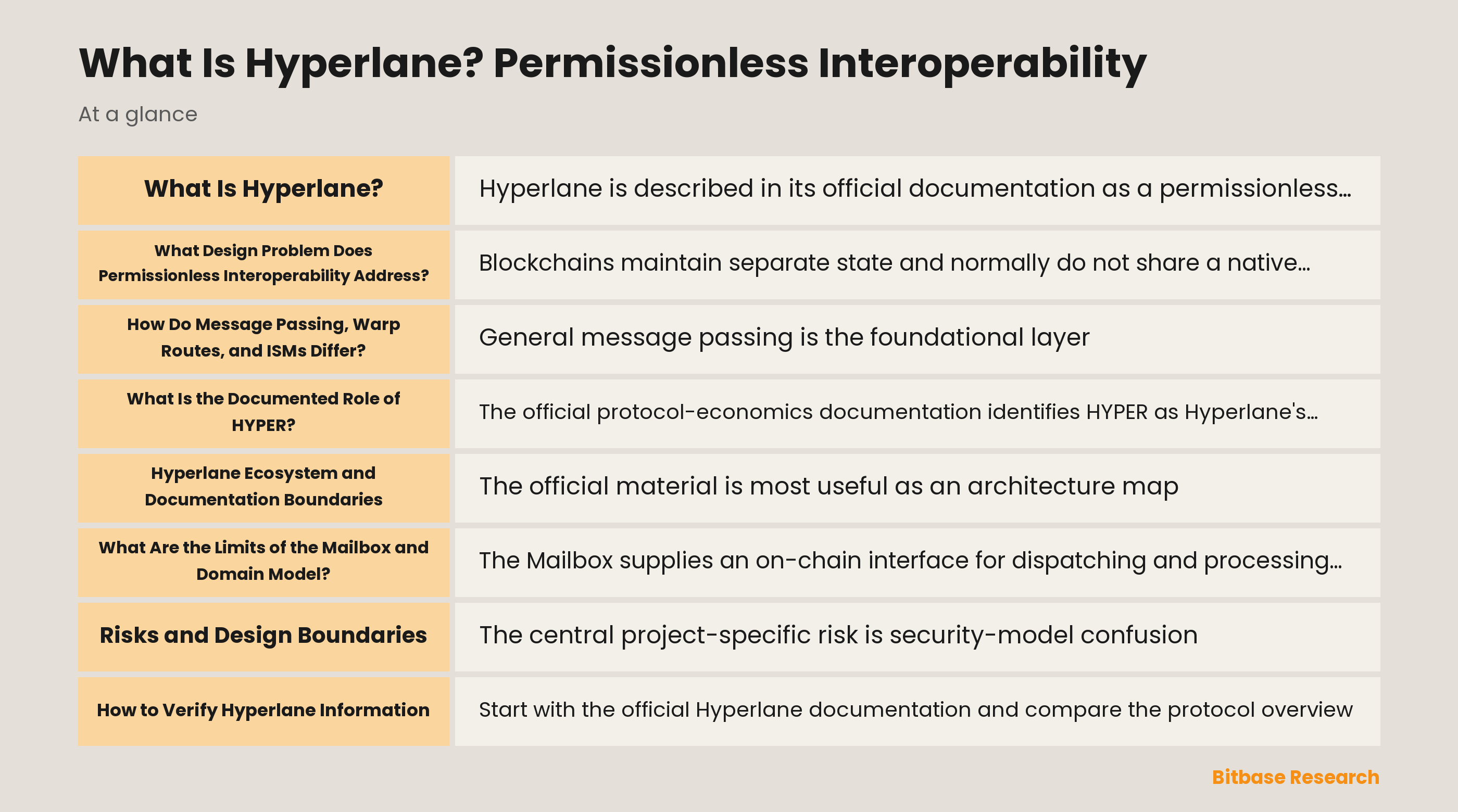
What Is Hyperlane?
Hyperlane is described in its official documentation as a permissionless interoperability protocol for communication across blockchain environments. In practical architectural terms, it gives an application a standard path for describing a message on one domain and presenting it for verification and handling on another domain. The protocol is about transporting and authenticating interchain messages; the meaning of a message still belongs to the application that creates and receives it.
Permissionless is an important but limited word in this description. It refers to an open deployment and development model rather than an automatic conclusion about every deployment, application, route, or security setting. A permissionless protocol can still contain separately configured contracts, off-chain components, application rules, and verification choices. Those choices determine what a particular integration accepts and how it behaves.
What Design Problem Does Permissionless Interoperability Address?
Blockchains maintain separate state and normally do not share a native application message bus. An application that needs to coordinate information across domains therefore needs a way to identify an origin, a destination, a recipient, and a payload without treating one chain's local state as if it were already visible on another. Hyperlane's messaging architecture addresses that coordination problem by giving those elements a common interchain format and a delivery path.
The design does not require every application to use the same business logic. One application may interpret a payload as a state update, another as an instruction for its own contract logic, and a Warp Route may use messages to coordinate linked asset representations. The common layer carries and verifies messages. It does not prove that the recipient application's interpretation, authorization rules, or downstream effect is correct.
How Do Message Passing, Warp Routes, and ISMs Differ?
General message passing is the foundational layer. A Mailbox can dispatch a payload that is arbitrary from the protocol's perspective, while the receiving application defines how its handler interprets the payload. This makes the primitive flexible, but flexibility is not a substitute for an application schema. The sender and recipient must agree on what the bytes mean, which state changes are acceptable, and which messages should be rejected.
Warp Routes are an application pattern that uses Hyperlane messaging to connect asset representations across domains. They are not another name for the Mailbox, and they are not proof that every asset route has identical contracts, assumptions, or security settings. A route has its own configuration and lifecycle. Its relationship to the base messaging protocol should be examined separately from the more general capability to carry arbitrary messages.
What Is the Documented Role of HYPER?
The official protocol-economics documentation identifies HYPER as Hyperlane's native token and places it in the protocol's economic-security design for default message-security arrangements. That is the bounded role supported by the documentation for this profile: HYPER is connected to the security context described by the protocol, while Hyperlane's core messaging architecture remains distinct from a ticker.
A native-token description is not evidence of a universal governance mandate, a fixed governance outcome, or control over every application-specific configuration. The current scope of governance, any decision-making process, token and contract identity, and the relationship between default and application-selected security arrangements are dynamic facts. They require an official publication-day check rather than an inference from the HYPER symbol alone.
Hyperlane Ecosystem and Documentation Boundaries
The official material is most useful as an architecture map. The protocol overview introduces arbitrary cross-chain messages and the Mailbox interface; the Mailbox material explains the on-chain send-and-receive boundary; the ISM material explains application-configurable verification; the protocol-economics material names HYPER; and the domain material explains the identifiers used for chains. Together, these pages clarify relationships without collapsing them into a single product claim.
The documentation also describes designs for more than one virtual-machine environment and records domain information, but a documentation map is not a blanket statement that every listed environment, integration, or route is currently available or uses the same configuration. Current deployment scope, integrations, contract identities, security modules, route status, and operational conditions belong in a publication-day review.
What Are the Limits of the Mailbox and Domain Model?
The Mailbox supplies an on-chain interface for dispatching and processing messages. Its documented message structure includes information such as origin, destination, sender, recipient, and a uniqueness component, which helps a receiving system reason about message identity and replay handling. That structure is not a business-rule engine. It cannot decide whether a payload is economically sensible, whether a recipient handler is well designed, or whether an application-level authorization policy is appropriate.
Domain identifiers are another boundary worth keeping explicit. Hyperlane documents unique domain IDs for supported chain contexts and notes that an ID may not always equal an EVM chain ID. A chain name, a numeric identifier, a deployed Mailbox, and an application's expected domain must therefore agree. Treating any one of those fields as a substitute for all the others can create routing, identity, or verification mistakes.
Risks and Design Boundaries
The central project-specific risk is security-model confusion. Hyperlane's ISM design allows an application to use a Mailbox default module or specify an application-specific module that can be configured, composed, or customized. Therefore, a statement about one integration's verification assumptions cannot be generalized to every Hyperlane integration. Security depends on the module actually selected by the recipient, its parameters, the relevant implementation, and the surrounding application logic.
Other risks arise at several layers: smart-contract defects, malformed or misunderstood payloads, incorrect domain mapping, unavailable or delayed transport, origin or destination chain conditions, and weaknesses in application authorization or decoding. A message that passes an interchain verification boundary is not automatically a message that achieves a safe or intended application outcome. Brand confusion and copied project information can add identity risk, especially when a protocol name, route name, and token ticker are discussed together.
How to Verify Hyperlane Information
Start with the official Hyperlane documentation and compare the protocol overview, Mailbox, ISM, protocol-economics, Warp Route, and domain-identifier material. The sources should consistently distinguish the base message layer from an asset-route application and distinguish an application-selected ISM from a Mailbox default. A page's date, scope, and whether it describes a design, a registry entry, or a present deployment all affect what it can substantiate.
Before publication, recheck the official identity of HYPER and relevant contracts, current governance scope, the deployment and domain record, selected security modules, route conditions, integrations, code versions, audit material, permissions, and legal or regional constraints. Do not treat a token symbol, an isolated contract identifier, a third-party summary, or a historical page as sufficient confirmation. The correct evidence joins the official source, the applicable domain, and the current stated purpose.
Conclusion
Hyperlane is best understood as an interchain messaging architecture with a permissionless deployment model. Mailbox contracts form the on-chain message boundary, and applications can communicate arbitrary payloads across domains. That base capability is deliberately broad, so the recipient application's own logic remains responsible for the meaning and consequences of a message.
The most important distinction is between transport, verification, and application behavior. Warp Routes are an asset-oriented application pattern built on messaging, while Interchain Security Modules let the application choose or define verification assumptions. No statement about a particular route or ISM should be expanded into a claim that all integrations share one security model.
HYPER has a documented native-token role in the protocol's security context, but its current governance scope and all time-sensitive token details require fresh official confirmation. A careful publication keeps the protocol, Mailbox, ISM, Warp Route, domain, and token layers separate, then rechecks every dynamic fact immediately before release.
Related market pages
- HYPER: View price · Spot market · Perpetual market
Disclaimer: This article is educational content from Bitbase Academy, provided for information only. It explains what a project does and what role its token plays in that system; it does not constitute investment, trading, tax, or financial advice, and it is neither a recommendation nor an endorsement of any project or token. Bitbase has not carried out due diligence on the project described here, and mentioning it does not mean Bitbase lists or supports the asset. Crypto assets carry significant risk, including price volatility, thin liquidity, smart-contract failure, regulatory uncertainty, and the possible loss of their entire value. Written as of August 2026; a project's status, tokenomics, team, and contracts can change at any time. Verify everything yourself through official channels, the contract address, and a block explorer, and beware of imitation sites and phishing links.
References
[1] Hyperlane Docs: Introduction docs.hyperlane.xyz
[2] Hyperlane Docs: Protocol Overview docs.hyperlane.xyz
[3] Hyperlane Docs: Mailbox docs.hyperlane.xyz
[4] Hyperlane Docs: ISM Overview docs.hyperlane.xyz
[5] Hyperlane Docs: Protocol Economics docs.hyperlane.xyz
[6] Hyperlane Docs: Warp Routes docs.hyperlane.xyz
[7] Hyperlane Docs: Domain Identifiers docs.hyperlane.xyz