ICP Swap is a documented decentralized-finance project on the Internet Computer. Its official material presents ICS as the project ecosystem and governance token, while ICP is the separate native token of the Internet Computer network.
Readers searching for `icp swap`, `icp swap ecosystem and use cases`, or `how does icp swap work` should first separate a project name, a token symbol, a canister identifier, and a web interface. Those labels can refer to different things. This profile describes the project at a conceptual level and does not give directions for acquiring assets, connecting an account, authorizing a request, or using a financial feature.
The material cited here spans ICPSwap's site and documentation, the Internet Computer's official dashboard, and Internet Computer technical documentation. It is useful for identifying how the project describes itself, but it is not a substitute for a publication-day review of deployed components, governance records, and interface status. In particular, the presence of a page or a canister record is not evidence of an unchanged or available feature.
What Is ICP Swap?
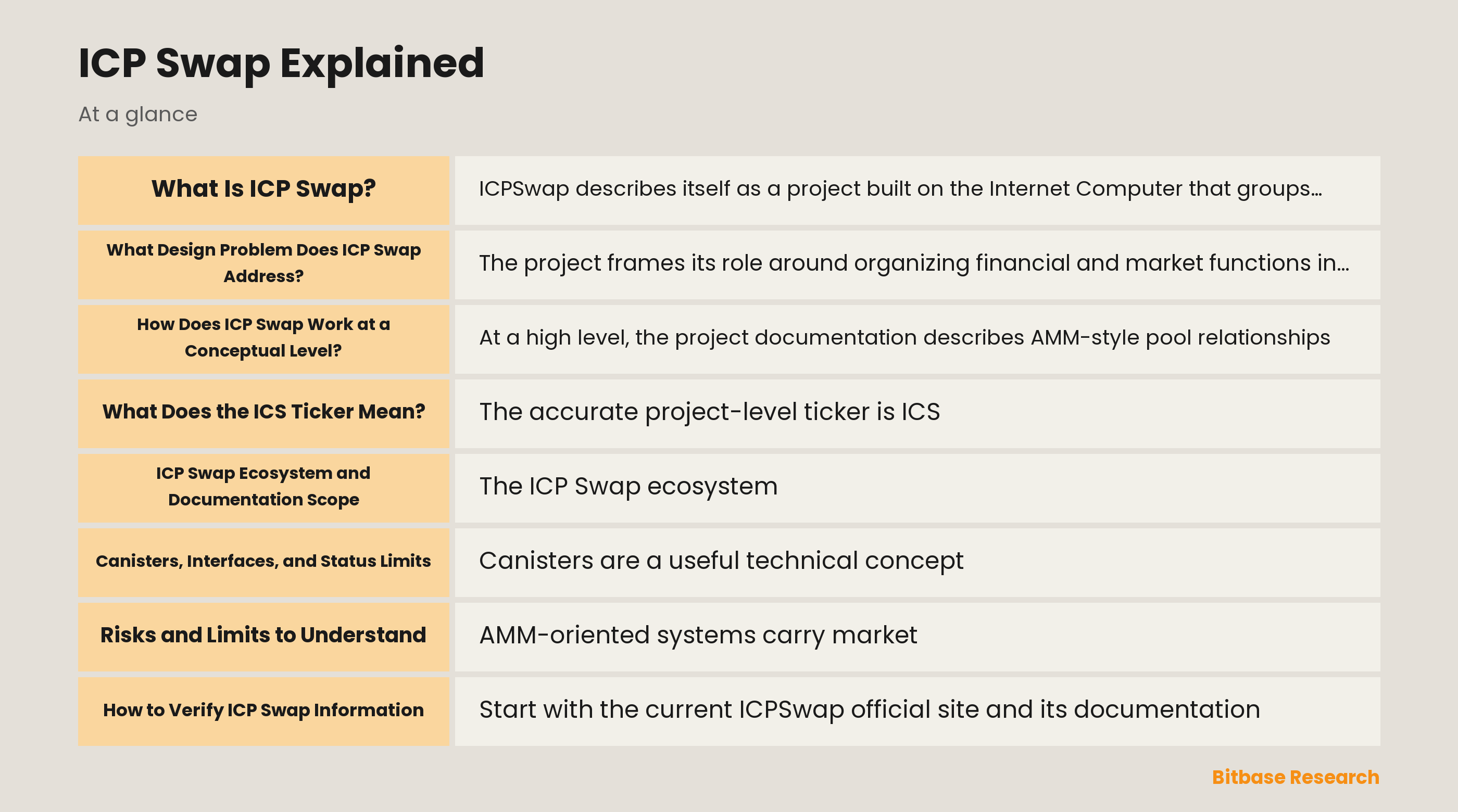
ICPSwap describes itself as a project built on the Internet Computer that groups financial, market, and DAO-related services. Its documentation historically uses both “ICPSwap” and “ICP Swap” in surrounding public material. For profile purposes, ICP Swap is the project name, not the name of the Internet Computer's native token and not a universal label for every asset that an interface may display.
The project documentation describes swap and liquidity concepts, while its broader material also names functions such as a token list, DAO-related services, and other product categories. A category named in documentation should be read as a documented scope statement. It does not prove that every category is live, unchanged, accessible in every location, or suitable for a particular person.
The underlying Internet Computer is an application platform that uses canisters. Official Internet Computer documentation defines a canister as a unit that combines code and persistent state and is executed by the network. That background helps explain why an ICP Swap project description can refer to onchain components without implying that a single contract, a single website, and the whole project are identical.
What Design Problem Does ICP Swap Address?
The project frames its role around organizing financial and market functions in the Internet Computer environment. At a general level, an automated market maker, or AMM, is a design for relating assets through rules and balances held by a pool rather than through a traditional order-book model. This is a conceptual distinction, not a claim about execution quality, price, depth, or access.
Official ICPSwap materials also discuss liquidity pools and price ranges. In such systems, the relationship between two assets and the chosen range can affect how a position's composition changes as the pool price changes. A price range is therefore a mechanism parameter, not a stable promise about price behavior, liquidity, or a financial outcome.
The design problem is broader than a screen that displays a pair of symbols. It includes how onchain records, asset ledgers, pool rules, accounting, and governance information are organized. The public documentation does not remove the need to distinguish project descriptions from the independently verified state of a particular canister, ledger, or interface.
How Does ICP Swap Work at a Conceptual Level?
At a high level, the project documentation describes AMM-style pool relationships: a pool records rules for a pair of assets, and its internal ratios are relevant to price formation. This explains the phrase “how does icp swap work” without turning the explanation into a transaction or product-use procedure. It does not establish a particular pool configuration, fee schedule, or current interface behavior.
Internet Computer architecture provides a useful boundary. A canister is an onchain compute and state unit with its own globally unique canister identifier. An identifier designates a network object; it is not, by itself, a brand certificate, token ticker, contract address for every component, or proof of the current code and controllers.
An ICPSwap proposal published through the Internet Computer dashboard described a historical architecture in which individual trading pairs ran in their own canisters, alongside later work on data management and indexing. That is evidence about the proposal's stated context, not a basis for asserting the current architecture of all pairs or services. Current component arrangement, versions, and interfaces need fresh official confirmation.
What Does the ICS Ticker Mean?
The accurate project-level ticker is ICS. ICPSwap's official site calls ICS the ICPSwap token and describes it as an ecological token and a governance token. The project documentation and its SNS-related material likewise distinguish ICS from the Internet Computer's native ICP asset.
ICS is not ICP. ICP is the native utility token of the Internet Computer, whereas ICS is the token identity that ICPSwap materials associate with its own ecosystem and governance. Neither the shared letters nor an interface listing creates equivalence between the two assets. A project profile should keep their names, issuer context, ledger records, and governance roles separate.
The ticker is also not a canister identifier. On the Internet Computer, a ledger canister can implement a digital-asset standard, and each canister has a distinct identifier. A publication should not infer an official ICS ledger identifier from a ticker, a copied token list, or an unaffiliated page. Exact supply, distribution, governance parameters, and the relevant ledger record are time-sensitive facts that require a current first-party check.
ICP Swap Ecosystem and Documentation Scope
The ICP Swap ecosystem, as described by the project's site and documentation, includes the named ICPSwap project, the ICS token identity, an SNS and governance context, AMM and liquidity documentation, and other listed product areas. These labels show the scope that the project's material chooses to document. They should not be read as a guarantee of product availability, security, legality, liquidity, rewards, or any result.
The official Internet Computer dashboard hosts an SNS page for ICPSwap and links it to the ICPSwap site. That corroborates a governance-related project identity, while the ICPSwap documentation links to an SNS white paper. Even so, a dashboard profile, a white paper, and a site menu serve different purposes. They do not independently establish the present state of every canister, token parameter, or interface.
The project documentation has changed over time, as shown by dated pages and roadmap material. Documentation scope is therefore best treated as an editorial map. Before publication, the exact current menu, supported asset standards, governance configuration, component status, and any stated cross-chain or bridge-related scope should be reviewed in the project's current official sources rather than inferred from older pages.
Canisters, Interfaces, and Status Limits
Canisters are a useful technical concept, but they do not make a project description self-verifying. A canister holds code and state, and an application can use more than one canister for distinct responsibilities. A public web interface may present information from those components, yet the interface name, its deployment, and the underlying canister identifiers remain separate things to verify.
The Internet Computer dashboard proposal cited in this research contains historical claims about pair canisters and resource-management changes. It should be treated as a dated governance record, not as a real-time status feed. Similarly, an older white paper can explain intended design without confirming present deployment, permissions, implementation, or availability.
This distinction matters for a project profile. “Onchain” describes where a component is designed to run; it does not prove that the code is immutable, that an interface points to the expected component, or that a process will behave as described. Current controller information, governance decisions, upgrades, and interfaces may change the relevant context.
Risks and Limits to Understand
AMM-oriented systems carry market, price, liquidity, parameter, smart-contract, accounting, oracle, governance, and operational risks. In a range-based design, changes in the relation between paired assets can alter a position's asset composition. A documented range mechanism does not guarantee a desired price, execution, liquidity condition, or financial result.
Internet Computer canister architecture introduces additional boundaries: software can contain faults, state and controller arrangements can change, inter-canister dependencies can fail or behave unexpectedly, and an interface can become stale or misleading. A canister identifier records an address-like identity on the network, but it does not by itself verify project ownership, code intent, audit scope, legal treatment, or safety.
There is also identity risk around similar names and symbols. “ICP Swap,” “ICPSwap,” “ICP,” and “ICS” are not interchangeable. Copied pages, copied graphics, unofficial social posts, and a ticker without the matching official ledger context can create false associations. No source in this profile guarantees the availability, legality, security, liquidity, yield, or outcome of any component.
How to Verify ICP Swap Information
Start with the current ICPSwap official site and its documentation, then compare their project and token descriptions with the ICPSwap SNS entry on the official Internet Computer dashboard. Check page dates and scope. A claim about governance, architecture, a product category, or a token parameter should have a matching primary source rather than rest only on a search result or a copied summary.
For token identity, distinguish ICS from ICP and seek the current official ledger context. For a deployed component, a contract address is not the usual ICP term: the relevant expression is a canister identifier. Where an official source supplies such an identifier, compare it with the corresponding Internet Computer block explorer or dashboard record for the same network and component.
A block explorer or dashboard can display public records, but it cannot alone establish brand ownership, current interface status, safety, legal treatment, liquidity, or future behavior. Conflicting, missing, or stale primary records are a reason to avoid presenting the associated detail as current. These are verification principles, not instructions for interacting with the project.
Conclusion
ICP Swap is best understood as a documented project on the Internet Computer whose material describes AMM-related and governance-related concepts. The project-level token ticker supported by its official material is ICS. ICP remains the separate native token of the underlying Internet Computer network.
The central editorial discipline is separation: project name from token ticker, ICS from ICP, a canister identifier from a token or brand, and a documented interface from current onchain status. This profile explains those distinctions conservatively. Before publication, re-check the official sources, SNS record, identifiers, and current documentation without converting the article into use instructions.
Related market pages
- ICS: View price
Disclaimer: This article is educational content from Bitbase Academy, provided for information only. It explains what a project does and what role its token plays in that system; it does not constitute investment, trading, tax, or financial advice, and it is neither a recommendation nor an endorsement of any project or token. Bitbase has not carried out due diligence on the project described here, and mentioning it does not mean Bitbase lists or supports the asset. Crypto assets carry significant risk, including price volatility, thin liquidity, smart-contract failure, regulatory uncertainty, and the possible loss of their entire value. Written as of August 2026; a project's status, tokenomics, team, and contracts can change at any time. Verify everything yourself through official channels, the contract address, and a block explorer, and beware of imitation sites and phishing links.
References
[1] ICPSwap official site icpswap.com
[2] ICPSwap documentation: What Is ICPSwap iloveics.gitbook.io
[3] ICPSwap documentation: SNS White Paper iloveics.gitbook.io
[4] ICPSwap documentation: DAO iloveics.gitbook.io
[5] Internet Computer Dashboard: SNS DAO ICPSwap dashboard.internetcomputer.org
[6] ICP Developer Docs: Canisters docs.internetcomputer.org